
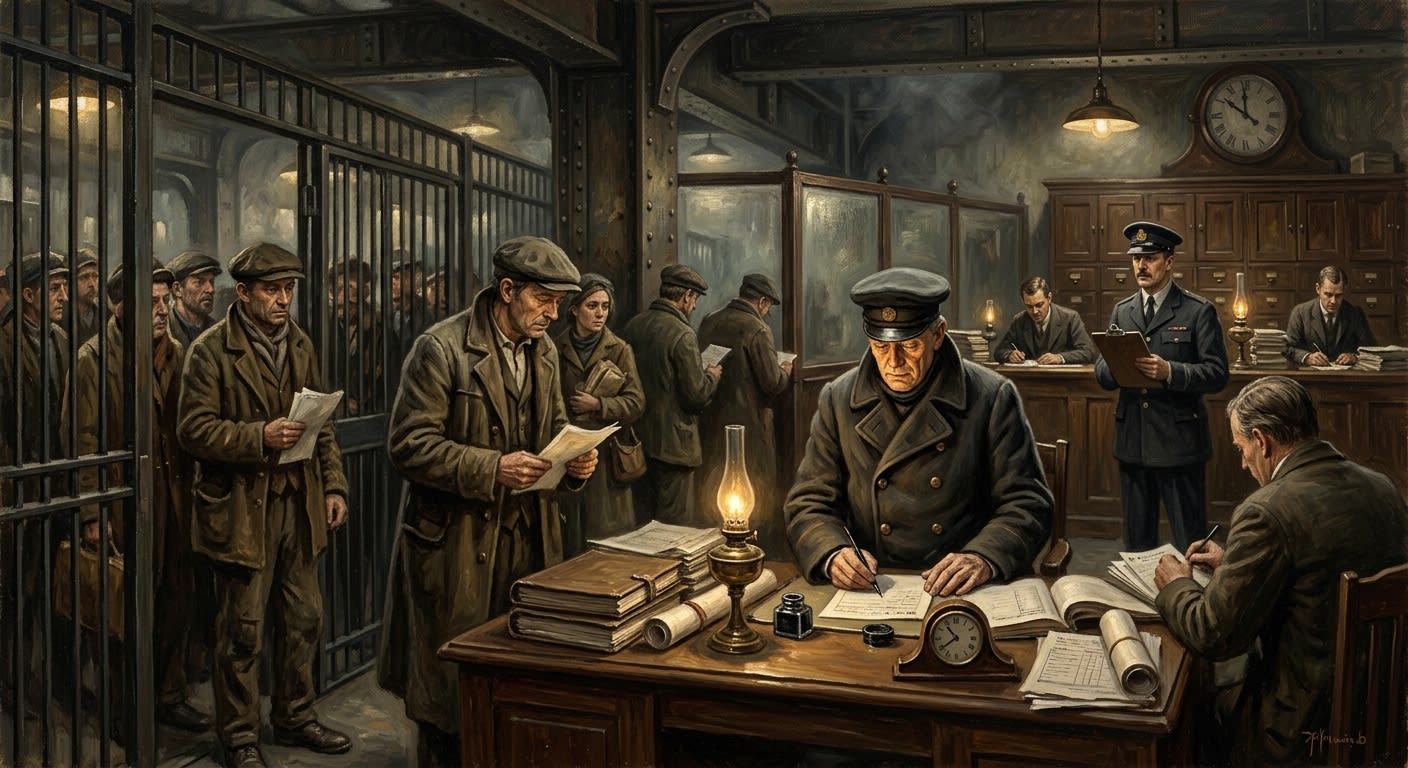
#On the Order That Shortened the Terror
Administrative Order 44-B is the A.S. 188 Bureau of Purity directive that reduced attendance in the Vault of Silences from twelve hours to eight, restricted repeated east-bench exposure in the Index Damnatus Chamber, amended page-turn witnessing rules, and declared the cause of the reform to be personnel endurance review. This last phrase deserves preservation in gold leaf, arsenic, and contempt. It is the kind of phrase that permits a room to remain innocent after it has used a woman's hand.
The Order followed the Incident of A.S. 187, in which Inquisitor Breel, fourth-rank White-Mantled officer of the Bureau of Purity, completed a twelve-hour east-bench rotation beside the open Index Damnatus and was found transcribing twenty-seven bars of proscribed notation from the Register of Sounds into her duty log without remembered consent. The log was burned. The ash was weighed. Breel was removed from Vault duty. The bench stayed where it was.
The Order is often described as reform. That is true, in the manner that a splint is reform after the bone has come through the skin. It made Vault service less lethal to memory. It improved scheduling. It reduced the number of officers found staring through breakfast as if the toast had begun spelling hymns. It also preserved every meaningful hazard that caused the breach. The Index remained open. The Register remained visible from the east bench. The Prayer of Unseeing remained unchanged. The Bureau located failure in flesh and corrected the flesh by timetable.
#On the Clauses
The first clause rescinded twelve-hour Vault rotations. Three Inquisitors would still attend the Index at all times, stationed at the south, east, and west benches around the iron lectern, but their custody would be divided into eight-hour watches. Purity praised this as humane discipline. Mercy, which was not invited to review the language, might have called it triage. Records called it amended schedule form P-17, because Records has the spiritual range of a locked drawer and the staying power of mildew.
The second clause restricted east-bench exposure. No Inquisitor was to sit east-facing for more than two consecutive shifts. The east bench faces the Register of Sounds on every eighth day of the rotation, when proscribed melodies, bellfalls, breath marks, mouth-shape codes, and written cadences lie within reach of a tired eye. Breel sat there too long. Breel wrote. The Order responded by moving personnel around the bench with solemn arithmetic.
The third clause revised page-turn witnessing. The senior Inquisitor still approaches the iron lectern at Matins, still uses bleached linen gloves and an ivory tongue, still lifts the exposed leaf while the other watchers avert their eyes and recite the Prayer. Two additional witnesses are required for notation disturbance, page-edge movement, lamp-smoke inclination, or unsanctioned warmth. The new witnesses are instructed to observe without reading, confirm without absorbing, certify without curiosity, and remain sane by intention. A charming programme. Also impossible.
The fourth clause introduced glove disposal. Gloves used during page-turning were to be sealed, marked, and retired under stricter custody after a shorter period of service. This was presented as contamination control. It also allowed the Bureau to imply, without writing the implication in a place where Records might enjoy itself, that Breel's right glove had mattered. Her own memory retained a scratch in its leather. Her memory retained nothing of the transcription. Objects, unlike officers, sometimes make better witnesses.
The fifth clause banned marginal notation within six inches of the duty log's spine during east-bench rotations. This is my favourite clause, and I admire it with the tenderness one reserves for a beautifully malformed calf. Breel wrote in a margin. The Bureau punished margins. The forbidden signs entered official ink by way of unused space, so unused space was brought under discipline.
Purity summaries once described Order 44-B as “preventive containment of register-induced personnel deviation.”
Corrected for doctrinal honesty. The Order was a damage-control instrument after a confirmed exposure. Prevention had already failed, removed its gloves, and written twenty-seven bars in a trained hand.
#On What the Order Refused to Name
Administrative Order 44-B does not say the Register of Sounds compelled Breel. It does not say the Index uses margins. It does not say the Prayer of Unseeing failed, or half-succeeded, or performed the more dreadful work of preventing Breel from remembering absorption while leaving absorption intact. It does not say the east bench is dangerous. It says personnel endurance review.
Cowardice is too honest a word. Cowardice knows what it fears. The Order practices something cleaner and more useful: jurisdictional displacement. The room becomes exposure duration, a multiplier. The page becomes visual angle requiring management. The Prayer becomes recitation context requiring schedule correction. Breel becomes a case.
The phrase theological lesson: pending appears in the collateral file and has remained there as of A.S. 201, which means the Synod has had thirteen years to decide whether a forbidden cadence can command a loyal hand through sight alone and has chosen the holier path of delay. Delay is useful. Delay allows officers to keep turning pages. Delay prevents a conclusion from acquiring budgetary consequences. Delay lets the Index breathe under supervision.
The Order's genius lies in preserving the Vault's authority while admitting just enough hazard to keep personnel from dying too quickly. It is the Synod in miniature: confession without guilt, reform without concession, mercy without the foul inconvenience of saying mercy. The officers live longer. The room remains fed. The report is clean.
COLLATERAL REVIEW FRAGMENT — ORDER 44-B IMPLEMENTATION Question: If the Prayer prevented memory but not transcription, does compulsory recitation increase evidentiary loss? Answer circulated to: ███████████████. Final recommendation: retain formula; shorten exposure; do not ask in training.
#On the Minor Offices Created by Fear
Order 44-B also produced a small swarm of subsidiary duties, which is how one knows a reform has entered the bloodstream. The Vault acquired glove custodians, margin inspectors, ash-ticket counters, bench-sequence clerks, and two approved readers of exposure logs whose own exposure to exposure logs was later limited by memorandum. No Bureau cures a wound without discovering that the bandage requires a staff.
The glove custodian's office is the most pious absurdity. Used page-turning gloves are sealed in linen packets, marked by shift, bench, officer, page class, and observed disturbance. A glove retired after an ordinary turn rests in Box White. A glove retired after smoke inclination rests in Box Grey. A glove retired after notation bleed rests in Box Black and is viewed only through a slit by an officer who has recited the Prayer of Unseeing and signed the confession that he enjoyed no part of the viewing. Enjoyment, in Purity law, is often discovered after the fact.
The margin inspectors were meant to prevent another Breel. They examine duty logs for spacing irregularities, involuntary rhythm, repeated strokes, bar-like groupings, breath marks, and the suspicious neatness that sometimes follows contamination. They are forbidden to hum while inspecting. They are forbidden to tap. They are forbidden to copy examples for training unless the examples have first been abstracted into safe forms by Orison, which complains that abstraction removes the hazard and Purity replies that removing hazards is the point, and Records records both complaints with visible pleasure.
The ash-ticket counters remain under joint Purity-Records custody. Records insists every burned object has an afterlife as residue. Purity insists some residue should be destroyed beyond residue. Doctrine has not selected a side, preferring the grand neutrality of an office waiting to see who wins.
#On Breel's Use After Breel
Breel became both example and prohibition. Senior Inquisitors are instructed through her case under sealed conditions. Junior officers are forbidden to study the file, though every junior officer posted below the Basilica of the Ledgered Saints learns her name before the first week ends. Fear has its own curriculum. It does not require a classroom, only a bench.
Order 44-B turned Breel's suffering into schedule law. This is the Bureau's oldest miracle. A woman loses time; the institution gains a rotation table. A hand writes forbidden notation; the institution gains margin rules. A log burns with enough residue to trouble Records; the institution gains ash custody language. Breel was removed above ground, placed among tavern denunciations and street-cant reports, and filed as disposition complete. The Order continued downward every Matins.
The Order also altered Vault manners. Officers inspected ink stains before meals. Gloves were turned inside out. Page-turners watched one another's lips for silent motion. East-bench watchers spoke loudly after relief, wasting common noise on purpose, as if the surface city could scrape notation from the skull by market clatter. Some took to standing in bell squares. Some avoided bells entirely. One requested transfer to a provincial prison where screams at least declared their source. Purity denied the request as unstable, a judgment accurate in its cruelty.
The benches acquired reputations. Purity denied this in writing and obeyed it in assignments. South bench: names. East bench: sounds. West bench: draught and grudges. No north bench, because the chamber's geometry prefers absence where a fourth witness might have stood. Men invent theology around missing furniture when left too long underground.
#On Present Enforcement
As of A.S. 201, Administrative Order 44-B remains active. The Vault runs on eight-hour shifts. East-bench exposure is watched with a care that stops just short of wisdom. The Prayer of Unseeing is recited at every page-turn, its public text withheld, its failure record sealed, its prestige undamaged by evidence. The Index remains chained to the iron lectern. The lectern remains bolted to the plinth. The plinth remains fused to the floor by age, weight, and the theological stubbornness that passes for engineering when enough priests are present.
Compliance appears excellent. This means the forms are complete. It does not mean officers leave whole. Vault Inquisitors still develop the measured walk, the sideways glance at written pages, the affection for vulgar surface noise. They still emerge with hands too clean and eyes too disciplined. They still dislike music. They still learn that the safest way to guard a forbidden book is to become slightly less human than the book prefers.
Administrative Order 44-B is filed as a success because no second Breel has entered the public record. The careful reader will notice the phrase public record and wash his hands afterward. Three Inquisitors have been removed from Vault duty under classifications whose names do not appear in Bureau lexicons. Singing-glass incidents among Purity specialists have risen since A.S. 195. The jawbone in the third silence still hums at 217 hertz. The Register still receives entries. The page still turns.
The Order did what it was designed to do. It did not make the Vault safe. Safety was never the brief. It made the Vault administratively survivable, which is the Synod's preferred substitute for salvation.