
#On the Necessary Blindness
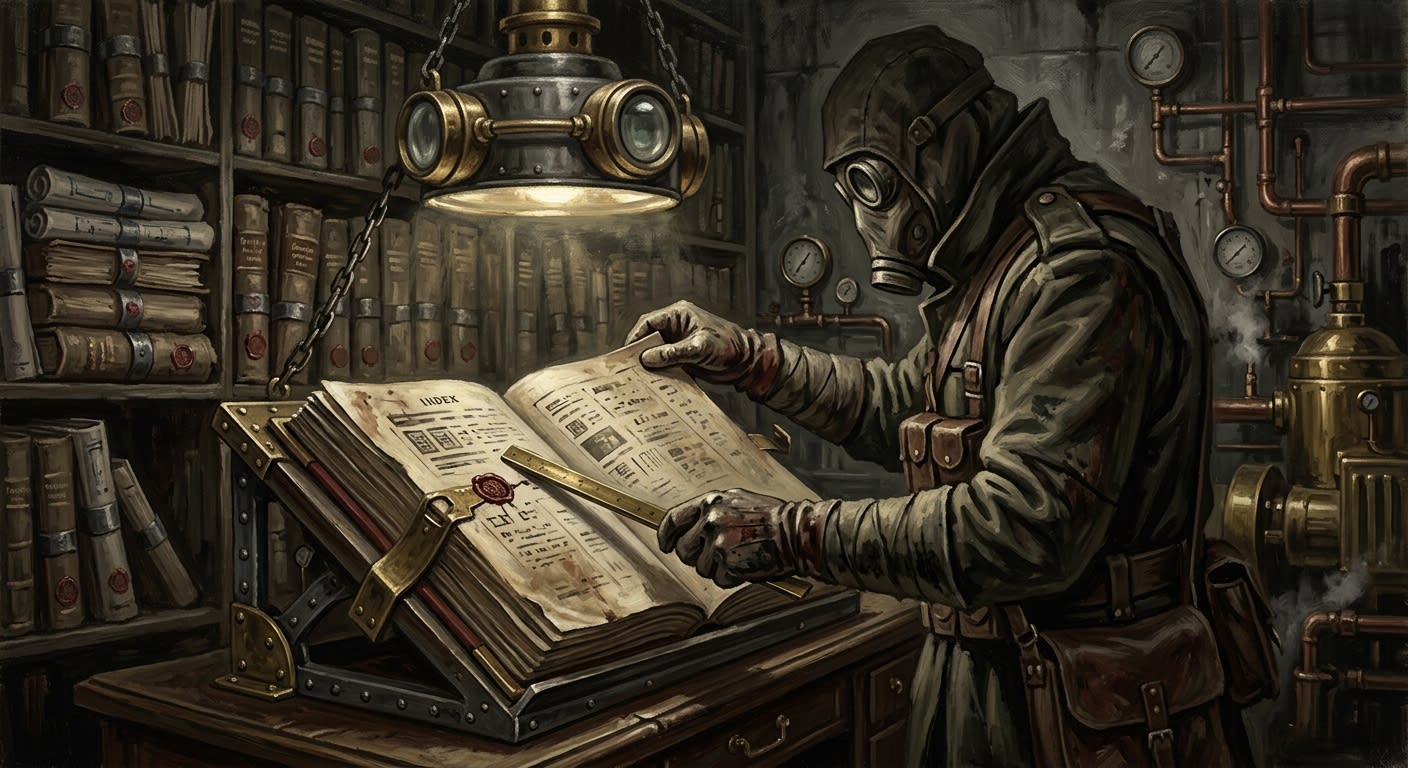
The Prayer of Unseeing is the formula recited by those condemned by office to handle forbidden matter without granting it residence in the skull. It belongs to the Bureau of Rites by composition, to the Bureau of Purity by use, and to every shivering officer in the Index Damnatus Chamber by dread. At Matins, when the chained Index Damnatus is turned with bleached linen gloves and an ivory tongue, the attending Inquisitors avert their eyes and speak the words that instruct sight to behave as though it had never been born.
Sight is a disobedient clerk. It files before permission. It copies before command. It recognises what the soul has been warned against recognising and then has the nerve to call the act memory. The Prayer exists because Purity discovered, with the speed that usually follows scandal, that “do not read” is an order and the eye is not a soldier.
#On Its Composition
The Prayer was composed after the Vault's early page-turn protocols produced three headaches, one illegible duty log, and a junior Inquisitor who identified his own handwriting in a Register he had sworn he had never seen. The date is filed under A.S. 94 in the Vault's institutional bundle, though Rites insists the final wording was refined across later rotations. Refinement is how Bureaus confess without confessing.
The text is short. It has to be. A formula recited beside the open Index cannot linger like a sermon. It moves in clauses: renunciation of recognition, surrender of curiosity, request for permitted blankness, seal upon the inward eye. No full public version circulates. Provincial training extracts contain gaps where the operative verbs should be, which makes them safe, useless, and beloved by committees.
Earlier training summaries described the Prayer as a “protective charm.”
Withdrawn. A charm belongs to village superstition, hedge-witchery, and the sloppy little prayers peasants sew into hems. The Prayer of Unseeing is a Bureau-ratified handling formula with doctrinal force, liturgical custody, and a failure record too dignified for pamphlets.
#On the Page-Turn
At Matins the senior Inquisitor approaches the iron lectern. The other two watchers stand at their benches — south, east, west according to the rotation — and turn their faces aside. The first clause begins before the page moves. The second clause covers the lifting of the corner. The third covers the fall of the retired leaf. The fourth is spoken only after the senior officer has withdrawn both hands and the Index has accepted the day's exposure.
The senior officer looks at the glove, the ivory tongue, the margin edge, the safe interval of paper where no letter should be legible. Should is a theological word masquerading as a procedural one. The Register of Names can feed a surname through three visible strokes. The Register of Sounds can instruct a hand by spacing alone. Breel taught us that, and Breel paid for the lesson by continuing to breathe.
The Prayer's genius is its refusal to ask for ignorance. Ignorance is too coarse. The Inquisitor may need to know whether ink darkened, whether a corner curled, whether a page shifted toward a bench. The Prayer asks for severance: perception without appetite, contact without possession, custody without inward copy. It asks the mind to become a ledger that records the existence of a sealed folio without opening the folio.
#On Known Failures
The Prayer has failed enough times to be respected. A formula that never fails has not been used near anything interesting.
Breel's case is the famous wound. In A.S. 187, after the twelfth hour of east-bench exposure, Inquisitor Breel transcribed twenty-seven bars of proscribed notation from the Register of Sounds into her duty log and claimed no memory of the act. She had recited the Prayer. The log was burned. The ash was weighed. Administrative Order 44-B reduced Vault shifts to eight hours in A.S. 188. The Prayer remained unchanged, because changing the Prayer would imply the Prayer had been involved, and the Bureau had already located the problem in endurance, which was cheaper.
RITES REVIEW FRAGMENT — POST-BREEL Question submitted: Did the Prayer fail to prevent absorption, or did it prevent awareness of absorption? Answer: █████████████████████████████████████████ Recommendation: retain wording; alter schedule; do not circulate distinction.
Other failures are quieter. South-bench officers report partial recognition of names absent from the exposed page. Folio carriers dream in sealed handwriting. One Rites copyist wrote the third clause backward on six consecutive mornings and refused breakfast until the error was praised. Purity calls these stress residues. Rites calls them marginal adhesions. Records calls them files.
#On Proper Use and Misuse
The Prayer is not a hood. It is not a shutter. It is not permission to stare. Junior officers misunderstand this with athletic stupidity. They believe recitation makes the page harmless, as though danger were a vapour dispersed by syllables. The Prayer leaves the Index dangerous. It leaves the handler legally survivable.
Misuse has penalties. Reciting the Prayer outside assigned handling duty is appetite. Teaching it without writ is distribution of restricted counter-content. Altering a clause is liturgical forgery. Singing it is Orison contamination. Whispering it over cards, dice, love letters, tax notices, condemned pamphlets, or mirrors is peasant nonsense unless it works, at which point it becomes heresy by efficacy.
A provincial Purity circular permitted field officers to recite the Prayer before opening any suspect document.
Rescinded. Blanket use produced clerks who opened more suspect documents, not fewer. The Prayer is authorised only where exposure is mandatory and supervised. Curiosity wearing vestments remains curiosity.
#On the Present Formula
As of A.S. 201 the Prayer remains in force within the Vault of Silences, at Index page-turns, sealed-testimony transfers, selected third-silence inspections, and certain Purity operations whose files smell of wax and bad sleep. Rites maintains the wording. Purity enforces the use. Records preserves incident notes under seals arranged with the usual optimism that a locked drawer intimidates memory.
The Index is still open. The benches remain. The south bench sees names. The east bench sees sound. The senior officer turns the page, says the words, and trusts that the eye has been disciplined for another day.