
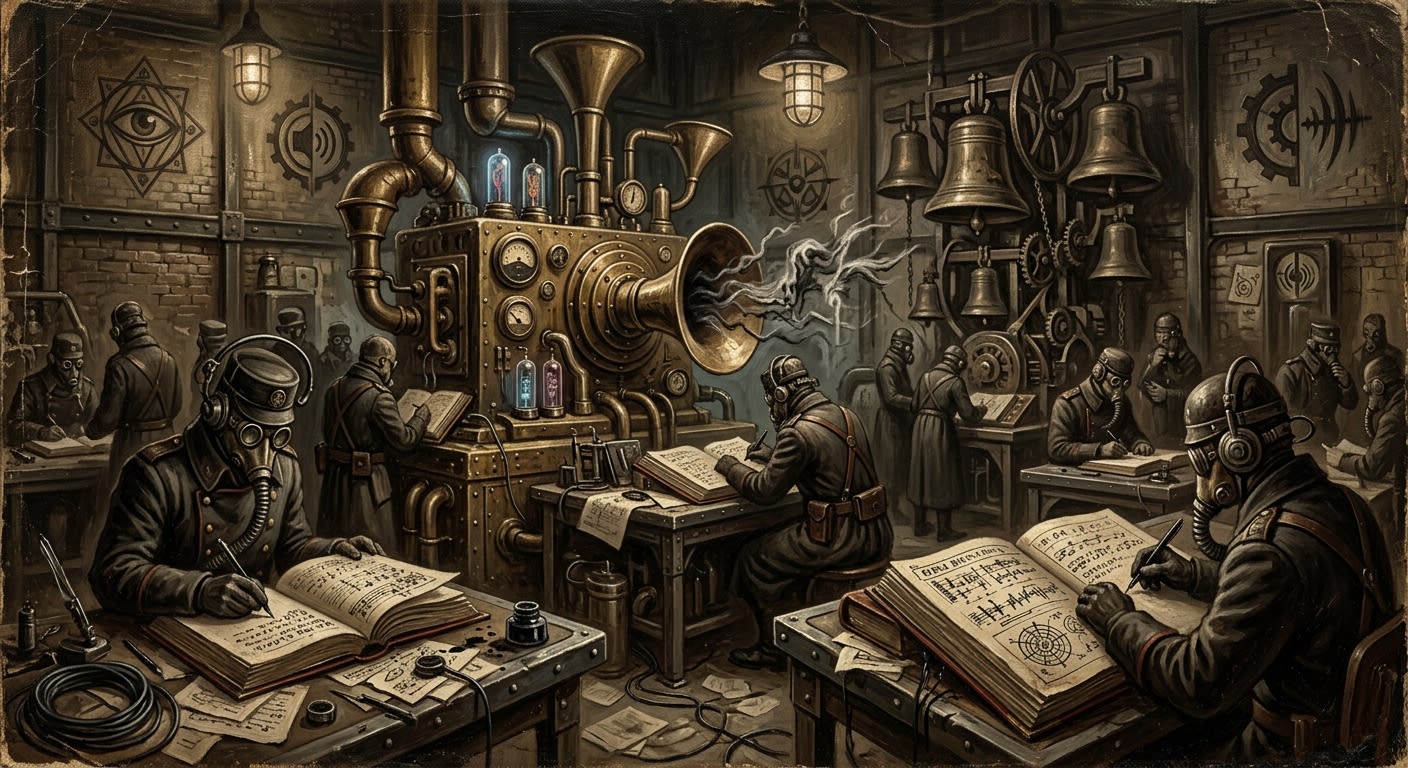
#On the Sound That Ink Can Hold
The Register of Sounds is the third of the Five Registers of the Index Damnatus, maintained under Purity seal and fed with the zeal of a starved organist by the Bureau of Orison and Song. Its subject is forbidden sound: hymns, bell-tones, cadences, children's measures, work-rhythms, military calls, lullabies, mourning drones, syllable intervals, breath patterns, and those obscene little tunes by which peasants prove that ignorance, given four bars and a washing line, can become treason before supper.
A forbidden book may be locked. A forbidden image may be scraped. A forbidden name may be struck from the Register of Names and hunted by the Index Runners across gatehouse, orphanage, ferry quay, and grave roll. Sound is less courteous. It departs the mouth, enters another skull, and becomes evidence with lungs.
#On Its Custody in the Vault
The master Register rests within the chained Index in the Index Damnatus Chamber beneath the Basilica of the Ledgered Saints in Strasbourg. It is visible from the east bench on every eighth day of the rotation, which fact became famous after Inquisitor Breel sat there too long in A.S. 187 and wrote twenty-seven bars of proscribed notation into her duty log without remembered consent. The Bureau burned the log. The ash was weighed. The bench remains.
The Register is copied in notation systems the Bureau insists are safe because they are official. This confidence deserves admiration in the manner one admires a man who stores vipers in labelled drawers. Orison notation, bellfall diagrams, mouth-shape codes, breath-count grids, pitch ladders, finger-tap marks, and silence intervals all appear in its pages. Some entries are complete melodies. Some are fragments. Some are warnings shaped like music because no safer shape would hold them.
The page-turn at Matins exposes the Register according to rotation law. Exposure to consecrated air is said to preserve doctrinal potency. Closing the Index is said to invite pressure. Pressure invites leakage. I have heard the same argument from plumbers, confessors, and cowards. In this case, regrettably, it may be true.
Earlier instructional folios described the Register of Sounds as a catalogue of “proscribed melodies.”
Corrected. The Register contains melodies, bell-tones, vocal cadences, work-rhythms, breath sequences, pitch intervals, acoustic returns, silent measures, and written forms capable of producing unsanctioned rhythm in the reader's hand. The word melody is too pretty. The error is withdrawn.
#On A.S. 114 and the Jawbone Tone
The most discussed frequency in the Register is 217 hertz, proscribed since A.S. 114 and later measured from the humming jawbone held among the Vault's confiscated relics of uncertain provenance. The jawbone does not sing. It hums with the patience of a clerk waiting for a superior to die. Orison found no sanctioned tone at that measure. Purity found that the tone had already been listed. Records found this comforting, because prior paperwork comforts Records the way warm milk comforts infants.
The A.S. 114 entry does not explain the origin of the ban. It gives three collateral notations, all sealed above ordinary consultation: one from a chapel in Lombardy where a funeral drone continued after all singers stopped; one from a barracks near Vienna where sleeping men answered roll call in voices belonging to the previous regiment; one from a bell-lab whose report consists of three pages of numbers and a final line in a hand no living auditor claims.
REGISTER COLLATERAL — A.S. 114 Tone class: ███████ Permitted comparison: none Observed human effect: molar pressure, involuntary memory, phrase completion Instruction: do not reproduce by voice, fork, pipe, bell, wire, glass, bone, or written cadence. Written cadence exception applies only inside the Register. Exception status: ██████████████
A forbidden frequency listed inside a forbidden book beneath a basilica, later emitted by a jawbone the Bureau cannot destroy, is exactly the sort of arrangement Strasbourg calls containment. One grows fond of the city, or one goes mad before lunch.
#On Field Entries
The Register grows from incidents. A mother hums four bars near Bastion-Irongate in A.S. 178; a relay fails; the garrison spends three days repairing holy machinery; the mother is given to Inquisitors; the child to the Orphanarii; the tune to the Register. A folk lullaby in Vienna gathers too many sleeping children under one cadence; Orison calls it contamination; Purity calls it seizure; five thousand mothers receive the Bureau's correction in flesh. A prison work-song changes a shovel line into a riot timetable. A dock chant carries cargo weights, debt codes, and an old Rationalist joke through the harbour before any censor understands why everyone is laughing on the same beat.
Each entry receives classifications: source, vector, interval, reproducibility, casualty, doctrinal contamination, enforcement action, residue. The last column is the most honest. A song leaves residue in throats, in walls, in tools, in the stepping habits of men who swear they have forgotten it. The Bureau can confiscate sheet music. It cannot confiscate the exact pause before a widow says amen.
#On Provincial Excerpts
Provincial copies of the Index contain only excerpts from the Register of Sounds. The reason is obvious enough for a child and has required six committees: distributing a complete catalogue of forbidden melodies would distribute the melodies. Purity solves this by issuing partial notations, redacted intervals, and warning diagrams so mutilated that the provincial officer charged with enforcement must often guess what he is hunting.
Guesswork produces industry. Tone Inquisitors (Unregistered) flourish. White-Mantled Inquisitors raid choirs, laundries, barracks, nurseries, rope-road stations, taverns, bell-towers, funeral houses, and anywhere else human beings commit the suspicious act of organising breath. Orison complains that Purity misidentifies intervals. Purity replies that Orison licences too much noise. Bells claims jurisdiction over bronze. Doctrine claims jurisdiction over meaning. Records requests duplicate copies and is refused, then archives the refusal.
#On the Present Hazard
As of A.S. 201, the Register remains active, open by rotation, guarded by Inquisitors who may not read it and consulted by superiors who pretend consultation is appetite with a seal. Breel's case reduced east-bench exposure. It did not cover the page. The jawbone grows louder by measurement no one publishes. Singing-glass incidents among Purity specialists have increased since A.S. 195. Orison continues to submit entries faster than Purity can classify them, which means civilisation is either well-defended or losing at excellent speed.
The Register's great obscenity is that it works. Banning a sound can save a bastion. Seizing a cadence can stop a riot. Burning a lullaby can prevent a breach whose shape no mason can repair. This is the argument the Bureau makes, and, damn them, sometimes the Ledger agrees.
One should not hum while reading this entry.