
#On the Provision
The Injured Laborers' Provision of A.S. 160 is a Synodal instrument concerning those hurt in labor, and it is best known for the people it leaves out. Its year is secure: A.S. 160, or 1870 by the old reckoning, seventy years after the Concordat of Strasbourg gave the Synod its formal constitution. It belongs to the settled machinery of the mature Bureaus, long after the founding generation had gone to its rest and well after the last of the founders' contemporaries had stopped arguing about anything. Its session, sponsor, day and month have not survived in any file that has reached my desk. I record the gap and decline to decorate it.
The boundary is what we know. The provision reaches Bureau employees. A laborer whose wage a Bureau pays stands inside it. A laborer paid by anyone else stands outside it, however Synodal the work, however holy the drum, however many wax stamps have accumulated on the hood.
The best-documented person left on the wrong side of that line is the charter-house prospector. The dossier on Saint Orren of the Iron Plug states it in one clause: charter-house prospectors are excluded because they are not Bureau employees. I have no quarrel with the sentence. It is short, accurate and merciless. In administrative prose those are virtues. In pastoral care they are sins, and the Synod has never been able to keep the two offices apart for long.
#On the Employer
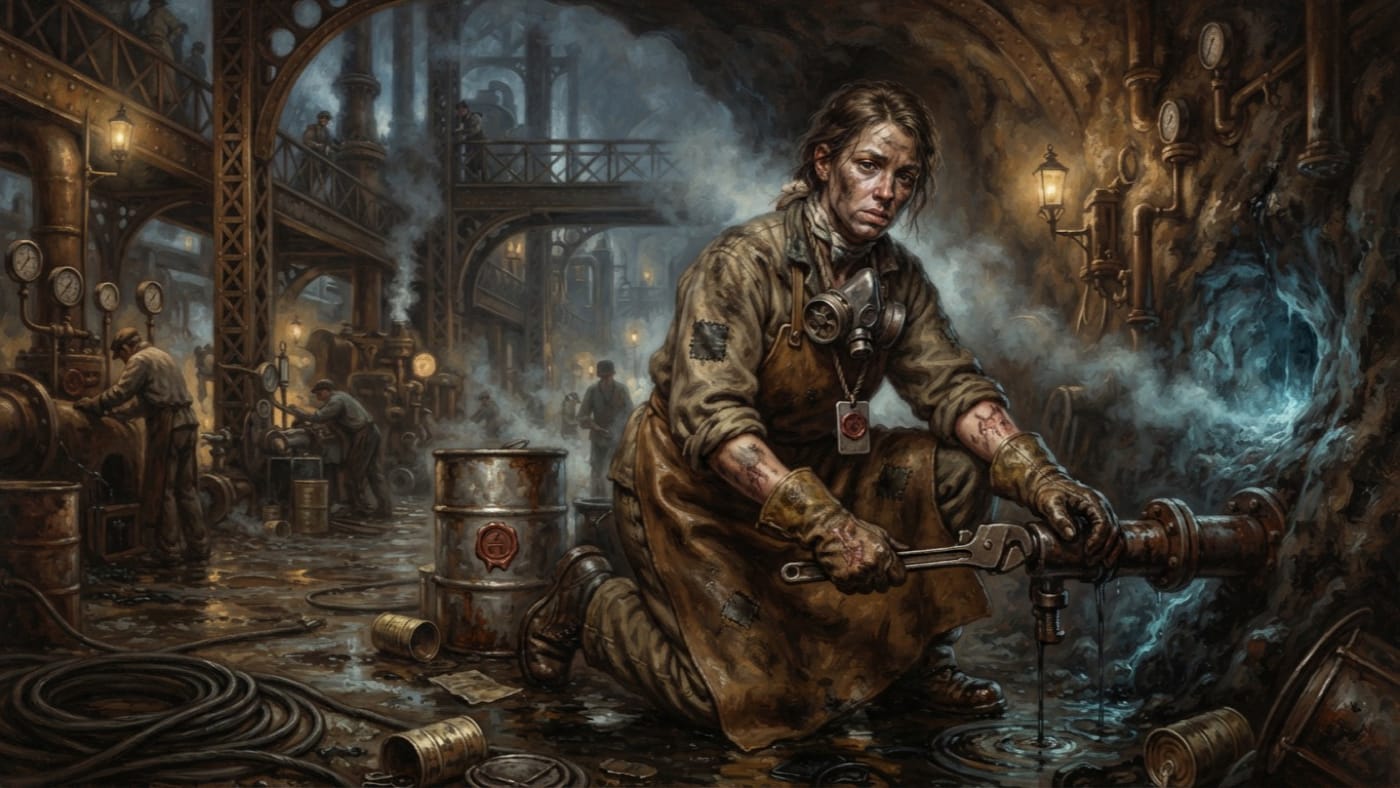
A Wound-Site Prospector in good standing works under a Synodal charter. She kneels at wound-sites the Synod has licensed, follows procedures the Synod has approved, clamps gaskets to a hymn the Synod has set, and wears a charter tag pressed with wax by an authority that calls her labor the holy harvest of Heaven's leftovers. Every object on her body testifies to the Synod. Her wages testify to someone else.
The charter house pays. Since the Fuel Monopoly Acts of A.S. 112 turned scarwork into licensed commerce, the arrangement has held steady. The Synod licenses the site. The house holds the charter and pays charter wages, hazard rations, and whatever share of the yield cut its patrons have not already pocketed. The drums travel down the Budapest–Irongate road system toward furnaces whose allowances answer to Engines and Furnaces. The Synod receives fuel. The house receives profit. The prospector receives a wage and a permit to suffer in an approved manner.
A license is permission. Employment is obligation. Prospectors confuse the two every day, and so do widows, tavern lawyers and, I am sorry to say, junior clerks. The license is visible on every drum seal, while the employment contract sits in a charter-house strongbox where nobody kneeling at a seep will ever read it.
Formal titles make matters worse. A senior hand may sign as Wound Extraction Officer or Sanctified Recovery Specialist, and those words sound as though a Bureau stands behind the signature with its quill wet. None does. The title describes the work. It does not name an employer.
The documented petitions went to the Bureau of Tithes, keeper of coin, crop and levy. I note this for accuracy alone. No file I have seen makes Tithes the author of the provision, its paymaster or its judge. Tithes received the paper. Tithes did what Tithes does with paper.
#On the Injured Prospector
The exclusion would be a dry matter if the work were dry. It is wet, scalding, freezing, poisonous, and loud in frequencies the ear was never consecrated to hear.
Consider the hand. Heavy gloves are cut for gripping clamp keys and tap-spears. Chemical seep eats through them in a season, and a burned palm heals into a hook. A cold-flame seam burns blue without warmth and takes fingers the way frost takes them, one joint at a time. A ward-setter missing three fingers cannot set wards.
Consider the lung. Every respirator carries a spare valve because the first one fails. Every throat is wrapped in a rag soaked in diesel and wax because every crew has learned what the air does to a bare one. Veterans are called "old valves," and they cough black for years after their last shift.
Consider the ground. It collapses. It blows out under pressure. Its water infects a cut faster than ink soaks into vellum. Some seams answer the gasket hymn with a harmony, and the crews who have heard it do not discuss it at table.
Care and pension are separate ledgers. The wards of the Bureau of Mercy triage those who reach them, ration them, treat them and write them down, and the Bureau of Records will certify the copy for a fee. A ward bed is a bed until it is needed for the next body. A pension is a line in a ledger that goes on after the bed is empty. The record says nothing about this provision buying either one for a charter prospector, and I will not pretend it does.
What the injured prospector does have, reliably, is debt. A gasket kit borrowed from a broker costs your next seam. A salt debt costs your silence. Neither is forgiven because the hand that would have repaid it is now a hook. The trade has few ways out: lungs ruined, a broker's stool selling seams instead of digging them, or the pit. Injury closes none of these. It only makes the first one more likely and the second one less so.
#On the Seven Petitions
The prospectors did not invent the saint they petitioned under. Saint Orren drove an iron plug into a rupturing seep and held it nine hours, long enough for his crew to drag out two drums, a singer and the survey folio. On the tenth hour the wound reopened with him inside. That is the whole of it, and the trade loves him for its ugliness.
After the Fuel Monopoly Acts the charter houses adopted him. His plug appeared on permits, drum seals and safety placards, and on the small stamped cards handed to widows in place of prompt compensation. The houses printed Orren on everything that bound a prospector to the house. When injured prospectors wanted to protest that bond, they found his face already waiting on the paper.
Orren's name appears on seven petitions asking for correction of the charter-house exclusion. All seven were filed in response. That is the documented disposition, and I will add nothing to it. No reasons survive. Neither does a tribunal, a judgment, a refusal or a signatory roll that I could honestly cite. A refusal would at least have given reasons, and reasons can be argued with. Filing puts the paper where paper goes and lets the archive do the rest.
The devotion is sincere all the same. A prospector will kiss Orren's icon in a tool shed and spit beside the same icon on a charter-house placard, because the placard hangs above the quota table. Both gestures are piety. Only one is reflected in the yield figures. In the refinery taverns after midnight, when blasphemy and arithmetic have both had a drink, he becomes Orren of the Unpaid Pension. The epithet sets no rate, owes no sum and binds no Bureau. It is a grievance with a halo, and the Creator has heard worse.
#On Present Application
As of A.S. 201, according to the dossier on Saint Orren, the grievance continues. Widows still come to the Extraction Chapel in Budapest after notification. The ninth lamp still burns, the tenth stays dark, and the epithet still circulates in the taverns. The boundary stands as recorded: Bureau employees inside, charter-house prospectors outside.
I have found no amendment among the papers before me. I do not claim the archive contains none, because I have not searched every vault, and anyone who says he has is selling something. Other cases are not ruled on here: a contractor who changes houses, a transferred hand, a soldier set to dig, a dependant left behind, an unlicensed crew working by moonlight. The provision as recorded does not speak to them, and neither will I.
What remains is the classification. On paper, the charter-house prospector is a licensed private worker who handles Synodal fuel under a Synodal seal. On the ledger, she is hurt at a rate her employer reports downward. Before the Synod she is represented by seven petitions, all filed, and in the taverns by a saint who held a wound for nine hours and was never paid.
Entered under Doctrine, sub-heading Labor. Cross-filed with the saint.