
#On the Iron Under Glass
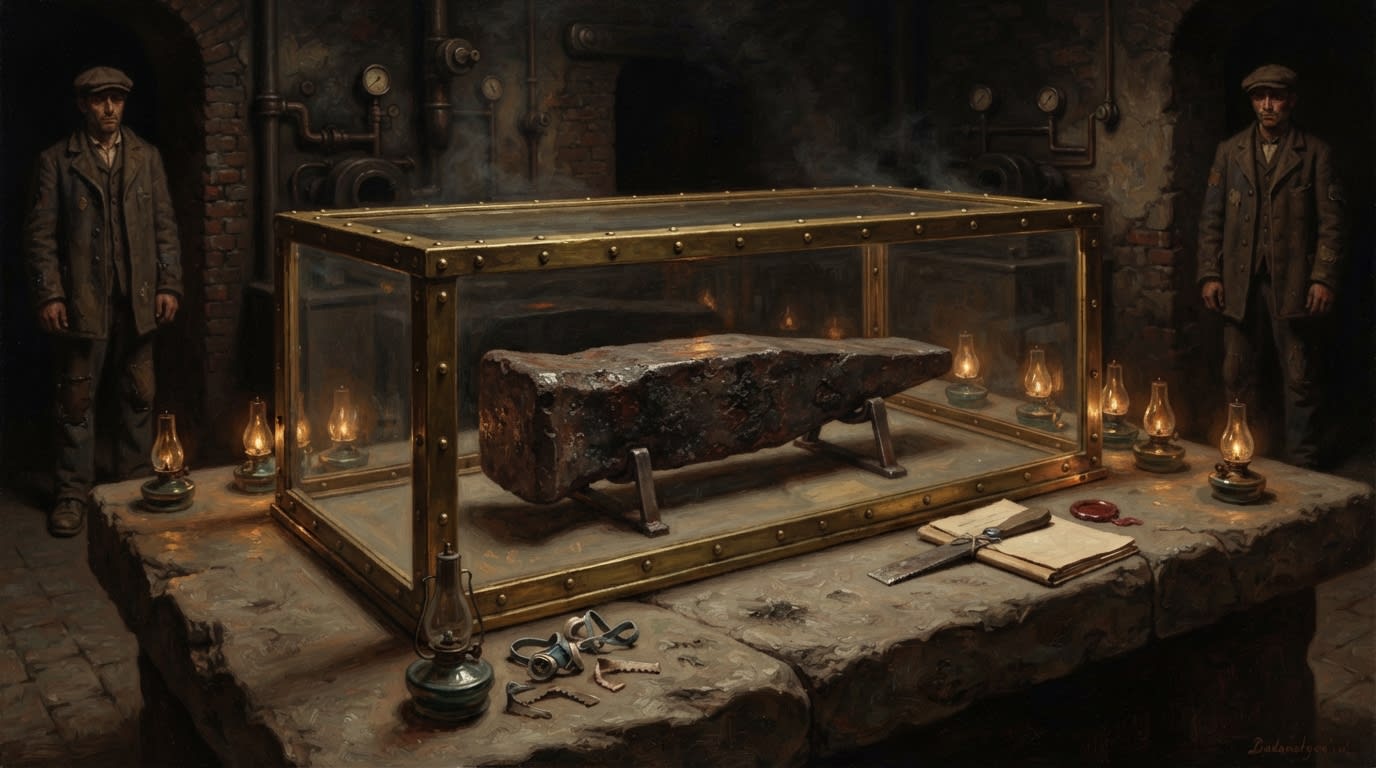
The Iron Plug of Saint Orren lies in a sealed case at the Extraction Chapel in Budapest. The Bureau of Relics catalogues it as R-0447-BP. It is iron, and it is black. Corrosion has turned its surface into a crust like burnt sugar, and under the crust the shape persists in one piece: blunt, tapered and ugly. Relics holds that iron of its apparent age and exposure should have gone to powder long ago. The Bureau records this observation and declines to finish the sentence.
Two questions stand before the case, and pilgrims habitually mistake them for one. The first asks whether Orren drove a plug into a rupture and held it there for nine hours. The Ledger answers yes. The saint's cult rests on it, and the Bureau of Doctrine has approved its meaning. The second asks whether this lump of iron is that plug. Relics answers provisionally. In the dialect of the reliquary this means the question remains open, the case remains shut, and the chapel keeps its posted hours.
No document traces the object from the fissure to the glass. The record does not say who carried it out, when, or from where. Its survival is a fact. Its pedigree is a petition.
No recorded dimensions, weight, assay or forging specification accompanies the catalogue entry. The blackened shape can be described; no measured drawing can be certified from the papers before me.
#On the Work of a Plug
Take away the lamps and the thing is a tool. A Wound-Site Prospector crew opening a seam drives an auger or tap-spear into the fracture. The prospector reads the pressure pitch through the handle and through his teeth, and the crew draws the seepage into gasketed drums while a singer of the Gasket Choir holds cadence from the chapel sled. A crew that means to tap must also be able to stop, and the plug is how it stops. It is iron, roughly shaped, made to be hammered into a mouth the crew opened itself, so that the mouth can be closed again when the drums are full or the pitch climbs.
Nothing about such an object was holy at the forge. Smiths made them with the same indifference they gave to tent pegs and pump pins. Crews lost them, bent them, left them in exhausted seams and stole them from one another. Orren's plug was meant for a controlled tap-mouth: a hole made by men, of known width, with a ward line around it. It was never meant for a wound that had decided to widen on its own.
The cadence used by present crews belongs to the Gasket Hymn Reform of A.S. 152, a joint initiative of the Bureau of Bells and Engines & Furnaces. Orren's account supplies iron and a sledge, and in his dossier a living singer carried out behind him. It does not identify the song or establish that he used the later prescribed cadence. A reform cannot be sung backwards through a calendar. Nor does the relic's present custody make it a spare plug for a charter drum.
Wound-sites keep their own counsel about why they split. Doctrine has its explanation, the trade has several, and the ground has never filed one. Pressure wants out, and for a while the iron refuses. All of extraction comes down to that one argument, conducted on bad wages.
#On the Nine Hours
The account in Orren's dossier is short, and I do not intend to lengthen it. In the early extraction years, before the charters, a crew working west of the Danube opened a demon-seep fissure that was meant to vent slowly into drums. The fissure widened. The chapel sled cracked, the singer lost cadence, and the ward setter called withdrawal. Orren took the plug meant for the tap-mouth, stepped over the salt line, and drove it into the split with a sledge.
It seated. The seep slackened. The pressure fell far enough for the crew to drag out two filled drums, a living hymn singer and the survey folio.
The plug held for nine hours. On the tenth the wound reopened, with Orren inside it. The dossier records that no body was recovered.
That is the deed. The year is not written down, nor the day, nor the exact fissure, and the Codex will not supply what the Ledger lacks. Nor does the account say how a plug driven into a reopened wound came to be lifted out again. Whoever did that work, if anyone did, left no signature. I find this the most honest silence in the file.
The approved reading, sealed by Doctrine, is containment. The plug did not heal the ground. It bought time, and the time ran out. Nine hours was the size of that mercy. It is no rating stamped on the iron, and a plug that resembles his does not carry his hours into another seam.
An A.S. 119 devotional tariff sheet declared that all charters under the Fuel Monopoly Acts "operate under Saint Orren's protection."
Withdrawn after two ruptures, one chapel sled inversion and a prospectors' petition objecting that the saint was being blamed for managerial greed. Revised language: "operate under Saint Orren's patronal invocation." The plug was never consulted.
#On the Outstanding Authentication
Relics lists three disputes against R-0447-BP: dating, corrosion, and residual warmth under glass. Each has its own column in the file, and none has been settled.
The dating fails because there is no date to test against. The rupture is undated. So is the plug's forging, and so is its arrival in Budapest. Examiners may argue about the iron's age until they corrode themselves, and they will still be measuring an interval with no fixed end.
The corrosion contradicts itself. There is too much of it for a recent forgery, and too little damage for the plug's alleged age and exposure. A relic that had decayed as expected would have been certified or rejected years ago. This one has decayed wrongly, so it remains in committee.
The warmth is reported. Custodians and pilgrims have described the glass as warm. No public register records a temperature, nobody offers a cause, and nobody has been licensed to propose one. I record the reports as reports.
The ordinary authentication procedure asks an examiner to inspect the object, reconstruct its chain of custody, weigh its doctrinal acceptability, draft a verdict and issue a Sanctity Writ before display. Relics calls provenance a spine. The surviving notice does not identify the assay, a measured age, the examiner, or which stages this plug passed. It gives a present result: display under provisional authentication, with metallurgical dating unresolved. Nobody has recovered a final writ that closes those questions.
Orren's companion objects show how many grades the Bureau keeps between yes and no. A fragment of his hammer carries a provisional rating of "probable". Orren's dossier shortens this to "probable"; the profession's account keeps the provisional qualification. Neither wording is a final authentication of all his companion objects. It is not displayed with the plug, and the public record does not settle where it rests. A respirator cloth said to hold his last breath belongs to a private collector in Marseille, whose documentation Relics has called "enthusiastic." The collector charges two Crowns a touch and pays the Bureau twelve a year for a licence to display it. That licence covers the cloth and nothing else. Nobody sells a touch of the Budapest plug, and the cloth's licence certifies no authenticity. No plug-specific fee schedule is supplied by the consulted notice; that silence certifies neither free admission nor permission to touch the glass.
The Wound-Site Prospector account states that Relics authenticates three objects attributed to Orren.
The three dispositions are separate. R-0447-BP has provisional authentication pending metallurgical dating disputes. The hammer fragment has a provisional rating of "probable". The Marseille cloth is unverified and licensed for display. One provisional authentication, one qualified rating and one paid licence do not make three final authentications.
The chapel needs a relic. The crews need a saint. Relics needs the question kept open long enough to keep jurisdiction over the answer. All three needs are met daily.
#On the Lamps and the Printed Seal
Nine lamps stand around the case, one for each hour the plug held. A tenth stands with them, trimmed and unlit. Prospectors leave beneath it what the work leaves them: broken gasket teeth, spent respirator clips, cracked pressure needles, and bone tokens from crews that came home short. The working men keep their distance from the glass. They have spent their lives beside things that ought to stay sealed, and they know better than to lean on one.
Their prayer is the one said before the tap: Orren hold the mouth. The longer form, preferred along the Budapest–Irongate corridor, adds and leave us outside it. I have heard Doctrine's clergy improve on this prayer. The trade has kept the original.
After the Acts of A.S. 112, the plug left its case in a second form. Charter houses printed it on permits, drum seals, safety notices and condolence cards. The Bureau of Tithes found the lamp chapels billable. The silhouette became the mark of licensed extraction. In the hands of black crews it became the mark of forged licensed extraction, which the trade calls an Orren seal and the courts call fraud.
So three objects now share one name. The first is the relic in Budapest, provisionally Orren's. The second is the iron plug in a crew's kit: a tool, which may hold, and which owes the saint nothing. The third is the plug printed on a drum, which certifies only that someone applied wax and ink to the drum. That one has never contained anything.
I note for completeness that the charter-house prospector is still excluded from the Injured Laborers' Provision of A.S. 160. The plug appears on his permit. He does not appear on the pension roll.
When the lungs fail and the tremor settles into the hands, the Bureau of Mercy has hospice beds for some of those workers. No pension comes with the bed. Their patron bought time with iron; his charter houses still ask the crews to do the same.
BUDAPEST EXTRACTION CHAPEL — NIGHT WATCH REPORT, A.S. ███ Tenth lamp observed lit without attendant action. Plug case interior fogged from within. Audible impact sequence: nine strikes, pause, one strike beneath floor. Custodian testimony removed for devotional stability. Relics classification: ███████████████████.
In public, the tenth lamp is unlit.
#The Ratification
As of A.S. 201, R-0447-BP remains in Budapest in its sealed case, under provisional authentication, with three disputes open and no provenance filed. The cult is active and the emblem is still printed. The hammer fragment is still rated probable and the cloth is still licensed. The wound that took Orren appears on no public map.
The iron does not rust to powder, and the clerks do not close the file. Prospectors pass the case on their way out to the corridor and keep their hands at their sides.