
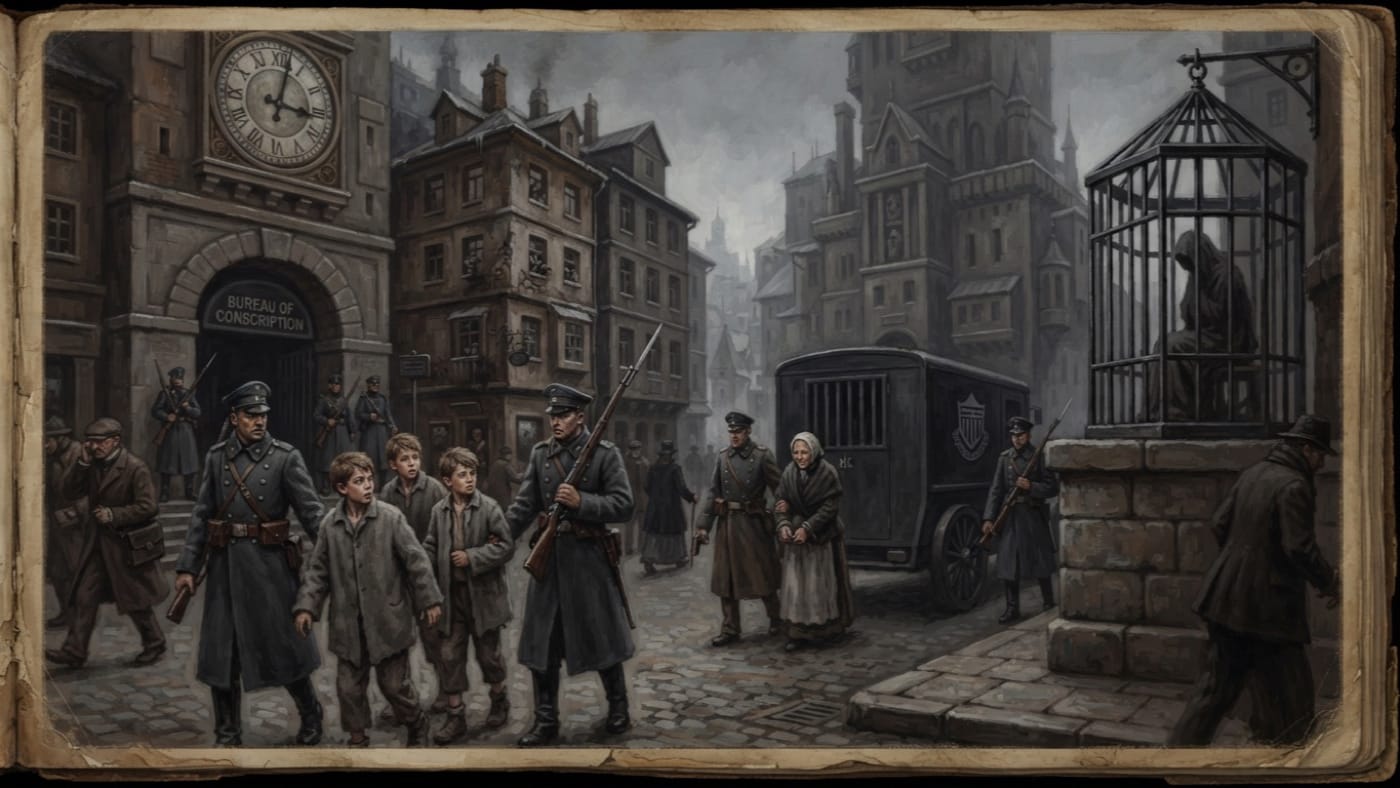
On the Innsbruck Audit of A.S. 178
In A.S. 178 (1888 CE), the Bureau of Purity audited a single household in Innsbruck and found three sons who did not exist. They had not existed for fourteen years. In that time they had eaten, grown, sickened and recovered, and the Great Ledger of Souls had recorded none of it.
The Bureau corrected the omission. The sons went to the Bureau of Conscription. The parents went into the Index Damnatus. The midwife went to the cages. The Bureau of Purity then raised its regard for the whole trade of child-concealment by one full tier. It treated the matter as a vindication of method, and the claim deserves the courtesy of an audit of its own. Three conscripts were recovered. The Bureau had spent fourteen years failing to notice them.
#On the Law Behind the Audit
The audit's authority descends from the Nursery Levy Decrees of A.S. 152, twenty-six years earlier. Before the Decrees a parish had one calendar month to register an infant. The Decrees cut that month to seventy-two hours. They required a midwife's preliminary notice within twelve hours, and they let registrars enter any home where a birth had been reported and the writ had not followed. They also reclassified concealment from negligence to heresy. Those are the terms as the Decrees were issued. The exact clock that governed an Innsbruck parish in A.S. 178 is a question for the Bureau of Records, which keeps a great many clocks and is fond of all of them.
The doctrinal ground is Synodal and settled. A soul concealed from the Ledger is concealed from the Creator's sight, and what the Creator does not see, the Great Deceiver may claim. I hold that teaching with every proper conviction. I also hold a pen, and the pen knows the second half of the sentence, which Doctrine leaves to the clerks.
A natal writ is a levy entry with a deferred date. The Bureau of Conscription reads the birth rolls as a quartermaster reads a granary, by counting what will be ready in a given season and allotting it before the harvest. Every infant stamped within the window is a number the Bureau can project and assign. Eventually that number becomes a line on a muster roll and a body sent toward the Sagittal Line. An infant who goes unstamped breaks the forecast.
Theology tells the parish why the child must be written down. Logistics tells it when.
#On Fourteen Years of Concealment
The account available to this office does not record what the household did, how it did it, or what finally betrayed it. I say so once and plainly, so that nothing below is taken for a reconstruction. What follows is an inventory of ordinary difficulty, which any family attempting this would have faced.
The birth is the easy part. The trade has methods for that hour: the false stillbirth, the ash-dummy entry that lends a dead infant's name to the column, the altered natal paper, the satchel and the shawl. The Pale Kin Runner exists because that hour can be survived.
The years are harder. A child eats. Ration chits are issued against registered mouths, so a kitchen that feeds more people than its allotment covers must go short or buy outside the chit. Buying outside the chit leaves a mark in somebody's book. A child grows, and a cobbler can count boots outgrown as well as any clerk. A child sickens, and fever does not check the Ledger before it climbs. A physician who is summoned becomes a witness, and a physician who is refused may mean a grave. Neighbours listen through timber walls. Cloth wears through and must be bought again, and every bolt has to be explained to someone with a reason to ask.
Multiply all of this by three, and then by fourteen.
The Bureau has its accountants to set against these needs. It checks baptismal registers against natal writs. It compares declared ages with observed weights. A stillbirth rate more than eight per cent above actuarial projection triggers an audit, and a ward's milk-ration allocation is read against the infants registered to drink it. These are ordinary instruments, used everywhere. I cannot say which of them, if any, reached this household. The account gives the year, the city, the household, the three sons and the fourteen years, and then it stops.
Fourteen years is a long time to be lucky. It is longer still to be competent, and the competence I mean was the household's. In every one of those seasons the ration ledgers were balanced, the parish rolls were copied in fair hand, and the Great Ledger was reconciled under wax and seal. Three boys in Innsbruck remained uncounted through all of it.
#On the Household's Disposition
The Bureau sent the household in three directions, and each direction has its own ledger.
The sons were conscripted. That is the whole of their recorded outcome. The account does not say where they were sent, whether they served together, or whether any of them lived to see A.S. 179. The Bureau of Conscription does not trace individual entries once a levy has absorbed them. They were recovered as assets, and nobody keeps watch over an asset once it is issued.
The parents entered the Index Damnatus. The Index is the Bureau of Purity's register of the forbidden: names, words, texts and emblems, posted and amended. Its oldest principle is that ignorance of it is itself guilt. A name entered there is a name that cannot be spoken without consequence. Whatever else happened to the two people who bore those names is blank in the account. It records no tribunal, no prison and no pyre. I will not invent one. The Index does not require the death of the named. It requires only that the name be finished.
The midwife was displayed in an Iron Choir until her silence was judged penitent. The Codex has used that phrase before, and I keep it because nothing I could add would be more exact. The Iron Choir is Purity's public liturgy of correction: the condemned are caged where travellers must pass them, and confession is expected to be heard. Her silence was judged penitent when it became permanent. The account does not give her name, her testimony, how long she hung in the iron, or the road by which she reached it.
#On the Revised Priority
Bureau of Purity classification of the Pale Kin Runner: "Priority: Tertiary."
Revised to "Priority: Secondary" following the Innsbruck Audit of A.S. 178, in which a single Pale Kin family was found to have concealed three sons for fourteen years. The Bureau revised its priority classification the following morning.
That is the whole correction: one word struck out and one written in. It cost the Bureau a drop of ink and the time it takes to warm the wax.
Read plainly, a priority tier is a queue. A tertiary concern waits until the desk is clear, and a secondary concern clears the desk. After Innsbruck the trade of hiding children moved up the stack of folios, and from then on it received a larger share of the attention that Purity rations as carefully as any parish rations milk. That increased attention is the documented consequence. The Codex records no new disposition category, no numbered instrument and no signing officer, and I decline to supply any of them for the sake of a fuller column.
The revision came, by the Codex's own reckoning, on the following morning. None of the other consequences carries a date. Conscription, Index entry and the long business at the cage each took whatever time such things take. I will not crowd them into a single night to make a tidier story. The Bureau has already made it tidy enough.
There is pride in that morning, and I recognise it because it is mine. Purity found three, and finding three proved the method worked. The same method had needed fourteen years to work, and that duration does not appear in the revision. The erratum records the alarm. The duration of the failure goes unrecorded.
#On Innsbruck's Separate Entries
Innsbruck lies in the Inn valley of Alpine Tyrol, within the Central Heartlands of Zone 2, well west of the Line. It appears twice in the Pale Kin file, and the two entries must not be shelved together.
In A.S. 163, fifteen years before the audit, the remains of Mother Sava were found in a wall-cavity in the city alongside eleven pairs of worn and outgrown children's shoes. She had burned her parish registry in A.S. 154 and vanished with eleven infants. The audit of A.S. 178 concerns a different household and a different midwife, and no record connects them. A reader who wants a pattern may draw one in their own ink.
#On the Bureau's Accounting
By the Ledger's measure, Innsbruck was a success. Three entries that had been missing were written in, the column was reconciled, and the Bureau of Records could close a gap it had not known was open. I have sealed commendations for lesser feats than that.
A ledger keeps two columns, and the Bureau entered only one. In the first are three conscripts, two names in the Index and a midwife's silence, judged penitent. In the second are fourteen years during which every audit passed that household by and every roll was certified correct. The Bureau of Purity filed the first column as proof of its vigilance. Nobody has filed the second.
The Bureau of Records proclaims that nothing is forgotten. I have checked its shelves, and the second column is not on them.