
#On the City Under the Passes
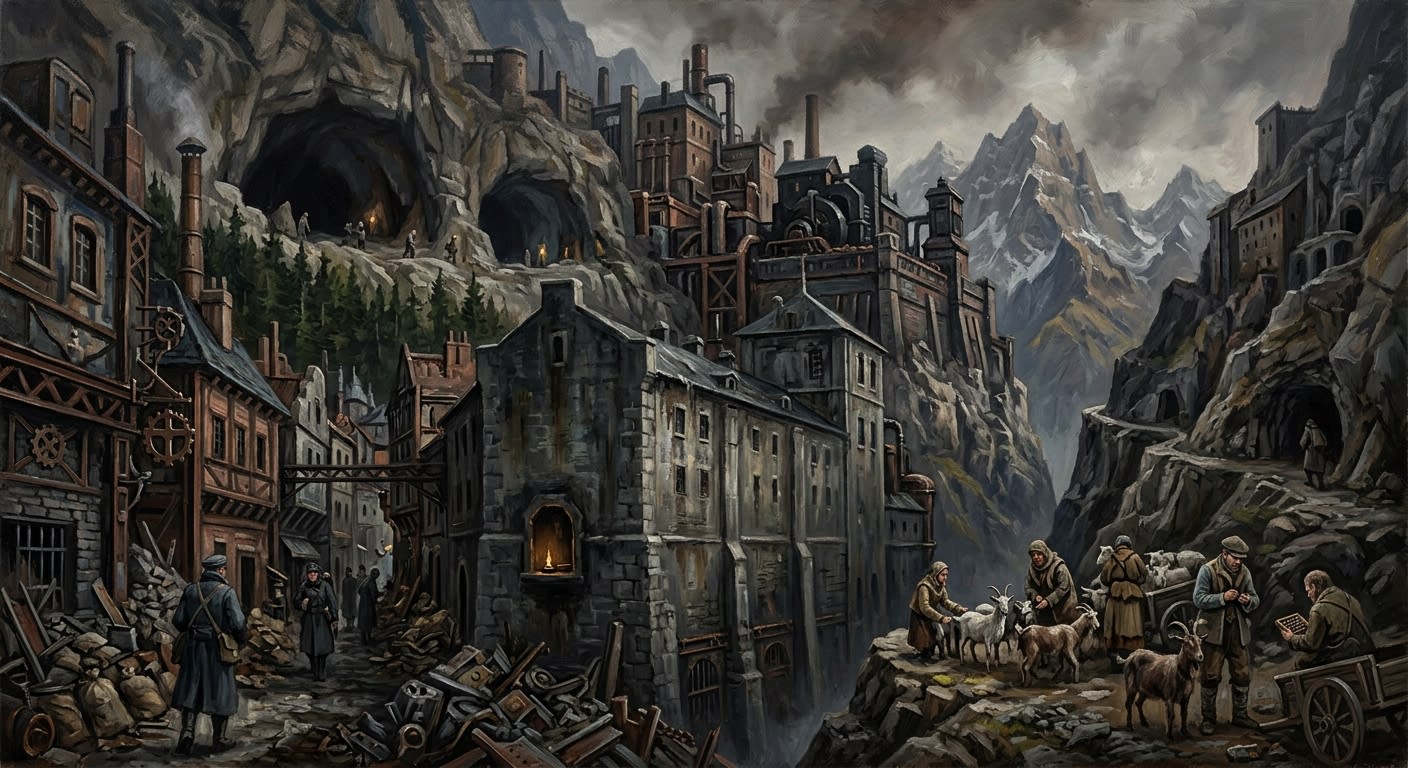
Innsbruck sits where mountains instruct men in scale. The city lies in the Inn valley, held between ridges that make every bell sound twice: once as metal, once as answer from stone. Merchants call it a crossing. Pilgrims call it a refuge. The Bureau calls it a Zone 2 alpine node of persistent devotional irregularity, cave-retention habits, child concealment precedent, and high-altitude audit difficulty. Each description contains a portion of the truth. Mine contains the best portion.
The northerner approaching Innsbruck sees roofs, river, bridge, snowline, and pious little façades painted in colours cheerful enough to make suspicion blush. The wiser observer sees apertures. Cellar grates. Hayloft seams. Chapel crypt vents. Goat tracks above the last tiled roof. Old smuggler cuts, avalanche shelves, limestone pockets, forgotten mine mouths, and those alpine caves where the faithful once learned to breathe quietly while Reason congratulated itself below.
The city is not beautiful in the Strasbourg sense. Strasbourg crushes the eye with authorised splendour, then bills the soul for admiring it. Innsbruck negotiates. It offers a gilded roof, a bridge, a market, a mountain line so clean it resembles a censor's blade, then hides its true inventory behind pantry plaster and cloud-shadow. Beauty in Innsbruck is a decoy that happens to be true.
Innsbruck's sin is shelter. Strasbourg sins upward, piling office upon office until Heaven itself must request a filing number. Cologne sins inward, vaulting coin and memory below cathedral stone. Innsbruck sins by making hiding look natural. A child can vanish into a dairy cousin's room. A priest can vanish into a goat shed. A relic can vanish into a cheese cave. A midwife can vanish into a wall. The city has spent two centuries pretending that terrain is innocence.
Terrain is never innocent. Terrain is an accomplice with weather.
#On the Cellar Saints Above the Treeline
The first sacred dishonesty of Innsbruck belongs to the Cellar Saints. After the Treaty of Regensburg in A.S. 30, when the Rationalist Republic claimed the continent, shuttered cathedrals, melted bells, and taught every clerk with a ruler to imagine himself an executioner of superstition, the faithful were offered the usual menu of conquered souls: recant, inform, or disappear.
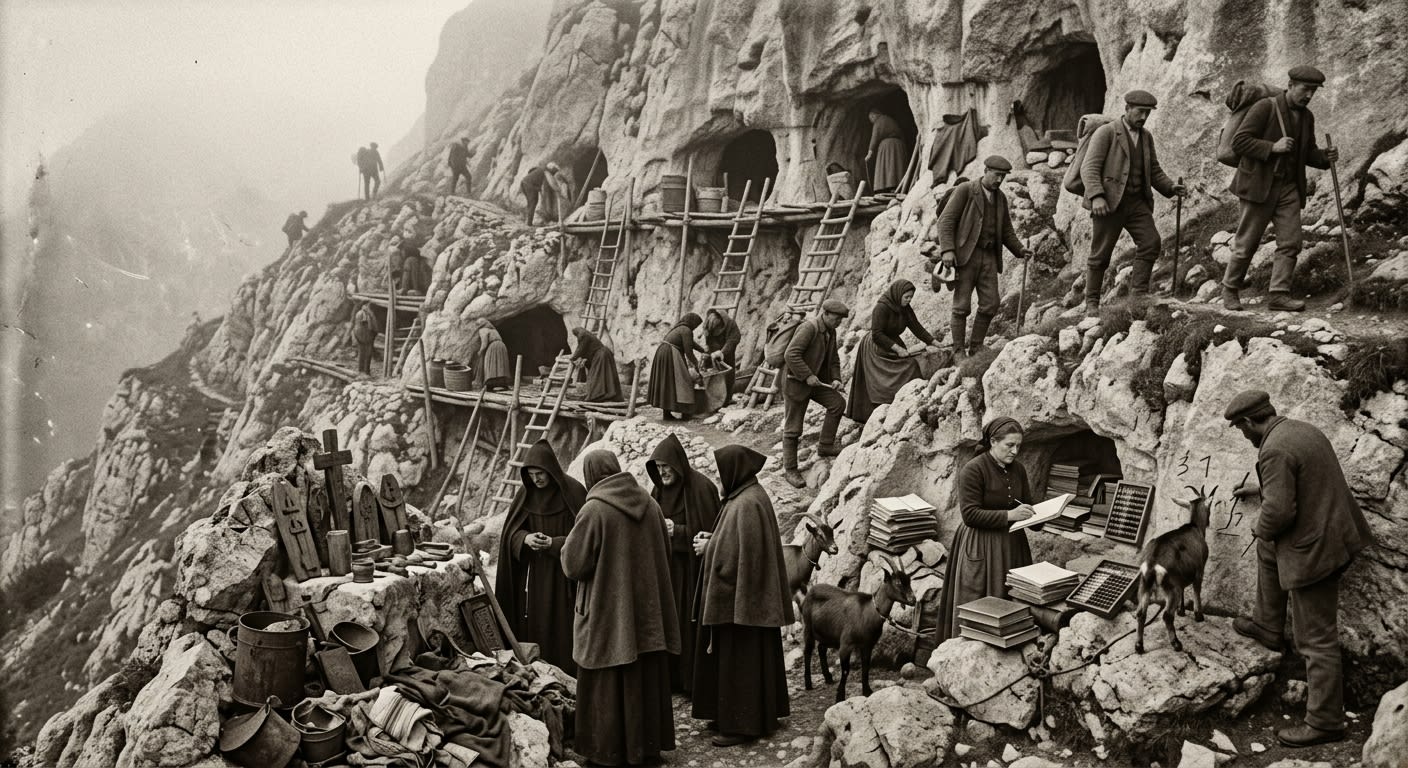
In Cologne they went below beer. In Lyon they went below bones. In Innsbruck they went above comfort.
The alpine cave communities formed higher than sense and lower than martyrdom, which is the narrow shelf on which most human courage actually lives. Families climbed beyond the last regular patrols into limestone mouths where smoke could betray a congregation, where snowmelt baptized infants with a violence no font would dare, where goat milk, root vegetables, and damp psalms kept bodies functioning at a level the Bureau of Medicine would later call survivable only because survivors remained available for questioning.
The Rationalists did not like altitude. Their pamphlets praised Nature in capitals; their patrols avoided Nature when it required wet boots. Natural philosophy remained strongest near coffee. This allowed the Innsbruck faithful to acquire a reputation for supernatural concealment when the truer explanation was sleet.
The caves preserved prayer without ornament. No organs. No painted vaults. No incense beyond the smell of people who had not washed properly since Michaelmas. A child learned catechism by mouth, not page, because pages could be seized and mouths could be made to lie only one at a time. The dead were buried in cairns whose crosses the wind erased within a season. That erasure saved them from the First Black Census more completely than any epitaph could have.
The Bureau of War has studied the cave rotations. This is one of those facts that should embarrass a civilisation and instead founds a training appendix. Watch was kept in six-person turns, prayer set by hand pressure rather than bell, ration distribution memorised by household need, silence drills imposed on children before they were trusted with fire. Later trench officers, having failed to produce discipline in men with boots and salaries, discovered that hungry mountain mothers had done it with hand-signs and cuffs.
An early Bureau of Doctrine teaching slate described the Innsbruck Cellar Saints as “fearless guardians of the mountain flame.”
Corrected. They were frightened, cold, hungry, and frequently furious with one another. Their merit lies in staying hidden anyway. Fear endured under discipline is better evidence than fear denied for ornament.
The last survivor of the Cellar Saints, Hilde Voss, entered the Innsbruck caves as an infant and died in A.S. 130 in a Bureau of Mercy hospice at Strasbourg. She still prayed under her breath after eighty-five years of legal safety. Mercy logged cause of death as age. Records added cause of life: faith. I admire the second notation despite its sentimentality, because sentimentality that accurate becomes evidence.
#On the Mountain Archive
Innsbruck preserved things because Innsbruck had places where objects could be inconvenient to find. The city became, during A.S. 30–45, a mountain archive without admitting the office. Chalices were pushed behind loose stones in goat cellars. Parish lists were rolled inside hollow broom handles. Icons were sealed behind plaster in rooms too smoky for Rationalist inspectors to enter without coughing like honest men. Bones went into cheese stores, where sanctity acquired the smell of rind.
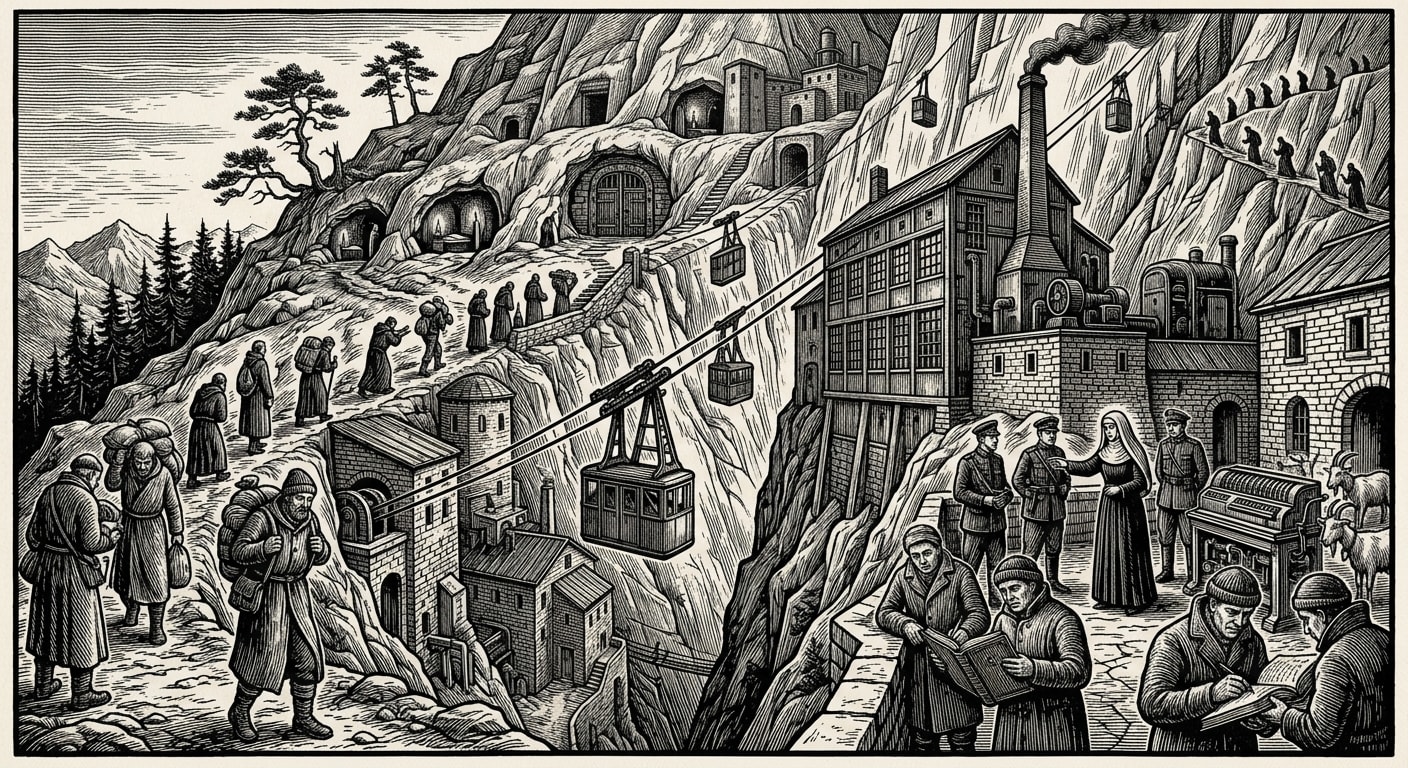
Relic preservation in Innsbruck lacked the grandeur of Father Ignatius carrying apostolic bones over the Rhine in a breadbasket. It had better storage discipline. The alpine communities learned to treat sacred objects like contraband livestock: fed by attention, moved before inspection, named only by household code. One cave register, recovered in A.S. 94 and filed under Relics with much muttering, lists a knuckle as “white pebble,” a martyr's tooth as “old bean,” and a strip of altar cloth as “winter rag, second shelf.” The Rationalists, finding such a list, would have seen poverty. The faithful saw inventory.
The Bureau of Relics has authenticated fewer Innsbruck objects than local devotion demands. This has produced the usual provincial sulking. Innsbruck believes itself under-credited, under-visited, under-cherished by Strasbourg, and insufficiently reimbursed for having survived exactly as long as it was required to survive. These complaints are spiritually ugly and administratively understandable.
Three Innsbruck relic disputes remain active as of A.S. 201. The first concerns the Snowmelt Pyx (Unregistered), a dented tin vessel said to have served as baptismal bowl for forty-one cave children between A.S. 31 and A.S. 44. Relics calls it devotional tin. Innsbruck calls it a font. The second concerns the Candle of Saint Velden (Unregistered), which has no flame left, no wick worth mentioning, and a following among widows that could fill a square if Purity were foolish enough to mock it publicly. The third concerns a goatskin satchel containing bone chips, chalk crosses, and a Rationalist checkpoint token bent into the shape of a fish. Records wants provenance. The mountain families answer with names buried under cairns. Both sides have been at this since A.S. 96. The satchel waits in a cupboard and gathers prayers faster than forms.
The mountain archive mattered after the Sundering. When the eastern world split open in A.S. 45 and the Rationalist Republic discovered that disbelief provides poor armour against claws, surviving relic chains became wartime supply. Not supply in the vulgar sense of grain, powder, boots, and nails, though the city managed those too. Supply in the older, stranger sense: sanctified matter, authenticated bone, scraps of cloth that made dying men stand another hour, bells too small for towers and perfect for carts.
Some of the relic streams feeding the Great Retreat passed through Innsbruck's hidden hands. Brother Tomislav's more famous reliquary path belongs elsewhere — Dalmatia, Zagreb (Unregistered), Kalnik Ridge, ash and light — but the alpine network helped teach the west what relic custodians had become. Custody was no longer a sacristan polishing silver. Custody was hunger, route discipline, false labels, and the willingness to let a sacred object look like trash until the proper hour.
#On the City After the Sundering
A.S. 45 did not redeem Innsbruck. Redemption is the word lazy catechists use when catastrophe happens to improve their argument. The Sundering made Innsbruck useful in a new direction. Refugees came through the passes with the eastern terror behind them and the old Rationalist offices collapsing around them. Republican functionaries tried to burn their own papers before mobs did it for them. Hidden priests came down from caves and found former inspectors asking for blessings with mouths that had once denounced blessing as civic infection.
The city accepted the reversal with alpine practicality. It sheltered, counted, fed, cheated, bartered, lied, prayed, and buried. It did not waste much time on forgiveness. Forgiveness is easier in warm climates.
In the decades that followed, Innsbruck became a transit hinge for western retreat, alpine provisioning, relic movement, and the awkward reappearance of families the Rationalist census had declared absent. Strasbourg's early agents found the city useful and irritating. Useful because its hidden networks could carry men, bones, and instructions without leaving straight lines on paper. Irritating because networks built for survival do not immediately become obedient simply because the victorious theologian has arrived with a stamp.
The old bridge over the Inn became the first contest. Proto-Bureau men wanted a checkpoint table and a declaration booth. The cave families wanted a prayer post, a bread table, and no clerk close enough to hear which names were spoken during reunions. For three weeks in A.S. 56 the bridge had both: a holy image at the west rail, a clerk at the east, bread in the middle, and arguments moving across it with such industry that the bridge earned its later nickname, the Little Concordat (Unregistered). No formal treaty survives. Three receipts do, all for nails.
The second contest was over bells. Rationalist meltings had left the city with small hidden bells, farm bells, chapel hand-bells, and one cracked bronze tongue recovered from a collapsed tower. Innsbruck wanted every recovered bell rehung according to local memory. Strasbourg wanted registry, dedication, ringing permissions, and proof no bell had acquired unlicensed significance during hiding. The dispute lasted until A.S. 71, when a storm broke two scaffoldings and flattened the registry tent. The locals called it judgement. Records called it weather damage. Bells were hung while the argument dried.
Augustinus drew allies from the Cellar Saint communities. Kratz drew instruments. Innsbruck gave both men less than they wanted and more than they deserved. Cave elders produced safe routes, testimony, buried registers, and memory. They withheld names. They had survived fifteen years by learning that a name, once given upward, seldom returns with all its limbs.
Post-Concordat school tablets once praised Innsbruck as “unhesitatingly submitted to Augustinian unity.”
Clarified. Innsbruck submitted in the manner of a cat placed in a chapel: visibly present, doctrinally claimed, privately prepared to leave by the window.
The Bureau of Records never forgave this texture of obedience. Records prefers cities that either resist cleanly or comply legibly. Innsbruck complied in fragments: one cave group surrendered names, another surrendered relic inventories, another surrendered only the dead, another surrendered a map so inaccurate it may have been devotional art. The resulting files remain hateful to read. Naturally, I read them.
The city's post-Concordat prosperity came from the same habit that made it suspect. It carried what needed carrying. Relics westward. Salt eastward. Pilgrims upward. Injured soldiers downward. Children sideways. Innsbruck learned to treat direction as confidential. A wagon leaving the market might serve Pilgrimage, Relics, Mercy, Conscription, a grandmother, or all five, depending on which bundle one had the authority to notice.
#On Mother Sava's Wall
The second sacred dishonesty of Innsbruck belongs to Mother Sava of the Ash Steps, though she came to the city by death rather than birth. In A.S. 154, after the Nursery Levy Decrees shortened the distance between infant breath and state seizure, Sava burned a parish registry and removed eleven infants from levy arithmetic. Purity hunted her for nine years. In A.S. 163, auditors found her bones in a wall-cavity in Innsbruck.
With her lay midwife shears, ash-ink tools, parish wax fragments, and eleven pairs of children's shoes. Worn. Outgrown. Mismatched.
The wall-cavity has done more damage to Conscription rhetoric than any pamphlet. A hidden child can be imagined dead. A stolen child can be imagined sold. A concealed infant can be imagined hoarded by some wicked old woman in a cellar for purposes suitable to sermon. An outgrown shoe refuses convenience. It says the foot lived beyond the file. Eleven outgrown shoes say the state measured too early.
INNSBRUCK RESIDENCE AUDIT, A.S. 163 — SUPPLEMENTARY NOTE Cavity depth: █████. Remains: adult female, probable Sava. Child remains: none. Shoes: eleven pairs, all worn, all outgrown. Additional mark scratched into interior plaster: █████████████. The examining clerk copied the mark twice and then swallowed the second copy. Cause recorded as devotional panic.
Purity sealed the site. The Pale Kin made it a reliquary by remembering it, which is the one consecration no Bureau has fully learned to forbid. Doctrine objected to both “den” and “reliquary” and settled on evidence site, that most damp-towel phrase, fit for men who fear poetry because poetry recruits faster than orders.
Innsbruck did not create Mother Sava's crime. It preserved her conclusion. The city that had once hidden saints above the treeline now hid the patron corpse of cradle resistance inside a wall, and then had the indecency to produce no children for Purity to confiscate from the cavity. Only shoes. Only proof that eleven bodies had walked elsewhere.
The residence itself was ordinary enough to offend symbolism. A pantry wall, a bricked recess, two floors above a cooper's shop, one alley from a licensed chapel, three doors from a baker whose records for that year remain suspiciously neat. No thunder. No secret altar. No circle of candles. The house had damp stairs, cracked plaster, and a roof that leaked toward the north gutter. Heresy prefers such rooms. Grand halls are watched by idiots who want promotion. Pantries are watched by women who know where the knives are kept.
Pilgrims now look for the house. The Bureau has altered the street numbers twice. The locals assist by giving correct directions in the wrong tense. “It stood there.” “It used to face that lane.” “My aunt remembered the lintel before the replacement.” In this way the site stays both known and unfound, a civic compromise of rare elegance.
#On the Pale Kin Uses of Innsbruck
Innsbruck became a teaching city for the Pale Kin Runner trade after the wall-cavity. The lesson was not sentimental. Sentiment kills routes. The lesson was operational: mountain cities can hide movement by making movement ordinary. Milk goes upward. Cheese goes downward. Laundry crosses lanes. Pilgrims arrive with bad knees. Goat boys enter houses no census clerk wants to smell. Winter guests sleep in rooms not listed for summer audit. A child becomes a cousin because every alpine household seems to possess one more cousin than paper can justify.
The Ward-Builders especially loved Innsbruck, insofar as people hunted by Purity permit themselves love for locations. Stranger placement thrives where strangers are already plausible. War, pilgrimage, seasonal labour, avalanche displacement, cave devotion, and transit trade made the city messy enough to shelter manufactured kinship. “The baker's sister's girl” could be from one valley over. “The widow's nephew” could have lost parents in a pass collapse. “The chapel brat” could belong to any saint with poor bookkeeping.
The method has local vocabulary. A snow cousin is a child explained by weather: trapped kin, delayed kin, kin whose parents perished in a pass no official wishes to inspect during thaw. A bell niece belongs, by story, to a dead ringer, cantor, or bell-rope family, useful because bell records are famously pious and famously filthy. A goat brother is attached to a herd before he is attached to a surname. These terms are not written. I write them here because the Bureau pays me to drag useful dirt into the light and then complains about the smell.
The Blood-Kin Purists distrusted the city. They prefer traceable cousins, family recipes, inherited names, and the dangerous comfort of resemblance. Innsbruck mocks resemblance. A child wrapped in wool, cheeks reddened by altitude, hair cut badly, accent borrowed from whatever kitchen fed him last, becomes a local fact faster than a family tree can object.
The Ash Registrars treasured the older cave precedent. If the Cellar Saints could preserve relics by relabeling bones as pebbles, a registrar could preserve a child by relabeling breath as stillbirth, cousin, orphan, kitchen nuisance, pageant extra, or the fifth goat-boy in a parish that officially employed three. Innsbruck taught them that paper fails best when reality is crowded.
The A.S. 178 Innsbruck Audit reclassified Pale Kin work from irritating domestic heresy to secondary priority. A single family was found to have concealed three sons for fourteen years. The sons were conscripted. The parents entered the Index. The midwife was displayed in an Iron Choir until silence became penitent. The Bureau revised its classification the next morning, proving again that arithmetic is the only angel Conscription hears clearly.
The audit also altered city habits. Shoemakers stopped keeping neat size progressions. Bakers began selling half-loaves in odd combinations. Schoolrooms accepted “temporary cousins” under parish courtesy clauses. Confessors developed a habit of coughing during questions about household numbers. The Bureau calls this adaptive evasion. The city calls it manners.
#On the Auditors and Their Failure
Auditing Innsbruck is a miserable vocation, excellent for improving mediocre officials. The city refuses flatness. A ledger likes rows. Innsbruck offers tiers: river street, market lane, chapel stair, loft room, upper pasture, cave path, avalanche shelf, side tunnel, bricked pantry, concealed cavity. The auditor climbs physically while descending morally. By the third day his calves ache and his sympathy begins to itch. Purity considers this a contamination risk.
Registry teams learned to count shoes, not children. Shoes betray growth, and growth betrays bodies. Milk tokens, bread rounds, school slates, blanket mending, goat purchase, cough syrup, laundry loads, chimney smoke, and the number of spoons washed after supper all entered the Innsbruck comparison tables. Records produced charts. Purity produced raids. The city produced explanations with the serene impudence of a grandmother holding flour on her hands and treason behind her stove.
The Order of the Root found Innsbruck offensive. Root men love hereditary lines, branching charts, cousin hooks, marriage loops, inheritance stains. Innsbruck gave them wards made from weather, cellars, cave godparents, borrowed surnames, and false grief. A Root examiner can pull at blood until his gloves split; the child he wants may be three streets away learning to churn butter under a name selected because the household dog answered to it.
The Bureau of Mercy made the usual noises about child welfare, which is Mercy's preferred method of arriving late with clean hands. Some Mercy kitchens sheltered hidden children, knowingly or with the blessed incompetence that makes charity difficult to prosecute. Some sold them. Some misplaced them into Orphanarii and then described the loss as administrative absorption. Innsbruck remembers the difference, but memory without stamps is only weather in the mouth.
Audit failure in Innsbruck rarely looks like failure. It looks like overwork. The clerk returns with pages full of names, houses, routes, milk tallies, shoemaker receipts, parish denials, cave shrine permissions, and enough marginal suspicion to choke a mule. His superior praises diligence. The contradiction hides inside abundance. Too much paper can conceal as effectively as too little. Innsbruck mastered that piety during the caves: give the hunter enough stones to count and he may forget the opening behind him.
The most successful raid in Innsbruck was also its most instructive failure. A.S. 188, Saint Oren's Market week (Unregistered): Purity sealed three lanes, counted forty-two households, recovered six unregistered minors, twelve false warding writs, two duplicated baptismal tokens, and a box of ash-ink nibs hidden in a flour bin. They missed the seventh child because she was standing in the open holding a goat and screaming at a boy who had stolen her ribbon. No one audits noise properly. The report praised operational thoroughness.
A later review faulted the raid for insufficient animal accounting. This is what failure does inside a Bureau: it grows a subcategory. By A.S. 191, Purity inspectors in Innsbruck were required to distinguish household goats, market goats, borrowed goats, and suspiciously affectionate goats. The manual runs twenty-six pages. It contains no useful definition of child.
#On the Present City
As of A.S. 201, Innsbruck remains pious, useful, watched, and unrepentantly difficult to flatten into a table. Its official churches commemorate the Cellar Saints with sanctioned hymns. Its back rooms remember Mother Sava with unsanctioned shoes. Its markets feed pilgrims, traders, auditors, ward children, and men with seals who would be less smug if the city did not sell such excellent sausages. The mountain caves receive licensed processions in summer and unlicensed visitors whenever snow, fog, or family grief provides cover.
The Bureau of Pilgrimage wants cleaner paths and better shrine receipts. The Bureau of Relics wants cave objects surrendered for authentication, by which it means capture. The Bureau of Records wants household lists reconciled with winter occupancy. The Bureau of Purity wants every wall measured. The Bureau of Conscription wants birth counts that do not blush when compared with boot purchases. The city wants the passes open, the goats healthy, the snow predictable, and the Bureaus gone by supper.
None of these desires will be satisfied. This is governance.
The sanctioned Innsbruck procession climbs each spring to the lower cave mouth (Unregistered), stops before the dangerous path begins, sings the Litany of Preserved Breath (Unregistered), and returns to town before weather can make theology too specific. Unofficial parties continue higher. They carry candles shielded in horn, bread, shoe tokens, and slips of paper bearing children's false names. The priests know. The guards know. The mountain knows and displays its usual mercy by saying nothing in a language bureaucrats can quote.
Innsbruck's danger is not rebellion in the theatrical sense. It has no banner worth confiscating, no manifesto good enough to burn twice, no charismatic fool standing in a square begging for martyrdom. Its danger is older. It teaches that hiding can be a civic habit, that survival can become tradition, that a cave method can become a nursery method, that a cellar discipline can become a ward route, that a city may kneel at Mass and still keep one child uncounted under the stair.
A Bureau of Conscription memorandum described Innsbruck's registry discrepancies as “residual alpine noncompliance.”
Corrected. Residual implies fading. Alpine implies geography is at fault. Noncompliance implies the city has failed to obey. The proper phrase is persistent devotional concealment under conditions of topographic assistance. It is less pretty and more expensive to print, which is why it is truer.
At dusk the Inn carries bell-sound along the valley. The bridges darken. Shop shutters close. Above the roofs, the cave paths pale before vanishing into stone. In one house a grandmother counts spoons loudly enough for the window. In another, a child practices an accent he will need if Purity visits. In a chapel, an authorised hymn praises the saints who hid underground. Behind the plaster of an inspected wall, someone has scratched eleven small soles into the lime and covered them before the dust settled.