
#On the Road That Learned to Sing
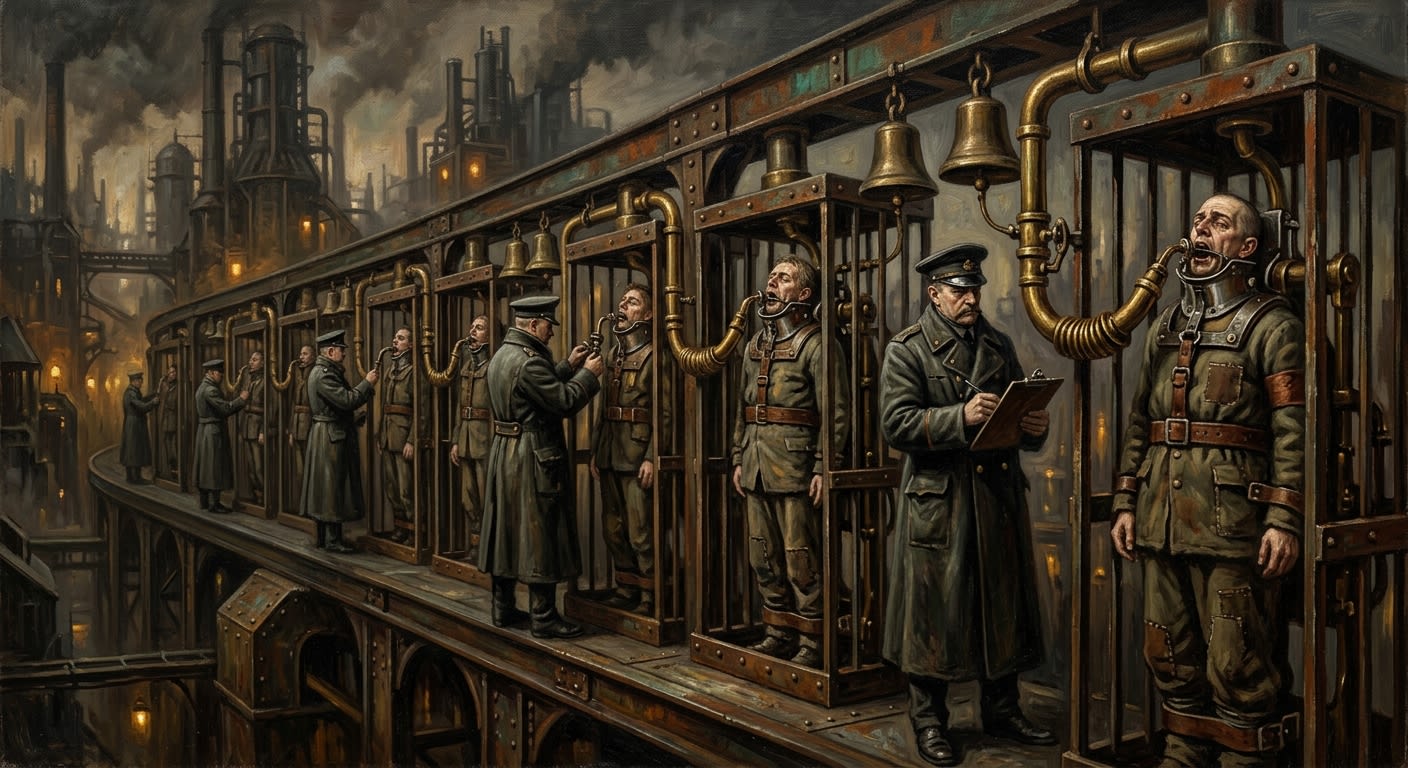
The Iron Choir of Mainz is a road, an instrument, a punishment, a schoolroom, a civic ulcer, and a magnificent answer to a question no merciful state would have asked: how long may a condemned throat continue serving Doctrine after judgement?
The answer, to the Bureau's delight, is longer than decency predicts.
It stands along the Mainz road to Strasbourg, where travellers pass beneath iron stanchions and see the cages hung in ordered ranks, some empty, some occupied, all rusted into that particular colour which bureaucrats call patina when they wish to avoid the word blood. The condemned are installed upright. Wrist-bells mark breathing when tongues fail. Throat-cuts are made shallow enough to permit hymn, deep enough to make hymn labour, exact enough to allow the Bureau of Records to deny accusations of waste.
The Choir does more than display bodies. A gibbet displays. A cage contains. A scaffold concludes. The Choir prolongs. Each condemned person becomes part of an acoustic schedule running from matins to compline, a public correction in which pain is held at pitch until the road itself acquires doctrine. Merchants lower their voices before Row Twelve. Pilgrim children count cages by parish. Bargemen approaching Mainz claim that on windless mornings the road hum reaches the Rhine before the city bells.
The Bureau of Orison and Song classifies that hum as residual liturgical resonance, Category Three, beneficial. Purity calls it penitential overflow. Doctrine calls it instruction. I call it Severian refusing to stop talking after death.
#On Severian's Diagnosis
No account of the Choir survives contact with honesty unless it begins with Severian's sentence over Mainz: This place is a single heretic body.
Lesser inquisitors hunt sinners by name. Severian opened the civic ledger and found organs. Parish as lung, market as stomach, bridge as throat, registry as memory, alley as vein, household as blood. He did not seek a culprit because culprit-hunting implied that the city possessed innocent tissue. Severian had no patience for consoling anatomy. If heresy moved through Mainz in many places, Mainz itself had become the body. A body may be corrected by incision.
The Correction proceeded parish by parish, street by street, guild by guild. Houses opened. Families separated according to doctrinal function. Confession chambers were tuned by borrowed psalmists before the Brand-Singer profession had hardened into licence, school, and throat inspection. Lictors burned records into flesh with a care that would shame most scribes. Records clerks followed with quills, because even horror requires a fair copy.
Civic primers formerly described the Mainz Correction as a sequence of unrelated prosecutions triggered by local Rationalist sympathies.
Corrected. The prosecutions formed one Purity operation under Severian's command. Public wording remains “sectoral correction.” The sealed appendix uses “systematic vivisection,” a phrase suppressed less for inaccuracy than for poor public manners.
Severian found ordinary punishments inefficient. A pyre consumes evidence. A beheading produces silence too quickly. A vanished prisoner teaches rumour, and rumour, being a drunk little clerk, files itself badly. He wanted a sentence that continued after trial, after branding, after civic usefulness, after hope. Mainz gave him bodies. Iron gave him grammar. The road gave him audience.
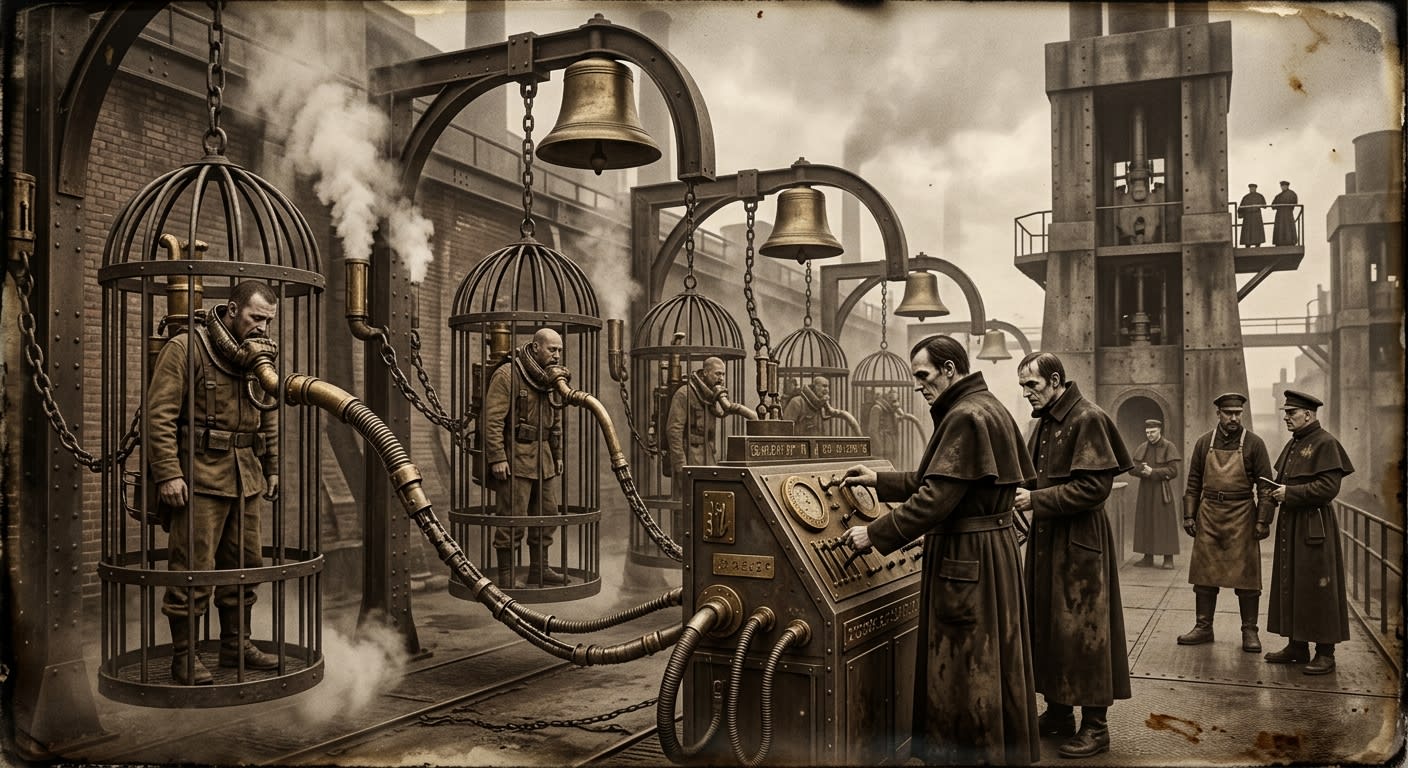
The first cages were raised beside the western approach, close enough to the toll path that no cart could pass without hearing the condemned breathe. Early sketches show crude suspension frames, blacksmith work reinforced with bridge-chain and confiscated guild iron. Later rows improved the design: throat rests, wrist-bell loops, drainage gutters, hymn slats, plaque hooks, cage-number plates, pitch markers, and small inspection ledges from which a Brand-Singer might lean close enough to judge whether a man still possessed useful tone.
The choice of iron was theological after the fact. Severian used what Mainz could supply quickly: bridge scrap, confiscated workshop stock, broken gate lattice, failed bell-collars, and the old civic chains removed from debtors when the debtors themselves became more useful as examples than as borrowers. Doctrine later declared the mixture symbolically perfect. Bridge iron for passage, gate iron for threshold, chain iron for obligation, bell iron for sound. I admire a Bureau that can find Providence in procurement leftovers. It saves money and looks eternal.
The Choir began as sentence. It became institution because institutions adore anything that repeats. By the third season, the road had forms, forms had deputies, deputies had grievances, and grievances had subcommittees. Sanctity followed at a respectful distance, wearing borrowed boots.
#On the Cage and Its Proper Occupant
A Choir cage is narrow by doctrine and cruel by measurement. The condemned stands with shoulders constrained, arms drawn forward or down according to inscription placement, head lifted by an iron collar that exposes the throat and prevents slumping before the day's assigned hymn cycle. The mouth remains free unless edited by prior Lictor action. Those whose tongues have been cut, nailed, pierced, burned, or rendered doctrinally untrustworthy are issued bells. This is called involuntary hymn.
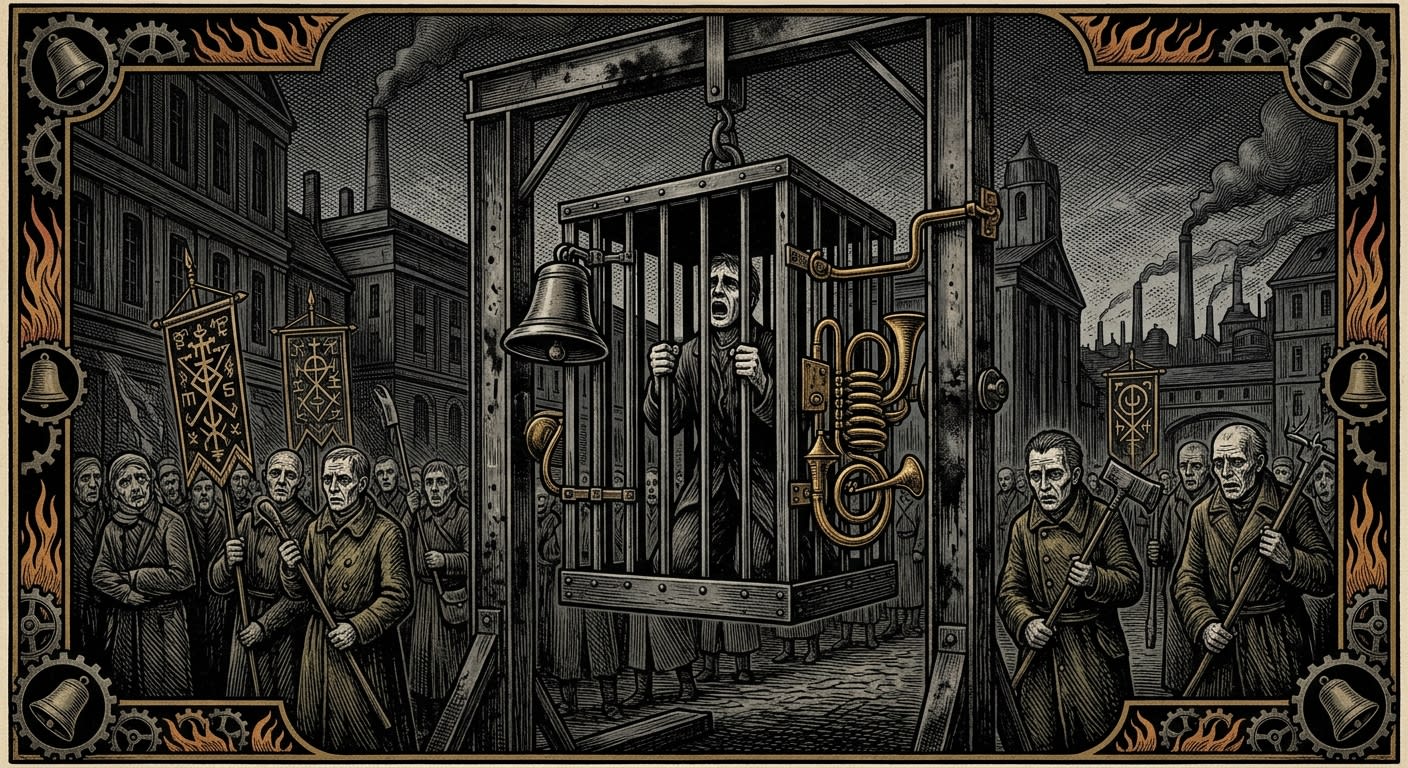
The throat-cut is the heart of the instrument. Too shallow, and the prisoner shouts. Too deep, and he dies before instruction matures. Too ragged, and pitch breaks into animal noise, which offends Orison auditors and gives children nightmares of the wrong sort. The cut must be made with anatomical humility and theological arrogance: enough wound to make voice costly, enough life to keep the cost public.
The Lictor supplies the body as text. The Brand-Singer supplies cadence. The cage supplies duration. Records supplies afterlife.
Condemned persons enter the Choir after branding, confession certification, and sentencing under Purity seal. Some arrive for explicit heresy. Some for refusal to denounce under Article 19. Some for forbidden words, unlicensed sheltering, Pale Kin concealment, Rationalist books, misreported births, failed cough compliance, or civic stubbornness given a better name by a clerk who wanted lunch. A midwife from the Innsbruck concealment case was displayed until her silence was judged penitent, which is to say until her body stopped disputing the schedule.
The arrival procession has its own small liturgy. The subject is brought at Third Peal in a covered cart, because Purity dislikes unscheduled spectacle competing with scheduled spectacle. A Records clerk reads the name, if the name remains permitted. A Lictor verifies the brand against the cage plaque. The Brand-Singer tests breath with a two-note prompt. The local witness officer counts bystanders, subtracts children too young to retain doctrine, adds pilgrims twice if foreign, and files the corrected audience. The body rises by pulley. The road receives another syllable.
Occupation lengths vary by offence, constitution, weather, Brand-Singer school, and whether Mercy has filed an objection loudly enough to annoy Purity. Mercy Tone prolongs. Judgment Tone accelerates. Silentists prefer less singing and more bell-work. Records prefers whatever produces the cleanest final notation. The condemned prefer nothing available to them.
The cages are never described as full. Fullness suggests a limit. Purity speaks instead of acoustic density, row usage, hymn coverage, and witness sufficiency. A row of empty cages may still be counted as active if the hum persists. A row of occupied cages may be judged deficient if tones decay below acceptable contrition. The Bureau rescues language from the vulgar grip of fact and sends the rescued thing to work.
#On the Brand-Singers and the Maintenance of Suffering
The Iron Choir Brand-Singer exists because screaming is imprecise.
Early Lictors discovered that flesh under iron thrashes, and thrashing ruins the inscription. Ruined inscription makes confession illegible. Illegible confession makes Records cross. Records, despite its pallor and dust, is terrifying when cross. The solution was sound: borrowed Orison psalmists first, licensed Brand-Singers after Writ 14-C in A.S. 104. A sustained note regulates breathing, slows convulsion, masks uncontrolled pain, and gives the iron a metronome by which guilt may enter skin without typographical embarrassment.
The Choir made those singers necessary after the rite. Branding is only the opening office. The cage is the long service.
Brand-Singers walk the road in grey vestments, notation boards under oilcloth, pitch-forks tucked into belts, throats scarred into professional gravel. They listen at each cage. They record tone decay. They alter hymn assignments when a condemned voice weakens from contrition into mere fluid. They replace the dead with newly branded subjects so that no row lapses into civic quiet. They tie bells to wrists. They tighten collar screws. They note weather effects. They report unsolicited harmonics under forms that tremble more than the singers do.
ACOUSTIC ANOMALY NOTICE — MAINZ ROAD, ROW ███ At Second Vespers, Cage ███ produced a responding fifth from an unoccupied cage. Brand-Singer instructed subject to cease. Subject replied: “I did.” Inspection found █████████████████████ in empty collar. Row retuned; witnesses reassigned; cage retained in service.
The Bureau of Orison and Song maintains the cages now, though it did not build them, a distinction Orison repeats with the injured dignity of an accomplice who only tuned the weapon. Orison classifies hum, corrosion, bell response, throat sustain, and those occasional intervals nobody wants to hear twice. Purity owns the sentence. Orison owns the sound. Records owns the forms. The condemned own nothing, which simplifies custody.
There are three Singer schools in common Choir service. Mercy Tone preserves breath and extends confession. Judgment Tone drives sharp cadence and brings the body swiftly to certified exhaustion. Silentists reduce the hymn to taps, bells, and shaped absence, claiming that too much sound invites whatever listens under the stone. Purity tolerates all three because rivalry produces useful reports. Bureaucracy thrives on quarrels that can be audited.
#On Witnesses, Children, and the Road as Schoolmaster
A punishment hidden in a cellar belongs to the accused. A punishment on a road belongs to everyone.
The Choir's placement was Severian's second genius. Mainz sits where Rhine traffic, pilgrim flow, bridge tolls, civic relic markets, and road traffic toward Strasbourg rub against one another under municipal supervision. To pass Mainz is to be counted. To pass the Choir is to be counted while listening. No sermon works so well as an unavoidable sound attached to visible consequences.
Pilgrim routes were adjusted so that catechism columns approached along the instructive side of the road. Children were marched past under the Little Witness Program, which increased confessional punctuality by sixty percent in Mainz according to Records. Mercy protested. Purity replied that children die daily in trench mud and might as well learn obedience while still in shoes. The Council of Veils ruled for obedience, as councils generally do when the alternative is admitting the children had a point.
The road teaches adults with less ceremony. Merchants time carts by vespers groans, then lie later and say they heard only bells. Bargemen claim the hum helps them judge fog. Soldiers on furlough laugh too loudly until they pass the cage where a former quartermaster hangs, his forearms written with ration fraud and his wrist-bell keeping better time than he ever did. Newly married couples walk faster. Widows do not look up. Clerks look up and pretend they are checking plate numbers.
Foreign pilgrims require special handling. Iberians cross themselves too loudly. Dutch merchants pretend curiosity, which is the least convincing of their national sins. British observers ask whether the installation is strictly necessary and then take notes with the appetite of men who will later call themselves appalled over dinner. The Bureau of Pilgrimage posts multilingual warnings: do not touch, do not sketch without permit, do not ask the condemned for commercial advice, do not answer if addressed in one's mother's voice. The last warning was added after the Speyer party (Unregistered).
The Choir has weather. In frost the cage chains contract and every row clicks like a roomful of teeth. In rain the throats clog and Brand-Singers must clear sound with vinegar, gauze, and small ecclesiastical lies. In summer the smell tests pilgrimage discipline more sharply than doctrine does. At night the hum sinks lower, or seems to, entering cart wheels and boot soles until the road itself appears to sing through the feet.
The road's seasons have entered local speech. A cold morning with brittle sound is called a Severian frost. A damp silence before rain is cage-weather. Children who refuse lessons are told they are making Row Eight faces. Bakers complain that overproofed dough has gone Choir-soft. The city has absorbed the installation the way flesh absorbs a splinter: redness, adaptation, permanent tenderness around the foreign thing.
Houses closest to the road have adapted. Windows face inward. Infants sleep through bells and wake at silence. Bakers knead at Matins because the first hymn tells them the hour. Tavern songs are forbidden within hearing range, though enforcement varies according to the tavern's tithe reliability. Several local families boast that their children can distinguish Mercy Tone from Judgment Tone before they can read. Mainz calls this civic refinement. Other cities call it Mainz.
#On Jurisdiction and the Sweet Rot of Shared Ownership
The Choir belongs to everyone who wishes to avoid sole blame.
Purity claims authorship through Severian, Lictor procedure, confession authority, and custody of the condemned. Orison claims maintenance authority over sound, cage-hum, bell schedules, Brand-Singer licensing, and acoustic anomaly routing. Records owns numbering, death certification, row histories, witness tallies, and the afterlife of every name once the body stops making itself administratively interesting. Doctrine owns interpretive meaning. Mercy owns objections. Tithes owns replacement-chain procurement whenever it can sneak a fee into the matter. Pilgrimage owns route notices and warning placards. Mainz owns the smell.
This shared custody produces meetings of rare beauty.
The Row Nine Retuning Conference (Unregistered) lasted six days and settled nothing except seating precedence. Purity demanded louder contrition. Orison demanded lower strain. Records demanded that cage numbers be sung at inspection so clerks could reconcile sound and subject without climbing ladders. Mercy demanded shade awnings for summer. Tithes demanded shade awning valuation rights. Mainz demanded reimbursement for gutter cleaning. Doctrine concluded the meeting by issuing a memorandum declaring all parties mutually obedient. The row was retuned at midnight by a Brand-Singer who had attended none of it.
The largest dispute concerns silence. Purity regards silence as failure unless silence has been sentenced. Orison regards silence as interval. Records regards silence as a blank field requiring explanation. Doctrine regards silence as a useful reservoir of future meaning. The cages, being iron and wiser than the attending officials, creak.
There are scheduled silences, of course. Fourteen heartbeats after Closing Tone. Seven breaths after a subject dies before the bell is removed. One full peal during certain feast-day processions so that the absence of the Choir may be noticed as sharply as its sound. Unscheduled silence triggers inspection. A cage row that falls quiet without authorisation receives Brand-Singer review, Lictor verification, Records exception form, Orison resonance test, and Purity suspicion by default. If all else fails, Doctrine issues a short statement explaining that the silence was interior hymn under disputed acoustics.
Money enters, because money enters every wound. Cage iron must be replaced. Bells crack. Collar hinges seize. Vinegar, gauze, throat oil, crow-nets, witness rails, pilgrim barriers, inspection lamps, and winter gloves all require purchase orders. The Bureau of Tithes once attempted to classify the Choir as revenue-generating pilgrimage infrastructure. Purity replied with a memorandum containing one sentence: “Touch the cages and be corrected.” Tithes withdrew, then billed the withdrawal under consultative restraint.
Travel advisories once described the Iron Choir as “decorative penitential architecture.”
Withdrawn after three pilgrims slept beneath Row Fourteen and woke reciting severance clauses in Severian's voice. Approved wording: “active acoustic correction installation; distance recommended.” The pilgrims were examined, corrected, and billed for lodging.
The Choir also raises the Judge problem, which Purity hates and Records files anyway. Severian's disputed death, the blank iron mask at the gate, the bones attributed to him rattling without wind, the theory that certain inquisitors burn through office into something masked and worse: all of it clings to the Choir like soot in a chapel vault. Purity denies. Doctrine narrows. Records preserves contradictions under locked headings. The cage with Severian's alleged bones receives more maintenance than several hospitals.
#On Failures, Harmonics, and the Cage That Answers
No instrument this cruel remains obedient forever.
The Choir's failures fall into categories, because Categories are how fear wears trousers in the Bureau. Structural failure: chain, stanchion, collar, hinge, plate, or cage gives way. Biological failure: subject dies early, survives too long, loses pitch, refuses food, swells, rots, bites through restraint, prays in an unapproved cadence. Acoustic failure: row hum shifts, bells synchronise without prompt, empty cage responds, Brand-Singer hears second voice, witnesses report words not present in the assigned hymn. Administrative failure: the wrong person hangs in the correct cage, which is easier to correct than the reverse.
One decommissioned Choir installation—location and year sealed beyond my present irritation—collapsed after branded prisoners achieved a resonance frequency that brought down the adjacent nave supports. Records called it an act of architectural piety. Survivors were rebranded. Engineers were consulted, blamed, thanked, and blamed again in the proper order.
Mainz has smaller failures too, the kind that never reach doctrine because the local clerks possess brooms. A cage bell comes loose and rolls into the road, ringing until a toll officer traps it beneath his boot. A subject dies with a note still in his throat, producing a soft whistle whenever carts pass. A Brand-Singer miscounts after three sleepless nights and assigns a Judgment cadence to a Mercy row; six bodies expire before breakfast and the paperwork describes the event as morning efficiency. One apprentice writes “beautiful” in the margin of a pitch log and is reassigned to latrine absolutions for sentimentality.
DECOMMISSIONED CHOIR FILE — CROSS-BUREAU SEALED Number of cages: ███ Initiating tone: ███████████ Brand-Singer status: harmonised / missing / not personnel Structural result: nave collapse inward, no bell-peal recorded Recovered phrase from three witnesses: “The room has learned the hymn.” Disposition: survivors rebranded; site paved; maps corrected.
Echo weather remains the singers' private terror. A Brand-Singer begins the Opening Hymn and the cage row returns it half a beat late, harmonised by no living throat. Or a dead subject's bell rings before wind reaches the row. Or an empty cage sustains Mercy Tone with the exact scar-voice of a woman retired two winters earlier. Or a child in the witness column answers the Choir in a language last filed under the Index Damnatus. Each event receives a name suitable for the shelf and a remedy unsuitable for sleep.
Purity insists these anomalies prove the Choir's spiritual potency. Orison insists sound behaves strangely around old iron, pain, bells, and bad stone. Doctrine insists the distinction is beneath public instruction. I insist that when an empty cage sings, the wise man steps away from the road and lets the Bureaus admire their vocabulary at a safe distance.
#On the Present Choir
As of A.S. 201, the Iron Choir remains active, maintained, audited, denied in excess, visited in rotation, avoided with discipline, and loved by no one sane. It remains Mainz's masterpiece and accusation. The city sells pilgrim tokens stamped with Augustinus, Hildegarde, Casselius, and the Cracked Bell. It does not stamp the Choir. Some monuments advertise themselves. Others advertise everything around them by making silence impossible.
The rows are inspected at First Peal. Brand-Singers walk before breakfast. Orison technicians check bell-cords, collar resonance, stanchion stress, throat humidity, and crow interference. Records clerks reconcile cage numbers with subject names, subject names with sentence codes, sentence codes with doctrinal categories, and doctrinal categories with whatever Purity has decided this week counts as sheltering. Lictors arrive when a body needs revision. Mercy arrives when a body should have died yesterday and has made the ledger untidy by continuing.
The Choir receives fewer mass installations now than in Severian's day. Modern Purity has subtler instruments: Article 19 referrals, White-Mantled dawn interviews, Classification Amber watches, Penitential Shadow removals, household listening cards, child denunciation primers. Public cages are expensive. Chains rust. Witnesses faint. Pilgrims complain. A good state must economize terror without impoverishing it.
Still, the Choir endures because some lessons require iron.
The latest inspection, A.S. 200, classified Row Three as structurally devout, Row Seven as acoustically fatigued, Row Fourteen as spiritually active under watch, and Row Twenty-One as “useful despite smell.” I treasure that last phrase. It could serve as Mainz's civic motto, Purity's budget defence, or my own epitaph should the Bureau ever become honest about the conditions under which prose is produced.
At dusk the road changes its register. Wheels slow. The Rhine damp rises. Mainz bells begin their authorised quarrel with the cage-row hum. A Brand-Singer lifts her pitch-fork and taps stone three times. The first condemned voice enters, thin as wire and wet as confession. A second follows. A bell answers for a man with no tongue. Somewhere near Row Fourteen, an empty cage creaks in sympathy and every official present pretends the sound was wind.
The traveller lowers his head. The child beside him counts anyway. The clerk makes a mark. The city breathes through iron.
After Compline, when authorised visitors have gone and maintenance men walk with lamps held low, the Choir loses its public manners. Chains mutter. Bells click in their sleep. The living subjects dream aloud in scraps of catechism. The dead settle against collars with the small administrative sigh of files being closed. The road cools. Strasbourg waits at the far end, clean on its hill of paper, pretending the sound does not arrive before dawn.
I once asked a cage-maintainer how long the Choir would last. He had one eye, two missing fingers, and the serene face of a man paid badly enough to know state secrets by accident. He spat into the road, listened to Row Seven answer the wet sound with a bell-click, and said: “Until they find something cheaper that sings.” A profound theologian, that man. Naturally, nobody has promoted him.