
#On the Law That Reached Into the Cradle
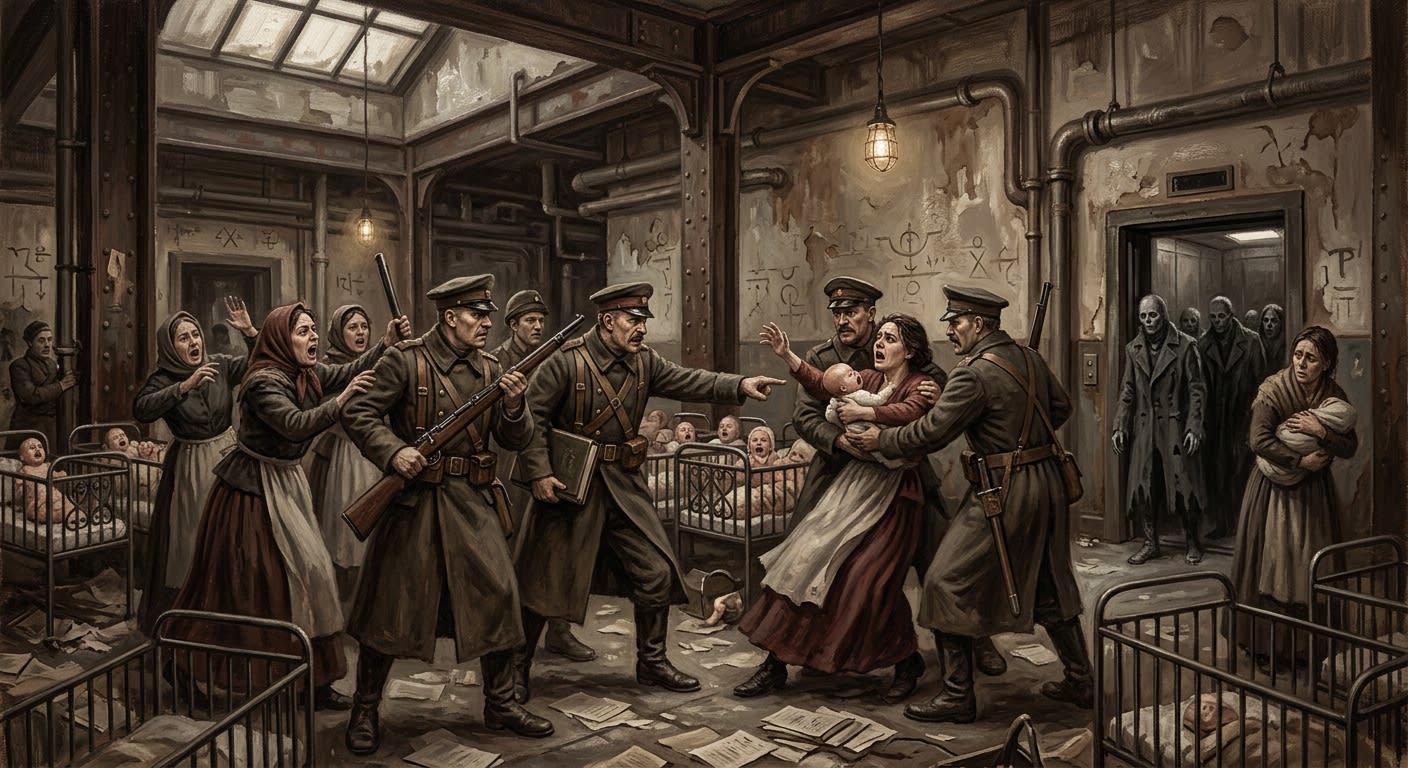
The Nursery Levy Decrees of A.S. 152 were written in the language of forecast, filed under infant registration, defended as a clerical correction, and experienced by mothers as an armed man entering the birth-room before the blood had cooled.
Before the Decrees, full infant registration was required within one calendar month. This was not kindness. Let no sentimental reader scratch mercy into the margin where procedure belongs. The older rule existed because roads washed out, priests became drunk, mothers died, babies died, clerks lost keys, midwives argued with weather, and parish life contained enough mud to clog even the Synod’s appetite. A month permitted error to be digested by the file.
A.S. 152 ended that softness.
The Bureau of Conscription declared the month-long window a forecasting deficit. Thirty days of unregistered life meant thirty days during which a future soldier, labourer, tithe-payer, ward, or famine statistic existed outside projected obligation. The Bureau had recently improved its levy tables. Improved tables require improved victims. So the cradle was brought nearer to the desk.
#On the Seventy-Two Hours
Seventy-two hours is a tidy number, and tidy numbers should be beaten before they enter law.
Three days: enough for the mother to stop shaking, if the birth was gentle; enough for fever to declare itself, if the room was dirty; enough for the midwife to wash linen, boil shears, lie to the husband, bury the twin who did not breathe, and decide whether the living child would survive the next night. The Bureau saw the same span and found an intake window.
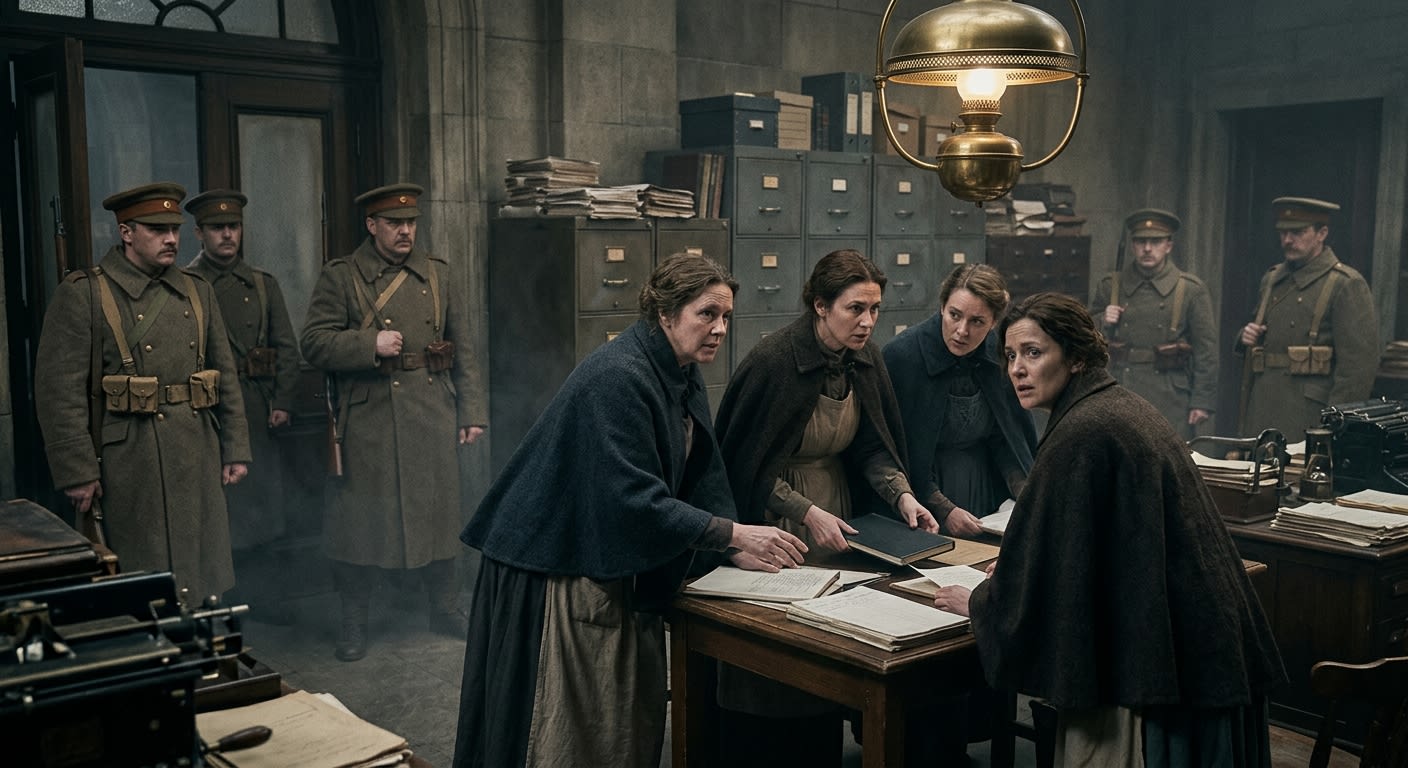
Under the Decrees, midwives were required to file preliminary birth-notices within twelve hours. Parish registrars received authority to enter homes where birth had been reported and registration had not followed. Failure to register moved from administrative neglect to active heresy. The official theology was simple enough to teach to stupid men: concealing a soul from the Great Ledger of Souls concealed it from the Creator’s sight; what the Creator could not see, the Enemy might claim.
An instructional sermon of A.S. 153 stated that the Decrees “protected infants from demonic predation by ensuring swift spiritual visibility.”
Corrected for doctrinal hygiene: the Decrees ensured swift administrative visibility. Spiritual benefits remain asserted, unmeasured, and convenient.
The stamp came first. Name, sex, weight, parish of origin, mother’s confession status, father’s levy eligibility, projected nutritional obligation, preliminary labour category, baptismal appointment, and mortality expectation. The infant became a number. The number became a line in a table. The table became a requisition fourteen years later, unless hunger, fever, flight, fraud, or the Creator’s private mercy intervened.
This was called care.
#On the Men Who Entered
The armed registry teams were the Decrees’ true face.
The first teams were almost comic in their uncertainty: one registrar with a leather case; one parish verger carrying baptism cords; one Conscription assistant with intake weights; two guards pretending not to look at the bed. Comedy ended quickly. A birth-room does not welcome boots. Men accustomed to barracks discovered that women in labour do not salute. Midwives discovered that a man holding a writ can be delayed by soup, tears, wrong stairways, missing candles, false bleeding, locked doors, angry grandmothers, and the old universal weapon of domestic government: everybody speaking at once.
The Bureau responded with checklists.
Hostile household density. I pause there because admiration demands its due. Some clerk, faced with a room of furious women, crying babies, aunties built like siege engines, and a grandmother calling down saints in a dialect older than Strasbourg’s patience, wrote “hostile household density” and went home proud. The phrase survived review. Of course it did. The Bureau recognizes kinship only after translating it into a threat map.
#On the Midwives’ Revolt
The midwives understood before the priests.
Priests saw sacramental urgency. Conscription saw numbers. Records saw a form. Midwives saw the first stamp arrive too soon. They saw mothers asked for names while still biting cloth. They saw registrars touch infants with ink-cold fingers. They saw weak children entered into future obligation before anyone knew whether breath had agreed to remain.
Some obeyed. Many obeyed. The Synod remains standing because most people obey most of the time, and because disobedience is tiring when the baby is hungry.
A handful began to lie.
They delayed birth reports by claiming the labour was false. They filed stillbirth notations for children moved through laundry doors. They taught mothers to rehearse fever stories. They hid cord-blood linen under ash. They paid ossuary men for infant burial tags. They learned which clerks were lazy, which guards were embarrassed, which priests would prefer a quiet falsehood to a public scandal in the women’s rooms.
BUREAU OF PURITY — EARLY NURSERY ENFORCEMENT SUMMARY, A.S. 153 Irregularities detected in ███ parishes. Midwife refusals: ███. False stillbirth cluster: █████████. Household obstruction incidents: █████. Recommendation: exemplary prosecution of three midwives per district; seizure authority for infants pending doctrinal review; public use of term ███████████ discontinued after street disturbance.
By A.S. 154, Mother Sava of the Ash Steps burned her parish registry and vanished with eleven infants. The Bureau has spent half a century insisting that Sava was an aberration. This is a lie told by institutions frightened by their own cause-and-effect. The Decrees created the conditions. Sava merely supplied the flame.
#On the Birth of the Pale Kin Runner
The Pale Kin Runner emerged within two years of the Decrees because the law compressed the distance between womb and Ledger until a new profession had room to stand there.
Every element of the later trade appears in embryo during the first enforcement cycle. The Bundle-Carrier answered the armed threshold. The Seal-Swapper answered the seventy-two-hour clock. The Route-Keeper answered registry patrol patterns. The Cradle Broker answered the terrible question of where a child could go after the mother’s room ceased to be safe. The Ash Registrar answered the deeper truth: no flesh escape survives if the file remains obedient.
Bureau of Conscription histories describe the Pale Kin as “pre-existing criminal elements exploiting compassionate legislation.”
Corrected: the criminal elements were summoned by the legislation, trained by its pressures, and refined by its punishments. Compassion was present only as a rumour, probably smuggled in by a midwife.
The Decrees also gave the movement its internal fractures. Blood-Kin Purists insisted that a child removed from the Ledger must be returned to blood. Ward-Builders placed children with strangers whose loyalty had been purchased by shared crime. Ash Registrars argued that the documentary void mattered before any household did. These factions did not arise from philosophical leisure. They arose from rooms where a registrar was already on the stair.
#On the Theology of Stolen Soldiers
The Bureau’s public phrase for an unregistered child became “stolen soldier.”
This formulation is vile, efficient, and durable in the way bad iron is durable: ugly, useful, hard to bend. It converts infancy into desertion in advance. A child hidden at three days old is not a baby protected from a predatory state; he is a future rifle removed from inventory, a future trench-hand subtracted from the Line, a future ration calculation damaged by maternal selfishness. The mother becomes accessory to a theft whose victim is the Synod.
The sermon form wrote itself. No uncounted souls. No hidden cradles. No private mercy against public survival. The Sagittal Line requires bodies; every body begins as a birth; every birth must enter the Ledger before private affection corrupts public duty.
A neat doctrine. A monstrous one. Neatness often is.
The phrase “stolen soldier” did more than justify enforcement. It created suspicion around mothers themselves. A woman who delayed naming became suspect. A midwife with too many quiet rooms became suspect. A family whose stillbirth grief lacked the correct public shape became suspect. The Decrees made maternity legible to the state by making it hostile to the state.
#On Enforcement and Its Arithmetic
The Decrees failed by succeeding.
Registration compliance rose. Conscription forecasts improved. Milk ration planning tightened. Orphanarium intake projections became more accurate. The Bureau of Records praised “increased cradle legibility” in A.S. 155, a phrase that should be locked in a reliquary of bad conscience.
At the same time, stillbirth anomalies rose, midwife prosecutions multiplied, parish fires increased, wet-nurse token fraud developed new artistry, and Purity found itself dragged into rooms where every victory looked like a soldier pointing a rifle at a cradle. The Bureau does not mind cruelty. It dislikes inefficient spectacle. Nursery enforcement produced too much spectacle.
By A.S. 178, the Innsbruck Audit revealed a family that had concealed three sons for fourteen years, which proved both that the enforcement regime could be beaten and that beating it merely postponed the Line. The sons were conscripted. The parents entered the Index Damnatus. The midwife died in an iron choir. Purity upgraded the Pale Kin priority classification the next morning. Arithmetic had spoken, and arithmetic, being heartless, believed itself profound.
#On the Present Condition
As of A.S. 201, the Nursery Levy Decrees remain in force. Of course they do. Laws that produce both numbers and enemies are beloved by every Bureau: numbers justify funding, enemies justify authority, and children, lacking votes, rarely file objections in triplicate.
The registration clock still begins at emergence. Preliminary notice within twelve hours. Full writ within seventy-two. Registrar entry authority remains active. Failure to register remains doctrinally charged as concealment. The language has softened in districts where riots taught manners; the practice has not. “Assisted natal filing” replaced “armed entry” on placards. Guards now stand outside more often than beside the bed. This is called reform.
The Decrees have produced fifty years of compliance, evasion, prosecutions, forged stillbirths, hidden children, ruined midwives, and files whose margins smell faintly of milk no matter how often Records sands the page. Their defenders point to levy stability. Their enemies point to the Pale Kin. Both are correct. The law did what it was built to do.
It counted the cradle.
The cradle learned to lie.