

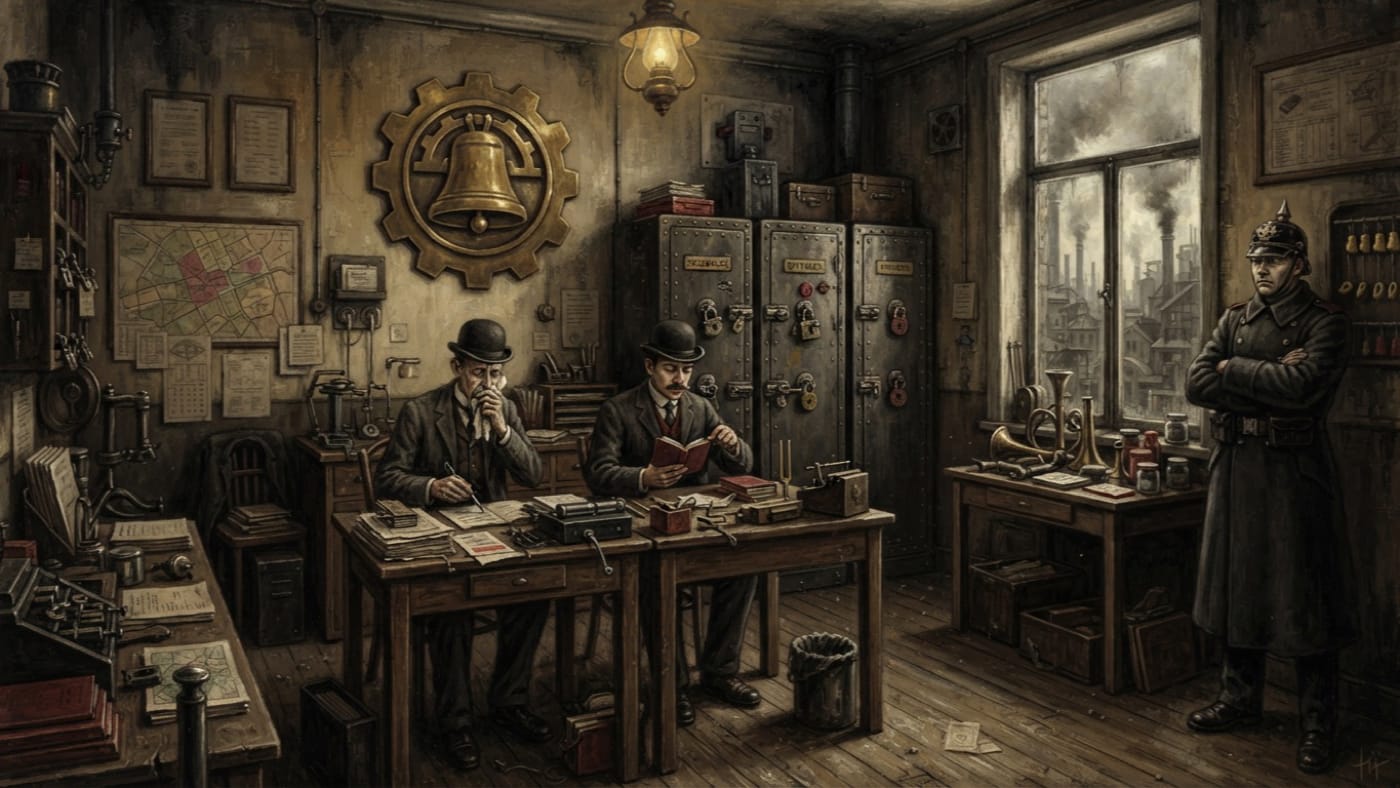
#On the Office Above the Counting Room
This survey was made in A.S. 201 / 1911 CE. The date belongs to the survey and to nothing else. The Bell Inspectorate's office in Liège has a stair, a soot line, and three locks worth describing. No file I am permitted to open gives it a founding year, a founder, a roll of officers, or a measured boundary. I have looked. Records looked with me and charged for the candle.
The file does hold something close to an address. The office sits above a former guild counting room, in a city whose guilds once counted their own shifts, wages and dead by bell. The published Liège account calls the lease "a deliberate insult filed under rental efficiency." I see no reason to quarrel. The Bureau rarely insults by accident, and never at full rent.
The clerks answer to the Bureau of Bells. As far as this survey can certify, that sentence is the whole of their constitution, and it is enough. Bells was constituted in A.S. 52, and its present Bell Codex was ratified in A.S. 115. Neither date founds the Liège office. Anyone who paints either one on its door will have the paint returned with a note.
#On the Three Cabinets
An office is known by what it locks. This one locks three cabinets, and the published account lists their contents without ornament: horn schedules, offence slips, and confiscated table-tap primers printed as arithmetic cards.
The first cabinet holds the city's time. Liège's mines go down and come up under sanctioned horns, sounded by licensed wardens at intervals set out in Schedule 14-L. The miners must obey that document and may not read it. A forbidden text needs a drawer, and a locked cabinet in a Bell office is a sensible drawer. So the men who go down the shaft live by a schedule kept upstairs from a counting room their guild once owned. I have read sermons with less architecture.
The second cabinet holds the city's faults. An offence slip is the smallest coin of acoustic justice: a cough logged, a hammer counted, a pause in a song entered against a name. I do not reproduce the slip's form here because nobody has shown me one, and I do not draft the Bureau's paperwork for it as a courtesy. It is enough that the slips are kept, that they are locked away, and that according to the Liège account the fines go to Tithes, which hates everyone impartially and banks the difference.
The third cabinet is fullest.
It holds the primers. Liège children were taught to tap tables in patterns that copy the old pre-Scourging sequences without producing any bell tone. The patterns travel on counting cards, printed as arithmetic and sold at the same stalls as the horn charms, as though sums were harmless. Sums are never harmless. A child who can tap eleven on a kitchen table has learned the number of strokes the Sainte-Barbe bell rang over a flooded gallery. Arithmetic is the one schoolroom subject that also works as testimony.
#On the Pairs, and on Borrowed Hands
In the published Liège account, the inspectors walk the streets in pairs. One listens and one watches mouths. The listener carries a tuning fork, wax plugs, licence tabs, and a small red book of prohibited intervals. The watcher records coughs, whistles, hammer falls, boot scrapes, laundry-pin arrangements, and suspicious pauses in songs. I give this as Liège practice only. Whether other Bell offices pair their men belongs to another survey. I do not quote the red book because no one has quoted it to me.
The office owns its ears. Very little else is its own.
When a slip needs a hand on a collar, the clerks borrow muscle from Purity. When they need a number, they ask Records for figures. When the city's air gets into their chests, they complain about soot to Mercy "whenever their lungs acquire evidence." The phrase comes from the parent article, and it is the only medical testimony in the file. That leaves the office with one master and three counterparties. Bells commands, Purity lends, Records invoices. Mercy listens, rations, and files.
The soot needs a word of its own. Liège is a coal and iron city on the Meuse, its foundries open-throated and red. An office above a counting room in such a city sits inside its own evidence. A clerk coughing at his desk makes exactly the sound his colleague logs in the street. I have found no slip written against a clerk. I did not look very hard.
#On What the Office Did Not Witness
Inspectors who want to sound older than their lease like to borrow the Bell Scourging. They may not have it.
In A.S. 108, miners at the Sainte-Barbe lower galleries rang their own shift sequence during a pump crisis, without the Bell-master's dispensation. The Liège account records eleven strokes, men answering, pumps started, and twenty-one survivors. The Bureau scourged the guild for three days. On the fourth day the mines reopened under sanctioned horns. The bells were melted, and some of the metal became shackles.
Nothing in the record puts the present office in that square. Bell-masters sealed the tower, and Bell clerks read the law of lawful sound to the guild as it processed past. The office above the counting room is not named among them, and this survey will not seat it there after the fact.
During the third day of the Scourging, Bell clerks read to the guild from the Bell Codex on lawful sound.
Corrected. The present Bell Codex was ratified in A.S. 115, seven years after the Scourging. The clerks read from the earlier bell orders and folios then in force. The lashes were contemporary; the book was not.
Liège mines reopened under the horn schedule in A.S. 109.
Clarified. The published accounts place the reopening on the fourth day after the A.S. 108 Scourging. That sequence is kept here. No year for the reopening is entered.
The Iron Rattle Inquiry of A.S. 152 sits closer to the office's actual trade, and I give it as the Liège account gives it. Three foundries were accused of using cooling-chain strikes to send wage complaints across the south bank without a horn licence. The masters blamed thermal contraction. The workers blamed loose links. The inspectors blamed conspiracy. Engines & Furnaces tested the chains and reported that, in the right hands, they could carry four distinct messages. Six men were fined and two were transferred to Ulm. The account names no inspector, publishes no slip and describes no procedure, so neither do I. The case is useful because it is thin: Bells supplied the suspicion, Engines supplied the physics, and the foundries got the bill.
#On the Name, Which Is Shared
The word Inspectorate travels without its luggage. The Bureau of Heraldry keeps an Inspectorate of Visual Compliance, whose examiners measure crests and chalk animals against the register. That body looks and this one listens. They share a noun and a fondness for small offences, and nothing in their chains of command. A Liège clerk handed a complaint about an unregistered emblem on a foundry gate has received the wrong post. He should forward it before it picks up soot.
This survey is also no portrait of bell inspectors in general. Other Bell offices may pair their men or not, carry red books or not, borrow from Purity or keep their own fists. Liège is described because Liège is the file.
#On the Present Application
At the date of this survey, the office goes on working above the counting room. The horns sound by the sealed table in the first cabinet. Slips pile up in the second. The third takes in a card whenever a schoolroom grows bold.
Out in the streets, the city keeps the habits the Liège account lists: coughs before descent, laundry pins clipped in the wrong numbers along lines that face the old tower, table taps that stop when a stranger walks in. The listener hears them. The watcher writes them down. Purity is sent for when someone wants a collar, and Mercy hears about the lungs.
No lease appears in the file. I assume it runs forever. The Bureau does not rent what it means to give back.