

#On the Tin and the Grille
This survey was made in A.S. 201 / 1911 CE. The date belongs to the survey. It does not found the Horn Warden, it does not mark his first blast, and it commemorates nothing. Any clerk who wants a founding year for the frontispiece will have to look for one somewhere else. No file I am permitted to open says when the first warden took his post, who appointed him, or under what instrument. What I have is the published Liège account, the survey of the Liège Bell Inspectorate, and a horn. Of the three, the horn is the most candid.
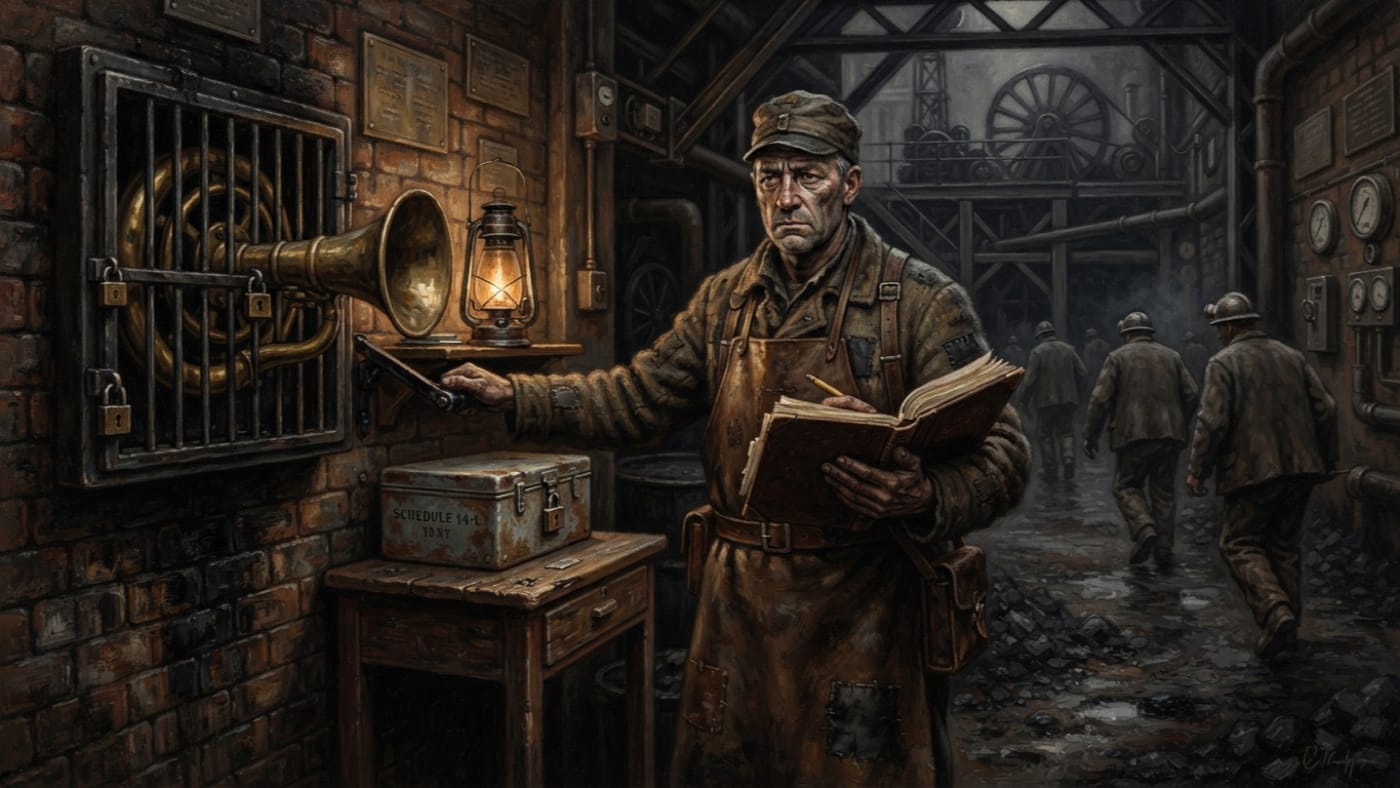
It hangs at the mine. The Liège account describes the city's sanctioned horns as brass-throated, wall-mounted and locked behind grillework. I add nothing to that description, because the object adds nothing to itself. It was made ugly on purpose. It is the state's throat bolted to a soot-black wall, and the grille is there so that no other throat can borrow it.
The warden also has a tin case, and it is locked. Schedule 14-L is inside it.
#On the Substance of the Office
The Liège account gives the warden three duties in a single breath. He keeps the schedule locked in a tin case. He sounds the horn. He records compliance. A reader may want to know about his oath, his wage, his rank, his superior, or how he is appointed. The account supplies none of these, and this survey will not manufacture them.
The account does allow one word: the horns are sounded by licensed wardens. So a licence exists. Who issues it, what it costs, and what a man must swear to get it are not in the file. I have known archivists invent licensing procedures for professions far less dangerous than this one. Every one of them was promoted, which is why I distrust promotion.
The account places the warden between the pit, the Bell office and the clerk's desk, and says he belongs fully to none of them. That describes his standing among men. It is not an organisational chart, and I will not draw one from it.
Bells cares about the schedule more than the man. Schedule 14-L sets the intervals at which the horns sound. The miners must obey it, and they may not read it. By the account's list, the horn signals descent, rise, danger, cease and assembly, and the men below know these as noises with consequences. The intervals, the length of each blast, and the pause that tells danger from cease are all unpublished. I would not print them if they were published. A schedule the obedient may not read gains nothing by appearing in the Codex, where the disobedient could annotate it.
So the shaft moves by a document locked in tin. One man opens it, the same man sounds the horn, and the same man then writes down who answered. Bureaux have built cathedrals on narrower foundations. I have filed for several of them.
The warden earns his hatred with the third duty. Sounding the horn only makes noise, but recording compliance makes evidence. The account says he records it. It does not show me the form, the column headings, or where the record goes when the page is full. With no ledger to describe, I can describe only the fact that one exists. A man from the street above the shaft writes down whether his neighbours came when the brass called.
#On the Origin, Which Is a Context and Not a Birthday
Readers will want the Scourging to be the warden's nativity. The Scourging is the setting of the office. It is not proof of when the office began.
In A.S. 108 / 1818 CE, by the Liège account, miners at the Sainte-Barbe lower galleries rang their own shift sequence during a pump crisis without waiting for the Bell-master's dispensation. Gallery Seven had taken water. The bell rang eleven times. Eleven was not a permitted number under the Cologne schedule then in use, and the water did not consult it. Men came, the pumps started, and twenty-one survived. The Bureau then scourged the guild for three days, took the clappers, annulled the signal tables and melted the bells. On the fourth day the mines reopened under sanctioned horns.
Before then the guilds had their own signals. The account records high strikes for the cage going down and coming up, slow low strokes for injury below, and iron rolled along rail for gas. Those meanings had been set by the guilds rather than the Bureau. The Bureau recovered them in brass and made them uglier.
After that, the account says only that the mines acquired a new profession. It gives no day, no year and no order. A horn needs a hand, and the hand needs a title. That much follows from the sequence, and nothing more does. I will not place a Horn Warden at the reopening, because the file does not place one there. I have read too many chronicles that fill an empty chair at a famous scene with whoever was convenient.
On the third day of the Scourging, Bell clerks read to the guild from the Bell Codex on lawful sound.
Corrected, as the Inspectorate survey has already corrected it. The present Bell Codex was ratified in A.S. 115 / 1825 CE, seven years after the Scourging. The clerks read from the earlier bell orders and folios then in force. The Office of Bells was constituted in A.S. 52 / 1762 CE. Neither date founds the Horn Warden.
The horn arrangement "has lasted ninety-three years."
Clarified. The figure in the Liège account is a sum counted from the Scourging to the present survey. No issue date for Schedule 14-L appears in any file I hold, and this survey enters no year for the reopening. The fourth-day sequence stands. The age of the schedule is unknown.
#On the Warden Among His Own
The account gives the reason for the hatred in one clause. He is hated by men who know he too was born in soot.
That is the right charge. A foreign official would be hated in the ordinary way, for being foreign. The warden is hated because he is not foreign. His people work the coal and iron of the Meuse. Their children are sooted again before supper. Their counter-rites are the ones the Bureau has had to name: coughs before descent, laundry pins clipped in elevens along lines that face the empty Sainte-Barbe tower, and table taps that stop when a stranger walks in. The warden knows all of this the way a man knows his own street. He has the tin case, and he keeps the record.
I can find no testimony from any warden, and I will not write any. He may resent the hatred, accept it, or drink it off nightly at the counter. The file records only that it reaches him.
#On the Warden and the Inspectorate
Some readers will confuse the warden with the inspector. Both belong to Liège's acoustic discipline, and both carry locked things. The resemblance stops there.
The Bell Inspectorate keeps a permanent office above a former guild counting room and answers to the Bureau of Bells. It has three locked cabinets: horn schedules, offence slips, and confiscated table-tap primers printed as arithmetic cards. The third is the fullest. Its inspectors walk in pairs, one listening and one watching mouths. It borrows enforcement from Purity and requests figures from Records. Those are documented features of the office. None of them is a documented duty of the warden.
Horn schedules are therefore kept under lock in two places I know of: a cabinet upstairs from the counting room and a tin case at the warden's station. The file does not say whether one holds a copy of the other, whether the tin is filled from the cabinet, or whether a clerk ever climbs down to compare them. I can see two locks and nothing that joins them.
The Liège account sets the Iron Rattle Inquiry of A.S. 152 / 1862 CE in the same city. Three foundries were accused of using cooling-chain strikes to carry wage complaints across the south bank without a horn licence. Engines & Furnaces tested the chains, and men were fined. The case shows how closely Liège sound is watched. It does not show a Horn Warden questioning anyone, and none is named in it.
The name causes a second confusion. The Bellwarden of the Line is a separate creature with his own Bureau file and his own miseries. He shares part of a title with the Horn Warden and none of his known practice. Do not borrow one man's chains to decorate the other.
#On the Ears
The Liège account reaches its own verdict on hearing, and I quote it whole: "The best Horn Wardens develop deafness early. The worst retain hearing and opinions."
This is the account's judgment, and I endorse it. It is not a medical finding. I have no Mercy file on wardens' ears, no count of the deafened, no physician's table and no rule requiring anyone to lose anything. A man stands beside a brass throat built to be heard underground and sounds it at intervals all his working life. The account says that early deafness is what makes a warden best. I find that the most honest line ever written about the profession, because it praises a man for being unable to hear what his horn was for.
The account also explains the second half of the sentence, though it does not say so. A warden who still hears also hears the shaft, and he may come to have opinions about it.
Liège has twice petitioned for the restoration of limited emergency bell privileges in deep-mine crises. The account gives neither petition a date. Both carried casualty tables that, according to the petitioners, showed deaths from delays under horn protocol. Both included testimony from widows and technical notes from engineers arguing that narrowly defined local signals could reduce deaths. Bells denied both. One engineering appendix recommending a limited restoration was later withdrawn from public circulation. The figures in those tables belong to the petitioners, and I do not reprint them as fact. I do record that they were submitted, and that they were refused.
#On the Present Application
At the date of this survey, the horn hangs behind its grille and the tin stays locked. When the schedule requires it, the warden sounds the horn and the shaft obeys: descent, rise, cease, and danger when there is danger. Then he writes down who came. Upstairs from the counting room, the third cabinet takes in another primer. The Sainte-Barbe tower is still empty.
The miners go down without reading the document that sends them. One of their own neighbours holds the key.