
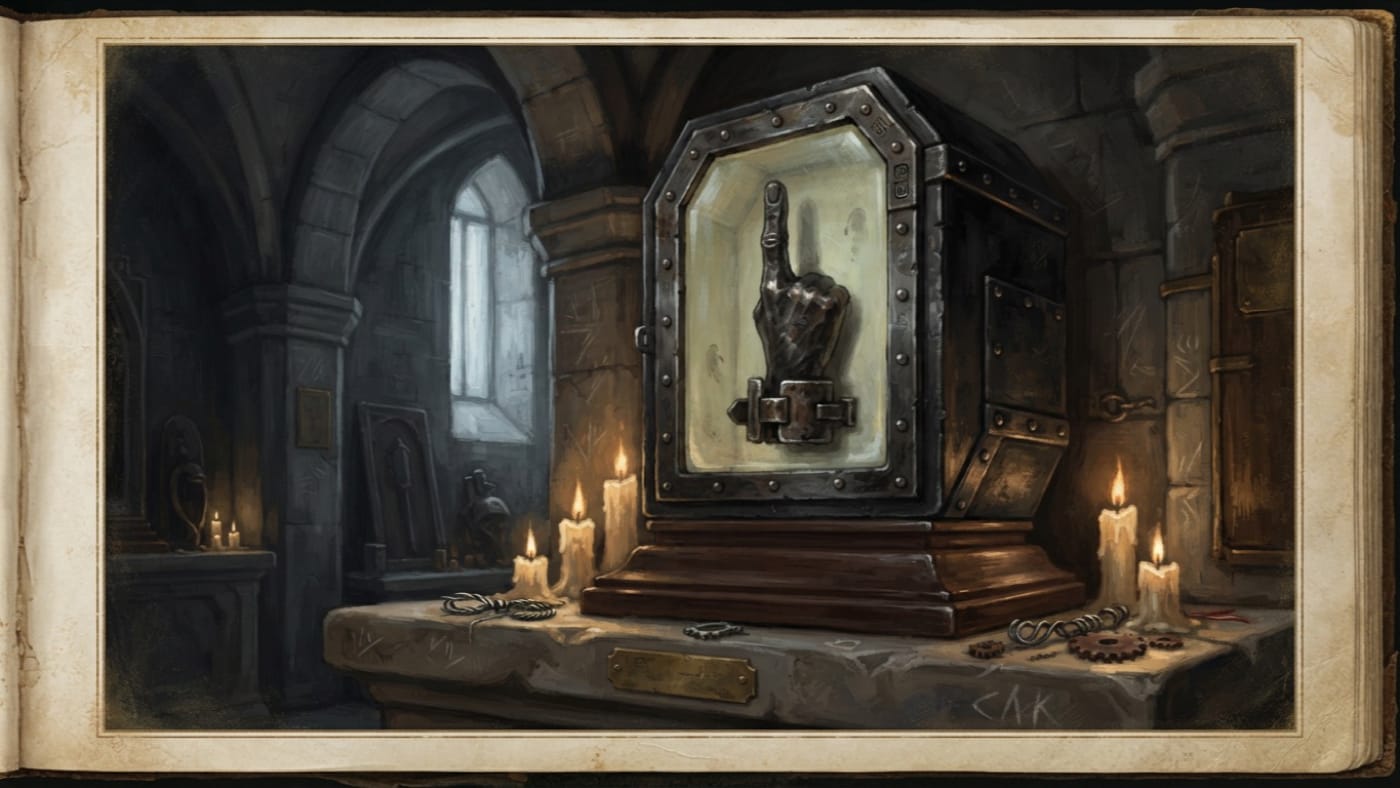
#On the Object and Its Custody
At Bastion-Sibiu, behind pale glass in a frame of black iron no larger than a missal's clasp-box, lies a right thumb that never grew on anyone. It was forged. It is blackened iron, worked to the shape of the digit it replaced, and for some years it was worn by Vera "Iron-Thumb" Malrec: Reliquary Salvager, tolerated patron, and the only saint in the Bureau's keeping whose principal relic was made by an armourer on a deadline.
The distinction has to be fixed at once, because pilgrims will not fix it for themselves. Malrec's own thumb, the one of bone and nail, was crushed in a vault mouth at Bastion-Irongate. The custody record lists no part of it. Whatever a candle-seller at the Sibiu steps tells you about a sliver of the original set into the reliquary's base is said for coin, and the Ledger contains nothing of the kind.
The registration reads, in the Bureau's own phrasing: Occupational Relic, Class Votive, Salvage-Adjacent. Each term is a fence. Occupational confines the devotion to one trade. Votive permits candles, petitions and fingerprints on the glass, and permits nothing on a rampart. Salvage-Adjacent means that the Bureau of Relics could not decide whether the object was recovered sanctity or only the hardware of a recovery, and settled for a hyphen instead of a ruling.
#On the Iron Taken at Irongate
The Quake-Year of A.S. 160 opened the cliff chapels of Irongate like ledgers left out in the rain. Malrec's crew was sent to a cracked service chapel below the southern cliff batteries. There the masonry had begun to breathe, and a complete saint-housing sat inside a living seam, with its shell, cradle and seal-band swallowed whole and still undigested. Most recoveries yield shards and holy grit, the sanctified rubble that Saint-Bone Melters burn down into mortar for the walls. Malrec went in after the whole object, hand first, with a rope at her waist.
She got it out. The wall closed as the housing cleared the seam and took the last thing still inside, which was her right thumb. The housing rang once. The crew, Engineering, and the part of the Relics report that survived revision all say the shaking stopped in that corridor. It did not stop in the gorge, along the Danube, or across the year, and I will hear no sermon claiming otherwise. Nobody has established why the corridor went quiet. Several people have guessed. I file the guesses under Doctrine and the facts under Engineering, and the two drawers are kept in separate rooms.
Children's chapbooks state that Malrec "smiled serenely" when her thumb was crushed.
Crew testimony: she screamed, threatened the winchman, vomited, asked whether the housing was intact, and fainted. The relic's provenance begins in that order. The Bureau will not let it begin anywhere prettier.
The replacement came afterward. An Irongate armourer whose name the record does not give made it from blackened hinge-iron cut from the outer clamps of the same housing she had pulled. The file does not say who allowed the clamps to be cut, and nothing in it suggests anyone was asked. The Malrec dossier calls the act illegal, pious, useful and immediately popular. I sealed that sentence myself and see no reason to improve it.
The housing went to the Bureau. The clamp-iron went onto a woman's hand. Popular devotion has confused the two ever since, and the Ledger will not. The saint-housing is the recovered vessel of an older sanctity, which no document I am permitted to cite has named. The thumb is a working tool cut from that vessel's hardware. One is treasure. The other is a receipt.
#On the Thumb in Service
It was equipment before it was holy, and the Salvagers have never let anyone forget the order. Malrec gripped rope with it where flesh would have burned. She pressed seal-wax with it, since iron cares nothing for heat or for the opinions of clerks. She hooked it under a reliquary lip and pried where a living finger would have hesitated or been taken. She also struck it on tables, hard, whenever a foremen's meeting needed to end. The Bureau has no category for that last use. The foremen call it the first miracle.
The record does not say how it fastened, whether it bent, or what it weighed. I will not forge the thing a second time on paper.
A tool becomes a sign once other hands start wanting it. Within five years of Irongate, "iron-thumb" was the Salvagers' word for anyone willing to hold the object while the others debated whether to touch it. The trade's other houses each answered in character. Contract Sanctifiers looked away when crews touched the thumb before a descent, because a blessing someone else has already supplied is one they need not invoice. Shadow Pullers copied it in tin. Licensed Recoverers condemned the copies from behind their licences and then bought them, from the same tinsmiths, at the same rates.
#On Touches, Copies, and Patronage
Malrec did not ask for a cult. She put a price on it, which is harder to argue with. After the third year she charged for touching the thumb. An apprentice paid one Crown and a foreman three. Anyone who had lost a digit in active salvage touched it free, provided the story was good. She tithed the takings. The Bureau investigated the income, found the tithe, and withdrew in visible disappointment. Those were her rates while she lived. No Sibiu tariff is on file, and anyone quoting her prices at the reliquary glass is collecting for themselves.
The signs travelled faster than the object. Chalk thumb-marks went up on lintels, and small iron crescents were sewn into glove seams. Tin thumbs, of the Shadow Pullers' pattern, hang on cords at the necks of men who would deny owning one. None of these is the relic. None has been examined, graded or sealed, and none ever will be, because the Bureau tolerates insignia the way it tolerates hobnails: they cost nothing to permit and a great deal to confiscate.
The maxim fastened to her name, Praise later. Lift now., is the whole of the trade's theology and most of its safety regulation. Nobody can show me where she first said it. Every crew I have questioned believes she said it to them.
#On Proof and Custody
The Relic Authenticators grade objects on a short and unforgiving scale: Ward-safe, Votive, Contaminant, Fraud. The thumb is Votive. It may receive candles, petitions, kneeling, and the reverent smudges the glass-clerks wipe away every morning. It may not be set into a ward, carried as battle-sanctity, or cited in any writ that promises protection. A Votive grade certifies that the object is what its provenance says and that venerating it does no harm. It says nothing about what the object does.
The thumb has passed the Candle Proof twice and flickered once. I give the results in that order because that is the order the Ledger gives. The Ledger does not give dates, sessions or the examiners' names, so I do not give them either. A flicker falls between the columns of the form. The Bureau has drafted several replies to it and sent none.
Then there is the audit. By report, during one inspection of the reliquary, the thumb tapped the inside of its glass. The auditor retired within the month. The retirement papers state their reasons, and none of those reasons is the glass. The clerks of the Sibiu register mention the glass freely, though only after the second bottle and never on vellum.
The Bureau of Relics holds that the thumb is venerated as a symbol of lawful recovery. The Salvagers hold that it helps ropes hold, gloves grip, and walls hesitate before they bite. Lawful recovery: clamp-iron cut without recorded permission from a housing pulled against Protocol by a woman who would not wait for three signatures. Both positions stand in the register side by side, and neither office has asked the other to explain itself.
The removal of the thumb from Malrec's hand is poorly recorded. It was already in custody before the vitae arranged her deathbed, and the Malrec dossier carries that correction. The date of removal, the road out of Irongate and the clerk who first signed for it at Sibiu are absent from every folio I am cleared to open.
#On the Limits of Approval
There is no cult decree. Devotion to Malrec is tolerated pending review, a phrase the Bureau of Doctrine uses for matters it expects to outlive. The thumb is authenticated, the woman is tolerated, and the protective claims are neither approved nor condemned. Approving them would oblige the Bureau to issue the thumb to the ramparts. Condemning them would oblige it to explain the auditor.
So the object stays where it is, black iron behind pale glass, graded for candles. Crews passing through Sibiu touch the glass on their way to the Carpathian works, and the deacons let them. Salvagers write the Creator's name and hers in the same chalk. The Bureau has looked at the arrangement for a long time and has elected, in its wisdom, to keep looking.