
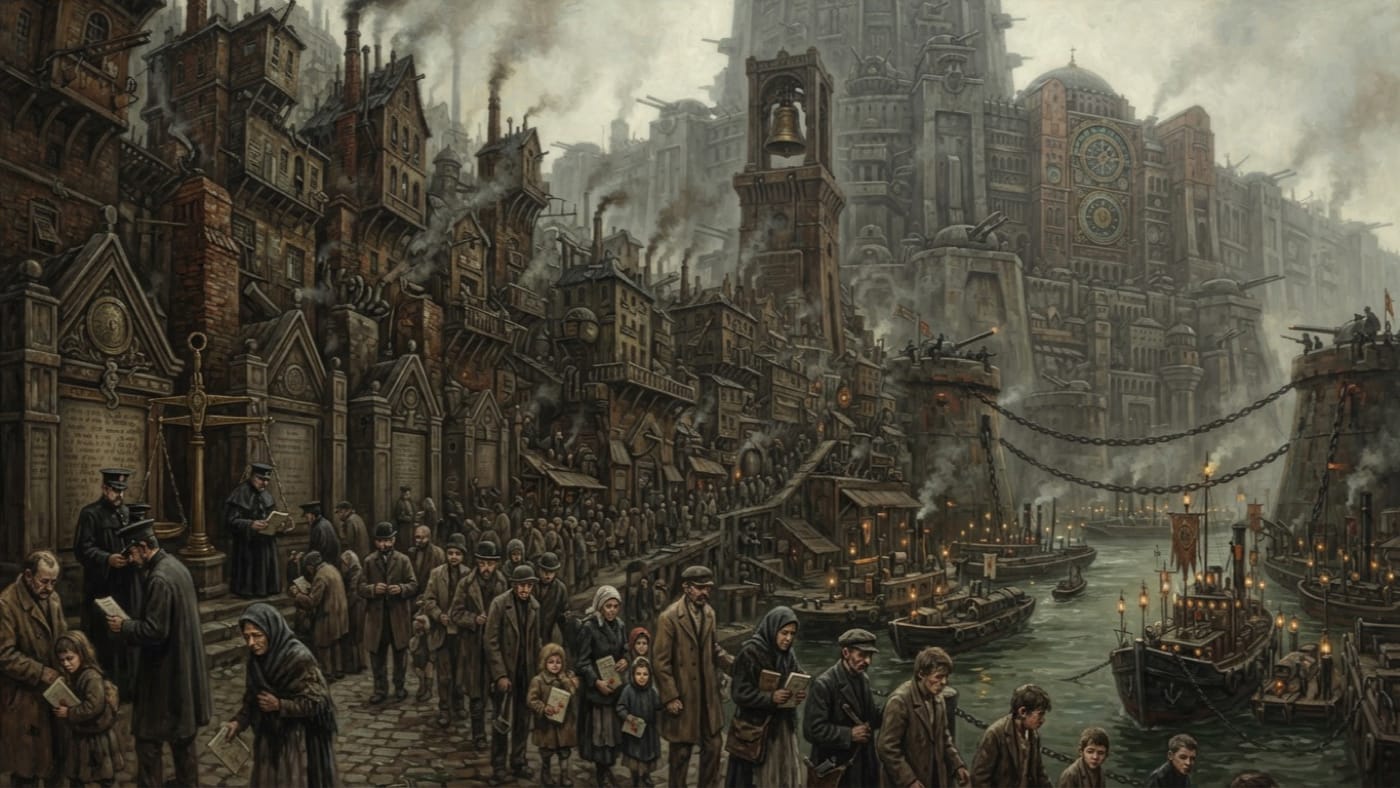
#On the City Beneath the Bastion
Istanbul and Constantinople are one city. The Bureau of Records keeps both names in use: the older for sermons, the plainer for manifests. A clerk who files a grain claim under the wrong one soon learns how long a correction takes in a city that counts its bread by the hour. The annals call the plainer name a bureaucratic restyling. They do not say when the restyling happened. I have looked.
The city is older than our calendar. It stood at the Strait before the Sundering of A.S. 45 broke the eastern world, and before anyone thought to bolt a fortress onto its back. In earlier prose I described Bastion-Constantinople as set upon the corpse of Constantinople. The phrase was admired. It was also inaccurate, because corpses do not queue for bread. The city beneath the fortress is ancient, enormous and terrified, and only the living can be terrified.
This Codex catalogues the city and the fortress separately, as it catalogues a reliquary apart from its saint. Readers who want ravelins and gun lines should go to the fortress dossier. This entry concerns the people who feed the fortress, sweep it, ring its bells and are rationed by it.
#On the Strait and the Civic Spine
Istanbul lies at the southern end of the Sagittal Line, where the north–south chain of seven bastions runs out of land. Thrace lies overland to the north, and the Black Sea opens to the northeast. Visitors from the heartlands assume the sea guards this flank. The sea is a road, and the enemy has learned to use roads. The Black Sea Reliquary Flotilla, which sailors call Saints Afloat, patrols that approach as a floating settlement of its own. The city watches the Flotilla's lamps the way a debtor watches a creditor's carriage.
Earlier cartographic plates styled this city and its fortress the Western Anchor of the Line.
Istanbul is the southern anchor. The fortress above it is Bastion-Constantinople. The name Bastion-Lorraine survives in veteran testimony and older files as a deprecated designation for the same installation, and it refers to no second site. A reader holding a plate that says otherwise is holding an old plate.
The civic city is organised along the Sanctum Mile. The Belfry of the Hinge stands at its western end. It was first raised in A.S. 68 during the southern-anchor works of the wartime Church, twenty-two years before the formal Synod. The Cathedral of the Perpetual Registry stands at the eastern end, on the site of the old Hagia Sophia. It was seized during the same works and formally titled in A.S. 72. These are separate events, and I have watched three committees merge them. Residents spend their lives walking the Mile from the hour to the record.
The Harbor of Chains lies below, the city's door to the sea and its gate against it. Between the Ossuary Rings and the harbour is the Carrier Yard, where the fortress's war-machines are cradled, repaired and sent out again under the Foundry Quarter's smoke. Civilians do this work. The machines of the Line are tended by people who go home at the evening peal to rooms built from bone.
#On Bread, Bells, and Clearance
The city does not feed itself. In the Lore Book's account, grain comes from Anatolia under Bureau seal, convoys come down through Thrace, and freight crosses the Bosporus with the tide and the patrols. Everything that arrives is weighed. Each wharf and road-gate has its tariff-chapel, where inspectors in half-priestly robes weigh sacks on scales engraved with scripture and announce the tariff in psalm.
There is a city saying, which Records has failed to stamp out, that grain waits longer in Istanbul than pilgrims do. Freight waits while clerks dispute the spelling on a manifest. Harbour tales describe ships settling at anchor with their cargo still aboard because the ledgers had not cleared. A sack that rotted in the marsh and a sack that rotted in the customs shed give a family the same supper, which is none.
Accounts of the city's place in the wider traffic disagree, and I record both. This Codex's entry on Kargath reports caravans leaving Istanbul for the western provinces and arriving as wagons of rot, when they arrive at all. The Lore Book reports convoys meant for the city coming down through Thrace in the same state. Records has not reconciled the two accounts, and I decline to do it for them. Rot has been entered in both directions.
Inside the walls the bells keep time, and that time governs hunger. Miss the noonday peal and the public kitchens lock. The Bureau calls the lock a mercy because it keeps pantries out of the bellies of the idle. That reasoning leaves out the sick, the slow, and the night-shift foundryman who slept through the peal because he had earned the sleep. Loaves are stamped in wax, and a mother must show the stamp before her children may eat what it marks.
The five Bureaus have held their present titles since the A.S. 90 settlement. Before it, the offices that weighed the city's grain had other names and the same scales. Anyone standing in a queue can see how the work is divided. Doctrine gives each peal its meaning. Records validates the manifest, then the person holding it. Tithes weighs the sack and charges for the weighing. Purity searches it for anything not listed. Rites standardises the grace said over what is left. A resident meets all five before breakfast, if breakfast happens.
#On the Inhabitants and Their Trades
The people of Istanbul are dockers, clerks, foundry hands, bell-ringers' families, pilgrims, widows and the very poor, and many are several of these at once. Dock gangs work the Harbor of Chains by tide and bell. Clerks live on salt fish and wax burns. Foundry hands turn iron into whatever the Carrier Yard needs that week.
Families in the Ossuary Rings live as people do in the Bastion-cities, with femurs for lintels, ribs for vaulting and kin mortared into the stair. Marrow-dust hangs in the damp. Children trace finger-bones in the plaster as other children trace wallpaper. Some residents report walls that creak differently for strangers. Inspectors file these reports as structural adjustment. Purity notes the names of those who report too often.
Then there are the Strait-Rats, entered on the harbour rolls as Auxiliary Ferrymen of Reliquary Freight. They move crates through fog and copy wax impressions with warmed seals. They cross while the bells are loudest, because a full toll covers the sound of oars. Some carry demon-glass in reliquary crates. Most carry what any city lacks in a bad month: salt, lamp-fuel, a second sack. Purity calls them heretics of the tide. A docker's wife calls them the reason her children ate in winter. When a ration debt comes due, a sailor who has never broken a seal runs one crate unsealed. He chooses to. Choosing under hunger is still choosing.
#On Hunger at the Gates
The Bosporus marshes belong to Kargath, Sin-General of Gluttony. His sin is need that grows with feeding, which is a different thing from the fat man at the banquet. The reeds there crawl. The water froths the colour of old bile. Rot in that marsh does not decompose; it waits. No credible deposition places him in a street of Istanbul, and he has no need to be there. His work reaches the city in sacks, in wells that run sour and then clear, and in grain found crawling on the third day of inspection.
His cultists work through the city's food. Purity's assessments place them in ration offices and relief stations. They are the merchant who has stock when no one else does, and the relief worker who arrives with full carts in a lean week. The danger is that their gifts work for a while. Purity's greater error is to treat every generous cook as a cultist. Most of the women ladling soup at the communal tables are doing exactly what the Synod asks of them.
The countermeasures here are the Dominion's, and they work unevenly. Communal meals help. The compulsory fasts weaken the people they are meant to protect. The Doctrine of Enough asks the underfed to treat their hunger as sin. I wrote part of that doctrine. In Istanbul I have heard it recited in the bread queue by people too short of breath to finish it.
Maldrake, Sin-General of Wrath, comes down out of Thrace in separate campaigns rather than as constant pressure. What he does to the city is not famine, even when the granaries suffer from both. Velmora, who is Greed, holds her principal front opposite Sibiu, yet the Lore Book reports her counterfeit relics reaching Istanbul's markets. Counting-house clerks describe coin that burns cold in the palm and credit that falls due sooner than the contract allows. A merchant who takes her loan signs it with his own hand. That is what makes it a sin, and what makes it hard to prosecute.
Behind every such offer the Codex sees the Great Deceiver. The people of the city see a loaf, and they have to decide.
#On the Present Condition
In A.S. 201 the city is occupied, badly provisioned and holding. The Belfry rings, the Cathedral records and the kitchens lock at noon. The Harbor of Chains still opens and closes for the Flotilla, and its lamps are still counted from the quay. The marsh has not been reclaimed, and no Bureau has issued a reclamation timeline since the last one was withdrawn. Freight still waits at the tariff-chapels, and some of it still spoils there.
Soldiers call the fortress the Last Lock. Residents call the city home, though rarely in front of an inspector. Both names describe the same stone.