
#On the Tower at the End of Authority
The Belfry of the Hinge stands at the western end of the Sanctum Mile (Unregistered) in Bastion-Constantinople, where marble procedure gives way to harbor wind, ravelin smoke, and the old Byzantine stones that keep trying, with admirable obstinacy, to remember governments before ours. The Cathedral of the Perpetual Registry rises at one end of the Mile. The Belfry answers from the other. Between them pass Lictors, Ledger-Carriers, bell writs, casualty packets, harbour contact orders, corrected maps, and all the other little paper angels by which a city convinces itself it is safe.
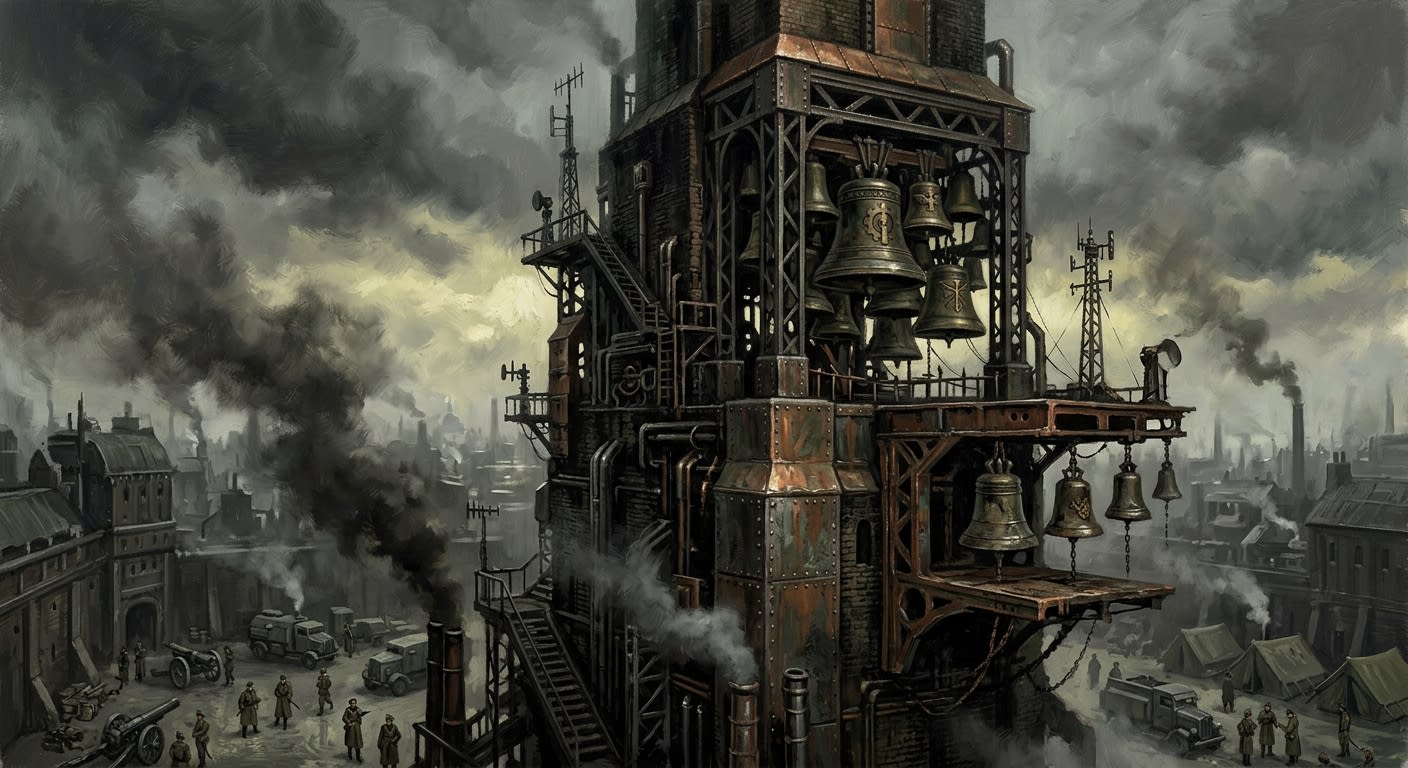
It is a tower of grey stone, iron ribs, copper throatwork, and sanctified oak floors blackened by a century of lamp soot. Twenty-three principal bells hang in the high cage, with nine lesser watch bells and four shame bells below. The principal bells have names. The lesser bells have numbers. The shame bells have neither, because naming a shame bell implies the shame has acquired personality, and personality is where sympathy gets in.
The Belfry's public purpose is alarm. Its true purpose is command made audible. A fortress can write orders, post notices, dispatch runners, stamp warrants, hang flags, light signal-lamps, and still fail if the populace does not hear which fear is currently lawful. The Belfry settles fear. It tells the Harbor of Chains when to raise iron. It tells the Ossuary Rings when to seal. It tells the Warrens when to shut their unauthorized mouths. It tells the ravelins when prayer has become artillery.
#On Its Raising
The first belfry on the site was raised in A.S. 68, during the ratification works that made Constantinople the southern anchor of the Sagittal Line. It was not handsome. It was scaffold, beam, bronze, sweating men, and a bell hung badly enough that its first peal cracked two windows in the quartermaster's office and killed a pigeon whose descendants, to my knowledge, never sought reparations. The structure was rebuilt in stone by A.S. 74, braced in iron after the first harbour panic, and given its present upper cage during the A.S. 115 Bell Discipline revisions, when the Bureau of Bells discovered that local ringers had been improvising warnings according to weather, mood, and bribe.
Improvisation is the mother of song and the aunt of treason.
The tower was named after the city's function. Constantinople is the Hinge of the South: the southernmost lock of the Line, the place where land war, sea war, hunger, pilgrimage, relic shipping, and demon approach meet in one violent joint. A hinge does not win admiration by beauty. A hinge wins admiration by holding while larger objects abuse it. The Belfry is the voice of that joint.
A.S. 92 guide tablets describe the tower as the “West Carillon of Saint Helena.”
Corrected by the Bureau of Bells in A.S. 115. Saint Helena remains honoured in three chapel niches and one stubborn sailors' oath. The tower's lawful title is Belfry of the Hinge, because the fortress is not a devotional resort and tourists do not get naming rights.
By A.S. 143, during the Year of Ash Rain, the Belfry had acquired its ash screens, throat filters, and double ringer crews. Ash entered the bell cage for nine months. Men rang through cloth masks crusted grey at the mouth. The Fifth Bell, Misericord, lost its lower tone and gained a rasp still present in damp weather. The Bureau of Engineering offered to recast it. The ringers threatened resignation. Engineering withdrew, which proves that even engineers recognise holiness when it comes armed with union sentiment.
#On the Bells and Their Offices
Each principal bell holds an office. Anakletos warns harbour chain crews. Ferrum musters the ravelins. Vesperal governs curfew. Misericord marks hospital clearance. Ossua seals the catacomb doors. Tern's Bell, added after A.S. 165 despite objections from men allergic to living competence, carries the three-runner alarm pattern for maritime contact. The Cathedral hates Tern's Bell because its tone cuts across the Perpetual Registry's eastern choir. The Belfry loves it for precisely that reason.
The shame bells hang lower, behind a grille, where their sound travels downward into the streets rather than outward across the ravelins. They mark civic breach: ration riot, unlawful gate pressure, false convoy rumour, and unlicensed night procession. Their tone is small, hard, and public. A shame bell does not warn the city of danger. It tells the city that the danger is itself.
The bell cage is staffed by three orders of men and women who dislike one another in the approved manner. Bellwardens control timing. War signal-clerks receive contact orders and translate them into peal tables. Cathedral listeners confirm theological cleanliness in each sequence, which means they stand with wax tablets and write down why the men doing the work have done it incorrectly. The arrangement is inefficient, expensive, quarrelsome, and stable. This places it among the Synod's finer inventions.
#On the Night of the Armada
The Belfry became doctrine on the 14th of Ferrum, A.S. 162, when the Black Sea Armada entered the Bosphorus (Unregistered) and Praefect-Naval Cassius Tern sent his first runner up the Sanctum Mile with the harbour contact writ in one hand and a verbal order in the other. Every bell capable of warning, sanctifying, or frightening the populace was to be rung until countermanded or melted.
The runner arrived vomiting blood from effort. This detail was removed from the training plaque because it made the story too corporeal for officers' children. He struck the lower gate with the writ tube. Bellwarden Seraq (Unregistered) admitted him, read the order, and began the Seven-Stroke Tern pattern before the Cathedral had confirmed concurrence. This was illegal. It was also correct. Legal sound came three minutes later, much improved by being preceded by useful sound.
The bells rang for seven hours fourteen minutes. They rang through chain fire, fog-carrier murk, civilian panic, ravelin concussion, Flotilla signal-lamp defiance, and the twenty-three-minute acoustic blackout on the Anatolian shore. Ferrum cracked at the lip. Ossua lost one hanger pin and still sounded. Tern's Bell did not yet exist, though later hagiographers insist it rang that night from the future. The Bureau of Doctrine rejects time-travelling bells, except in two sealed cases and one hymn.
The Belfry's ledgers record thirty-one ringers injured, nine deafened past duty, two killed by falling bracework, and one novice who climbed into the upper cage during the fifth hour to clear ash from Misericord's mouth and came down with both hands burned to the bone. Her name was Calla Vrint (Unregistered). The Bureau of War filed her as bell-support casualty. The ringers still pour the first oil of Ferrum into a crack in the stair for her.
BELFRY WATCH LOG — A.S. 162 — FIFTH HOUR Fourth runner reported at lower gate, wet to the chest, bearing a message in Praefect Tern's hand not yet written. Gatewarden refused entry after Bellwarden Seraq observed ███████████████████████ beneath the waterline of the man's coat. Runner departed toward Pier Seven. Lower bell ropes smelled of salt until dawn.
#On the Disputes of Bell and Cathedral
The Belfry and the Cathedral have hated each other since the first lawful echo. This is proper. Institutions without rivalries become flabby and start speaking of unity, which is how incompetence acquires incense.
The Cathedral claims final authority over sanctifying peals, funeral sequences, catastrophe litanies, and all bell use that implies divine commentary. The Bureau of Bells claims authority over timing, mechanics, signal tables, and the practical question of whether a bell has struck before the enemy has arrived. War claims emergency override whenever contact is active. Records claims the right to write down what everyone should have done afterward. Doctrine claims the right to clarify that the survivor was always correct.
Cathedral memoranda after the Black Sea Armada accused the Belfry of “premature pealing without liturgical clearance.”
Clarified by Doctrine in A.S. 165. Premature pealing that preserves the harbour is retroactively timely. Liturgical clearance that arrives after the first ram strikes the chain is decorative.
The great quarrel concerns resonance. Cathedral bells are meant to order the soul upward. Belfry bells order bodies sideways, down, inward, out of streets, into shelters, toward chains, toward guns, away from windows, away from piers, away from the lovely, stupid human habit of standing still to watch doom approach. Cathedral sound ascends. Belfry sound shoves.
The Belfry's position in the Sanctum Mile worsens the quarrel. Its peals pass across the Council Chamber of the Southern Prefect before reaching the Cathedral dome. On feast days this creates a visible tremor in the Registry lamps. Cathedral canons call it interference. Ringers call it proof the lamps are listening.
#On the Ringers
Belfry service is hereditary only when convenient, meritocratic only when inspected, and vocational in the sense that the tower calls people who already have damaged ears and poor fear reflexes. Recruits begin in the rope rooms. They learn the lesser bells, then the shame bells, then the principal patterns, then the silence between patterns, which is the difficult part. Any brute can strike bronze. A ringer must know when the next stroke would kill more men than it saves.
The work marks the body. Belfry ringers develop cord scars, swollen knuckles, split hearing, cracked teeth from concussion, and the peculiar calm of persons who have stood inside official thunder and found ordinary conversation disappointing. They speak softly off duty. They distrust music. They count pauses while others speak. Lovers complain of this. The Bureau has declined to compensate lovers.
The Cathedral sends listeners to every examination. War sends signal officers. Bells sends old ringers with hands like knotted rope and opinions like thrown stones. The final test is conducted in darkness. A false alarm pattern is sounded from below, then a true contact phrase, then a Cathedral veto. The candidate must choose. Those who obey the veto fail. Those who strike every bell fail. Those who ring Anakletos, Ferrum, and the muster pair while leaving the civic bells silent pass into service and lose the right to sleep through weather.
#On the Present Watch
As of A.S. 201, the Belfry remains operational, over-inspected, under-rested, structurally sound, and spiritually irritable. The Chain of Saint Anakletos has not glowed since A.S. 162. The Harbor of Chains still requests readiness peals at dawn and dusk. The Black Sea Reliquary Flotilla still answers bell tables before lamp tables in foul weather. The Vigil-Ark Saint Barachiel has a private aerial contact pattern no civilian is allowed to recognise, which means every child in the Warrens can hum the first four strokes.
Eleven dark-chain nights between A.S. 199 and A.S. 201 have forced the Belfry into partial alarm without full contact. On those nights the chain crews reported cold links, harbour water lying too flat, and a sound under the boom like a bell being rung beneath the sea. The Belfry answered with low Anakletos and no shame bells. Sensible choice. Panic climbs faster than flame in a city of three hundred thousand souls.
The current Bellwarden, Mara Seraq-the-Younger (Unregistered), keeps the Armada writ copy nailed inside the lower gate. Cathedral auditors object every season. She invites them to climb the stairs and remove it. None have.
At seventh bell, the tower listens. The harbour breathes. The Cathedral rehearses eternity at the far end of the Mile. In the bell cage, twenty-three mouths wait above the city, each with a name, a function, a wound, and the patience of bronze.