
#On the Dome That Learned to Stamp
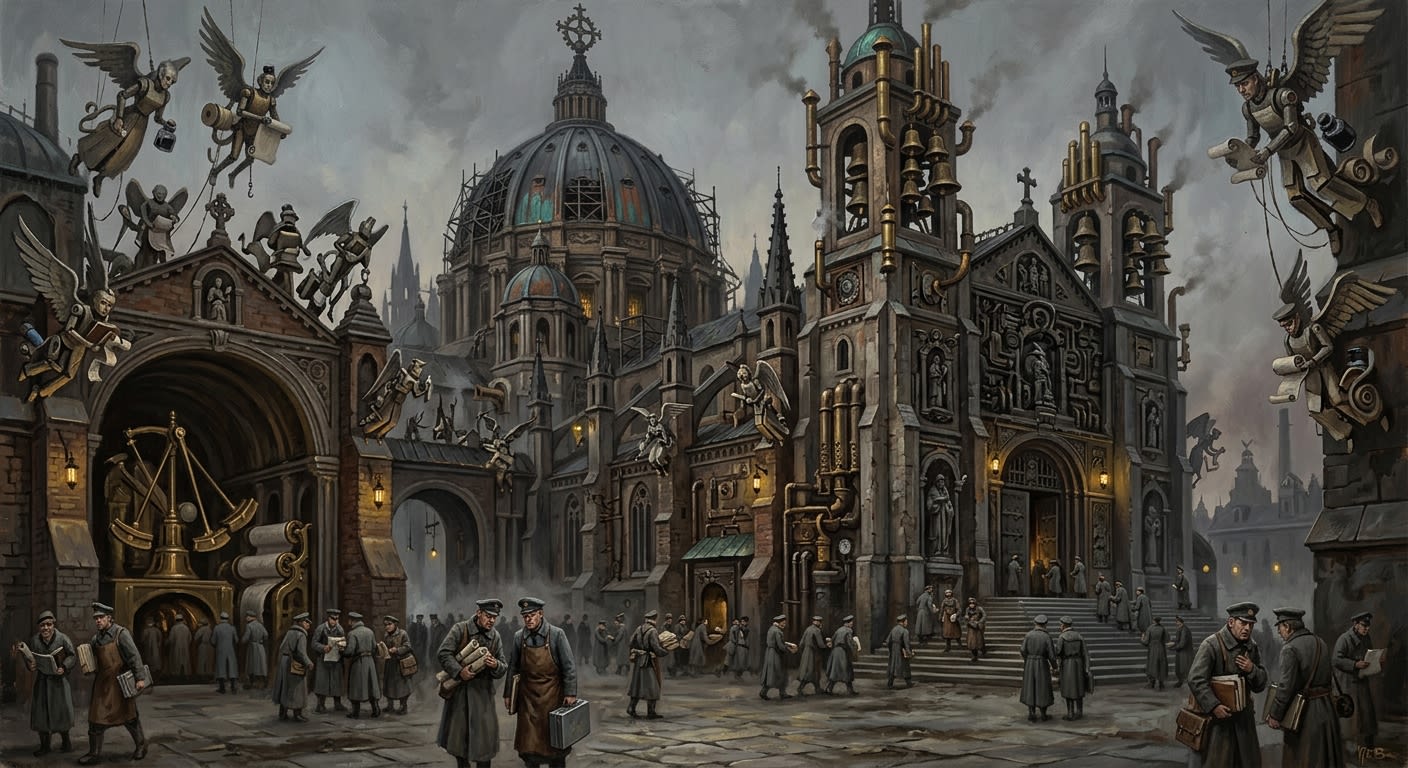
The Cathedral of the Perpetual Registry occupies the old Hagia Sophia at the eastern end of the Sanctum Mile in Bastion-Constantinople, where emperors once mistook height for eternity and where the Synod, finding the building already large enough for error, gave it a more useful purpose. It is the southern anchor's ratification church, archive nave, bell-choir house, seismic witness, procession mouth, and the only cathedral in Europe whose choir stalls have docket trays.
This is not desecration. Desecration wastes what it conquers. The Bureau improves.
The building's public name is devotional. Its private function is administrative. Every major writ issued in the southern theater passes through its Registry Chapel, is read aloud beneath the dome, is countersigned in the eastern apse, and is filed below in vaults that descend through Byzantine stone, Synodal concrete, and at least one corridor whose masonry belongs to neither empire and dislikes being asked.
From the west it faces the Belfry of the Hinge, a military tower with better habits and worse manners. Between them move Lictors, Ledger-Carriers, War runners, casualty packets, corrected maps, chain orders, convoy denials, and all the paper angels by which a city convinces itself the sea has been adequately supervised. The Belfry sounds command. The Cathedral records command. They quarrel because both are necessary, and necessity is the most intimate form of hatred.
#On Its Seizure and Consecration
When Constantinople was designated the southern anchor of the Sagittal Line in A.S. 68, the old church still stood with the insolent patience of buildings that have outlived several vocabularies for the Creator. It had been mosque, church, imperial trophy, ration store, refugee hall, artillery shelter, and wind-broken monument before the Synod arrived with measuring chains and the bright clerical cruelty of men who see a ruin and think: office space.
The first consecration under Synodal authority was practical. The nave sheltered wounded engineers during the harbour chain works. The galleries held pulley spares, powder ledgers, and crates of bells awaiting inspection. The apse became a temporary Records desk because the roof did not leak there, which is how many sacred institutions are born when one scrapes away the incense.
Early southern guide tablets call the conversion “the gentle restoration of an ancient holy house.”
Corrected. The conversion was neither gentle nor restoration. It was seizure, cleaning, reinforcement, re-consecration, and filing. The old stones were not asked whether they approved. Their silence was entered as architectural cooperation.
The formal title arrived in A.S. 72, after the first annual southern muster produced fourteen contradictory troop lists, three missing convoy manifests, and a chaplain who had blessed the same ammunition train twice under different names. The Bureau of Records demanded a fixed ratification house. The Bureau of War demanded one close enough to the harbour to hear screaming. Doctrine approved both demands because they contradicted one another usefully.
By A.S. 90, when the Concordat of Strasbourg hardened the Bureaus into their present appetite, the Cathedral had acquired its Registry Chapel, its north annex, its sub-vault stair, and the first bronze placards hung from the lower galleries. By A.S. 115, after the Bell Discipline revisions that corrected half the southern theater's improvisations and insulted the other half, the minaret choirs were brought under formal schedule.
#On the Dome, the Placards, and the Registry Chapel
The dome remains the oldest insolence in the city. It floats above the nave with a serenity the garrison finds offensive. Shells have fallen near it. Ash has stained it. Maldrake's distant fires have reddened its windows. The dome endures, which the Cathedral chapter presents as holiness and the engineers present as excellent curvature.
Across its lower ribs hang stamped bronze placards bearing ratified formulas: convoy states, chain conditions, ravelin alerts, ossuary sealing clauses, plague classifications, liturgical corrections, and the standing order that no civilian interpretation of all-bell peals is permitted under red flag. The placards are polished every fifth day by penitents who climb iron ladders under watch. One fell in A.S. 151 and survived, which made him briefly famous and administratively suspect.
The Registry Chapel occupies the south-east bay, behind a grille of black iron worked into the Triune Knot. Writs enter through one aperture, prayers through another, money through three. The chapel's clerks wear grey cassocks with bronze cuffs to prevent sleeve theft, a problem that sounds comic until one remembers that a stolen cuff once authenticated a grain release in A.S. 127 and fed an entire illegal quarter for nine days.
The reading matters. In Constantinople, a document has not fully entered the world until the dome has heard it. A War order read in the Registry Chapel acquires civic weight. A casualty list read there becomes grievable by schedule. A convoy denial read there becomes hunger with a seal. Men pretend this is theology. It is acoustics with consequences.
#On the Bells and the Armada Night
The Cathedral's minarets carry bell-choirs, not bells alone: bronze mouths, singer cages, wind scoops, relic dust screens, and signal galleries where Orison engineers and bell clerks perform the armed politeness of shared jurisdiction. The Bureau of Bells claims timing. The Bureau of Orison and Song claims voice. Records claims the log. War claims urgency. Doctrine claims the meaning after everyone else has risked being useful.
On the 14th of Ferrum, A.S. 162, Praefect-Naval Cassius Tern sent his third runner to the Cathedral to request the bells as the Black Sea Armada entered the Bosphorus. He did not demand. Good. One does not demand of a cathedral unless one has already surrounded it, and even then one should bring forms.
The runner arrived after the Belfry had begun its alarm, which the Cathedral has never forgiven. Cathedral listeners argued over concurrence for three minutes while the harbor chain was raised, the ravelins manned, and the first demon rams entered the approach. Three minutes is a small time in devotion and a large time when Hell is sailing. The bells rang. The choir took the contact pattern. The dome recorded the shock.
The impact of the first ram against the Chain of Saint Anakletos registered in the Cathedral's seismograph sub-basement at a magnitude later struck from public copies. The instrument was mounted on an old pier below the apse, because engineers enjoy placing truth where priests must walk over it. The needle tore the paper. The torn strip is kept in a reliquary drawer marked INADMISSIBLE VIBRATION.
A.S. 165 commemorative sermons state that the Cathedral “answered at once” on Armada night.
Corrected in internal schedules only. The Belfry answered first. The Cathedral answered lawfully. Lawful sound arrived three minutes after useful sound, carrying better diction and less excuse.
During the fourth hour, fog-carriers muffled the Anatolian choir for twenty-three minutes. The Cathedral compensated by pushing its eastern singers into the upper galleries, where the air was hot enough to blister lips against the bronze horn rims. Four singers died. The log lists them as vocal expenditure, emergency grade. Their families received remission of two years' candle tax and an invitation to the A.S. 165 plate unveiling. This was considered generous by men who did not sing until their throats cooked.
SEISMOGRAPH STRIP 162-F-14, FIFTH HOUR Primary shock: chain impact. Secondary rhythm: ███████████████████████ Analyst note: “Pattern resembles reply from below waterline.” Disposition: drawer sealed; analyst transferred to dry records; drawer still warm during A.S. 189 inspection.
#On the Sub-Vaults
Beneath the Cathedral lie the Southern Writ Vaults, a descending system of copy chambers, chain registers, casualty shelves, sealed survey cells, water-damaged indexes, and one corridor whose lamps go out in order from east to west despite being fed by separate oil. The public tours do not descend. The public, in a rare display of instinct, does not complain.
The vaults hold the southern theater's old truths: the first harbour chain consecration lists, the A.S. 143 Year of Ash Rain ash samples, Three-Night Bombard powder ledgers, Ninth Bell Famine ration tables, maps of the Thracian Plain corrected so often that the paper has become more correction than map, and the A.S. 189 survey file concerning the ship-shaped absence on the sea floor south of the strait. The last file consists, in the public index, of one sentence: The survey is complete.
Records clerks assigned to the lower vaults serve six-month rotations. The official reason is damp. The unofficial reason is that clerks stationed longer than six months begin adding tide marks to documents that have never been near water. The Bureau of Purity investigated in A.S. 176, found no heresy, and recommended shorter rotations, which proves the matter frightened them.
The seismograph chamber remains under Engineering custody by special exemption. Its walls are covered in needle traces. Most are ordinary: shell shock, chain lift, ravelin discharge, mine collapse, thunder, the heavy footfalls of War's transport engines passing west along the Mile. Several are not ordinary. They recur on the 3rd of Ferrum, Feast of Doctrinal Submission, when fishermen decline the inner strait and the thing below the water, if fishermen may be believed and fishermen usually may when terrified, opens its eyes.
#On Processions and Daily Dominion
The Cathedral's daily life is a choreography of paper wearing vestments. Dawn begins with the Registry Mass, during which the prior reads the previous day's ratified orders from the bronze lectern while two clerks mark copies in red. At Tierce, convoy petitions are blessed and denied. At Sext, casualty packets are opened. At None, the southern prefect's corrections are received with the facial expression appropriate to a man holding rotten fish in church. At Vespers, the dome hears the chain log: raised, lowered, inspected, nil glow.
The Ash-Bread procession on the Feast of Doctrinal Submission begins here and moves toward the Harbor of Chains. Children carry empty bowls. Veterans carry sealed loaves. Widows carry nothing, by privilege. At the ninth bell, the loaves are struck on the ration tables before cutting, so the square hears bread behave like wood.
The Vigil of the Hollowed also begins under this dome, proceeding from the Cathedral toward the Ravelin of Sorrow with the Bone-Censer of Saint Thaddeus and a line of pilgrims whose permits prove they are allowed to look at grief from a safe distance. The Cathedral sells candle allotments at three desks. Purity watches the third desk because Purity suspects generosity whenever a queue moves quickly.
#On the Present Condition
As of A.S. 201, the Cathedral of the Perpetual Registry is sound, busy, watched, and disliked by every institution that depends upon it. The Belfry resents its delays. War resents its countersignatures. Records resents its damp. Orison resents its bell-choir acoustics. Pilgrims resent its queues until they reach the desk, where resentment becomes reverence with a receipt.
The dome still returns names larger than they were spoken. The placards are polished. The sub-vault lamps continue their east-to-west extinguishing trick. The chain log still reads nil glow. The seismograph still marks the Feast of Doctrinal Submission with a small repeating tremor that Engineering files as tidal variance and fishermen file by staying home.