
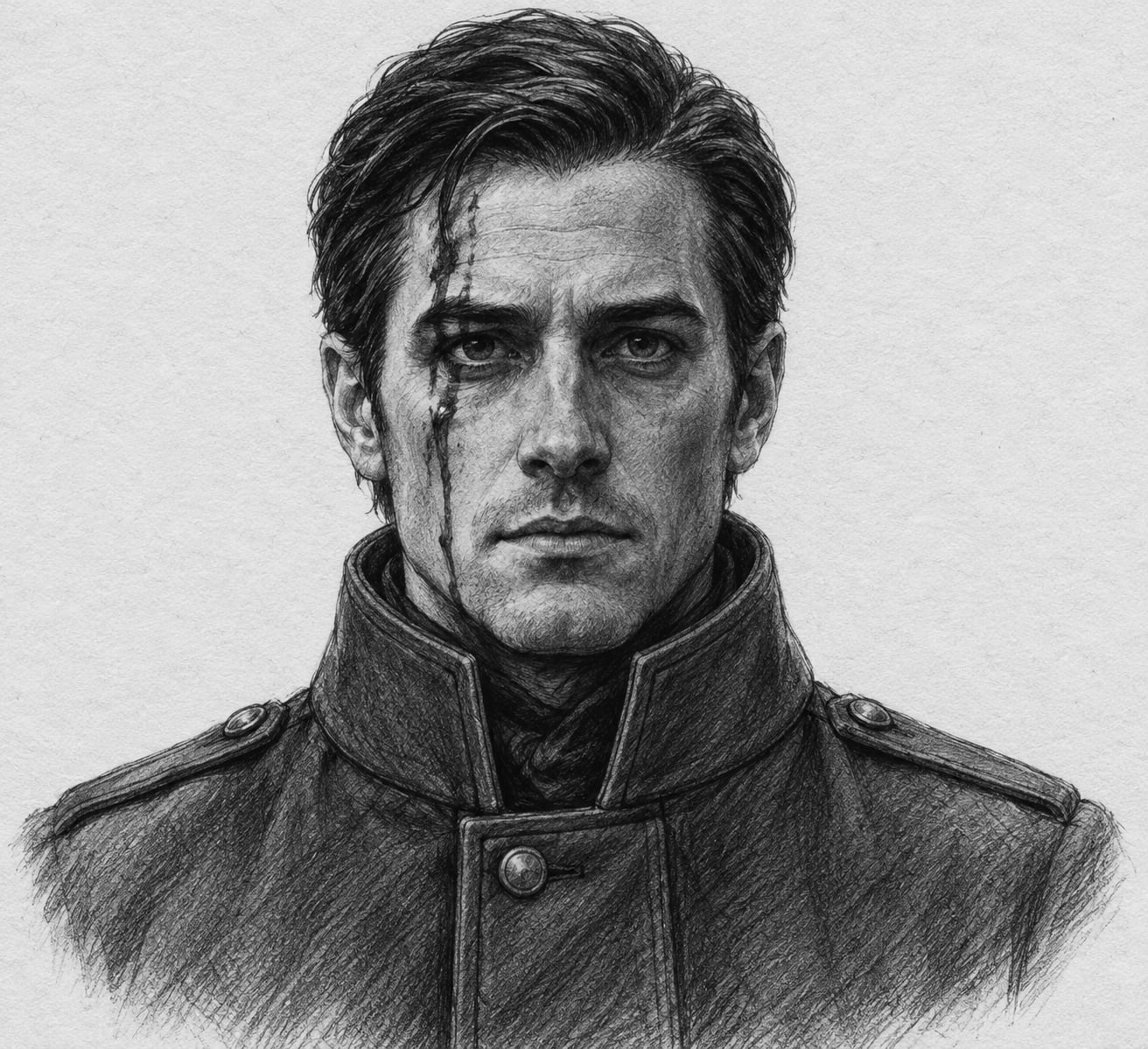
#On His Station
The Registry keeps him as an initial, a surname, a licence and a grade: J. Sarn, Licensed Arbiter, Second Class. No given name follows the initial, and the Registry adds no birthplace, parish, age, wife, debt or face. I have searched the Bureau's indices for more and received the usual reward for diligence, which is dust in the cuffs.
What survives is his office, and the office is enough to hang him by. The Caravan Court of Nine Weights licensed him, trained him in the archaic Treaty forms, and authorised him to pronounce judgement beneath the stones of the Treaty Ring. At the Steppe Gate that authorisation carries a particular hazard. The law there is carved, the wind reads it aloud, and a binding term spoken in court must be spoken as the stone holds it. An arbiter's ruling is only as sound as his mouth.
Second Class meant he was trusted with live clauses and with salt factions who had already begun killing one another. It did not make him the High Arbiter's equal, and it did not exempt him from consonants.
#On the Salt Arbitration
In A.S. 94, eighteen years after the seven stones were raised, Sarn took the bench in a dispute between two Moldavian salt-convoy factions. The word Moldavian describes the litigants. The Registry is silent on Sarn's own country, and I will not lend him one.
The quarrel began in contract and rotted in transit. The surviving accounts list theft, a salt-weight discrepancy, stolen mules, escort violence and murder, counter-claims, oath breach, and an exchange of theological insult that the abstract mentions without quoting, whether from delicacy or from fatigue. The faction names, the quantities in dispute and the full wording of the judgment are absent from every record I am cleared to cite. Treat any broadsheet that supplies them as a forger's sample.
The judgment ran through the usual stations of a frontier settlement: passage duty, escort liability, the weight discrepancy, the broken oath. Then it reached the end, where every such ruling at the Steppe Gate must go. The settlement was bound by a clause carved on the southern face of the Third Treaty-Stone, in an archaic script that Doctrine would later associate with the Triune Alphabet. To close the case, the arbiter had to speak the binding term aloud.
Sarn was trained for exactly this moment. The licence existed for it. The parties stood at their marks, the witnesses stood close enough to swear, and the wind did what it has done since A.S. 76.
#On the Damaged Syllable
He reached the binding term and damaged one syllable.
That much is fixed. Everything after it divides three ways. One witness held that he softened the second consonant. Another held that he swallowed the terminal vowel. A third, a dying inn-runner, wrote that the wind spoke over him and made the error his by adoption. All three accounts were taken before any correction could be recorded under full seal. None of the witnesses survived to be cross-examined, which made the file tidier and spoiled it as evidence.
I decline to choose between them. The Bureau has chosen nothing either, though in its case the abstention is policy. This entry does not reproduce the word and never will. Its correct pronunciation appears in no document available to me. Anyone in the Corrals offering to teach it to you for half a week's feed is selling you a coffin with a phoneme card attached.
Consider what the third account does. If the wind spoke over him, Sarn's mouth may have been clean and his office still guilty, because the stones do not divide fault between a man and the weather standing behind him. The inn-runner's phrase, "his by adoption," is the nearest thing to a defence Sarn ever received. It was written by a man bleeding from the ears, and it convicts him anyway.
The stone answered. Throats were squeezed shut from within. Ink rose at ears, gums, nostrils and the corners of the eyes. Thin cuts opened across skin in lines that matched the grammar of the breached clause. The enforcement took parties, witnesses, scribes, guards and onlookers. The record puts Sarn at the centre of the first strike as presiding officer and does not say what the strike did to him. His name appears on no injury list, burial entry or later docket. I have found no punishment, pardon or subsequent case, and I will supply none.
The syllable did not stay in the Ring. It went into the wind, and the wind carried it to the Oath Inns, the Scribe Bazaar and the pens, where people asked what had happened and repeated what they had half-heard. Each repetition set off a fresh enforcement. By dawn the Red Pronunciation had killed approximately one thousand people. That is a single count for the whole night, and the Bureau still managed to get it wrong.
STAMPED ERRATUM — Bureau of Doctrine, A.S. 95
Registry notice: approximately one hundred casualties, Red Pronunciation.
Revised to approximately one thousand. The prior figure omitted bodies removed before classification and bodies whose throat injuries frustrated identification. This correction was entered twelve months after the event.
#On the Licensed Aftermath
The Bureau of Bells sent an emergency Cantor-team. It arrived nine days after the cascade, which is punctual for a Bureau that measures emergencies in routing slips.
The survivors had not waited. Translator-scribes drew the first phoneme cards, showing lip, tooth, tongue, palate and breath, while the corridors still stank of ink and piss. Inn-keepers banned casual repetition near doorways. Seal-casters began marking fatal clauses with red caution glyphs. All of it was drawn around the hole Sarn left. The record credits him with none of it, and none of it stood in the Ring on the night he spoke.
The market followed the panic in better shoes. By A.S. 95 the Scribe Bazaar had tripled in size, and pronunciation certificates had become mandatory for passage masters. The Seal-House Consortium argued that centralised stamping would prevent another cascade and won its monopoly in the aftermath. The Bells team, arriving late, classified the local remedies as theologically adequate and absorbed them into Bureau vocabulary. I call that efficient. The scribes who drew the cards use other words, and they charge for those too.
Sarn's own legacy is smaller and more intimate than a monopoly. Every arbiter at the Ring now touches his throat before a binding term. The gesture has no statute behind it, and nobody prescribed it. It is performed in public, under the stones, by men who never saw Sarn's face and know his error better than their fathers' given names.
#On the Clause That Remained
In A.S. 178 Procurator Maxentius della Torre promulgated the Edict of Graphic Uniformity and chained the continent to the Triune Alphabet. Critics complained that Purity had confused handwriting with salvation. The Bureau of Doctrine answered them with Sarn.
The difficulty was chronology. The stones date to A.S. 76, Sarn spoke in A.S. 94, and the Edict came eighty-four years after him. Doctrine settled the matter by naming the Red Pronunciation a proleptic validation: an event that came before the Edict and still proved it, since malformed syllables were evidently murderous long before Purity got round to regulating them. I state the doctrine as Doctrine states it. I do not certify that the calendar agrees.
So a Second-Class arbiter with no recorded given name became a doctrinal exhibit eighty-four years after the fact. His tongue was entered as evidence in a case he never heard of.
The clause outlived its use as a sermon. During the survey of A.S. 92, two years before Sarn's hearing, Records placed seventeen rubbings in the Burnless Archive: fourteen stone-face panels and three duplicates. One of them carried the southern face of the Third Stone, the clause he damaged. The Archive keeps its paper. Its folios refuse fire, acid and departure.
At the quarterly audit of A.S. 199 the count was sixteen. The rubbing of the Third Stone's southern face was gone.
Every morning Paper Keeper Seld puts on cotton gloves, lifts the blank folio to the lantern and finds no text. If text comes, it will be a clause, and someone will have to read it aloud correctly. That is the duty Sarn was licensed for, and the one he failed.
What has returned is his clause. The evidence stops there. Nothing places Sarn in the Archive in A.S. 199, or anywhere after the night of the cascade. No folio among the Living Addenda that have appeared since A.S. 194 carries his hand.
High Arbiter Senn Vark now sits beneath the Third Stone and speaks no sentence without a witness. He was not at Sarn's hearing. He governs by its precedent all the same, and the wind still reads the southern face to him every day the court sits.
#On the Record's Limit
The file is short and will stay short: an initial, a grade, one hearing in A.S. 94, and one syllable damaged in three different ways according to three dead witnesses. After that the man leaves the Registry, and the clause stays.
I have been asked whether Sarn was a fool, a saboteur or a casualty of the weather. He was trained, licensed and wrong once, in front of the one audience that does not accept apology. The evidence takes him no further. I take him only a little further: he ought to have been better, and I pass the same sentence on any arbiter who stands at the Third Stone with a dry mouth.