
#On Motion and Public Repentance
"Sanctity is motion." — Bureau of Rites, Standard Directive, A.S. 94
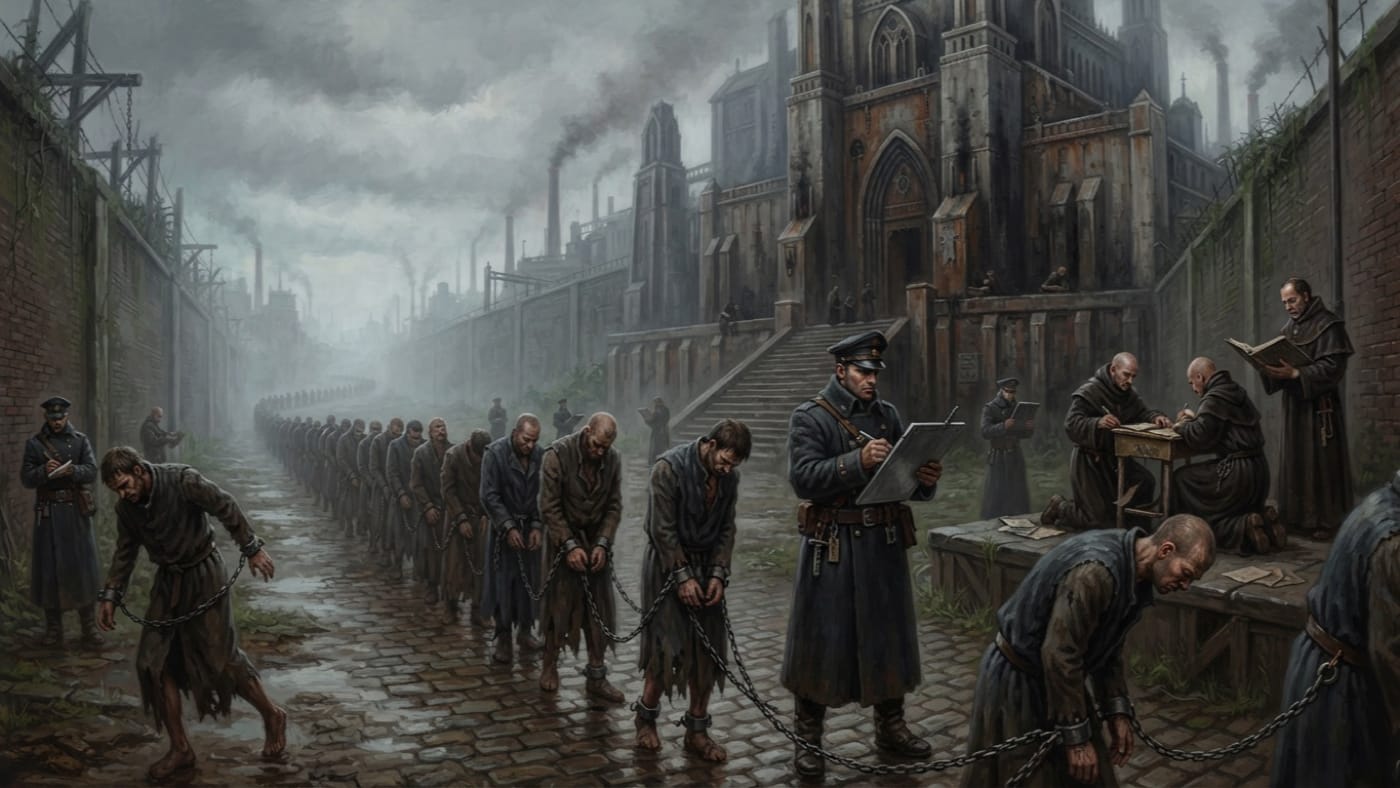
The Jubilee is a rite performed by the feet. A parish discharges a sentence of penance on its knees in an afternoon. Here the sentence becomes distance, and the distance is walked in public, in iron, with the wrists joined, past a population that has been told where to stand and what to hold. The Bureau of Rites supplies the doctrine: a soul that has strayed is corrected by being made to go somewhere on purpose. The Bureau of Pilgrimage supplies the road. The spectators supply the proof.
A penitent who repents alone in a cell repents for the Creator's ledger and no other. A penitent walked lime-white through a market square at dawn repents for the town as well. The town holds its prescribed pennants at the prescribed height and so testifies that the repentance occurred. Children wave. Shopkeepers uncover. The column passes. In the comfortable parishes of Zone 1 people now call the whole affair festive. A coercive institution can receive no higher compliment from the people it coerces.
There is also the larger instrument. Every tenth year the Peregrine Jubilee marches chained penitents across disputed routes. When it has finished, the rival pilgrimage guilds that held those routes have generally finished as well. Every Peregrine Jubilee is a chain on the road, though not every chain on the road is a Peregrine Jubilee. The distinction chiefly interests guildmasters.
#On Oath, Flight, and Iron
The earliest columns the record can see, from A.S. 94 to A.S. 108, walked without chains. The condemned swore an oath, an escort walked beside them, and the sanctity of the road was trusted to do the rest. The road kept its sanctity. The condemned did not keep their oaths. They left the column at night and in the confusion of crossings, and they left in numbers, into towns that fed them, hid them and kept quiet about it. The archive calls the worst of these departures the First Jubilee Flight. It does not let me date the Flight more closely, and I decline to give it a commander. A door left open for a night needs no general.
The iron came in A.S. 109. A rite founded on the claim that the walking corrects the walker was refitted so that the walking could no longer be refused. Doctrine was left exactly as it stood. Only the hardware changed. Three years later, in A.S. 112, the men and women who walked beside the iron were licensed under Synodal authority as Pilgrim-Chain Handlers. The Bureau of Pilgrimage was not formally established until A.S. 123. It then took over an apparatus that was already running, with writs, keys and Handlers in place, and it has administered that apparatus ever since with the confidence of an heir who has never been shown the will.
"…the Bureau of Pilgrimage's delivery statistics collapsed so thoroughly that the Bureau of Records… published a comparative analysis…" — as printed in the entry On the Pilgrim-Chain Handlers, of the unchained interval A.S. 94–108.
The Bureau of Pilgrimage did not exist during the unchained interval and kept no statistics then, collapsed or otherwise. The figures belonged to early Jubilee administration. They passed into the Bureau's custody later, together with the embarrassment. The Bureau of Pilgrimage has accepted the custody. It contests the embarrassment.
#On the Bodies Assigned to the Road
A column is filled from three intake classes, and the Handler's slate marks each one. The first class is the condemned, whose sentences specify penitential transport. The second is the offered: families surrender these people in exchange for reduced tithes or commuted sentences, and they receive a receipt. The third is the voluntary devout, who ask for the chain on their own account. The third class exists. The machinery handles it the way a customs house handles a parcel that declares its own contents honestly, with suspicion and a second inspection.
Every wrist in the column wears a cuff, and every cuff carries a route tag: name, offence class, destination shrine and serial number. The serial matches a line on the Handler's slate. The tag should not be confused with the metal route token stamped by a Route-Stamper. The token proves that a passage is lawful. The tag proves that a body is property of the passage. One continuous run of links joins every cuff to the next. Columns go single-file on open road and in pairs over bridges, and in dense streets they close up into the "centipede," which shows the public the greatest number of penitent faces per yard of pavement. Ranked keys divide authority over the iron. The lowest key adjusts a cuff, a middle key parts a segment, and the master set unlocks everything and is not meant to leave the Handler's body.
Because the chain is continuous, its consequences are shared. When one walker stumbles, the stumble runs down the line, and a single fall on a wet descent can bring down twenty people. The Pilgrim Roads offer ration-stones and parish-kept verges. The column receives what the slate allows: water poured from the mercy gourd, rest by the minute, bandage by the strip, and every unit is entered against a serial number. A walker who has not been logged as relieved has not been relieved, whatever the ditch beside the road may say.
#On Shrines, Bells, and the Taking of Confession
Every shrine on the route is a checkpoint, and the order of business at each one is fixed. The column halts. The Handler presents the slate, and a Route-Stamper counts heads against it and checks tokens against tags. Then the walkers kneel, still chained, and are offered confession. Offered is the Bureau's verb.
A shrine-priest hears what is said and writes it onto pre-ruled strips of vellum. The Handler has no authority to absolve and no wish to. The Handler's office at the shrine is custodial: the penitents kneel, they speak, and the strips are collected, bundled and sealed before the column moves on. The packets travel with the column to its destination and go from there to the Bureau of Records. A refusal to confess is marked on the slate. According to the Handlers' own account, a third refusal sends the refuser to the Bureau of Purity, and that account mentions no return. The same account adds that confessions made in chains name other people, the people named are investigated, and some of those investigations end in cuffs.
Over all of this hang the bells. The Bellway Harmonisation of A.S. 148 bound the routes to the Bureau of Bells, so that a column must now reach its next shrine-post inside a fixed window of tolling. A late column leaves a gap in the sequence of bells, and anyone along the route can hear the gap. The division of labour is precise. Pilgrimage holds the road, Bells holds the hour, Rites holds the words, Records holds the strips, and Purity holds whatever the other four have failed to hold.
#On the Price of Renewal
Calling the Jubilee a renewal of souls does not make it any cheaper. Permits are charged at the departure yard and tolls at the tithe-gates. Indulgence tokens sell along the route, with bell-hours worked into the metal. The shrines take their offerings, and those offerings rise in Jubilee years. Families who offer a relative to the chain buy a lighter tithe with the relative. When the Peregrine Jubilee passes over a disputed route, the rival guild's tolls, shrines and token presses pass to the Bureau, either by absorption or by ash. Seen from the counting-house, a penitential march converts sinners into revenue at a fixed rate of exchange.
At the bottom of all this sits the gourd. The Road-Mercy Scandal of A.S. 136 exposed Handlers who had been selling relief: water, rest, bandage cloth and looser cuffs, paid for in coin, in heirlooms and in worse. Fourteen Handlers were burned. Relief was then standardised by formula: so many units per column per mile per season, recorded on the slate and checked at every shrine. The Handlers' entry records A.S. 141 as the formula's last revision. The formula settles who is owed a cup, and it says nothing about whether one cup is enough. The routes have lengthened since A.S. 141. The formula has not.
I have measured the gap between ledger and road exactly once. In A.S. 188 I walked as an observer behind a column on the Strasbourg–Przemyśl corridor under a Handler named Maren Kessler. Four hundred and twelve walkers left the yard. Three hundred and seventy-nine were entered at the first shrine. Three hundred and seventy-nine were entered at every shrine after that.
The ledger does not say what became of the thirty-three. I cannot say either. Some may have died. Some may have been unchained for reasons the slate leaves out. Some may be in a sympathetic town tonight, eating someone's bread. The figure filed at the first shrine was the one that mattered. After that it only had to be repeated.
#On Completion
The road has a form for the dead: Form 17-C, Cessation of Ambulatory Penitence. The Handler signs it and the nearest shrine-priest countersigns. The cause and disposition come printed in advance. The disposition is "roadside reclamation," the Bureau's phrase for a ditch that has been blessed. The form's notification line says the next of kin have been informed under standing directive. The line holds good for the offered, whose families signed them onto the chain. It holds less well for the condemned and the willing, whose families signed nothing and are notified of nothing.
A column that arrives with every serial accounted for is recorded as delivered in full, and a serial accounted for by Form 17-C counts toward that total. The Bureau of Pilgrimage reports its delivery rate as total, and its arithmetic is correct. The ledger has two columns, delivered and ceased, and the Bureau prints only their sum. Survival needs a third column, which the ledger has never been ruled to carry.
The rite counts itself complete at the destination shrine. The keys are returned and the slate is closed. The confession packets go to Records and the forms to the archive. The iron goes back to the depot to be oiled for the next writ. Somewhere behind the column, a priest on a donkey with a censer is still blessing the verge at a trot, because another column is a day behind.