
#On Jupiter in the Approved Charts
Jupiter exists twice, and the Bureau answers for only one of the two.
The first Jupiter crosses the sky above Kraków, Strasbourg and every other roof at the hours the Creator appoints, and it holds no licence for doing so. The second is printed. It appears in the approved cosmology issued under the Seventh Catechetical Supplement as a small black mark at the head of a column of positions. Every figure in that column was set in type, proofed by a Doctrine reader and sealed. The first Jupiter belongs to Heaven. The second belongs to the Bureau of Doctrine, which paid for the ink.
Most of the faithful never notice that there are two, because most of the faithful do not own telescopes. A farmer looks up and sees a light. A catechist opens the Supplement and finds the light's approved address. Both go to bed content. Trouble starts when someone compares the two and writes the comparison down.
This entry treats Jupiter as a subject of record. Its size, its colour, its company and its distance from anything else are outside the file, and I decline to supply them from memory. The Codex holds what was sealed. In the autumn of A.S. 199, at the close of the Condemnation of Kraków, the Bureau sealed two findings: Jupiter had wandered from its printed place, and the people who noticed had no standing to say so.
#On the Kraków Measurements
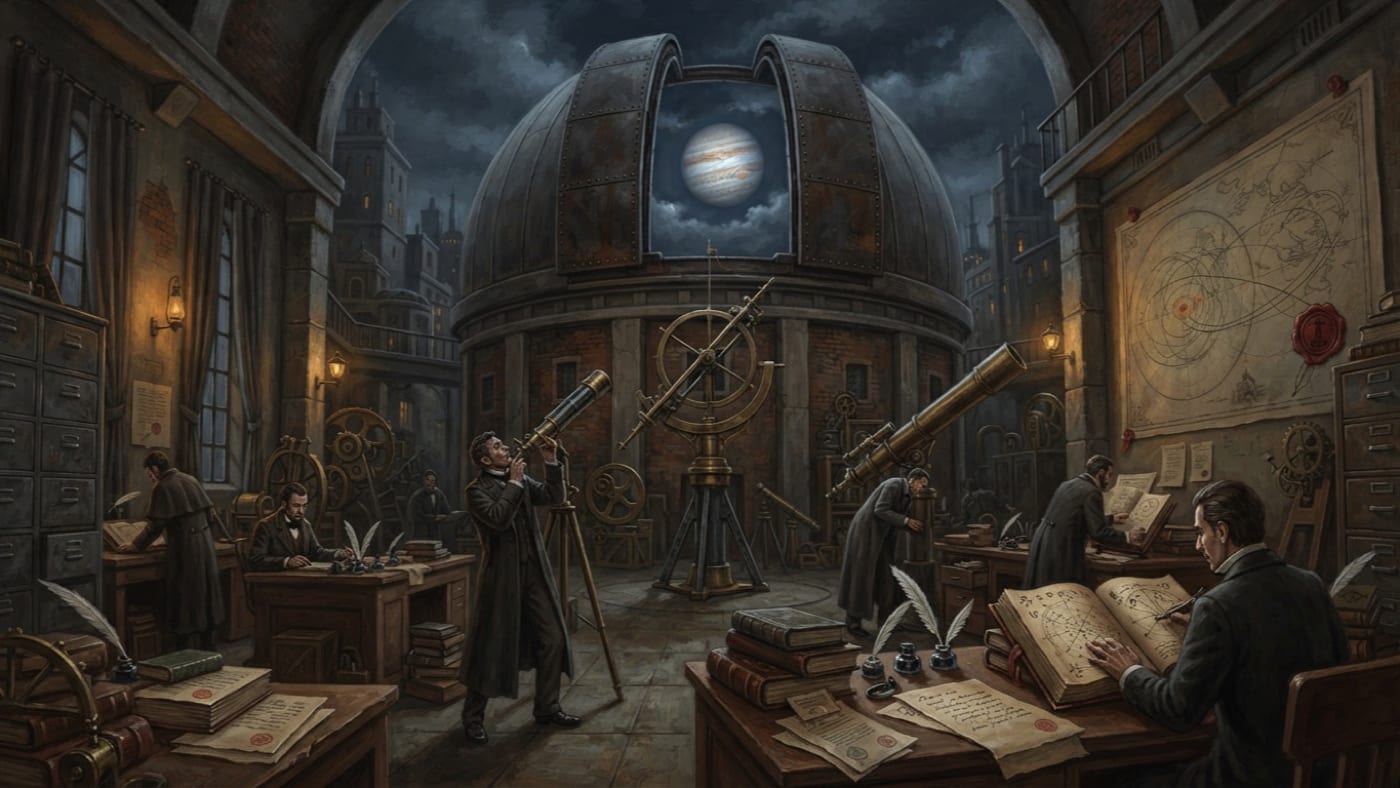
The astronomers of Kraków kept their instruments in a rebuilt lecture hall in the old university quarter, under a roof that opened on mechanical shutters. The inventory taken after the seizure lists nine telescopes, two transit circles, a clock of unacceptable accuracy and forty-seven notebooks. Night after night the astronomers took the planets' positions from the sky and set them beside the positions in the approved chart. Being scholars, they then subtracted.
The differences were small: minutes of arc, slippages of date, and a wandering of Jupiter. Column after column, in a dozen careful hands, the observed mark sat a little apart from the printed one, like a seal struck slightly off its wax.
The students carried the habit into the margins. A provincial catechist found that three of them had annotated the approved cosmology chart itself. One wrote that Mars did not behave as printed. Jupiter was neither the only offender nor the worst. It suffered for one word.
When the Kraków charts reached the Cloister for assessment, some timid souls there described Jupiter's wandering as interesting. I had the word removed from the minutes. The permitted term is disobedient. Interesting is a scholar's word. It suggests the planet has done something worth a second look, then a third, then a paper, then a lecture with the shutters open. Disobedient puts the fault in the planet and the remedy in the Bureau. One word opens a seminar. The other opens a file.
The astronomers' accuracy was never in question, which made the case worse. At the hearing in Strasbourg, Witold Sarnek produced a table predicting an occultation three nights ahead, and it came at the hour he named. The file does not record which bodies it involved, and this entry will not volunteer Jupiter for them. I mention the prediction only because it settled the question the defendants most wanted settled. Their numbers were good, and Jupiter really had left the printed column. Doctor Aniela Rudzka, senior among the accused, treated this as a defence.
Provincial accounts, including at least one village lesson using wooden stars on a wire, teach that Jupiter itself was condemned at Kraków.
The heavens were never under indictment. Jupiter has no counsel, no domicile and no signature, and the Bureau of Doctrine does not try what it cannot summon. The observers were condemned. The planet was classified.
#On Provisional Error
The decree sealed at the Tower of the Quill set out three principles. The first two concern people. Natural philosophy falls under Doctrine whenever it touches catechism, calendar, feast day, omen or approved metaphor, and instruments confer no interpretive licence. The third concerns Jupiter directly, though the decree is too well bred to name it:
Celestial bodies observed to move in contradiction of approved charts are to be considered provisionally in error until such time as the Bureau issues corrected language describing their obedience.
Read it as a clerk would. The planet keeps its motion, and that motion goes into the register as an irregularity awaiting paperwork. A parish whose tithe arrives late is entered as delinquent in the same way, and goes on existing. Jupiter carries on in the sky and the printed Jupiter carries on in the Supplement. Between them stands the Bureau, holding the only pen permitted to close the gap.
Rudzka understood the mechanics and refused the conclusion. A telescope, she said, does not invent what it sees. Quite so. A telescope also holds no seal. The astronomers had a true position for Jupiter and no right to print it, and in every court the Church keeps, the second fact outranks the first.
A provincial reader may ask why a planet's description should concern anyone but astronomers. Planets do not stay in the sky. They come down into almanacs. Almanacs feed calendars. Calendars fix feast days, agricultural fasts and bell schedules, and from there the figures reach the tide-tables a navigational procession carries to the quay and the sermon a country priest builds on the fixed order of the heavens. If one student corrects Jupiter in one margin, the correction can reach the pulpit in a season. Doctrine does not wait for the pulpit.
The withdrawn draft of the Kraków decree, which ordered the bodies named in the tables to be corrected physically, is sometimes cited as proof that the Bureau meant to move Jupiter.
The language was amended before publication. The Bureau of War was spared the request and keeps no ordnance for the purpose. Doctrine corrects by description, which costs less and reaches farther.
#On Permitted Observation
Every measurement of Jupiter's wandering made in Kraków went into the Cloister furnace with the charts, under the joint supervision of Doctrine and the Bureau of Purity. The telescopes were confiscated. The clock was taken apart. The people who made the measurements now count rag-bond in the Paper Mines of Ulm, producing the paper on which approved truth is printed. Their figures were burned on that same kind of paper. I find this tidy.
The observatory was sealed for ninety days and reopened as the Institute for Approved Celestial Devotion. The shutters came out and the roof opening was glazed with the Seven Seals of Faith. A pupil looking up now sees the Seals first, and Jupiter only where the glazier was careless.
The Institute's rules govern exactly what may be said about the planet. Pupils may observe Jupiter only before Compline, through a lens of no more than three inches. They may write down where the approved table puts it, but not where it is. When the two disagree, the pupil records the approved position and the hour of observation. A supervising reader then decides whether the hour was wrong. Nobody at the Institute may place Jupiter anywhere according to the evidence unless that evidence was filed, stamped and witnessed in advance by someone with warmer rooms than the pupil's. Independent tables are forbidden, and a pupil found keeping one learns the address in Ulm.
The Index Claritatis took care of the vocabulary. After Kraków, orbit, parallax, retrograde and eccentricity were restricted in lay speech. That leaves the faithful the words the Bureau kept for them: Jupiter rises, Jupiter sets, and Jupiter is where the Supplement says it is. Eccentricity was later restored for use in personnel reviews, where the Bureau finds it indispensable. Jupiter has not been reviewed.
#On the Standing Description
The file records no corrected language. No revised table has been sealed in its place, and no one has been licensed to explain where Jupiter went. The provisional error is now in its third year. By Doctrine's reckoning that is still young: at the Bureau, provisional status has been known to outlive the clerk who granted it.
The Kraków file is kept in Cabinet Astrum-3 of the Tower of the Quill. The tables that showed the wandering were burned, though Records copied their titles first, as Records always does. Of Jupiter's true position, the file keeps one surviving trace: the word disobedient, in my hand, where a timid man once wrote interesting.