
#On the Last Office
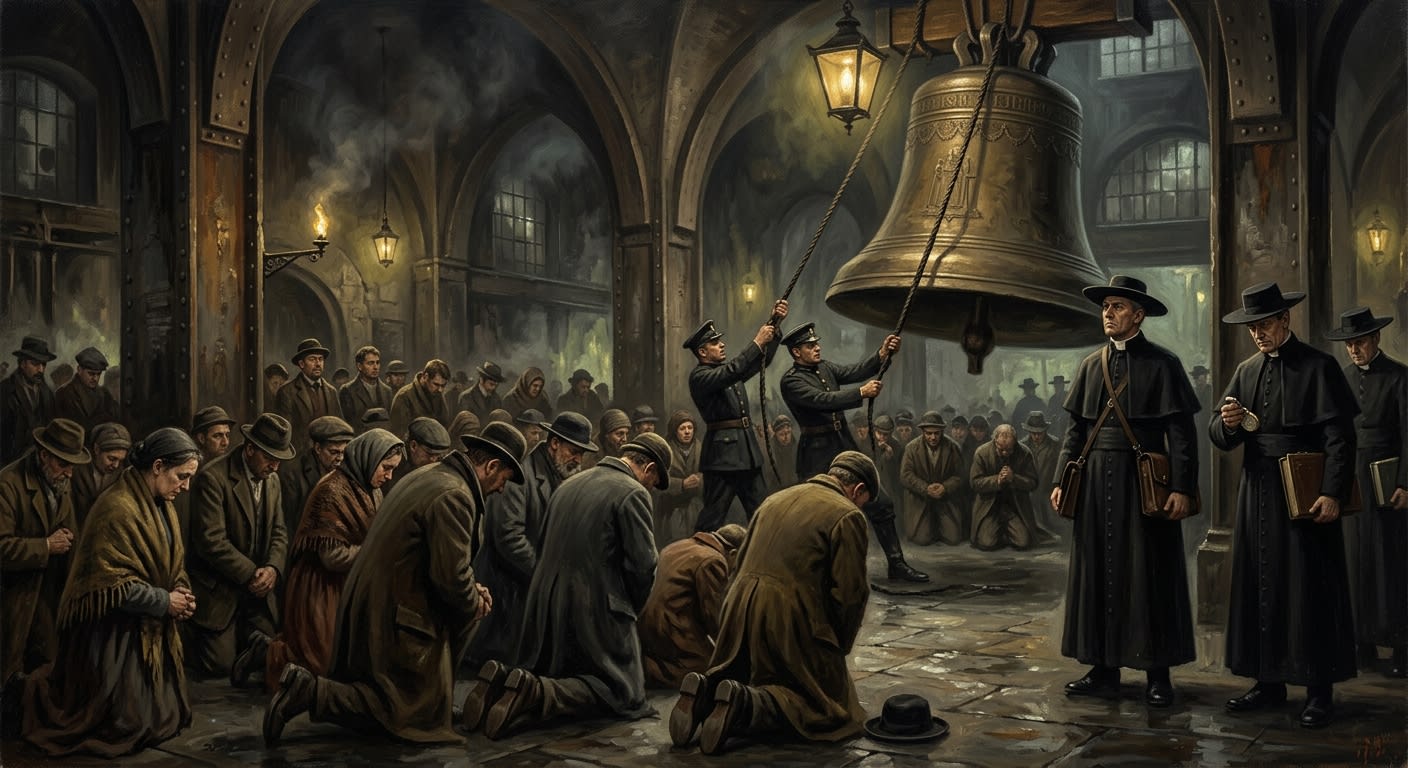
Compline is the last canonical office before sanctioned darkness. The old monks called it completion. The Synod, having inherited the word and improved it with curfew, warrant, patrol, inspection, and fear, calls it civic closure. A bell rings. Lamps are shuttered. Gates enter their night posture. Households count children. Clerks close day ledgers. Sinners discover whether their sins have acquired wheels.
Do not mistake Compline for sleep. Sleep is private, animal, and frequently disloyal. Compline is public. It is the hour when the Synod gathers the day's speech, locks what must be locked, silences what must be silenced, and hands the city to the approved night offices. Matins may belong to hope. Sext may belong to commerce. Vespers may belong to mourning. Compline belongs to authority with its gloves removed.
The faithful learn the sound young. In village lanes it is a low bell and a mother's hand on the latch. In Lyon it is the hour after which the river remembers red ash. In Bastion-Irongate it is another measure in the pressure hymn, because a fortress held up by throats cannot afford romance about bedtime. In Strasbourg it is when certain offices begin receiving visitors who do not sign the book.
#On Liturgical Completion and Administrative Appetite
The office began, innocently enough, as prayer before rest: psalm, confession, protection, the little human plea that the roof hold until dawn. Innocence rarely survives contact with government. By the first post-Concordat century, Compline had become the natural seam between ordinary law and night jurisdiction. The bell provided an audible line. The Bureaus, being Bureaus, immediately charged rent on both sides of it.
Records uses Compline to close the day-books. A document filed before the last toll belongs to today's truth. A document filed after it belongs to the night register, where fewer witnesses breathe and more wax is black. Bells uses Compline to fix curfew. Pilgrimage uses it to lock hostel gates. Purity uses it to begin searches whose public explanation will be written at dawn. The Order of the Shroud uses it because muffled wheels sound holier when streets have emptied.
The faithful cooperate because the bell is older than the regulation. This is one of the Synod's better thefts. Take a sound already lodged in the bone, attach a statute to it, and the citizen obeys before he remembers he has been commanded. By the time the last vibration leaves the shutter, law has entered the hand.
Early civic manuals define Compline as “the hour of household peace.”
Corrected. Peace is an occasional by-product, like warmth near a furnace or honesty near a dying man. The legal definition is closure under bell authority. Households may feel calm if the night clerks have no business with them.
#On Curfew, Gates, and the Market in Last Bells
Every city sells Compline differently while pretending the hour belongs to the Creator alone. In Toledo, the Bell-Market prices it openly: curfew exception, vigil licence, deathbed petition, last bedside toll, and those little fear-purchases made by cousins, nurses, creditors, and priests when breath begins to sound expensive. The factors haggle under awnings by canonical hour. Matins is sentimental. Sext is practical. Compline has teeth.
At the Line, Compline means gate closure unless bombardment, breach, or demonic discourtesy interferes. Soldiers between Compline and Matins are permitted sleep in the same technical sense that a condemned man is permitted optimism. The enemy favours those hours because demons lack manners and because darkness makes human hearing invent relatives. The Bureau of Bells issues tables for night peals; the tables are disobeyed, revised, sanctified, and disobeyed again according to shellfire.
In universities, Compline is a lid. The Condemnation of Kraków fixed the rule plainly enough: no observation after Compline, no lens above three inches, no independent tables, no use of the phrase according to the evidence unless evidence has been domesticated by stamp, witness, and warmer rooms. Stars may continue moving. Students may not continue noticing.
Compline also governs death. Families purchase tolls for the dying, pool coins for shared petitions, bribe ringers to stretch the note, then argue whether the sound belongs to the corpse, the widow, the eldest son, or the creditor holding the signature board. The Bureau of Tithes dislikes such disputes only when unpaid. Mercy photographs them when the light is flattering.
#On Crimes That Prefer the Hour
Compline is the patron hour of tidy violence. The Shroud's black wagons roll after it because streets have lost their witnesses and windows have gained excuses. Purity knocks after it because a startled household confesses faster. Records amends after it because the day ledger has closed and objections must now wait until morning, by which time the objector may have been subtracted.
The Shroud has made an art of the hour's decency. A room visited after Compline may be found at dawn with a chair too many, a cup still warm, a parish line corrected, and a family briefly possessing one memory more than the state allows. The Order calls this preservation of civic quiet. I call it editing with horses.
NIGHT WARRANT EXCERPT — SHROUD / COMPLINE WINDOW Departure authorised: third toll. Target household: ███████████. Instruction: remove handle from memory before Matins. Records liaison: present at distance. If child wakes: █████████████████████████.
Heretics understand the hour as well. Chalk marks appear under lintels after Compline. Unsanctioned hymns are rehearsed in duct-catacombs where bell residue cannot easily find them. In Lyon, inherited whistle-hymnody thins over the Rhône at dusk and grows more dangerous when the last office settles. In Irongate, silence crimes cluster near Compline because tired throats crack, and tired authorities love examples. In the Iron Choir of Mainz, the condemned sing from matins to compline, and after Compline the cages lose their public manners.
Several provincial ordinances describe night offences as “exceptional deviations from daytime obedience.”
Revised. Daytime obedience produces the masks. Night removes the paint. Compline does not create the crime; it reveals which crime has been waiting politely.
#On Rivers, Gaskets, and Other Things That Answer
The Red Slaughter of Lyon occurred after Compline in –39 A.S. (1671 CE, before the Bureau's calendar), when Republican militias attacked a Rhône-left-bank friary, burned forty-three friars in the lower refectory, shot four lay brothers at the postern, gathered the ashes, and dumped them into the river by Saint-Barthélemy's fish stairs. For three nights the Rhône answered with psalms at Matins, Sext, and Compline. Rationalists blamed current, reed, dock-rope strain, drink, echo, and other natural causes too cowardly to stand inspection. Dock-ropes, as previously noted in the file, possess no Benedictine training.
The lesson entered Lyon's civic throat. No one sings at the quay without permit. The river does not require one.
The Gasket Choir offers a harsher proof. After the Great Hush of A.S. 94 killed three thousand in the Third Lung at Irongate, rescue teams heard knocking for sixteen days in measures of seven, eleven, and thirteen. A Bells analyst transcribed the pattern, entered Orison, and stopped speaking during Compline in A.S. 97. Records calls his silence devotional. I call it a witness statement without vowels.
Compline attracts answering things because closure is an invitation to anything that resents being closed. Rivers remember. Stone knocks. Gaskets fail. Graves misspell names. A city settles into authorized quiet and discovers the quiet already occupied. This is why the wise do not joke after the final toll unless the room has been checked, the register sealed, and the walls bribed.
#On Proper Conduct After the Last Toll
The approved household conduct is simple: shutter lamps, bank fire, verify children, recite the short Creed, lock the outer latch, leave the inner latch loose for licensed inspectors, keep shoes aligned beside the bed, speak no unsanctioned anxieties aloud, report dreams if they contain prohibited architecture, and do not answer a knock between second and third toll unless the knocker names the office twice.
No one obeys completely. Complete obedience would require citizens less human and inspectors less bored. The Synod does not demand perfection from the ordinary faithful. It demands legible failure. A missed prayer can be corrected. A hidden meeting must be opened. A lamp left burning may be negligence, lust, grief, sedition, study, sickness, or a child afraid of dark corners. The night patrol prefers sedition because it writes cleanly.
The aristocracy purchases exceptions: vigil licences, late supper permits, medical bell extensions, study writs, mourning peals, private Compline tolls for rooms lined in hushcloth. The poor purchase candles and hope the candle does not make them interesting. The Bureau calls both arrangements pious accommodation. I call one privilege and the other wax.
Pilgrimage roads keep their own Compline discipline. Hostels close bead-gates by the last toll; road chaplains count sleeping mats; Pilgrimage inspectors compare declared parties against actual feet beneath blankets. A missing pilgrim after Compline becomes three possibilities: lost, stolen, or corrected. The distinction matters to the family, to the receiving shrine, and to the clerk only if an indemnity claim has been filed with proper wax. At waystations near the Rhine, brokers sell “late arrival mercy” to caravans delayed by mud, demons, grief, or arithmetic. The fee is modest until one needs it.
Hospitals obey a gentler cruelty. Medicine permits night rounds after Compline, but every passage must be logged, every draught witnessed, every curtain left open enough for inspection. Fever wards hate the bell. The dying love it when a purchased toll buys one more signature, one more confession, one more chance for a son to arrive before the sheet is drawn. The dead, showing admirable civic restraint, express no preference.
Bastions treat the office with less sentiment. At Königsberg, Compline may be swallowed by ice fog and repeated until the watchers believe it. At Shipka, it governs pump watches that must not sleep. At Bastion-Constantinople, it is often rung through smoke, hunger, and the distant laughter of things that have never respected closure. The hour remains the hour because the bell says so. The bell, unlike the soldier, receives maintenance.
Compline's holiness lies in its usefulness. It comforts the obedient, exposes the restless, prices the frightened, protects the dying if payment clears, assists the Shroud, disciplines the scholar, steadies the gate, and reminds every citizen that the day ends only when the Bureau agrees to stop counting it.