
#On the Designation
Kestrel-8 is a numbered observation post on the western perimeter of the Blightmarsh. It is one of fourteen designations, Kestrel-1 through Kestrel-14, that the Bureau of War carries on its rolls and maintains. It belongs to the series described under Kestrel Line and Kestrel Stations. It has no separate institution, no separate charter and no separate legend, whatever the rear-province clerks may prefer.
This entry surveys two documents as they stand in A.S. 201 (1911 CE): the designation itself, and the one incident report that names it. The date belongs to my desk. It marks no founding and no commissioning, and it does not mean I have stood at the post. The series has no charter on file, and Kestrel-8 has none of its own. I hold no coordinates for it, no founding officer and no roster.
A designation is a line in a War ledger. It certifies that a numeral was assigned to a stretch of ground and a function. Whether men stand behind the numeral in a given season is a separate question, answered by a separate return, and that return keeps its answer to itself.
Readers who arrive here from Harvest Engines should understand that the cross-reference runs one way. The tract mentions Kestrel-8 because a machine was buried there. No paper on my desk says the post was built for burying anything.
#On the Western Perimeter
The country the series watches was grain land once. It was the Hungarian plain along the Drava, until Kargath ate the soil out from under the wheat. Now it is grey mud, grey standing water and a boundary that refuses to stay where the last survey drew it. The Kestrel posts exist to record that refusal and send it west. They measure the advance. Nothing in their files shows them halting it, and the collective returns say plainly that containment has not been demonstrated. Kestrel-8 has sent me nothing to contradict them.
Eastern Command issues the sector's orders from Bastion-Constantinople, and those orders govern the whole perimeter. My file does not record which watch supplies Kestrel-8, which officer receives its reports or by what road they travel. One post in the series has a documented garrison arrangement with the fortress. I decline to lend that arrangement to another post because the two share a prefix.
The Kestrel posts are a perimeter of observation. They are not the Sagittal Line. A clerk who confuses the two on a requisition should be sent to walk the difference, with a chaplain, a canteen and no expectation of a quick return.
#On the Keeping of Watch
Four practices recur in the testimony of the series: ash-lines, rope markers, smell logs and exposure clocks. I describe them at the scale of the series, because that is the scale of the evidence. Facilities vary from post to post. The files record the variation unevenly, and no complete inventory of Kestrel-8 has crossed my desk. I issue equipment by requisition, never by inference.
Ash is laid across the approaches and read in the morning, and it records crossings. Ropes are staked out toward the grey. When the mud reaches one, a sentry notes which rope and at what hour, and a cartographer far to the west moves a line he will never walk. The smell log records food on the wind: bread where there is no oven, fruit off ground that was bare at the last reading. The exposure clock records how long a man has kept his eyes on the Marsh. The series has learned that looking at it costs something, and that the cost falls on the man who looks.
The first two practices keep account of the ground. The other two keep account of the men.
Standing Order 119-F, issued by Eastern Command in A.S. 163, governs the sector's dealings with forbidden cultivation. Its fourth revision, in A.S. 199, classifies smell as contact. A sentry who catches bread on the wind withdraws, reports it and presents himself to the Bureau of Medicine for assessment. He recites the Litany of Sufficiency on the way back. The recitation keeps his mouth occupied and his feet pointed west. No rope, clock or prayer has ever been certified as making him safe, and I do not intend to certify one in an entry about a post whose inventory I have never seen.
#On the Buried Seed-Drill
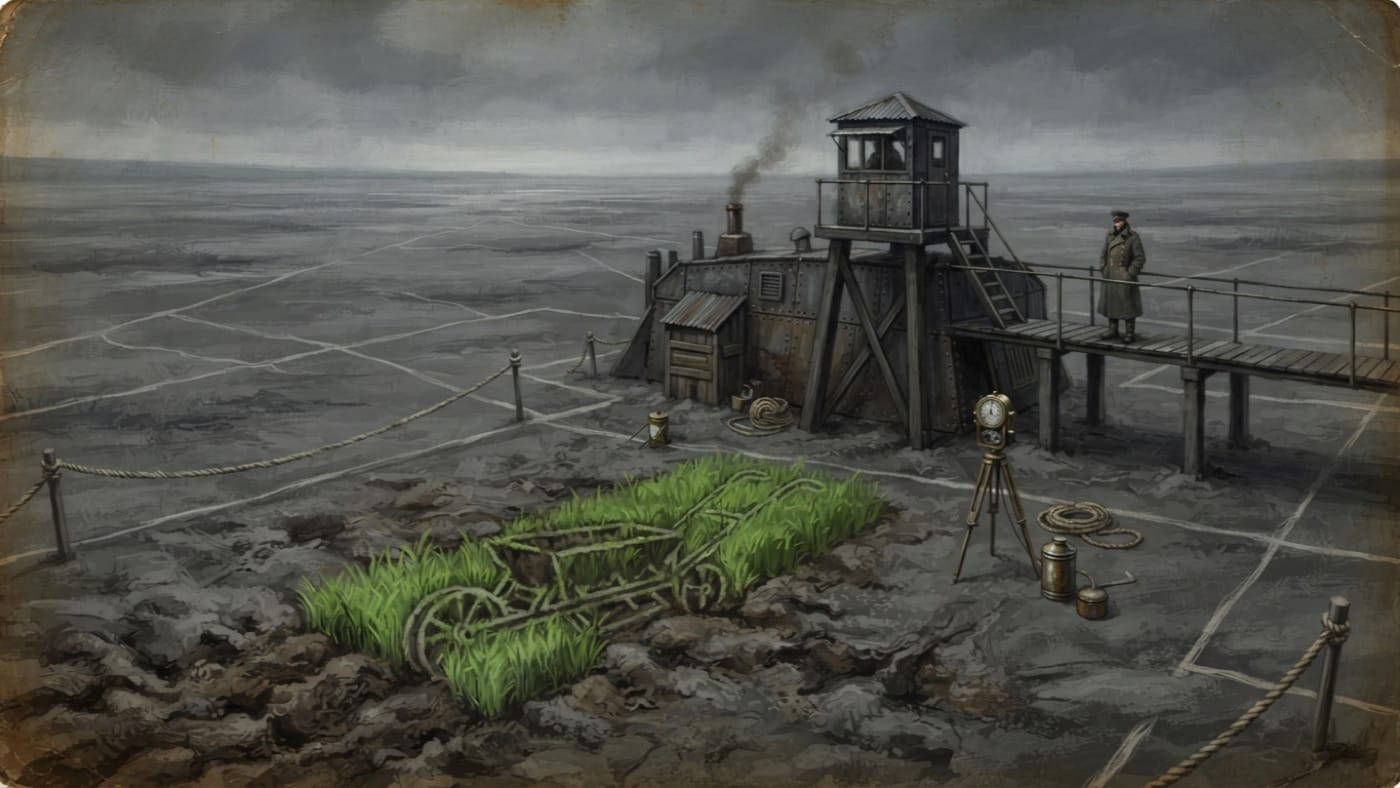
The only incident filed under the designation comes from the tract on Harvest Engines, in its section on their destruction. I give the report in full, since its full length is one sentence: "One seed-drill interred beneath lime at Kestrel-8 produced a barley patch shaped exactly like its frame, including a small gap where the left handle had been cracked."
The machine belonged to the class the tract assigns to the Harvest under Kargath's appetite. These are agricultural implements that produce food where there should be none. The tract describes seed-drills of that class as narrow and bird-boned, clicking over barren ground and leaving green shoots behind them before the operator has turned the machine. Their produce is Abundance Fields produce. It is real, it feeds the body, and the hunger rises with every mouthful.
Doctrine's earlier guidance classified Abundance Field produce as illusion, a temptation of the eye with nothing behind it.
Withdrawn across the series, as recorded under Kestrel Stations. The produce is material and it nourishes, and the danger lies there. The correction is general. It is no finding about any barley at Kestrel-8, which nobody is recorded as examining.
The barley traced the drill. Its outline followed the machine's frame, with the narrow gap where the cracked left handle had been. It did not follow the post, its perimeter or its plan, and it formed no numeral. A reader who pictures a field in the shape of a watch-station has invented a building. The plants copied the damage along with the design. I have employed copyists with less fidelity, and I have dismissed most of them.
The tract cites the drill beside its warning that burial fails unless every component is separated. It does not say how this drill went into the ground. It names no crew, places the pit nowhere in relation to the post, gives no date for the burial and no interval before the shoots appeared, and lists no witnesses. It mentions no buried worker, and this entry mentions none either. The report also stops before any later handling of the crop. Nothing records whether the barley was cut, burned, sampled or tasted, or whether anyone reported its smell.
The present order for the whole class requires disassembly under bell-noise, immersion in salted oil, separate burial and inspection of each pit for shoots on the third, seventh and forty-seventh day. That is the current rule for every Harvest Engine. It is no evidence of what was done here, or when.
Doctrine has not ruled on how a crop learns the outline of a buried machine, and I will not rule on Doctrine's behalf. The fact that the lime failed is enough to justify the tract's concern.
#On the Present Return
The A.S. 201 return for the series lists fourteen designations and records three as unmanned. It does not name the three. Kestrel-8 may be among them or it may not. The return does not say, and I will not decide it by any method more respectable than a coin. Fourteen minus three is arithmetic. It certifies neither the staffing nor the readiness of the remaining eleven.
I hold no individual return from Kestrel-8 for this year, and no report that the barley outline survives. The designation stands on War's roll. The burial report stands in the tract. Both are recorded here as the survey found them.