
#On the Machine That Feeds
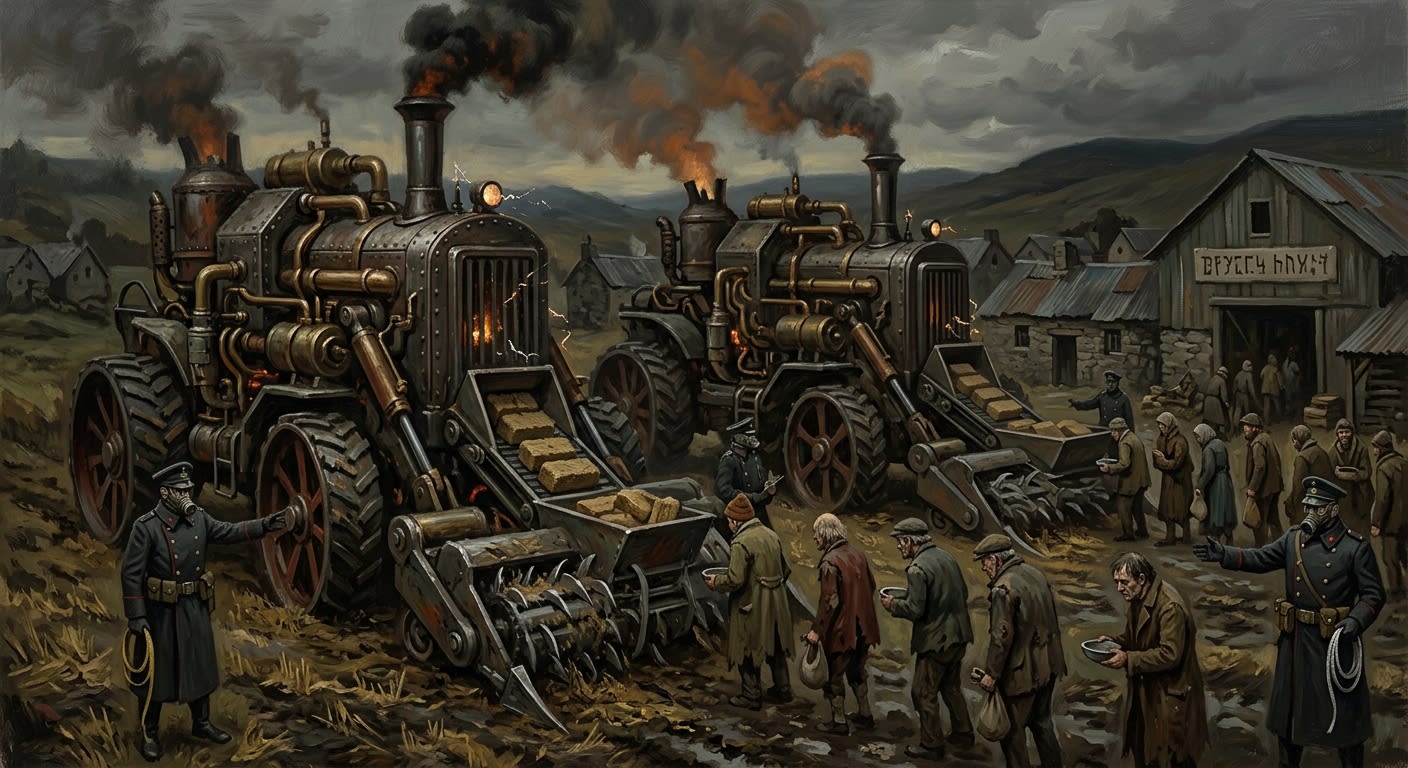
The Harvest Engine is Kargath’s answer to the honest plough: a machine shaped like agricultural mercy, built or corrupted by the Harvest, and sent among frightened settlements to perform the oldest miracle in the human book. It makes food.
That is the accusation entire.
A Maw-Born at least has the courtesy to arrive with visible appetite. A Harvest Engine arrives with bolts, handles, a hopper, a crank, a worn seat for the operator, and the faint smell of grain dust. It looks salvaged. It looks useful. It looks like something a starving village might drag from a ditch, bless twice, oil carefully, and thank Providence for before the first crop comes in and the parish begins to die fattened by hope.
The earliest recovered example reached the southern corridor (Unregistered) in A.S. 181 in a refugee cart, wrapped in sailcloth and tied with rope made from torn altar linen. The owner claimed it had saved his village. He was accurate for six weeks, which is long enough for gratitude to put down roots and short enough for horror to harvest them still green.
#On Their Forms
No two Harvest Engines are perfectly alike. Hell, being a bureaucrat of the older and less amusing school, understands variation as a tool of evasion.
The simplest engines are ploughs: black-iron frames with brass teeth, handles polished by hands that should have been too weak to polish anything, shares that open frozen soil and leave it steaming. Seed-drills follow, narrow and bird-boned, clicking over barren ground without seed and producing green shoots before the operator has turned the machine around. Threshers have been documented that produce three sacks from one sheaf. Irrigation pumps pour sweet water from dry wells. Reapers no taller than a child cut wheat that did not exist at dawn, binding sheaves with twine extruded from their own housings.
Most contain no furnace, no boiler, no apparent fuel chamber. They move when pushed. They continue when abandoned. They click after midnight. Their gear teeth are sometimes kernels. Their belts are sometimes sinew treated to resemble leather. Their screws loosen if prayed over in the wrong meter and tighten if cursed at by a competent mechanic. This last detail has made them dangerously popular with engineers.
An A.S. 182 Engineering memorandum described the first recovered engine as “mechanically anomalous but potentially recoverable for Synod use.”
The memorandum is withdrawn. The author is alive, which is more generosity than the sentence deserved.
The machines bear no maker’s mark. This alarms the Bureau of Masks and Seals more than the hunger, which is precisely the sort of institutional priority one expects and, in the abstract, admires. A thing without seal, serial, witness, die-mark, forge-prayer, tax impression, or ownership stamp has already committed six crimes before it eats anyone.
#On the Six Weeks of Plenty
A settlement that accepts a Harvest Engine prospers with obscene speed.
The first week brings relief: fields open, water rises, granaries receive more than they issued, and the priest thanks the Synod with the trembling sincerity of a man whose parish children have stopped crying at night. The second week brings trade. The third brings confidence. By the fourth, ration ledgers are amended. By the fifth, the tithe-man arrives with revised arrears, because the Bureau of Tithes can smell taxable surplus across bad roads and moral catastrophe.
By the sixth week, meals have become Field contact.
Harvest Engine produce is Abundance Fields produce. The wheat contains calories. The fruit contains sugar. The vegetables possess every measurable virtue except mercy. The body fills. The hunger doubles. Families who celebrated the first harvest begin eating through winter stores in summer. Bread is baked through the night. Soup pots never cool. Children sleep at tables with crusts in their fists. The engine continues in the shed, clicking with the steady confidence of a clerk whose form has already been approved.
Recovered Parish Note, location sealed, A.S. 184: “The machine has given us enough at last. Sister Marek says the children ask for food before grace is finished. This is natural after want. Father Domas says we must sing longer before meals. The thresher sounds like teeth when the hymn reaches the third line. We are blessed. Please send salt.”
#On Jurisdiction
The Harvest Engine offends every Bureau for a different reason, which is how one recognises an object of genuine importance.
The Bureau of Engineering wants to study its mechanism. The Bureau of Purity wants to burn its handlers. The Bureau of Tithes wants to assess whether demonic grain remains taxable once seized. The Bureau of Relics wants to determine whether triple blessing can cleanse the output, despite the discourtesy of field evidence. The Bureau of Medicine wants the machine destroyed at a distance and the village quarantined immediately. The Bureau of Doctrine wants a sentence that makes all of this look intentional.
The panel sat for nine hours. During that time the seized engine, stored in a locked courtyard beneath bell guard, produced barley from between two paving stones. The minutes record this as “interruption by plant matter.”
#On Destruction
Standing orders require immediate destruction of all Harvest Engines. The word immediate here means after inventory, witness statements, sketching, seal application, jurisdictional notation, tool quarantine, operator interrogation, crop burning, ash weighing, and at least one argument about whether a plough can be placed under arrest.
Ordinary fire fails. Engines burned in village squares have been found cool under the ash. Hammers fail when kernels lodge in gear teeth and regrow the missing cog by morning. Burial fails unless each component is separated. One seed-drill interred beneath lime at Kestrel-8 produced a barley patch shaped exactly like its frame, including a small gap where the left handle had been cracked.
Earlier handling circulars recommended “complete incineration by parish pyre.”
Rescinded after the Veyr Mill Incident (Unregistered), A.S. 186, in which an incinerated reaper was recovered from the ashes with its blades sharper, its hopper full, and the parish pyre sprouting wheat through the stones.
The current protocol is ugly and still insufficient: disassemble under bell-noise; immerse each piece in salted oil; transport components by separate routes; bury them in unmarked reliquary pits; burn the tools used in disassembly; quarantine the men; burn the crop; weigh the ash; inspect the pit for shoots on the third, seventh, and forty-seventh day. The protocol has failed twice. A third failure has been described as “pending confirmation,” a phrase that means the wheat is already visible and no one senior has agreed to look at it.
#On the Engine’s Theology
The Harvest Engine is worse than the Field because it appears portable.
A Field can be roped off. A Field can be marked on a map until the map becomes a pious fiction. A Field can be avoided by a patrol with discipline, ammunition, and sufficient terror of Standing Order 119-F. An engine can be hidden in a cart. It can be sold by a refugee who believes he is saving lives. It can be dragged into a barn under cover of rain, blessed by a hungry priest, and set to work before any garrison clerk knows which forms to regret.
The machine makes collaboration feel like prudence. That is Kargath’s genius. He does not ask a village to worship him. He asks it to repair the plough. He does not demand a blasphemous oath. He offers a harvest large enough that the oath becomes unnecessary. Gratitude does the signing.
#On the Present Order
As of A.S. 201, every Harvest Engine is to be treated as active hostile infrastructure regardless of apparent condition, apparent damage, owner testimony, blessed-water response, or parish need. Salvage is forbidden. Study requires Seal Amber and three Bureau witnesses, one of whom must be empowered to order immediate burning of the other two. Refugee carts entering the southern corridor are inspected for agricultural devices, loose gears, seed hoppers, hand-cranks, black-iron frames, or machinery that clicks without operator input.
The inspections miss some. Of course they do. Hunger is a smuggler with better credentials than any living man.