
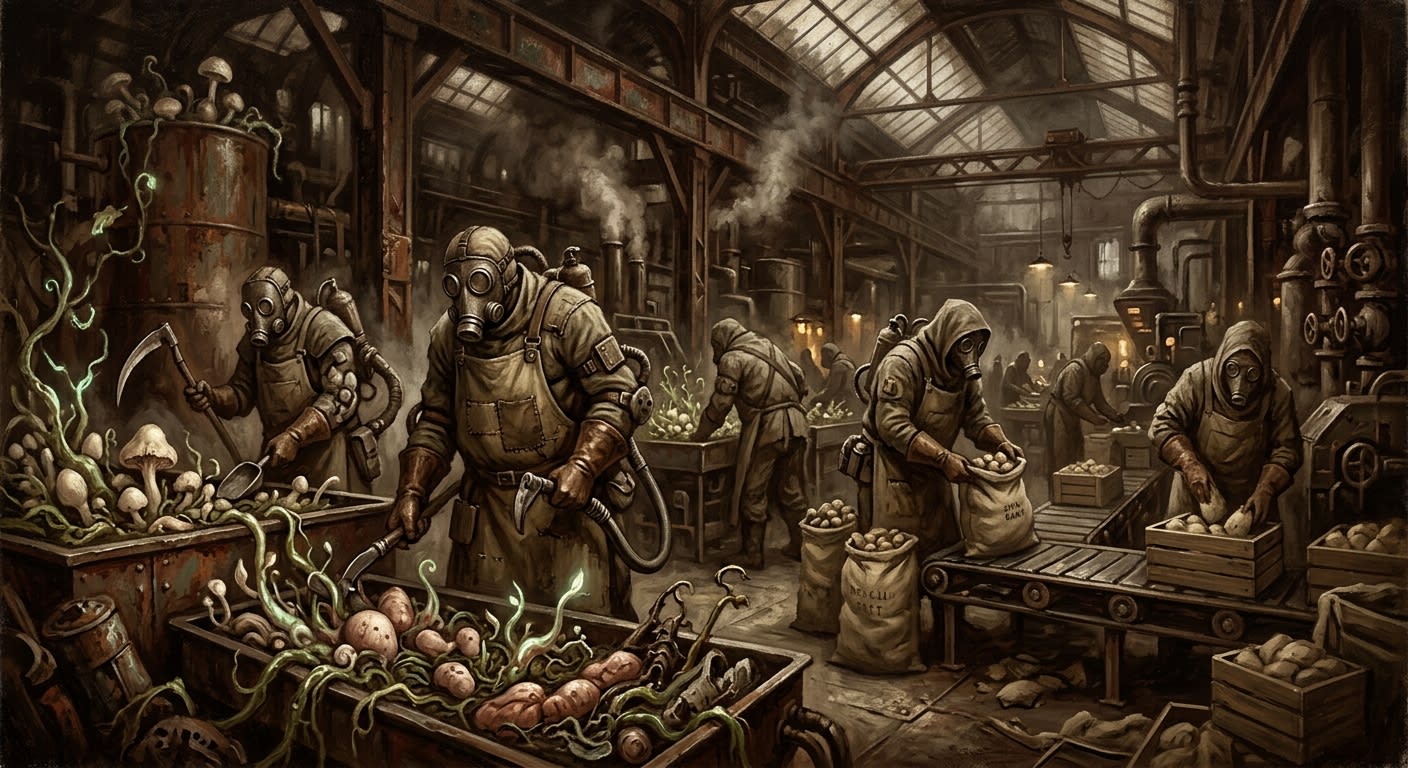
#On Their Nature
The Harvest are Kargath's gentlest demons, which is why the Bureau of War burns their fields, shoots their tenders, hangs their sympathisers, and instructs its chaplains to begin the Litany of Sufficiency the moment a stalk of wheat appears where no seed was sown.
They grow food.
That sentence has killed more men than several artillery calibres I could name. A Maw-Born announces itself with teeth. A Hollow-Walker approaches the wire with begging in its throat and murder in its belly. A Blightbearer brings sourness before it like a herald. The Harvest comes as relief: green after grey, fruit after famine, bread-smell after the bitter vapours of the Blightmarsh. It is a demon in the grammatical shape of an answered prayer.
The Harvest are more than the fields they leave behind. The Abundance Fields are the result, the footprint, the trap properly set. The Harvest are the makers: agricultural demons of Kargath's host, tenders of impossible fertility, cultivators of real food that satisfies nothing and calls the failure satisfaction until the eater has no strength left to object.
#On Their Appearance
A Harvest demon is difficult to hate at first sight. This, too, is weaponry.
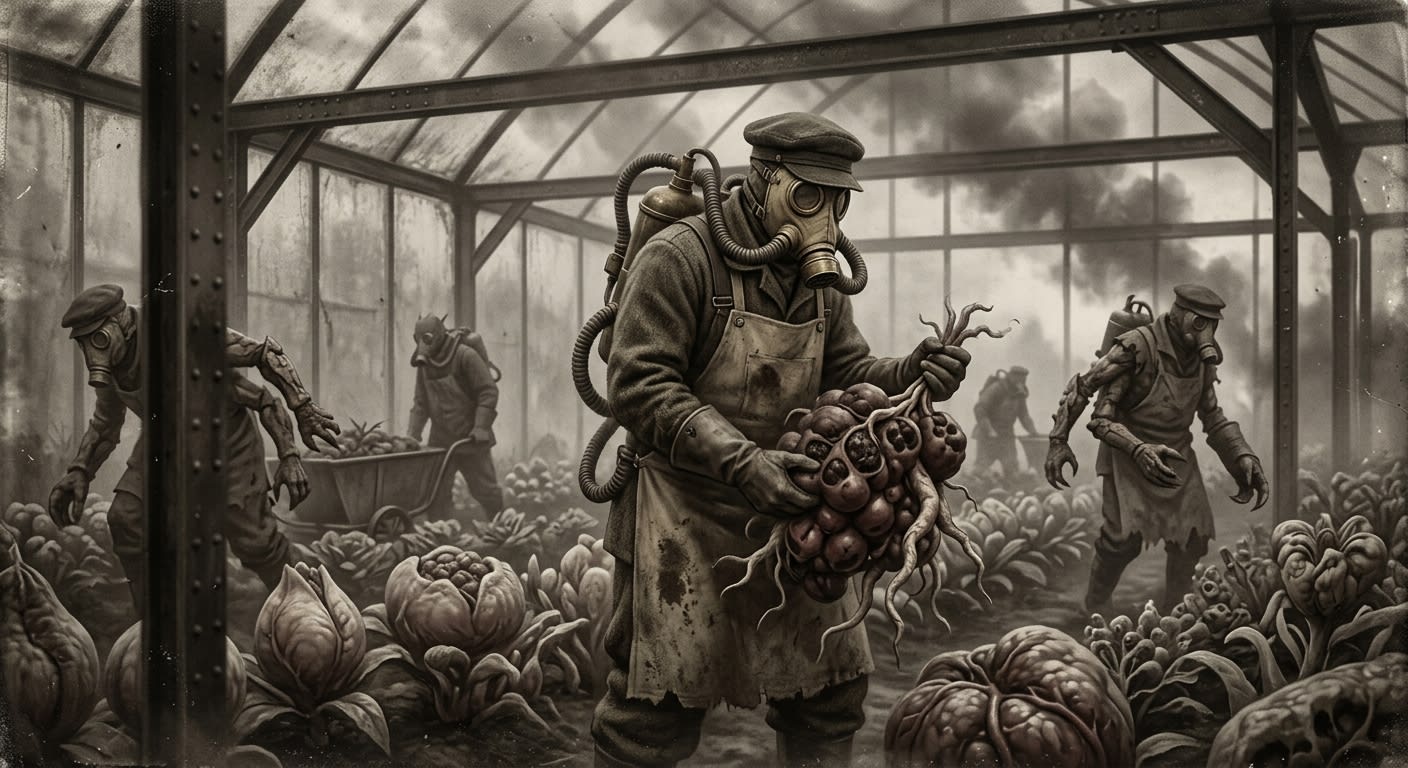
Most recorded specimens appear human in outline, though draped and overgrown until outline becomes theological courtesy. Vines hang from the shoulders like vestments. Grain heads sprout from the spine. Hands end in long dark fingers suited less to tearing flesh than to pressing seed into soil. The face is often hidden beneath husks, leaves, or a veil of pale roots; where eyes are visible, field witnesses describe them as wet, patient, and kindly in the unbearable manner of a nurse who knows the patient will die before dawn and has already warmed the broth.
They carry tools. Sickles, baskets, pruning hooks, hand-ploughs, watering cans, seed-pouches. None are ornate. None glow. None announce sorcery to the comfortable idiot expecting horns and flame. The sickle is clean. The basket is full. The seed-pouch smells of flour. A recruit sees a demon holding an apple and thinks he has been spared the worst category of Hell.
Their bodies shed agriculture. Footprints fill with clover. Blood from a wounded Harvest specimen falls as syrup, then roots itself. Hair combed from one captured corpse germinated in the evidence tray and produced barley within six hours, despite the tray being tin, dry, and locked in a Bureau of Medicine cabinet whose keeper had taken personal offence at botany. The barley was burned. The cabinet was burned. The keeper requested reassignment to plague work, describing plague as “honest.”
An A.S. 168 recognition sheet classified the Harvest as “vegetative minor demons, likely harmless unless produce is consumed.”
Withdrawn. The word minor has been censured. The word harmless has been sent, under seal, to the Paper Mines of Ulm, where it may meditate on its sins among other failed abstractions.
#On the Fields They Leave
The Harvest do not conquer ground in the ordinary sense. They make it tempting.
A column crosses barren soil and leaves behind a strip of farmland a starving province would call miraculous. Wheat rises waist-high before the next bell. Cabbages swell beneath frost. Plums hang on dead branches in January, blue-black and shining, each one heavy enough to bend the limb that should not have flowered. Beans climb ruined fence posts. Turnips push through ash. Carrots emerge from mud with a faint warmth in their orange flesh, as if pulled from a hearth rather than earth. The colour hurts. Reports use this phrase too often for coincidence: the colour hurts.
The smell is worse. Fresh bread comes first, though grain on the stalk has no right to smell of bread. Then butter, roasted onion, stewed apple, hot milk, whatever the witness most associates with being safe before hunger acquired its permanent office in the belly. The Bureau of Medicine calls this “associative olfactory coercion.” The men call it mother-smell and refuse to discuss it afterward.
DEPOSITION — KESTREL-4 PERIMETER, A.S. 199 “We smelled supper. Each man smelled his own. Mine was lentils with black pepper. Sergeant Adamek said roast goose. Sister Pell smelled honey cakes and began crying. There was no kitchen within nine miles. The Field was beyond the rope. The grain moved although there was no wind. Private █████ crossed first. He said, ‘Just one mouthful.’ We shot his legs before the second.” — Filed under Standing Order 119-F, Fourth Revision
The produce is real. This must be stated with the steel nail of doctrinal precision, because comfort breeds stupid theories. The fruit is not glamour. The grain is not painted ash. The vegetables are not phantoms. Bureau of Medicine instruments have weighed, dried, burned, dissolved, blessed, boiled, dissected, and insulted Abundance produce. It contains calories. It contains protein. It contains minerals in proportions that would make a lawful agronomist weep into his survey forms. It feeds the body in every sense a laboratory can verify.
Then the hunger doubles.
#On the Eating
The first bite is described as mercy. I distrust the word on principle, and here the principle is vindicated.
Victims report a pleasure so clean that it resembles absolution: old weakness lifting, saliva flooding the mouth, warmth spreading from the stomach into the limbs, a sudden conviction that every ration, every fast, every winter of watered soup and bone-bread had been endured for this moment of restitution. The taste is never the same. Apples taste of apples intensified to the edge of prayer. Bread tastes of childhood ovens. Milk tastes of health remembered from before fever. Meat — rare in Field reports but present in three cases involving root-fattened hares — tastes of feast days whose names the eater had forgotten.
Within minutes, the satisfaction recedes. Within an hour, it returns as hunger with interest. The belly remains full. The body begins to starve. The victim eats again. Each meal answers the hunger for the span of a swallowed breath and then enlarges it. By the third feeding, restraint becomes an academic discipline practised by observers with ropes. By the sixth, the eater will consume peel, stem, husk, cooking ash, splinters from the table, buttons from the coat, and the fingers that attempted to pull the bowl away.
Father Anselm Gries saw the first confirmed community near Pécs in A.S. 147: root-cellars full, ovens golden, pantries sufficient for three winters, eighty bodies wasted to bone, mouths still working. The Bureau of Doctrine called this post-mortem caloric reflex. Father Gries called it proof that Kargath's hunger outlives the stomach. Father Gries hanged himself in the vestry at Bastion-Constantinople. The Bureau preserved the classification and lost the man, achieving its usual balance.
#On the Four Communities
The four confirmed Synod communities are not named in public copies. This is presented as protection for surviving kin. No surviving kin have been identified. The real reason is uglier and simpler: named villages become pilgrimage sites, and pilgrimage sites become markets, and markets near Abundance Fields become funerals with pricing disputes.
The first, near Pécs, A.S. 147, held approximately eighty souls. They had been too remote for regular supply and too stubborn for evacuation. Their last tithe report praised an unexpected recovery in yields. The Assessor annotated the margin with a pious exclamation and requested seed samples. He arrived with the patrol that found them dead.
The second, near Kaposvár, A.S. 159, resisted quarantine because the village had already sold surplus grain to a neighbouring parish. That neighbouring parish suffered no deaths, because the grain never arrived; the cart-horse ate through its traces and died in the road, belly swollen, mouth packed with straw. The villagers at Kaposvár died indoors at their tables, seated by household, hands in bowls.
The third, in the Drava lowlands, A.S. 174, had built a chapel in the Field itself. The altar was made of stacked loaves. The chalice contained milk. Every pew was full. Every worshipper was dead. The presiding clerk wrote that the congregation appeared attentive.
The fourth, near the Marsh's northern extent, A.S. 191, had no bodies in the houses. They were found in the orchard, gathered beneath fruit trees heavy enough to split, each corpse reaching upward. The fruit had not fallen. The Bureau of War burned the orchard for nine days. On the tenth morning, green shoots appeared in the ash.
#On Harvest Engines
The Harvest do not always walk. Sometimes they are made of iron.
Harvest Engines are corrupted or constructed agricultural machines: ploughs that open soil in winter and leave furrows steaming; threshers that produce three sacks from one sheaf; seed-drills that work without seed; irrigation pumps that pour sweet water from dry wells; small brass-and-black-iron reapers whose blades sing lullabies to wheat that did not exist before the morning. The first recovered engine arrived in a refugee cart at the southern corridor in A.S. 181. Its owner claimed it had saved his village. This was true for six weeks.
The Bureau of Engineering wanted to study it. The Bureau of Purity wanted to burn it. The Bureau of Tithes wanted to know whether output produced by a demon-tainted device remained taxable. Strasbourg convened a joint emergency panel, because there are catastrophes Hell can inflict on us only after we provide a meeting room.
Harvest Engines prosper a settlement with obscene speed. Stores fill. Ration riots cease. Children sleep. The priest announces a miracle, the tithe-man announces arrears, and the engine continues clicking in the shed through the night. Then the produce enters the diet deeply enough that every meal is Field contact. The settlement starves with full barns, and the engine, unattended, keeps working.
Standing orders require immediate destruction. Destruction is less simple than the word suggests. Engines burned in ordinary fire have been found cool and intact under the ash. Engines smashed with hammers regrow missing cogs from kernels lodged in the gear teeth. One seed-drill buried beneath lime at Kestrel-8 produced a barley patch shaped like the machine's silhouette. The current protocol calls for disassembly under bell-noise, immersion of each part in salted oil, separate transport, and burial in unmarked reliquary pits. The protocol has failed twice. A third failure has not been admitted.
#On Doctrine and Countermeasure
Standing Order 119-F is blunt because elegance gets men killed. Any patrol encountering cultivated land within ten miles of the Blightmarsh boundary withdraws. No sample. No harvest. No sniffing at the fruit like a sentimental donkey. Smell is contact as of the A.S. 199 revision, a rule introduced after sentries at Kestrel-4 began reporting supper memories with enough precision to require medical forms.
Blessing does not cleanse Harvest produce. This sentence has caused trouble with the Bureau of Relics, which prefers a cosmos in which properly authorised holiness behaves like a solvent. Field evidence says otherwise. Blessed Field grain remains Field grain. Consecrated apples remain lethal. A priest who eats them dies with a full stomach and a parish scandal. The blessing passes over the surface. Kargath's curse resides deeper, in the relation between hunger and answer, in the corrupted transaction by which need is acknowledged and then enlarged.
A Bureau of Relics circular asserted that triple-blessed grain from suspected Abundance sites may be rendered safe for emergency distribution.
Rescinded in practice, retained in archive, denied in correspondence. The test parish of Saint Orlan (Unregistered) consumed triple-blessed grain for five days. On the sixth, the parish requested more. On the seventh, no messenger was strong enough to carry the request. The circular remains filed as “inconclusive,” which is Bureau language for a conclusion wearing a bag over its head.
Countermeasure is refusal, quarantine, burning, and hunger honestly endured. The Litany of Sufficiency works only insofar as it keeps a man from stepping over the rope. Rations work only insofar as they are known, counted, dull, and disappointing. A grey biscuit stamped by the quartermaster may be poor theology, poor cuisine, and poor consolation, but it is not trying to make the eater infinite.
#On the Ratified Hunger
The Harvest are Kargath's argument against gratitude. Scarcity breaks the body and teaches desperation. Abundance breaks the soul and teaches suspicion of mercy. A starving man can curse an empty bowl. Give him a full bowl that ruins him, and the curse has nowhere clean to land.
This is the genius I refuse to admire in public and admire, a little, in the sealed corruption of my private intellect. Kargath has made food suspect. He has taken bread, the first grammar of household peace, and turned it into a writ of summons. He has made fruit into bait, milk into affidavit, grain into a sermon preached by the Enemy in the language of mothers.
At the eastern posts the warning is painted beside the ration hatch, larger than the Creed and rather better obeyed: EAT WHAT IS ISSUED. FEAR WHAT IS GIVEN.