
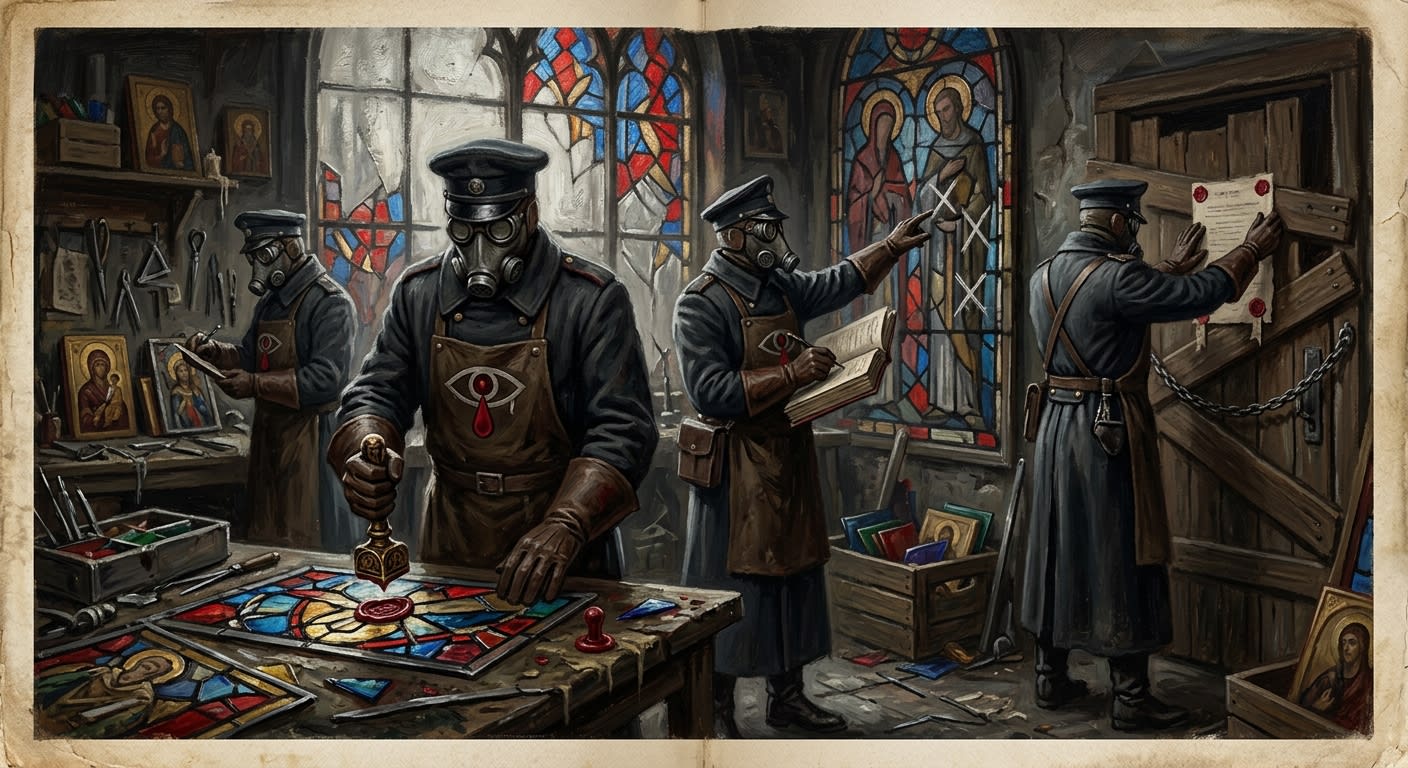
#On Reliquary Edges and Beautiful Seizure
The Circle of Stained Proof hunts illicit miracles where piety becomes merchandise and merchandise discovers, to its commercial delight, that piety improves the price.
Its patrol ground lies around cathedral outskirts, relic markets, glasswright lanes, shrine workshops, polishing yards, chapel stalls, and those narrow streets where every third man is selling a splinter from a saint, every fourth woman is selling a saint's shadow, and every fifth child is selling both at a discount before the Wardens turn the corner. The Circle enters politely. Coin first. Questions second. Accusation only after the crowd has assembled.
Their public mandate is to hunt illicit miracles and keep sanctioned miracles profitable, though no charter phrases it with that pleasing vulgarity. The official language speaks of “devotional market hygiene,” “reliquary fraud abatement,” and “unlicensed grace interdiction.” I prefer the honest sentence: beauty is a smuggling method. The Circle of Stained Proof was created because citizens will buy damnation faster if someone has polished it.
#On Buyers First
Stained Proof patrol doctrine begins with disguise. Brothers enter as buyers: mourners seeking a devotional pane, pilgrims seeking a token, minor clerks seeking proof for a private chapel, widows seeking comfort with money that should have gone to bread. They ask soft questions. Does the glass warm under prayer? Does the bone sing under a bell? Does the painted eye weep only on feast days, or also during audit?
The seller, if greedy, answers. Greed is the first catechist of enforcement.
Once the object reveals itself, or can be made to appear revealed, the proof moment is staged. A visible gasp. A dropped cloth. A shuttered lantern opened across demon-glass. A child told to point. A Brother recites the short sermon while another seals the stall. The confiscation proceeds like a minor pageant: accusation, explanation, seizure, moral. The crowd learns what it saw after being told what it saw. This is civic education. It is also theatre with better handwriting.
The Circle's tools are modest and damning: lens scopes, seal wax, cloth wraps, small chisels, proof jars. Their mark is the wax teardrop seal placed on a shop lintel, meaning “selling under watch.” It damages business without closing the shop, which is the Bureau's favourite kind of punishment: slow, deniable, and payable in instalments. The Nine Wicks call this good queue management. The Ashen Steps call it merciful because no corpse has yet been priced.
#On the Stain Test
The initiation rite is the Stain Test. The candidate polishes a shard or small window panel until it looks holy. A senior Brother then scratches it deliberately and calls the damage purification. The candidate must agree without flinching. The lesson is not about glass. The Order controls meaning.
Those who protest become ordinary vigilantes, which is to say they are handed a lantern and sent to annoy drunks. Those who understand are trained for relic markets, where surfaces lie more eloquently than witnesses and a scratch can turn beauty into evidence.
Reliquary Annex Twelve, known as the Glaze Room, serves as home base. It sits behind the cathedral workshops, bright by day and pitch by night, with a single hooded lantern to prevent reflections from multiplying into claims. Confiscated glass, lenses, reliquary fragments, painted tears, false aureoles, and miracle residue are catalogued at a long polishing table. Proof jars line the shelves. Seal wax stains everything. A locked rack of “disposed” pieces stands behind the inner screen. The pieces remain remarkably undestroyed for objects so frequently certified as destroyed.
#On Workshop Closure and Public Unveiling
Workshop Closure is economic execution performed at dawn. Seals slapped on doors. Tools wrapped. Apprentice lists seized. The master glasswright stands in the street with his hands empty while neighbours count how many times he blinks. A workshop can survive fire faster than closure; fire at least leaves sympathy. Closure leaves suspicion.
Public Unveiling is harsher because it recruits the crowd into the sentence. The offender's wares are displayed on trestles and explained as heresy in a miniature sermon. A blue pane becomes “counterfeit Marian moisture.” A rib fragment becomes “porcine imposture with devotional varnish.” A lens becomes “an instrument of ocular sedition.” The audience repeats the phrases by supper. By Compline the offender's children have heard them from other children, who are the cruellest and most accurate heralds in the Synod.
The Circle trades headline-worthy captures for toleration: demon-glass shards lifted from back stalls, counterfeit reliquary windows seized before installation, miracle fragments prevented from crossing into wealthy chapels under unpaid seals. The Bureau of Relics complains about interference. The Bureau of Purity complains about insufficient severity. The Bureau of Tithes asks whether the confiscated goods were valued before burning. The Bureau of Shadows asks who bought them. The Circle of Mute Radiance says nothing, which is its most irritating argument. The Circle smiles with spotless gloves.
#On the Aesthetic Tithe
Their tolerated sin is the aesthetic tithe: one beautiful thing taken from each major seizure, officially for disposal, privately for patronage. A stained shard. A lens with a saint's eye painted in silver. A strip of demon-glass that hums under candle heat. A reliquary clasp shaped like a lamb with human teeth. These objects disappear upward through hands clean enough to deny ever touching them.
Circle-Captain “Saint” Havel Brune is the name most often attached to the practice. Public hero. Spotless gloves. A man with the unbearable calm of a portrait that has heard confession. Privately, reports say he is addicted to relic-light visions, sitting after midnight before seized panes until the colours instruct him. The Bureau of Medicine would call that Optical Residual Devotion. The Brothers call it looking too long. I call it promotion pressure entering through the eyes.
Earlier Circle inventories recorded all aesthetic tithe objects as “destroyed under witness.”
Corrected. Several witnesses appear to have been patrons.
The arrangement is filthy and useful. Dangerous beauty reaches sanctioned hands. Officials acquire private chapels with interesting windows. The Circle receives protection. Contraband competitors vanish from the market. The public sees purity. The private rooms see colour.
#On the Patron Window
The Patron Window is the Circle's toleration-killer: a secret pipeline by which seized dangerous beauty returns to elite buyers — relic-men, guild patrons, minor prelates, senior clerks, and officials whose public sermons against corrupted glass are improved by having corrupted glass in their private devotions.
GLAZE ROOM REVIEW — ANNEX TWELVE, FILE 6-P Inventory gap traced from seized shrine pane at Saint Odran's Lane to private chapel window belonging to ███████████████. Pane still warm after prayer. Three witnesses reported healing of minor ailments. Bureau ruling: “unverified aesthetic coincidence.” Original seizure record amended to indicate total destruction by hammer.
If a seized shard is traced to an official's private chapel, the Circle becomes evidence of Synod hypocrisy. This cannot be permitted. Hypocrisy is a tool of governance, not an exhibit for public handling. The shard must vanish, the ledger must clarify, the official must discover a sudden pilgrimage obligation, and the Circle must sacrifice someone low enough to bleed convincingly.
#On Clean Ink
Pre-dawn is narrative hour. Fingerprints are wiped. Jars resealed. Target shops become “known nodes.” Competitor suppression becomes “market correction.” Patron delivery becomes “secure disposal.” The Circle rewrites the night in clean ink, and clean ink, once dried, possesses a sanctity no eyewitness can overcome without money, rank, or martyrdom.
Stained Proof remains tolerated because illicit miracles breed faster than licensed ones, and licensed ones have fees attached. The Brotherhood supplies the hands, the Wardens supply public distance, and Rihn's ancient clause supplies the blessed fog in which everyone pretends this was intended. Their service is seizure. Their sin is taste. Their danger is that they know exactly which saints look best in private glass.