
#On the Cellar Where Mercy Became Evidence
The Cologne Schism of A.S. 178 began, as most durable disasters begin, with a page someone should have burned.
Three watch circles of the Lantern Brotherhood had been shielding Mercy Preachers for years before the matter acquired a name fit for the archive. Cologne was suited to the crime. Zone 2, vault-finance city, archive-bank hive, cathedral-mint throat of the Rhine Heartlands (Unregistered): a place where paper moves faster than bread, where confession funnels have precedents older than most marriages, where every street-corner has learned to look guilty before being questioned. The Brotherhood held the after-curfew lanes because the Wardens could not. The Preachers softened those lanes because cudgels, while admirable in their directness, are poor instruments for grief.
The arrangement was simple. A Preacher spoke in fog. A patrol took the next street. A lookout developed a blindness specific to amber glass. A family with a levy mark reached a stairwell, a cellar, a cousin's shop, a second cousin's coal cart. The street remained quiet. The reports remained clean. The Brotherhood congratulated itself on Order. The Preachers called it mercy. The Bureau, for once, was late.
#On the Route Slip
The triggering page was a route slip from a market ward near the old archive-bank stairs. The paper named no Preacher and ordered no rescue. It did something worse. It placed an Anchor one lane too far west, reassigned an Echo to a dead bell-court, and delayed a Blade under the pretext of lamp-fault inspection. Beside the altered route, in a different hand, stood a levy roll with three sons marked for collection. The timing matched the sermon hour. The sons vanished before the Wardens reached the lane.
A sensible Brother would have eaten the slip. A devout Brother would have burned it. A stupid Brother compared it to the patrol log.
That comparison made the old arrangement visible. Mercy Preachers were calming streets and using Brotherhood gaps as corridors. Brotherhood officers were avoiding riots and providing those gaps. The ledger showed participation without vocabulary. Cologne had discovered the most dangerous kind of evidence: evidence requiring interpretation.
Early Brotherhood memoranda described the dispute as “temporary unease concerning consolator-adjacent route variance.”
Corrected after seizure of the market ward route slip, the matched levy roll, and six chalk marks appearing along the affected stairwell. The unease had routes. The variance had beneficiaries. Temporary language was withdrawn, having failed to become true.
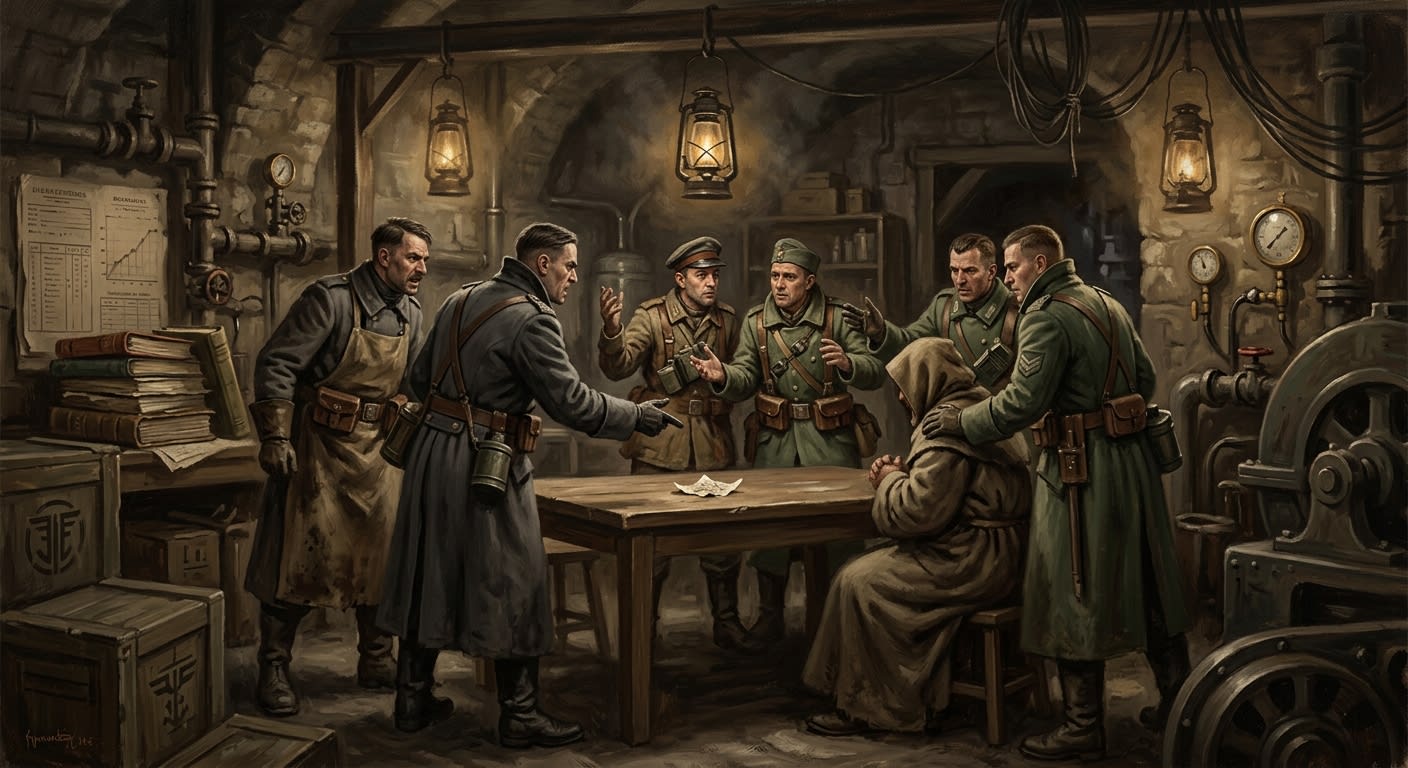
The question passed from patrol to cellar. It did not pass upward. Upward passage produces supervision, and supervision produces names, and names produce bodies in Bureau rooms. Instead the circles convened under a lamp-table in a vaulted cellar whose owner, according to subsequent tax records, had operated a licensed cooperage there for forty-one years despite no barrel ever having emerged from the premises. Cologne rewards tradition.
#On the Three Answers
The cellar produced three answers, each one wrong in a different but instructive fashion.
The first answer became the Ward-Soothe Purists. They held that shielding a Preacher made the shield complicit. They severed contacts, burned route slips, returned passwords to ash, and resumed strict curfew enforcement with the bleak pride of men who had chosen correctness over civic sense. Their doctrine was peace without politics, calming without comfort, order without the dangerous warmth by which a person remembers he is not cattle. Their districts became louder within a month.
The second answer became the Lantern Loyalists. They held that the Brotherhood served the street first and vocabulary afterward. If a Mercy Preacher reduced arrests, shortened patrols, saved oil, and prevented queue windows from becoming doctrinally troublesome shards, then toleration was field judgement. They kept the routes, changed the minutes, and developed a language of omissions so durable that the Bureau of Shadows could admire it while preparing to strangle it.
The third answer became the Soft Insurgents. They committed clarity. The Brotherhood, they said, had always been resistance dressed in permission. The Synod tolerated auxiliary blades because the Synod lacked hands. Every alley under Brotherhood lamp was a confession of insufficiency. Every Preacher sheltered by a patrol merely put words to what the route map had been saying in silence since A.S. 94.
#On Shadows Calling Inaction a File
The Bureau of Shadows filed the matter as “Internal Fraternal Disagreement, No Action Required.” Readers of weak formation may imagine this phrase indicates passivity. It does not. Shadows' inaction is a hook placed in water. It waits because fish have the vanity to swim.
Within three quarters, Shadows had compared patrol omissions, Preacher sermon maps, levy-delay anomalies, chalk recurrence, and the new Purist noise reports. The Purist districts produced more arrests and worse temper. Loyalist districts stayed quiet and accumulated suspiciously clean fog notations. Soft Insurgent districts showed the least actionable variance and the most repeated phrases. The file grew fat. No Action Required became, in the usual manner, a stack of actions denied individually by every office that performed them.
SHADOWS WATCH NOTE — COLOGNE CELLAR, SUPPLEMENTAL Recovered phrases: “The Preacher quiets the ward.” “The ward remains ours.” “If comfort is rebellion, absence of comfort must be loyalty.” “The route is older than the writ.” At this point the transcript records glass breakage, then ████████████████████████, then a line in a hand not belonging to the recorder: “You heard us because we wanted the file to hear.”
The Schism did not erupt into street battle. That is one reason the Bureau underestimated it. No barricade, no torchline, no shouted creed for an Inquisitor (Unregistered) to harvest. Instead there were route changes, discipline changes, refused passwords, new chalk marks, altered patrol silences, and the small bitter manners of men who had once trusted one another in alleys where trust is more valuable than oil.
#On the City's Memory
Cologne remembers badly, which is to say usefully. It remembers the First Council and the later Council, the Miracle, the Ash Banks, the seventeen Aldebrand femurs, the confessor-kiosks, the archive vaults, the Night of Borrowed Curfew. It keeps each memory in a separate drawer and lets them contaminate one another through the wood. The Schism entered that cabinet as a civic rumour before it entered the Ledger: three lanterns on a cellar table, three shadows on a wall, three exits into streets that looked identical by dawn.
The image is false in details and true in value. Brotherhood iconography now renders the night as three lamps: clear glass for the Purists, ordinary ash-oil for the Loyalists, amber reflection for the Soft Insurgents. No contemporary witness mentions such arrangement. The absence troubles no one. Symbols are what events wear when paperwork strips them naked.
Popular broadsheets claimed the three factions fought with knives beneath Saint Gereon and left twelve Brothers dead.
No death roll supports this. The Bureau of Records recognises two broken lanterns, one missing route-book, three disciplinary transfers, and a cellar lease corrected retroactively. Twelve dead would have been easier to classify. The Bureau dislikes symbolic efficiency when it cannot invoice the corpses.
The Mercy Preachers understood the Schism before the Brotherhood did. A Fog Preacher (Unregistered) knows when a lane has changed its listening posture. Candle-Runners learned which Brothers still coughed twice near shrine-lamps, which ones stared straight ahead, which ones asked questions with Purist hunger. Mercy Architects redrew safe houses in a week. Tongue-Smiths altered catechisms by a syllable. The work continued. It acquired better manners.
#On the Present Use of an Old Fracture
As of A.S. 201, the Cologne Schism remains officially unresolved because resolution would require naming what the Brotherhood is. Tolerated auxiliary personnel is a phrase, not an answer. The Brotherhood performs Bureau labour without becoming a Bureau organ. It carries blades after curfew without admitting independent militiahood. It is the Synod's admission, written in lamp-oil and bad conscience, that Order requires deniable hands.
Purists still polish their clear lanterns and make districts brittle. Loyalists still misfile mercy as workload reduction. Soft Insurgents still teach the route map to speak. The Mercy Preachers still pass through the gaps, softer now, sharper now, every comfort trimmed to pass inspection and cut after passing.