

#On the Year and the Paper
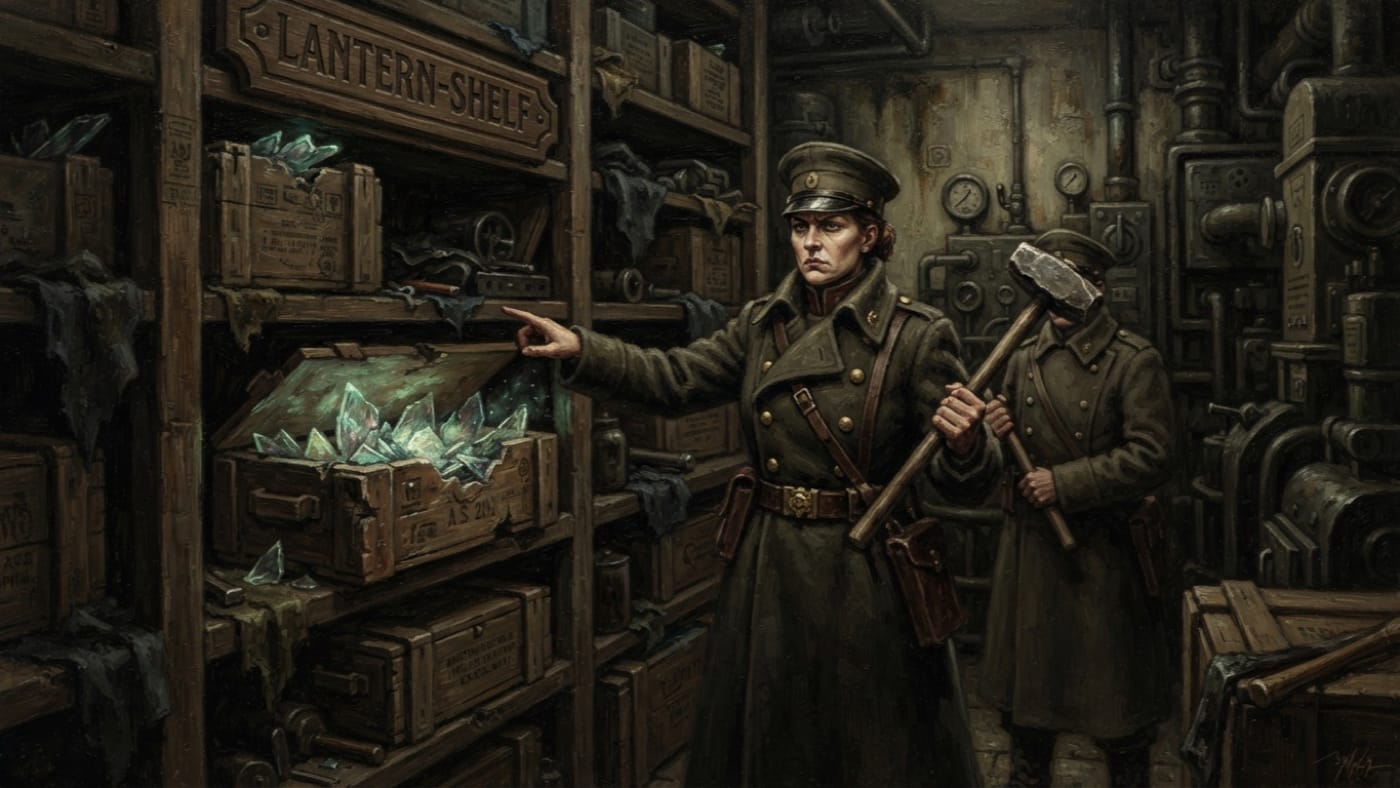
The Lantern-Shelf seizure belongs to A.S. 200 / 1910 CE. That is all the calendar gives it. The surviving record does not state the day, the month, the hour, or the street, and this compiler will not invent them to give the event a nicer frame. What survives is two pieces of paper in the file of Captain Mavra of the Bureau of Purity. One is a commendation that has since been struck through. The other is a correction issued for restricted circulation. Between them they record one find, one captain, one hammer and one raised hand.
The plate is compiled in A.S. 201. That year belongs to the compiling, the binding and the wax. It is not the year the hammer fell. I mention this because some junior archivist will read a seal date and decide it is when the event happened, and I would sooner say so now than correct him in front of auditors later.
#On the Name
"Lantern-Shelf" is a label. The commendation uses it, the correction keeps it, and neither says what it refers to. It could be a shop, a stall, a fixture, a district nickname, or some clerk's private shorthand that got into the minutes. Nothing in the file settles it. I have been asked for a site plan. I have no site plan. Any drawing of the place, its doors, its shelving or its distance from the quay would be my own fiction.
What the file does give is Mavra's station. She serves in the Maskwright Lanes of Thessaloniki, attached to the Salt-Scourge Detachment, the Purity militia charged with coastal contraband suppression. That places her. It does not place the Lantern-Shelf, and I will not let the reader treat the two as the same thing.
#On the Commendation and Its Correction
The commendation praised a discovery. The correction says it was arranged. Here is the entry as the file carries it.
Bureau of Purity commendation, A.S. 200: the Lantern-Shelf seizure described as the "spontaneous discovery of concealed demon-glass stock."
Corrected for restricted circulation. The stock had been placed for discovery. The discovery was spontaneous only in the sense that the hammer fell when Captain Mavra raised her hand, and no earlier.
Read the struck line for what it is. It is good evidence of what the commendation claimed and no evidence at all that the claim was true. The strike-through does not erase it. The line stays legible so that later readers can see exactly what the Bureau once praised.
The correction makes three assertions and no more. The stock was put in place before anyone found it. The finding was therefore staged. The timing of the hammer followed Mavra's hand. It does not say who placed the stock, where it came from, who supplied it, or why that stock was chosen over any other. It names no witnesses, arrests, injuries, fines or crowd. On its face it does not dispute that the stock was demon glass. It disputes that anything was concealed and that anything was spontaneous, and those were the two words the commendation was built on.
I have seen readers take a correction as permission to supply everything the commendation left out. It gives no such permission. It removes two words of praise and leaves a very small set of facts in their place, and the compiler's job is to leave those facts as small as they are.
#On the Captain's Habits, Which Are Not This Event
Mavra's file describes how she usually works, and it describes it at length. She raids at noon. She sets up visible cordons, positions confiscation carts and rotates the hammer-bearer. Inquisitor Velek usually reads the warrant in a dry voice. The Bureau-Friends usually prepare decoy crates holding enough real contraband to break convincingly. Smoke widens the square. The usual sequence ends with the sermon, the fine, and a rise in traffic under the quay.
All of that is pattern, and a pattern is not a record of what happened on a particular day. The Lantern-Shelf papers do not say the seizure happened at noon. They do not put Velek there, mention smoke or a warrant, name any Bureau-Friend, or describe a crate. The only thing the general file and the correction share is the raised hand, and that is the one detail I will connect between them. On the evidence, every other part of the usual sequence may or may not have taken place.
Polisher accounts from the Lanes, which I cite as the trade's own testimony and not as Bureau finding, describe staged confiscations as an ordinary part of the business. Active shards get swapped into crates meant for breaking, so that Purity looks competent while the better stock stays with its owner. The same accounts say a stamped confiscation receipt works as a unit of bribery. This tells us that staged finds were common in the Lanes. It does not tell us that the Lantern-Shelf stock was swapped, kept back or paid for.
#On the Value of a Discovery
The Bureau would call this a discovery because a discovery has nobody who prepared it. A discovered crate implies only a vigilant officer and a guilty concealer, and Purity is always pleased to have one of each. A placed crate implies somebody who placed it, an arrangement behind that person, and a conversation that no Bureau wants written down. The commendation picked the first version. The correction quietly recorded the second, then marked it restricted so that very few people would read it.
The arrangement suits several offices. Purity gets a find to praise. The Bureau of Tithes gets a seizure value to enter in the ledger. A frightened Thessalonian gets to see evil broken under a Purity hammer. Mavra's wider file describes how Purity's public suppression of the glass trade sits alongside the lenses that keep reaching the Bureau of War, which needs eyes in brine-fog and asks no questions about them. That is the background. I do not say the Lantern-Shelf served War, that any lens went anywhere, or that anyone gained from this particular find. The file does not say so either.
Strasbourg, Doctrine and the junior clerks always ask the same thing: who corrected the commendation, and why. The file does not say. It does not name whoever wrote the restricted note, whoever ordered the strike-through, or what made either of them do it. I can tell you the correction exists, what it says, and that it was restricted. I cannot name its author, and the Ledger does not let me guess one into existence.
#On Other Seizures Not to Be Confused With This One
Mavra's name sits on several Thessaloniki incidents, and readers keep merging them.
The Mavra Demonstration of A.S. 199 was a Purity disposal fire in the Pitch Markets. It happened a year earlier, worked differently and is recorded in its own file. Nothing in that file explains the Lantern-Shelf, and nothing here explains the fire.
The episode of the unbroken crate also falls in late A.S. 200. That was the sweep down Saint Varda's side-street, where the third crate started to hum before the warrant was finished and Mavra chose not to strike it. It is a separate incident in her file. The two sit in the same year, but the record gives no order between them and no link from one to the other. Its crates, its officers, its smoke and its competing stories from Quietists, Revelators and Bureau-Friends all belong to that incident. None of it carries over to the Lantern-Shelf.
#On the Present Condition of the File
As of A.S. 201, Captain Mavra is still active in Thessaloniki. Her file holds the struck commendation and the restricted correction side by side, so the record contains both the Bureau's public praise and its private qualification of that praise.
Whoever compiles the next plate will want more than this. They will want the hour, the shelf, the hands that placed the stock and the name of the person who restricted the note. They will not find any of it here. The surviving record states that in A.S. 200, demon-glass stock was found where it had been put, and that the hammer came down when Captain Mavra raised her hand, and not before.