
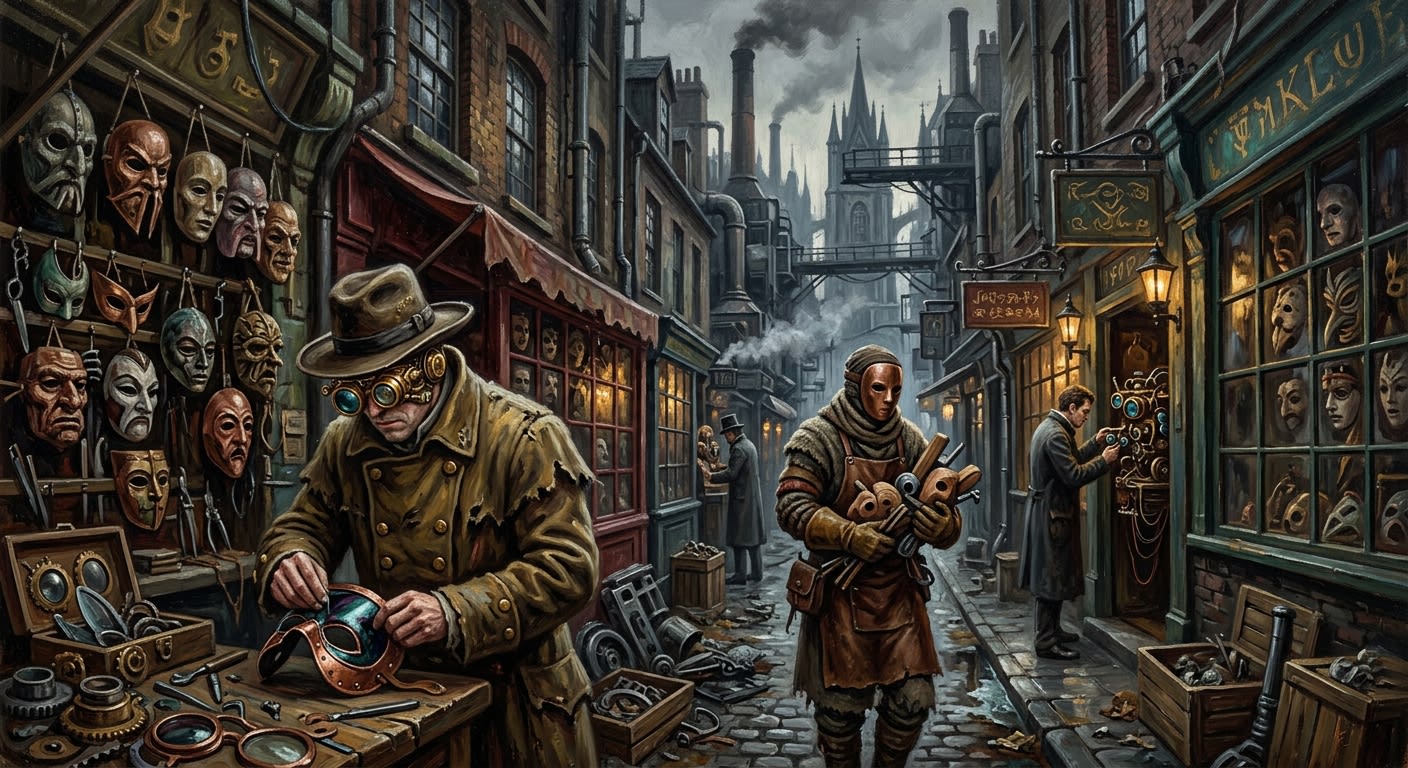
#On the Street Where Masks Learn to Lie
The Maskwright Lanes of Thessaloniki are a district, a workshop-chain, a criminal theology, and a municipal embarrassment with excellent output figures.
They lie three turns inland from the Pitch Markets, where the harbour smell changes from tar and fish-guts to hot sand, metal filings, lamp oil, ash, singed leather, and the faint sweet stink of fear warmed over a kiln. Legal signs hang over illegal rooms. Legal masks hang beside illegal eyes. Every shop has a street door, a raid door, a cellar door, and a fourth way out known only to children, rats, and clerks who have been paid enough to forget architecture.
The public trade is plain enough for sermons: brine goggles, fog masks, leather respirators, harbour filters, salt-cloth face covers, and iron trench masks for coastal regiments whose lungs have begun filing objections. The private trade mounts demon glass into eye-pieces so soldiers may see through fog, glamour, smoke, dread, and whatever official phrase currently disguises Hell in motion. The invoice says Optical Supplies, Standard. The pane says otherwise.
#On the Lanes' Foundation in Heat and Need
The Lanes began as ordinary craft streets after the harbour fortification years, when chain smoke, brine-freeze, marsh fever, and coastal furnace-work made face coverings less a luxury than a survival instrument with straps. Thessaloniki's formal charter had been ratified in A.S. 72 and re-ratified in A.S. 93; by the next generation every quay rigger, quarantine orderly, dredger-diver, and chain apprentice had learned that the Aegean enters a man's lungs whether invited or not.
The first maskwrights worked leather, brass mesh, smoked glass, wool filters, and waxed cloth. Their saints were ordinary, their invoices dull, their customers mostly alive. Then the southern war fed the harbour harder. The Sister Trenches needed masks by the crate. The coastal batteries needed fog lenses. Pilgrim convoys needed brine shields. The Lanes swelled, multiplied benches, stole apprentices, married kiln-fire to quota, and discovered that every respectable craft becomes suspect once demand exceeds doctrine.
Early Harbor Ledger notes classify the Lanes as “minor leather-and-glass trades, non-strategic.”
Corrected. The Lanes became strategic the moment a soldier could breathe, aim, and keep his face attached because some filthy shop behind a fish-briner finished an order before Matins.
Demon glass changed the district without changing its smell. Shards moved through under-quay tunnels, wrapped in salt-fish barrels or reliquary cloth, warm beneath oiled linen. Maskwrights learned from Polishers. Polishers learned from smugglers. Smugglers learned from drowning. By A.S. 151, after Varna taught every port that raw glass killed and mounted glass merely corrupted at billable rates, the Lanes had already acquired their modern grammar: quiet-box, cold wash, grind, candle test, lead, iron, denial.
#On Glassman Dimo's Corner
Glassman Dimo gives the Lanes their present reputation because every district needs a face, and Dimo's has helpfully been burned into legend.
His shop stands where the legal mask-fitters borrow respectability from the harbour offices and the illegal Stainwrights borrow smell from the fish briners. The front room displays brine masks and fog goggles. The second room hides devotional glazing behind cracked saints. The cellar holds quiet-boxes, ash-grit, lead came, iron sockets, black-diesel rags, and work that the Bureau of War purchases through forms too clean to have touched the truth.
Dimo certifies silence with the closed-eye mark of Varda. Apprentices treat that stamp with more trust than three Bureau seals and one episcopal blessing. A pane that passes beneath Dimo's hand may still ruin a man, but it will usually ruin him after delivery, which is as much warranty as the age permits.
Dimo's apprentice, “Saint” Orelia (Unregistered), sings while cutting glass. The melody belongs to no known hymnal. Certain shards quiet faster. Certain shards brighten. Certain shards show nothing at all, which is the rarest mercy in a district where even shop windows are suspected of having opinions. Dimo permits her song under three rules: no own name, no noon-sun, no finishing if the glass answers in harmony. These rules should be carved above every theological faculty in Europe.
PURITY OBSERVATION — MASKWRIGHT LANES, A.S. 199 Subject O. sang during furnace-grade cut. Pane reflected █████████████████ wearing inspector collar. Observer requested transfer to rope inspection. Original pane entered War requisition channel █████ under label “smoke tolerance lens.” Follow-up: no raid authorised until replacement decoy stock prepared.
#On Raids, Crates, and Municipal Theatre
The Bureau of Purity raids the Lanes seasonally. The seasons are not meteorological. They correspond to quota pressure, visiting inspectors, War deniability cycles, and the number of sermons Captain Mavra has not yet performed before a sufficiently frightened crowd.
Inquisitor Velek reads warrants in the dry voice of a man announcing weather he personally dislikes. Captain Mavra arranges noon light, visible chains, cracked glass, kneeling apprentices, confiscation carts, and smoke enough to convince civilians that danger has been broken in public. The Bureau-Friends prepare the crate. One active shard hums for the crowd. Several blanks wear enough cloth to look expensive. The real masks leave beneath the quay, through Ledger-Ghost Tamsin's papers and Pilot-King Nenos's water.
Production does not materially decline. This phrase appears in multiple reports with the mournful repetition of a bell no one wants to hear. Purity breaks display stock. War receives mounted optics. Tithes assesses fines. Shadows updates its map of the under-quay. Doctrine condemns the arrangement in prose of suitable splendour. The Lanes reopen by dusk with fewer cracked panes in the window and more orders pinned behind the saint shelf.
Purity notice, A.S. 200: “The Maskwright Lanes have been cleared of contraband optics.”
Clarification. The Maskwright Lanes were cleared of contraband optics placed where Purity was expected to look. Remaining materials were unavailable for inspection due to architecture, smell, bribery, War seals, and the ancient mercy of locked doors.
#On the People Who Breathe There
The Lanes live on children with steady hands.
Grit-Runners mix ash-grit, clean tools, empty quiet-boxes, and learn the first law before they learn accounts: never touch an active shard. Lappers grind fracture-lines where voices catch. Mounters frame panes in lead or iron. Stainwrights certify silence. Mask-Lens Surgeons do combat work and speak about it rarely, because combat work has a habit of returning in the faces of men who survived wearing it.
Pelas remains the district's cautionary name. In A.S. 198, three Grit-Runners touched active Lust-palace shards. Pelas broke their fingers before the precinct runner could arrive, saving the Lanes from whatever the glass intended and giving Purity a sermon it still uses when convenient. Dimo is invoked as the civilised version: temperature instead of fracture, delay instead of punishment, thick frames instead of public pain. The trade needs both legends. Children learn faster when mercy has knuckles.
The three Polisher factions keep their corners. Quietists thicken lead and sell disappointment. Revelators court voices behind panes and call it market differentiation in words less honest than mine. Bureau-Friends maintain the choreography of survival. Their quarrels travel through spoiled grit, delayed referrals, false warnings, and customer gossip. Open violence is rare. Open violence attracts Purity, and Purity attracts paperwork, which is worse.
#On the Present Condition
As of A.S. 201, the Lanes are louder, richer, more watched, and less suppressible than ever.
Demon-glass distribution has risen across Zones 5 through 7 after Maldrake's A.S. 198 pressure and the shard glut from Wound-sites, Wrath-slag, and Lust-court debris. The southern regiments want lenses. The harbour wants fees. The under-quay wants cargo. Purity wants visible victories. War wants results without authorship. The Lanes provide all five and ask only to be denounced on schedule.
Their danger is real. A single active pane mishandled in noon-sun can show a face belonging to a man not yet dead. A hook-grade sliver can hold a buyer until his fingers enter the surface. A song cut one phrase too long can make glass answer in harmony. The Lanes are a district of small rooms where Hell is made slightly useful and men pretend usefulness has absolved the handling.
No honest census exists. The Harbor Ledger counts legal mask shops. Purity counts raids. War counts deliveries. Tithes counts fines. The Lanes count fingers, panes returned without incident, apprentices who survived their first month, and crates that left before Mavra turned the corner. Their arithmetic is ugly. It is also the arithmetic by which soldiers on the southern coast keep seeing through fog.