

Reading is done. Writing the article now, using only the attested record of the A.S. 199 fire.
#On the Compilation and Its Single Fire
This account of the Mavra Demonstration was compiled for the Codex in A.S. 201 / 1911 CE. The compiling is the only part of it that belongs to 201. The fire itself belongs to A.S. 199 / 1909 CE, in the Pitch Markets of Thessaloniki, the tar-black district between the Chainward Quays and the Maskwright Lanes. None of the papers put before me gives a day, a month or an hour, and I have not supplied one. A Codex that dates a fire by guesswork ought to be used to start one.
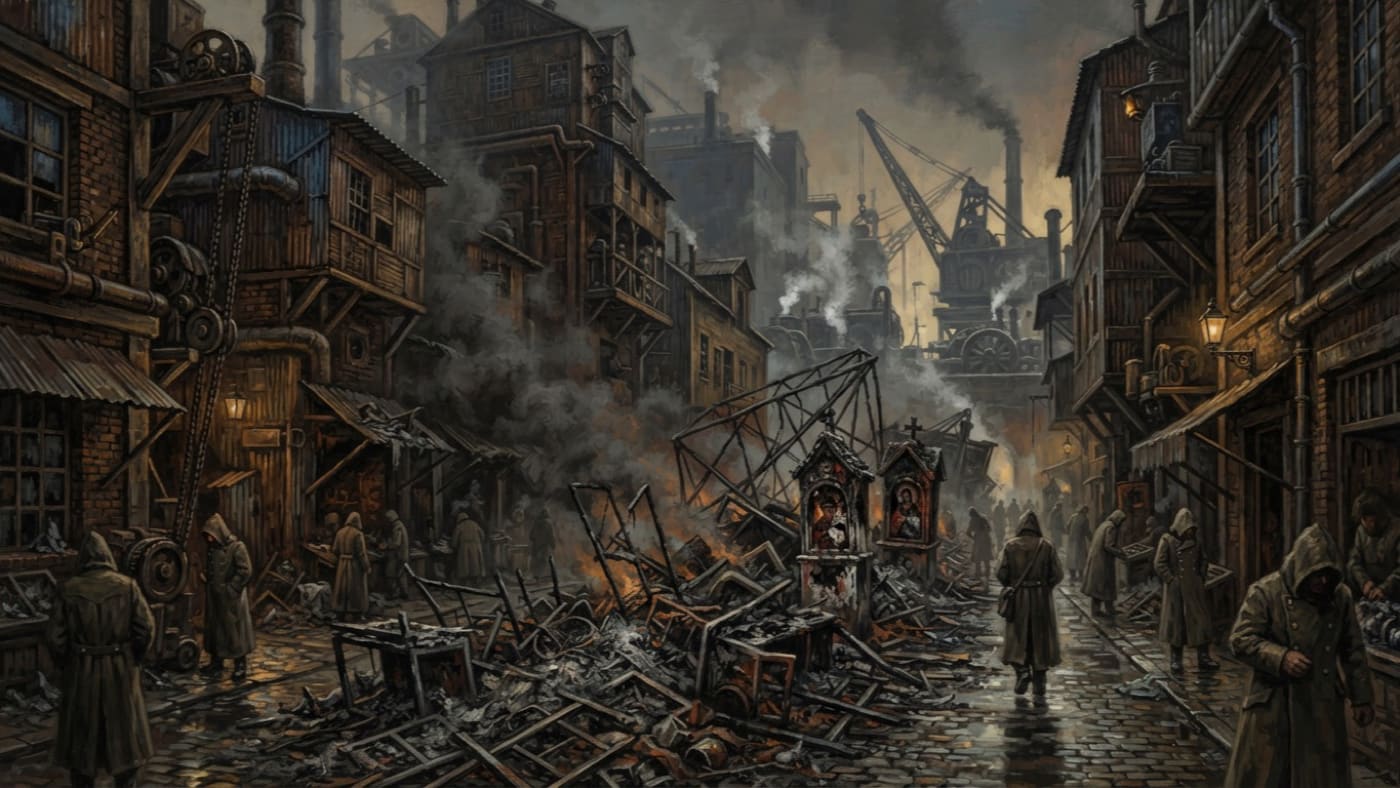
The full record can be recited before a censer stops swinging. The Bureau of Purity filed the event as controlled disposal. It destroyed eleven stalls, two alley shrines, a rope loft and a cat. The Chandelry Compact of Saint Boryn's Palm filed seven reimbursement claims. The Bureau of Tithes accepted one.
That is all of the canon. Everything else on this page is context, a statement of where the file ends, or my own opinion, which carries my own seal and no one else's.
#On the District That Received the Fire
The Pitch Markets sell pitch, tar, resin, lamp oil, wick, rope-seal, quarantine smoke, mask varnish and chain-grease. Nearly all of it burns, and what does not burn is sold to people who keep things lit. The trade grew out of barrel commerce around the A.S. 72 harbour-chain works. By A.S. 93 the Bureau of Records had entered it as Auxiliary Maritime Supply, Third Register. Those years date the market and nothing else. They do not date the fire, and the Compact's own founding appears in no register I have consulted.
The whole harbour draws on the district. Ships need its caulk. The Chainwrights need its grease for winches that keep the chains taut. The Quarantine Crescent buys its smoke-pots and storm lamps, the Refugee Sheds its steady light, and the Maskwright Lanes its varnish. Choose any lane in the Markets and somewhere in the city an office depends on it.
Purity lit a fire in that district and called it controlled. I record the word with the respect owed to any word a Bureau has paid for.
The inventory says nothing about what the eleven stalls sold. A reader who pictures Wick Court burning, or River Tar Row, or Coffin Seal Alley, is supplying the picture himself, because the inventory counts stalls and names no trades. It does not name the saints kept in the two alley shrines. It gives no height or owner for the rope loft and no name for the cat. It does not say whether any customer went without supplies for a day, a week or at all. I have the losses by category and I will not furnish them with anything more.
#On the Three Filings
Three offices each did one thing. Purity disposed, the Compact claimed and Tithes accepted. None of the three filings tells the story of the other two, and a careful reader should keep them in separate drawers.
Purity's filing. "Controlled disposal" claims two things: that something was being disposed of, and that the disposal was supervised. The file does not say what was disposed of. In my survey of the Markets I observed that the district's worst fires have all been official, and that official confiscation piles burn slowly, for an audience, and too close to other people's stock. That was a remark about the district's habits. It is not a finding about what lay on the pile in 199, and I will not quietly turn it into one.
The Compact's filing. Seven claims tell us there were seven claims. They do not tell us there were seven claimants, or that seven of the eleven stalls belonged to Compact members, or that the shrines and the loft were included. Nobody filed for the cat. If someone did, I have not seen it, and I would very much like to.
Tithes's filing. One claim was accepted. Acceptance means a Bureau has agreed a claim is admissible. It does not mean money changed hands. The file does not say which claim was accepted, who filed it, what it asked for, or whether anything was paid. On the other six it records no acceptance and gives no reasons. I cannot tell you whether they were refused, withdrawn, set aside or are still waiting in a Tithes pigeonhole, and anyone who tells you confidently should be asked for his folio number.
"Tithes accepted one, because even Tithes fears widows holding melted lamp chimneys."
Corrected for this compilation. The sentence appeared in my survey of the Pitch Markets. The widows were my reasoning, not Tithes's. No Tithes finding gives a reason for the acceptance, and no record places a widow, a chimney or a melting at the Demonstration. The joke goes back to the margin, where it belonged.
"On the Compact's figures, one claim in seven was paid."
Corrected. That line in the Compact's survey went one word beyond its evidence. The figure is one claim in seven accepted. The file records no payment.
#On the Name and the Captain
The event carries the name of Captain Mavra of Purity's Salt-Scourge Detachment. Her raids in Thessaloniki are known for their staging, their smoke and their crowds. That is all the name establishes. The Demonstration's record does not say she gave an order, stood in the lane, chose the pile or struck a light. It holds her neither guilty nor innocent. An event's name is a filing label, and filing labels have been fixed to the wrong parties since the first clerk learned to blot.
Inquisitor Velek does not appear in the file either. My survey of the Markets describes how a Purity raid there usually goes: Velek reads the warrant, Mavra points, the Bureau-Friends bring out decoy tubs, barrels are split and one shard turns up exactly where everyone expected it. That describes the usual performance. It is not an eyewitness account of 199. Its arrests, its barrels, its shard and its cast stay in that description and are not to be carried over into this fire.
As for "Demonstration", the record does not say what was being shown, or to whom. Purity names its acts as a playwright titles his pieces, and the audience is never consulted.
#On the Neighbouring Years
The Silence of Thessaloniki belongs to A.S. 198 / 1908 CE. The bells failed, the Markets lowered their voices without stopping work, and three Wick Court stalls handed out blue-wicks they later tried to write off as storm spoilage.
The first Night of Quiet Bells was kept on 14 Ashmonth A.S. 199 / 1909 CE. Each year since, the Markets have closed after the dusk peal, hooded their fires and turned their account boards to the wall. The Demonstration happened in the same year. The record does not say whether it came before or after that first observance, and it records no connection between the two. A district that hoods its fires and a Bureau that lights one in the same year make a tidy pairing on paper. The fact that it looks tidy is reason enough to keep them apart.
The Lantern-Shelf seizure of A.S. 200 / 1910 CE is a separate episode and belongs in a separate drawer. By the corrected account in Mavra's file, stock was put in place to be found and the hammer fell when she raised her hand. That was a staged discovery, a year later, by a different method, with its own evidence. None of it explains the 199 fire. Only the shared captain's name invites the comparison, and the comparison is refused.
#On the Present Condition
As of this compilation in A.S. 201 / 1911 CE, the Pitch Markets are still active, still watched, still necessary and still flammable. No record has reached me of anything being rebuilt, of the six unaccepted claims being settled, or of a later inspection of the burned lanes. I report that absence as an absence and not as a finding. The external audit from Strasbourg has listed the district under several headings. The Demonstration is not named among them, and I have not added it.
The surviving record is four numbers and one phrase. The numbers are eleven, two, one and one, and they belong to the ruin. Seven and one belong to the paperwork. The phrase is Purity's own. Laid side by side they give a fair measure of what "controlled" means in a Bureau's vocabulary. The cat, uncontrolled, filed nothing.