
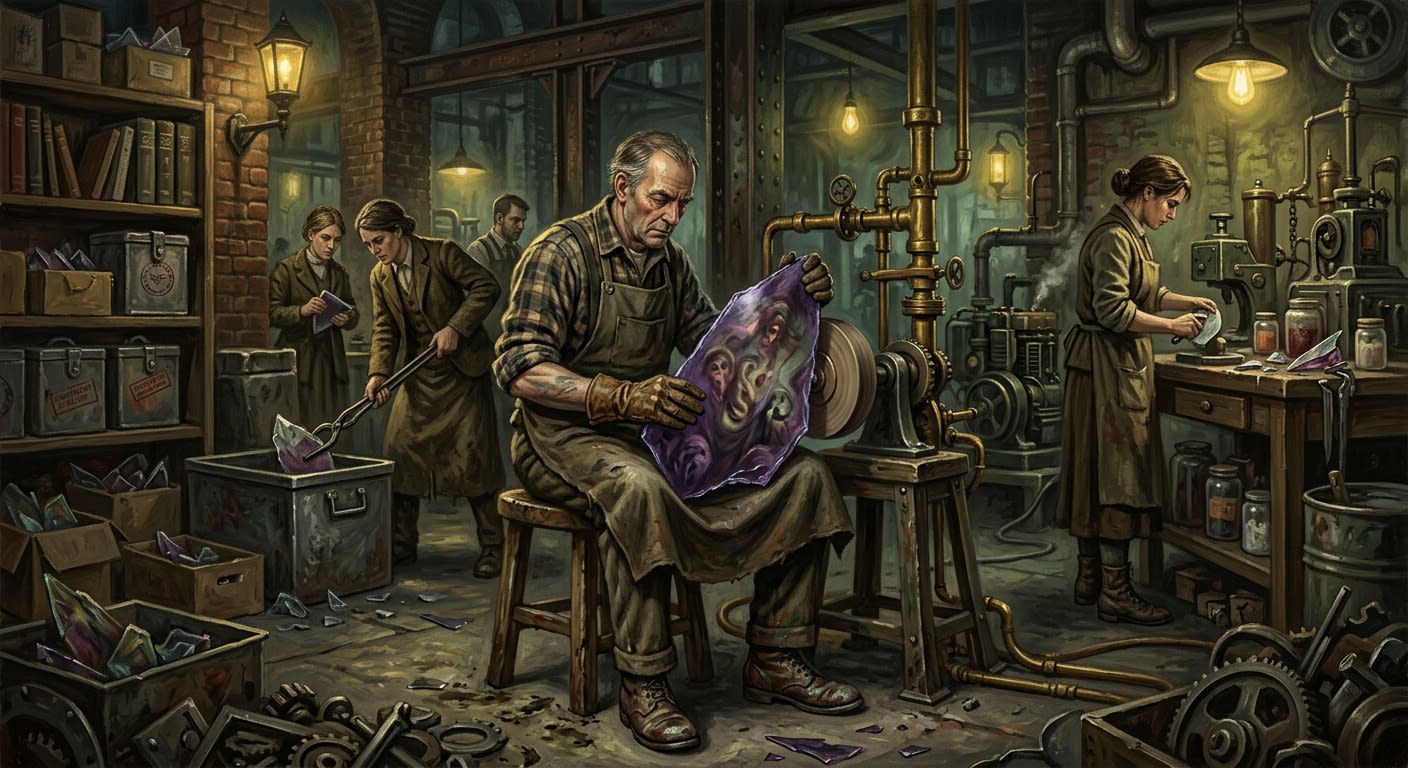
#On the Sect That Sells Nothing Beautiful
The Quietists are the conservative faction of the Demon-Glass Polishers, though the word conservative flatters them with philosophy. Their doctrine is plainer: make the glass shut up.
They polish for containment and silence. Their best panes show colour, depth, church-window brilliance, and nothing else. No dead son. No coming wound. No saint's mouth moving behind lead. No lovely little damnation adjusted to the buyer's grief. A Quietist pane is a refusal wearing a price tag, and in the demon-glass trade a refusal can cost more than a revelation because it requires discipline.
Their clientele is safer than most: captains who need fog-resistant lenses, nobles who want reliquary panes with no surprises, Shadows operatives whose purposes are best served by glass that does not begin offering advice, and the occasional frightened priest who has acquired a shard through pastoral accident, which is the canonical phrase for buying one.
#On Their Rule of Silence
The Quietist bench begins with negation and ends with accounting.
A fresh shard enters the quiet-box. The lid is sealed with lead. The box sits through one full night. If the lid hums, the apprentice writes no poem about it, because apprentices with poetic temperaments belong in graves, choirs, or Revelator workshops. The shard is cold-washed with salt, ash, and black-diesel film. The grind is slow. The Lapper removes fracture-lines where whispers catch. The Mounter uses lead came thick enough to offend glaziers and please survivors. The Stainwright reads names belonging to strangers before a candle. If the flame bends, the pane returns to grit. If the pane shows a face, the pane returns to grit. If the pane remains dark, the invoice may begin.
Quietists do not trust beauty. They trust returns without complaint, customers who remain alive, and panes whose owners sleep badly for ordinary reasons.
A Bureau of Purity classroom sheet describes Quietists as “the least dangerous branch of an illegal craft.”
Correction. They are the branch most skilled at delaying danger until it can be sold under warranty, buried under lead, or transferred to a client with rank enough to make the file hesitate.
Their first maxim is Varda's: lead first, vision second. Their second is nastier: a pane that speaks has already stolen payment. In this they differ from the Revelators, who hear a whisper and begin calculating what a widow will pay to hear more. Quietists hear a whisper and reach for the clamp.
#On Varna, Their Favourite Sermon
Every faction in the trade claims the Mirror Riot of Varna as origin, proof, curse, and advertisement. The Quietists claim it most cleanly.
A.S. 151: sailors sold raw demon glass in the harbour as prayer aids. Civilians lifted unwrapped shards to their faces. Purity arrived with hammers and converted contraband into catastrophe. The fragments reflected skeletons moving independently of living bodies. Hundreds drowned. Purity called the matter mass hysteria aggravated by heretical optics. The Quietists call it bad handling.
This is why they win arguments inside workshops. The Revelator promises a voice from behind the pane. The Bureau-Friend promises a raid that misses the true crate. The Quietist points at Varna and says nothing. Silence, properly aimed, is a cudgel.
QUIETIST TRAINING SLIP — COPY RECOVERED THESSALONIKI, A.S. 199 Question: What does raw glass want? Answer: ██████████████████ Question: What does polished glass want? Answer: less. Instructor note: if apprentice writes “truth,” dismiss before dusk.
Their Varna litany is recited before active batches: wrap before gaze, lead before lamp, stranger's name before yours, no noon-sun, no public smashing. Prayer is too generous a classification. It works better than several.
#On Their Buyers and Their Cowardice
Quietists sell to cowards with money, which is to say they serve civilisation.
A captain wants a lens that cuts fog near Thessaloniki without showing the drowned choir moving under the keel. A noble wants a devotional pane made from contraband material, but would prefer the pane refrain from displaying his father's sins during supper. A Shadows courier wants a shard mounted into a field-glass because hostile glamour hates demon glass, but the courier does not want the instrument to learn his childhood name. These are Quietist customers: hypocrites with sound instincts.
Glassman Dimo is not properly theirs, being too practical to belong to any faction that would claim him; still, his best work flatters their doctrine. His quiet panes return without complaint. His apprentice's forbidden melody makes certain shards show nothing at all. Quietists call this evidence. Dimo calls it a finished order and charges accordingly.
Their cowardice has saved lives. This must be recorded, since the Bureau is otherwise stingy with praise and I am not. A Quietist who refuses an active pane to a widow preserves the widow, the workshop, the queue outside, the inspector who may later pretend to close the shop, and the theological convenience of everyone involved. Such restraint lacks glamour. Good. Glamour is what caused half the problem.
#On Rivalry With the Revelators
The Revelators despise Quietists because the Quietist shop makes their own trade look like pimping visions behind a chapel.
This accusation is accurate, which makes it socially unforgivable.
Revelators say the glass speaks because it has knowledge. Quietists say the glass speaks because men keep paying it to continue. Revelators polish to the edge of speech. Quietists grind the edge away. Revelators cultivate tremor, widow-market, pilgrim-confirmation, soldier dread. Quietists cultivate dullness, return business, sleeping customers, and inspectors who find nothing worth writing down.
The conflict rarely becomes open violence. Open violence attracts Purity, and Purity attracts loss. Instead the factions injure each other through referrals, rumours, faulty grit, spoiled lead, and that most intimate of workshop weapons: a customer warned in time. Many a Revelator sale has died because a Quietist cousin murmured, “that pane will know your name by Friday.” Many a Quietist has lost a captain because the captain wanted courage rather than survival.
A Shadows memorandum calls Quietists “politically neutral within the polishing economy.”
Amended. Quietists are neutral in the manner of a locked vault. They favour whoever leaves the contents undisturbed, pays the guard, and stops asking whether the lock has a soul.
#On Their Present Use
As of A.S. 201, demon-glass distribution rises through Zones 5 to 7, fed by Wrath-slag, Lust-court shards, Wound-site fragments, and the Bureau of War's devout hunger for lenses filed as Optical Supplies, Standard. The rise should have made the Quietists extinct. It has made them necessary.
More glass means more amateurs. More amateurs means more voices in stalls, barracks, shrine-corners, and quay rooms. More voices mean Purity raids, public sermons, broken decoy crates, and real stock moving under the floor while Captain Mavra performs righteousness above it. Through this sacred rubbish, Quietists continue their little office: lessen the hum, dull the image, thicken the lead, send the customer away disappointed and alive.
They will never be canonised. Their patron will remain pencil-drawn, their benches illegal, their best panes mislabelled, their invoices written in hands trained to forget their own names. This is as it should be. A Quietist with public honour would become a Revelator by afternoon.