
#On the Black-Stinking Commerce of Necessary Fire
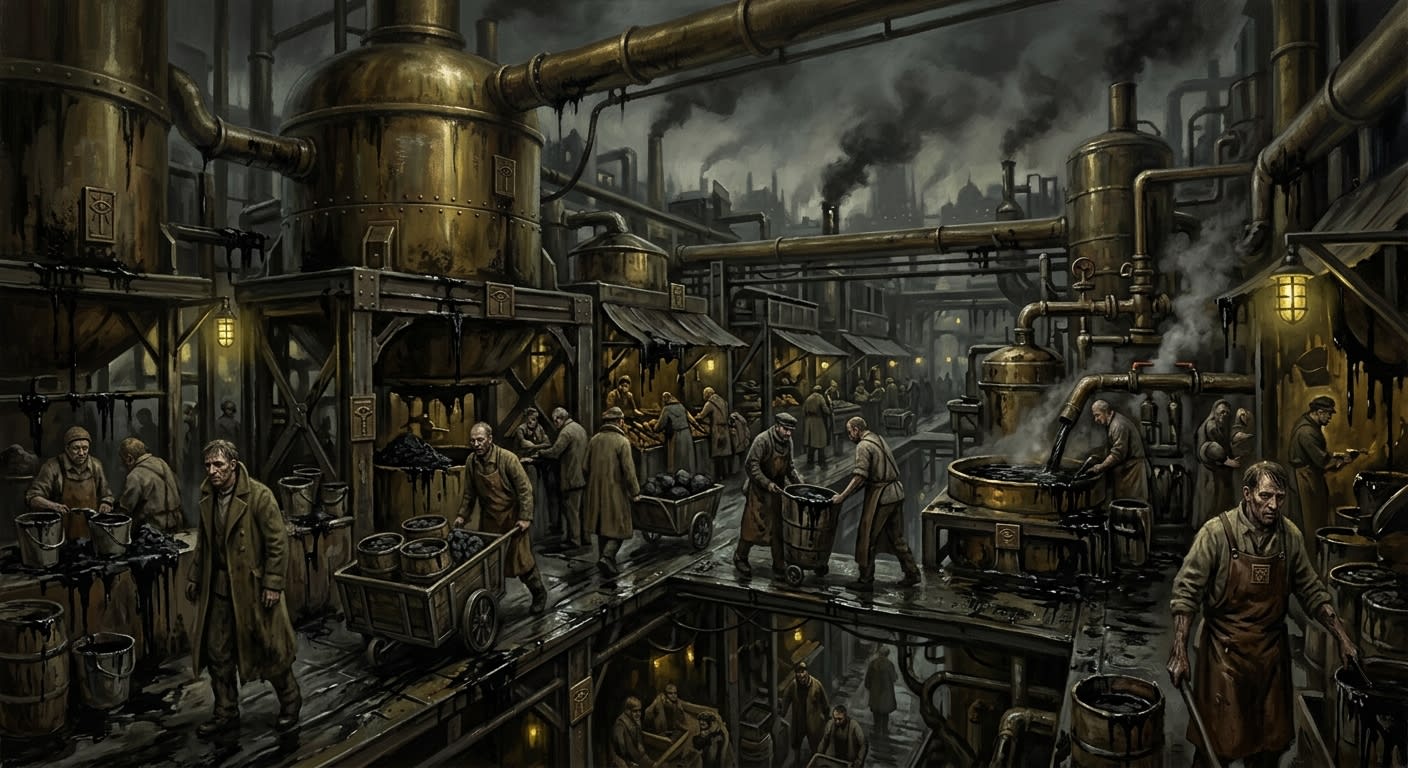
The Pitch Markets of Thessaloniki lie between the Chainward Quays and the Maskwright Lanes, where the city’s harbour breath thickens from salt and paper into tar, resin, smoke, rope fibre, fish-guts, hot iron, wet wool, lamp oil, vinegar, and the little sour note of men who have spent too long near fire they cannot afford to waste. They are called markets because goods are sold there. They are called pitch because the goods cling to fingers, ledgers, boots, lungs, and conscience.
Every port has chandlers. Thessaloniki has a district of chandlers large enough to need patrol routes and corrupt enough to have opinions. There are stalls for caulking pitch, hull tar, rope sealant, lantern resin, storm lamps, dock torches, quarantine smoke-pots, coffin-seal wax, chain-grease, mask varnish, tarred sailcloth, tinder cakes, blessed wick, unblessed wick, and the grey intermediary wick whose legal status depends on whether Purity or Tithes has arrived first. The Pitch Markets sell what keeps ships from sinking, ropes from rotting, lamps from dying, masks from leaking, quarantine sheds from stinking too honestly, and the harbour from admitting that its famous chains are, in daily practice, supported by men with buckets.
The district stands low, damp, and loud except on nights when fear does the work of a marshal. Its roofs are patched in black sheet and fish-scale tin. Its gutters shine with oil even after rain. Its stall-fronts hang with sample cords, pitch cakes wrapped in sailcloth, lamp chimneys in straw cages, resin bricks stamped with saints, and account boards so heavily corrected that the older debts have become texture rather than writing. A stranger can find the Markets by smell. A local can find them blindfolded by heat.
#On Foundation, Charter, and the Invention of Honest Filth
The Pitch Markets began before anyone dignified them with a name. The A.S. 72 harbour-chain works required rope-tar, caulking resin, lamp oil, wagon grease, and enough black sealant to make the new towers smell like a shipyard and a cremation shed had found common doctrine. The first sellers worked from barrels near the quays, shouting over divers, chainwrights, priests, and clerks whose boots sank into fresh pitch because no one had yet decided where commerce should stand.
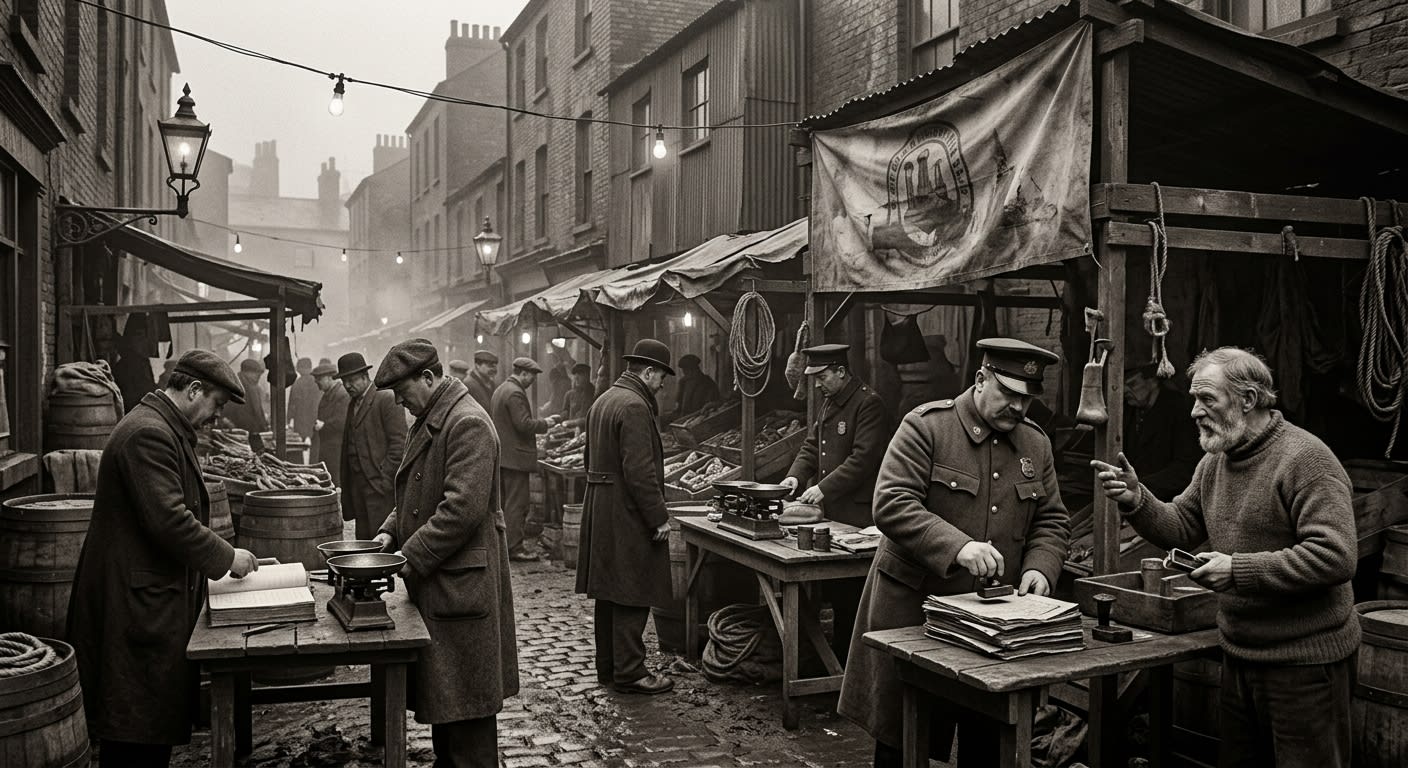
By A.S. 93, after Thessaloniki’s re-ratification corrected the invisible-ink charter and the harbour began pretending its paperwork had always been legible, the chandlers had spread into lanes behind the Chainward Quays. They supplied the Elder Tower winch houses, the Younger Tower (Unregistered) rope sheds, the quarantine pens, the first mask-makers, the rivering of pilgrim traffic, and the coastal patrol boats that returned smelling of brine and cowardice. The Bureau of Records entered them as Auxiliary Maritime Supply, Third Register. The sellers called themselves Pitchmen, Chandlers, Wick-Hags, Tar-Knucklers, and, on feast days, respectable.
Respectability lasted until the first audit.
Early Harbor Ledger notes describe the Pitch Markets as “minor chandlery stalls, locally sufficient.”
Corrected. They became strategic the moment the harbour discovered that chains, lamps, masks, quarantine fires, and ship hulls all require black substances handled by people polite society prefers to smell only at a distance.
The A.S. 112 quarantine expansions made the Markets permanent. Vinegar sheds needed smoke-pots. Fever wards needed oil-lamps that could burn through wet nights. Rope-law officers needed cordage sealed against rot. Undertakers needed coffin pitch. The Quarantine Crescent needed the district and despised the need, which is the ordinary foundation of urban hierarchy. By A.S. 145, after the Crying Choir and the tongue-loss files drove half the harbour into counter-humming disciplines, the Markets sold throat-tallow and lamp-wicks dipped in bitter resin for use in refugee sheds. By A.S. 151, after Varna’s demon-glass discipline made the Maskwright Lanes strategic, the Markets had become the district’s black pantry: varnish, lead soot, kiln fuel, packing pitch, decoy crate sealant, ash-grit binder, silence wax.
No charter created the Pitch Markets. Need did. Need is the oldest charter and the least forgiving.
#On the Stalls and Their Odours
The Markets divide themselves by smell because smell is cheaper than signage and more reliable after rain. The River Tar Row (Unregistered) sells heavy caulking pitch in iron-lipped tubs, stirred by men whose arms are black to the elbow and whose baptisms must have taken extraordinary effort. Wick Court (Unregistered) sells dipped candle cords, storm-lantern strips, smoked prayer tapers, quarantine blue-wicks, and cheap devotional lights whose saints peel off under heat. The Rope-Seal Yard (Unregistered) sells grease, resin dust, tarred hemp, and splice wax to chain crews who pretend not to buy from vendors currently under investigation.
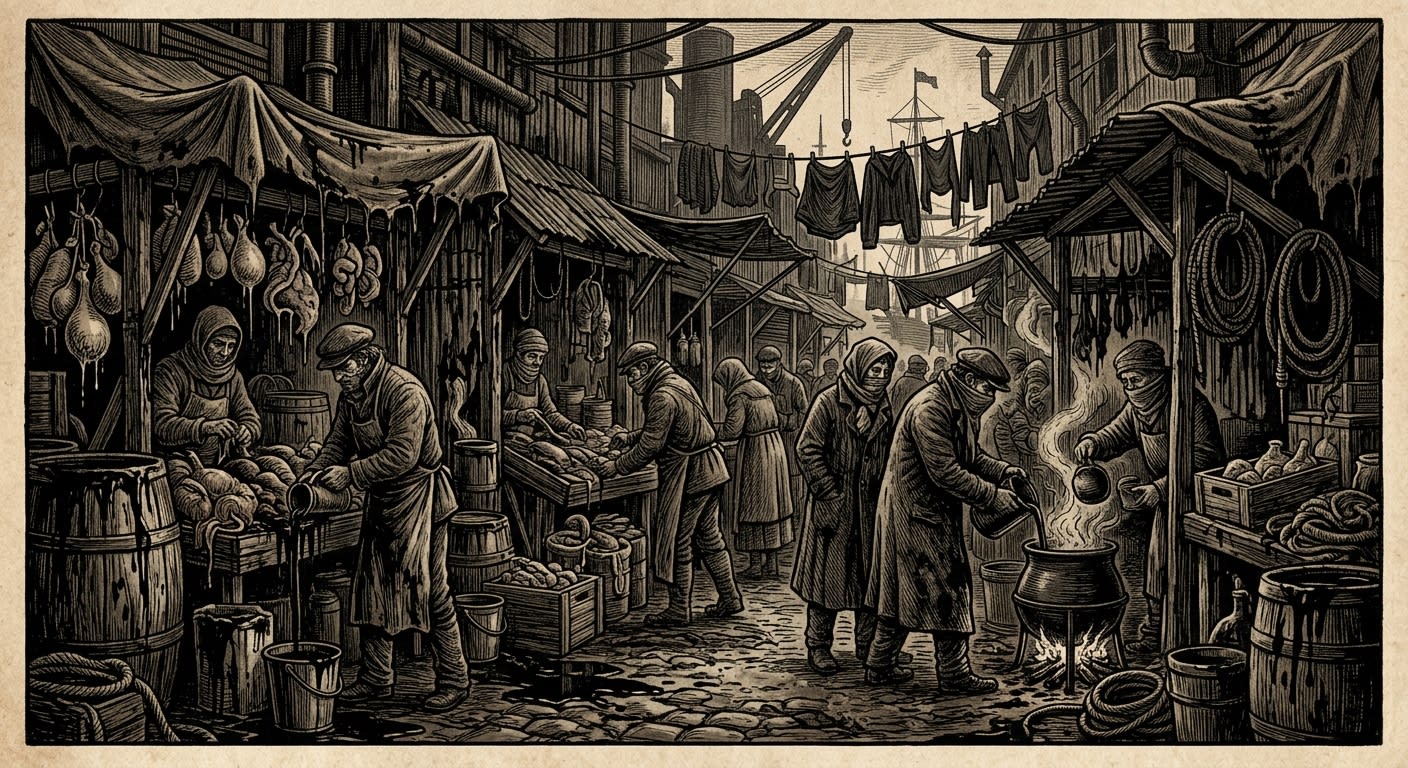
Coffin Seal Alley (Unregistered) belongs to the mortuary suppliers. Its pitch is darker, thicker, cut with lime ash, and sold under quiet voices to undertakers, hospice runners, battlefield ashbinders, and families who cannot afford proper brass but still want the lid to hold. The Mask Varnish Steps climb toward Maskwright Lanes, where legal leather breathers and illegal demon-glass rigs both require sealant that will not fog, crack, sing, or melt when a soldier exhales terror inside the frame. The difference between legal and illegal varnish is two stalls, one wink, and whether the receipt says harbour respiratory stock.
Pitch is not one thing. This is the first lesson the district teaches and the last lesson fools learn before paying twice. Hull pitch must flex. Chain grease must cling under salt. Coffin seal must harden. Lamp resin must smoke predictably. Mask varnish must not show faces in the drying pan. Quarantine pitch must burn sour enough to discourage rats and sweet enough not to make patients riot. Pilgrim pitch, sold in little devotional cakes, need only smell expensive.
The sellers know sources by colour: pine black from inland caravans, fish-oil tar from the Aegean boats, ash-resin from burned coastal groves, shrine wax adulterated by monks with flexible ethics, and the forbidden red-black gum that comes through Drowned Row in barrels marked rope salvage. The last burns with a low green edge. Purity confiscates it annually. War buys it monthly.
Market inspection note — acceptable pitch classes: hull caulk must be black-brown, flexible, and salt-tolerant; chain grease must be heavy, iron-safe, and free of speaking bubbles; mask varnish must dry with low fog and no reflective bloom; quarantine smoke must be bitter enough for rats and tolerable enough for patients; devotional cake requires appearance, not truth.
#On the Men and Women Who Sell Blackness
Pitchmen have the hands of smiths and the accounts of gamblers. Wick-Hags run half the district by memory. Tar-Knucklers carry tubs across planks slick enough to murder magistrates. Resin Boys shave bricks, steal offcuts, learn which vapours cause nosebleeds, and grow into either merchants or cautionary stains. The best chandlers keep three ledgers: one for Tithes, one for partners, one for the shelf behind the saint where the real arithmetic waits with a knife.
Women dominate wick and lamp trade because Thessaloniki’s women trust men with flame only when war has already damaged the alternatives. Old Mother Salla (Unregistered) of Wick Court can identify sixteen adulterations by smoke colour and a seventeenth by the way a buyer avoids eye contact. Her storm-wicks kept the Refugee Sheds lit during two harbour fog closures and one Quarantine Crescent cordon. She has never held office. Office would reduce her authority.
The district’s guild, if one insists on granting guildhood to a conspiracy conducted in aprons, is the Chandelry Compact of Saint Boryn’s Palm (Unregistered). Saint Boryn (Unregistered) was a dock labourer burned in A.S. 96 when a lamp store ignited during a false plague closure. The Compact claims he carried six children out before his hands fused shut. Records confirms three children and one goat. Festivals confirms nothing. The Compact celebrates him by inspecting lamp stores with a severity the Bureau might envy if it could bear to learn from people who smell of tar.
Their enemies call them profiteers. Accurate, but insufficient. A chandler who does not profit dies poor in a district where poor men are used as fuel by richer metaphors. Their customers are worse: captains demanding cheap sealant before a winter run, quarantine officers demanding lamp oil on credit, War buyers demanding priority, Purity agents demanding confessions, pilgrims demanding candles that smell like courage, and Maskwright apprentices demanding varnish that will not eat through leather before delivery. The Pitch Markets answer all demands at market rate, adjusted for weather, fear, and whether the buyer has brought armed witnesses.
#On the Silence and the Night When Fires Lowered Their Voices
During the Silence of Thessaloniki in A.S. 198, the Pitch Markets did what the rest of the city did: they stopped. Not entirely. Fire cannot be told to observe theology. Lamps had to burn in quarantine. Chain crews needed grease. Refugee Sheds needed throat-tallow and steady light. The market did not cease labour. It ceased noise.
On the first silent evening, chandlers kept their fires covered and spoke under breath. The absence of the bells made each human voice feel indecent, as if speech had been stripped of its license. On the second night, when the sleep-singing began in the Sheds, wick-runners carried rough hum-lamps through back lanes without calling prices. On the third, three stalls in Wick Court gave away blue-wicks to Shed matrons and filed the losses later as storm spoilage. Tithes rejected the classification. The district paid in coin and contempt.
PITCH MARKET NIGHT LOG — 16 ASHMONTH, A.S. 198 Stall 44 reported lamp-flame bending toward harbour during unstruck dawn peal. Stall 51 reported sealed pitch tub vibrating in Elder-Younger sequence. Resin Boy Camber opened tub after warning; contents formed █████████████ before cooling. Public copy: spoilage due to heat variance.
When the bells returned in exchanged voices, the Markets heard the wrongness in their furnaces. This sounds poetic only to people who have never worked flame. Flame is an instrument if one spends enough years feeding it. Old sellers said the new dusk peal made lamps draw too fast. Chain-grease pots shivered at the wrong hour. Quarantine smoke settled low in corners. Mask varnish dried with tiny crescent wrinkles along the rim. None of these signs appear in official acoustic reports because officials do not ask pitch how bells sound.
The Night of Quiet Bells changed the district permanently. Each 14 Ashmonth after dusk peal, the Pitch Markets close without haggling. Fires are hooded. Account boards are turned inward. Wick Court sells nothing after the last vibration fades. The Refugee Sheds still receive hum-lamps by prior arrangement. Payment waits until morning. No one calls it charity. Charity attracts sermons and audits. They call it balance.
A Bureau of Festivals memorandum classified Pitch Market closure on Quiet Bells as “commercial fatigue following civic coincidence.”
Corrected privately. Merchants do not abandon evening trade from fatigue. They abandon it when every customer, thief, creditor, widow, and child in the district knows that the wrong word may be heard by the wrong water.
#On Contraband, Purity Theatre, and Useful Combustion
The Pitch Markets are a smuggler’s convenience because everything already smells incriminating. Demon-glass shards can hide inside resin bricks. False saints ride in wax tubs. Letters travel rolled into wick cores. Untaxed black-diesel arrives beneath fish-oil tar. Mask varnish made from suspect gum leaves no proof if burned hot enough. The Drowned Row Syndic keeps routes through under-quay tunnels, but the Markets keep the packing materials, and packing materials are the difference between contraband and evidence.
Purity raids the district often enough to maintain doctrine and gently enough to preserve supply. The pattern is liturgical. Inquisitor Velek reads. Captain Mavra points. Bureau-Friends produce decoy tubs whose fumes make the crowd step back. Two apprentices are arrested, one old chandler curses for effect, three barrels are split, one active sliver is found exactly where everyone knew it would be found, and the inspectors leave with carts of goods unsuitable for War delivery anyway.
War purchases through intermediaries. Chainwrights buy directly and dare anyone to object. Quarantine buys on credit and pays in certificates that Tithes values less than spoiled eel. The Maskwright Lanes send children with folded slips bearing the closed-eye mark of Saint Varda, which means the varnish must be quiet, thick, and capable of drying around lenses that may dislike ordinary glass. The Pitch Markets do not ask what the lenses are for. Asking reduces plausible ignorance and may require a better price.
The district’s worst fires have all been official. Private crime burns fast and hides badly. Official confiscation piles burn slow, theatrical, and too near other people’s stock. The A.S. 199 Mavra Demonstration (Unregistered) destroyed eleven stalls, two alley shrines, a rope loft, and a cat with better papers than several dockhands. Purity filed “controlled disposal.” The Chandelry Compact filed seven reimbursement claims. Tithes accepted one, because even Tithes fears widows holding melted lamp chimneys.
#On Present Condition
As of A.S. 201 the Pitch Markets remain active, rich, watched, extortionate, necessary, and likely to burn again before the next audit concludes. Thessaloniki’s chains still need grease. Its ships still need caulk. Its Quarantine Crescent still needs smoke. Its Refugee Sheds still need hum-lamps. Its Maskwright Lanes still need varnish that can lie smoothly over illegal sight. Its pilgrims still need candles, and pilgrims, being pilgrims, prefer candles with stamped holiness and no questions about the wax.
The external audit from Strasbourg has listed the Markets under supply integrity, contraband concealment, acoustic response during civic silence, and tax irregularity. This is four knives for one throat. The district has responded by cleaning the front stalls, hiding the rear tubs, rehearsing innocence, and raising prices. I approve the last measure. Panic should be monetized by competent hands rather than wasted on amateurs.
Criminality is not the chief danger of the Pitch Markets. Criminality can be mapped. Their danger is that they are necessary in too many directions at once. Close them and ships leak, lamps die, masks fail, quarantine stinks, chains grind, and the Night of Quiet Bells loses half its hooded flame. Leave them alone and contraband moves, raids become theatre, War lies through purchase orders, Purity lies through smoke, and the city keeps functioning.
Function is the ugliest defence of sin.