
#On the Ford and the Supply Road
"Traffic casualties, non-combatant, weather-related." — classification entered by the Bureau of Records for the dead of the Latch River ford, A.S. 97
A ford is the poorest kind of crossing a state can own. It has no arch to bless, no toll-house to garrison and no keystone on which to carve a Bureau's arms. It is shallow water and an agreement among wagoners about where the bottom is firm. The Latch River ford was such a place in A.S. 97, the year 1807 in the old count. The merchants who used it wanted exactly one thing from it: the far bank.
The Queue Road was young then. Its builders had raised it as a secure artery after the bandit years, and its doctrine was speed. Grain, salt, cloth, powder and shot went down it toward the Sagittal Line, whose trenches eat on a schedule and starve on a delay. The road had no gate-chain yet. It had no lanes of wet timber and no clerk in a cage pricing the minute. A wagon arrived and a wagon passed. Those who now curse the road for its obstructions should know that it was once guilty of the opposite fault.
#On the Rumour and the Week of Pressure
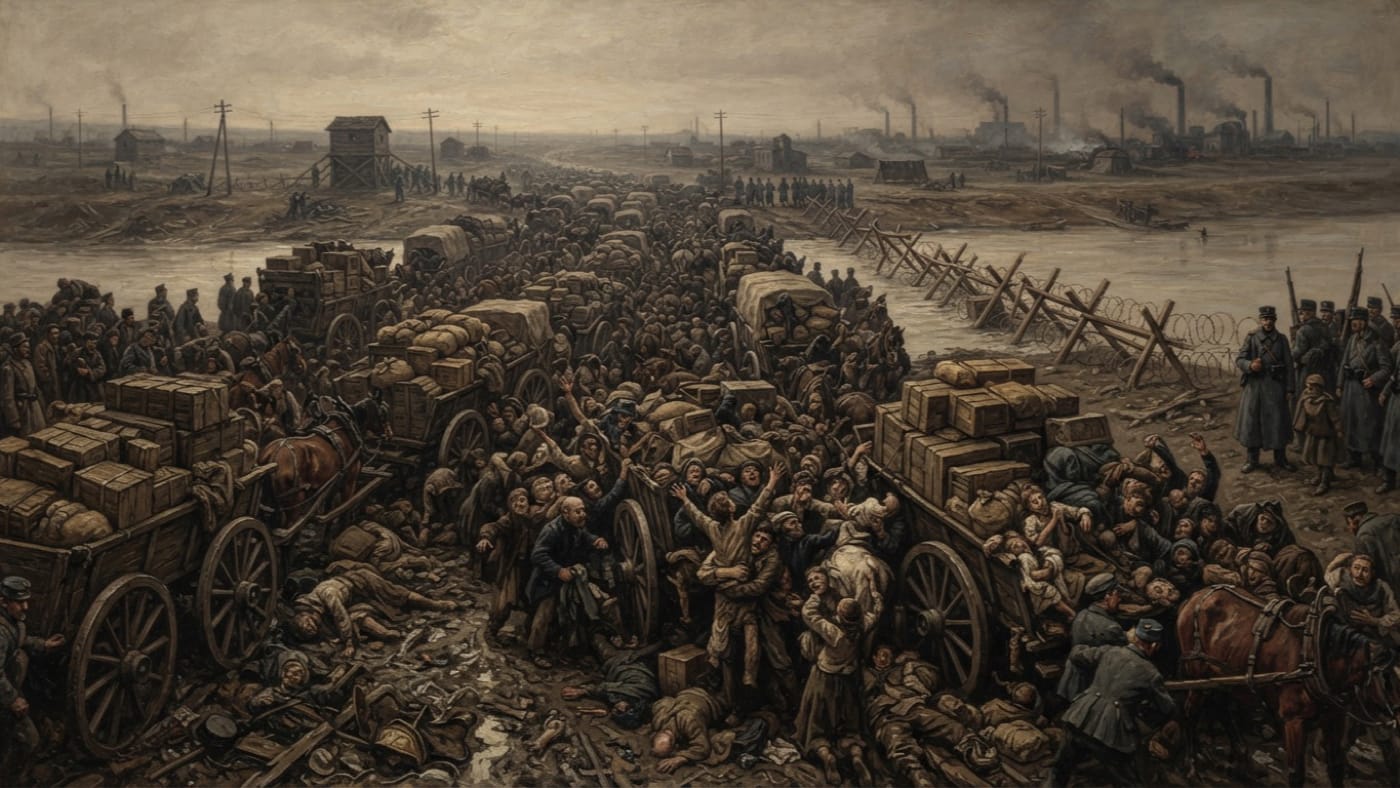
The rumour said there was plague upstream. It was false. The chronicle preserves nothing more of its content, and nothing more is needed. A sentence spoken at a riverbank about a sickness that did not exist was enough to set several thousand people and their freight moving in every wrong combination of directions.
Merchants are a rational order until they are frightened. Then they become a hydraulic one. Those at the water wished to be across it, or away from it. Those behind them wished to be wherever the first group was not. Those further back had heard only that something was wrong at the ford, and that the goods feeding the Line were about to become worthless, contaminated or seized. They did what a merchant does with a perishable cargo and a closing market. They pressed on.
A road built for throughput makes no provision for the moment when throughput turns back on itself. The wagons locked first: iron-rimmed wheel against iron-rimmed wheel, tailboard against team, a horse in its shafts with nowhere to set a hoof. Then the people between the wagons discovered that a body in a press does not fall, because there is nowhere for it to fall. Its neighbours hold it upright, chest to back, while its ribs carry the weight of the road behind. Breath goes before footing does.
This lasted a week. A competent officer and a closed gate can break a crowd in an hour. On the Latch road there was as yet no chain of gates to close, and the surge fed itself from behind. Each new arrival had heard the rumour too late to doubt it and too soon to learn better.
#On the Dead and Their Classification
Three thousand died in the crush. Pressure killed them: ribs that could not rise, feet that never found the mud again, and wheels that rolled a hand's breadth at the wrong moment. Five hundred more died afterward of fevers, among people who had spent a week standing in their own filth beside a river. The two figures belong to different deaths and should be kept in different columns. Together they make three thousand five hundred. Arithmetic supplies that sum, and no census has independently sworn to it.
The fevers prove nothing about the rumour. A sickness that follows a crowd belongs to the crowd. It does not travel back down the road to vindicate the liar at the ford. The chronicle does not name the sickness, so I shall not name it either.
Then the dead went to the Bureau of Records, and Records did what Records exists to do. It found them a class: traffic casualties, non-combatant, weather-related. Each term can be defended. They were in traffic. They bore no arms. And the weather, by the Bureau's own finding, killed them.
Stamped Errata: The preceding paragraph says that "the weather, by the Bureau's own finding, killed them." For killed them, read was entered against them. "Weather-related" is a filing category attached to the dead by the Bureau of Records. It is not evidence that rain, frost, flood or any other condition of the sky caused the panic or the crush, and the account records no weather for that week. The author regrets reading a column heading as a cause of death. Every warden of every ledger is professionally prone to that error.
#On the Nine Gates
The Bureau of War answered the crush in its native grammar. It built gates: nine inspection gates along the road. The chronicle records the response and withholds the timetable. It gives no opening dates, no order of construction and no assurance that the structures standing on the road in A.S. 201 keep the shape of the first ones. It does establish the principle. A road that had existed to move wagons would now stop them, look at them and decide.
Inspection is a modest word for a large change. A gate turns a crowd into a line, and the line into a sequence of individuals. Each of them can be asked his business, his cargo and his name. The surge at the ford had no author because it had no record. After the gates, everything on the Queue Road had a record, and nothing moved until it had first been seen.
In A.S. 102, five years after the panic, the Synod Permit Directorate was constituted under the joint seals of War and Records. The soldiers who had built the gates and the clerks who had classified the dead finally sat at the same table. The Directorate's mandate was orderly throughput. Within two years its method was price. Minute pricing began quietly in A.S. 104 and was policy by A.S. 110. By A.S. 130 the nine gates had earned more in time-credit revenue than all the Rhine bridge tolls combined.
The documents give the sequence in this order: a road that failed, a ledger of dead, a chain of gates and a tariff on standing still. I set it out as they give it. No folio says whether any official foresaw the last link when the first was forged. The Directorate's critics impute design, its clerks impute providence, and both are guessing.
#On the Panic's Administrative Afterlife
The road's later furniture descends from the week at the ford, though none of it was there that week. The Barricade Maze grew out of surge-control practice and hardened only after the Directorate took the road. The iron Bell-Mark Gantry raised its first frame in A.S. 111. The Queue-Marshals trace their formalization to a different disaster, the Three-Day Crush at a bastion gate, and they resent having their founding grief borrowed. Readers who picture the Latch panic among rope lanes, rate boards and marshals in their later regalia are picturing the cure and calling it the disease.
The same year produced the Bread-Scale Uprising. The two are often filed in one breath, as the Commerce Clerk's own entry files them, but they are separate events. The uprising began with lead poured into the pans at a bastion's southern gate. It gave the Synod its seized scales, its sacramental weighing and its relic-calibrated zero. The ford gave the Synod nothing so devout. It gave a road the habit of stopping.
Between them, the two events of A.S. 97 taught the Synod that supply could kill by fraud and by fright. The Synod drew from that lesson the conclusion it draws from every lesson. The cure for a dangerous movement is a supervised one, and supervision is billable.
Today a wagoner on the Queue Road pays for his minutes at nine gates and complains at every one. He is still standing at the ford. He has merely been put in single file.