
#On the Lombard Compact
Fourteen cities of the Lombard plain once swore themselves into an alliance and called it the League of Milan. The name honours Milan. Whether Milan presided, hosted, paid, or merely lent its syllables, the surviving record does not say. No roll of members has reached any registry I am permitted to read. There is no founding charter and no date of first sealing. Nobody recorded the chamber where the delegates sat, or the offices they shared out among themselves with the usual municipal hunger for titles.
What survives is the end of the thing. The League enters the Synod's memory at the moment the Synod removed it. The Bureau of Oaths filed the death. Nobody filed the birth.
Lombardy supplies the setting, and the setting is all it supplies. Grain, silk, canals, roads, guildhalls and money moved along the corridors of the Po. It was a province rich enough to imagine it could govern its own promises. Its communes had old habits of private compact, guild to guild and town to town, each pact witnessed by whoever stood nearby in a clean collar. I name no member city. Como in particular belongs to a later and wetter chapter, and I will not enlist it in a League it is not recorded as joining.
#On Northern Jurisdiction
The Concordat of Strasbourg constituted the Synod in A.S. 90. The Bureau of Oaths received its charter two years later, in A.S. 92, and took its place among the organs now counted as the Holy Bureaus. Oath procedures were older than the charter. The wartime Church swore men to service long before anyone printed a Witnesser's licence. The charter turned that habit into jurisdiction, and jurisdiction is the only kind of habit that can send a bill.
The doctrine is short enough for a child to recite and severe enough to frighten a magistrate. A vow becomes recognized law when a licensed Witnesser hears it and Strasbourg registers it. The Witnesser stands silent, watches the hands, hears the cadence and marks a lead tablet. The Registry files. Everything else, in the Bureau's phrase, is merely breath. Whether the Creator also attends the filing is a question for Doctrine. The Bureau of Oaths requires only that Strasbourg did.
The cities of the League held another view. They believed themselves exempt from northern ecclesiastical jurisdiction. In their account, promises made among Lombard communes answered to Lombard custom and to no desk on the Rhine. The record does not say which privileges, precedents or ancient parchments they cited, and I decline to write a legal brief for a delegation that never got to submit its own.
The quarrel was simple, as the gravest quarrels usually are. Fourteen cities said their compact bound them. Strasbourg said that it decided what binds.
#On the Five-Page Writ
In A.S. 97, five years into its charter, the Bureau of Oaths performed its first significant dissolution of a treaty. It annulled the League of Milan.
The instrument was a writ of five pages. The act of annulment was a single stamp. By the Bureau's own account, the writ took three years to draft and six hours to enforce. I give those figures exactly as the Bureau gives them, with the contentment of a clerk who has balanced a column nobody else could add.
Earlier editions of the Holy Bureaus entry dated the annulment of the League of Milan to A.S. 7. Other registers carried A.S. 207.
The annulment belongs to A.S. 97. A.S. 7 is eighty-five years before the Bureau's charter. A.S. 207 is six years after the present. The Bureau of Oaths is patient, but it does not annul in advance.
The ratio is the Bureau's boast. Three years of drafting meant clauses weighed, precedents gathered and language passed from hand to hand until no syllable could be challenged. Then came six hours of enforcement. The Bureau does not record how those hours were spent, who spent them or with what instruments. I will not invent couriers, cavalry or seized gates that the archive does not contain. The grounds of the writ are also missing from every summary I have read. A man may admire a judgment without being shown its reasoning. The faithful do it on every feast day.
The account does establish the order of events. The writ was composed and the stamp applied, and the League ceased to exist as a lawful bond. The rites formalized after the Breach Plagues of A.S. 110–115, with their specialist officers and their separate ceremonies for each kind of broken vow, were more than a decade away. The account does not say what ceremony, if any, went with the stamp in A.S. 97. The Bureau did not need one.
#On the Embassy at Strasbourg
The League's ambassadors came to Strasbourg to protest.
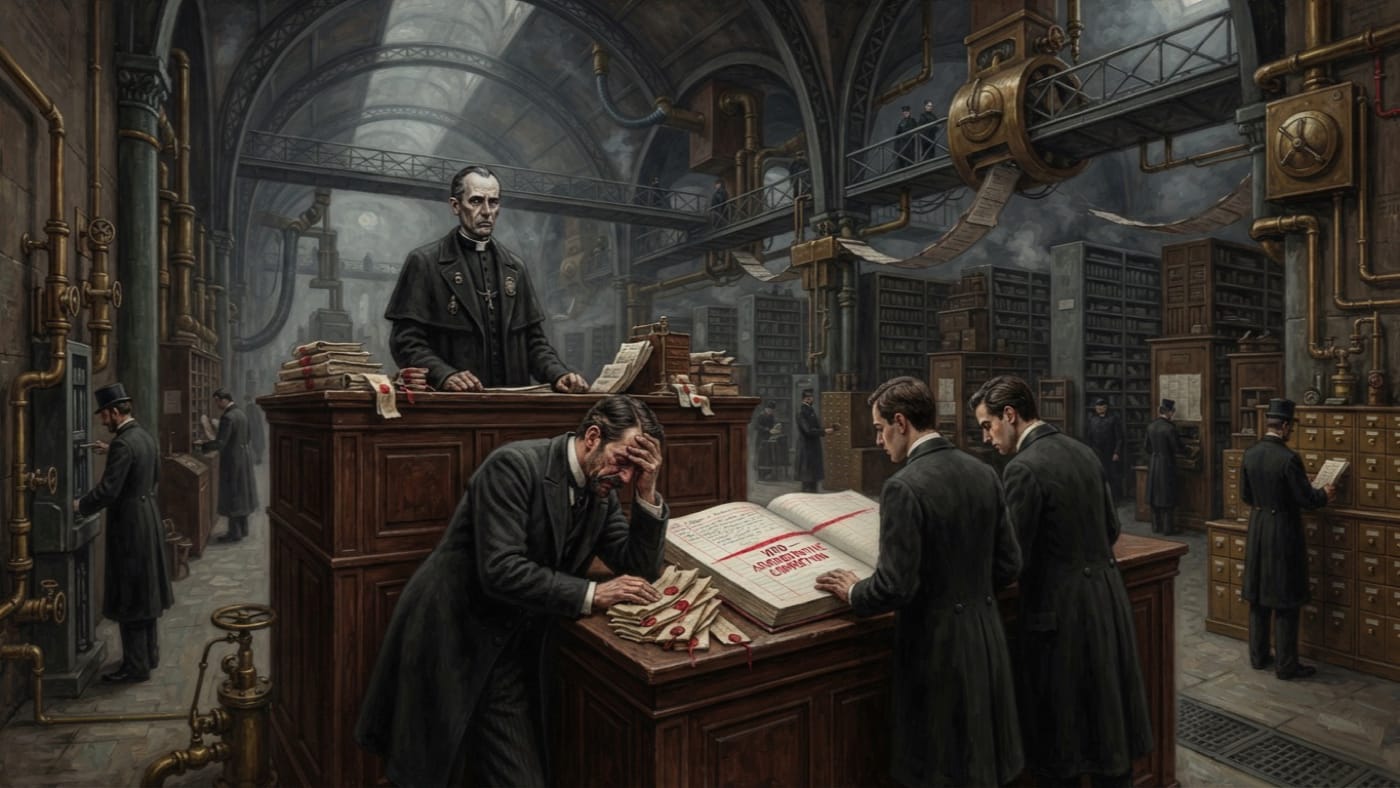
The verb deserves scrutiny. They came after the writ, after the stamp, after the filing. They arrived as envoys of an alliance the Registry had already closed, and the proof was waiting for them. Their own names were entered in the Ledger of Dissolved Compacts. Their seals were filed under the heading "Void — Administrative Correction."
I have no record of their speeches. Whatever they carried to the Rhine (privilege, custom, the dignity of fourteen cities), the account does not preserve it. I will not write orations for men whose words the Bureau did not think worth transcribing. What the account preserves is paperwork: a ledger with their names, a file holding their seals, and the classification written above both.
One of them bore the title Conte di Sforza. The record does not give his given name, the city he spoke for, his rank in the delegation or what became of him afterward. One fact about him survives, and it survives in the passive voice: he is reported to have wept. A Witnesser was present and noted the tears. The Bureau's account calls them evidence.
It does not say what they are evidence of. A man in that room might weep for his city, his office or his pride, and the account does not choose among them. It had no need to. A Witnesser's notation moves a man's distress from his face into Strasbourg's custody, where it will outlast the face. Tears unrecorded are a private matter. Tears on a Bureau tablet belong to the file.
#On the Compact Retained
The Bureau of Oaths destroys nothing. Its general practice with an annulled entry is to strike it through in red ink and leave the original legible beneath the line. I have not been shown the League's folio, and I decline to describe a page I have not read. The principle is enough. An annulled compact is kept so that it may stay annulled where everyone can see it.
Careless readers confuse two collections, so I keep them apart here. The Ledger of Fidelity runs to seven hundred volumes beneath the Basilica of the Ledgered Saints and records vows sworn under Synodal jurisdiction. The Ledger of Dissolved Compacts is the smaller and grimmer archive of annulled treaties, expired guild bonds and voided marriages. The present survey of A.S. 201 counts it at forty-seven volumes, and its archivists call it the Graveyard. Its size in A.S. 97 is not recorded. The League's entry lies somewhere in it, older than most of its neighbours.
The Bureau did not have to invent a founding parable, because the League gave it one. Any later quarrel over jurisdiction can be answered by pointing at a shelf. On it sit the fourteen cities, the five-page writ, and the names of the men who came to object, entered before they arrived. The Bureau tells this story itself, without being asked. That alone tells you it finds the story flattering.
#On the Later Lombard Record
Voiding the League did not quiet Lombardy. In A.S. 150, fifty-three years after the annulment, Milan and other Lombard cities declared for the Coalition of the Crossed Keys, and the province earned a far uglier entry in every Bureau's books. That rising is a separate episode, with its own actors and its own archive. No record I have read makes the League its ancestor. I will not draw a line of descent across half a century merely because both stories begin in Lombardy and end in a Strasbourg ledger.
As of A.S. 201 the province is administered and registered, though not fully pacified. Its guildhalls still remember compact-making the way old soldiers remember a wound, mostly when it rains.
The League of Milan has no hall and no delegates in our day, and no claim on any Lombard magistrate. Its ambassadors' names stay where the ink put them. Their seals stay under the heading they found on arrival.