
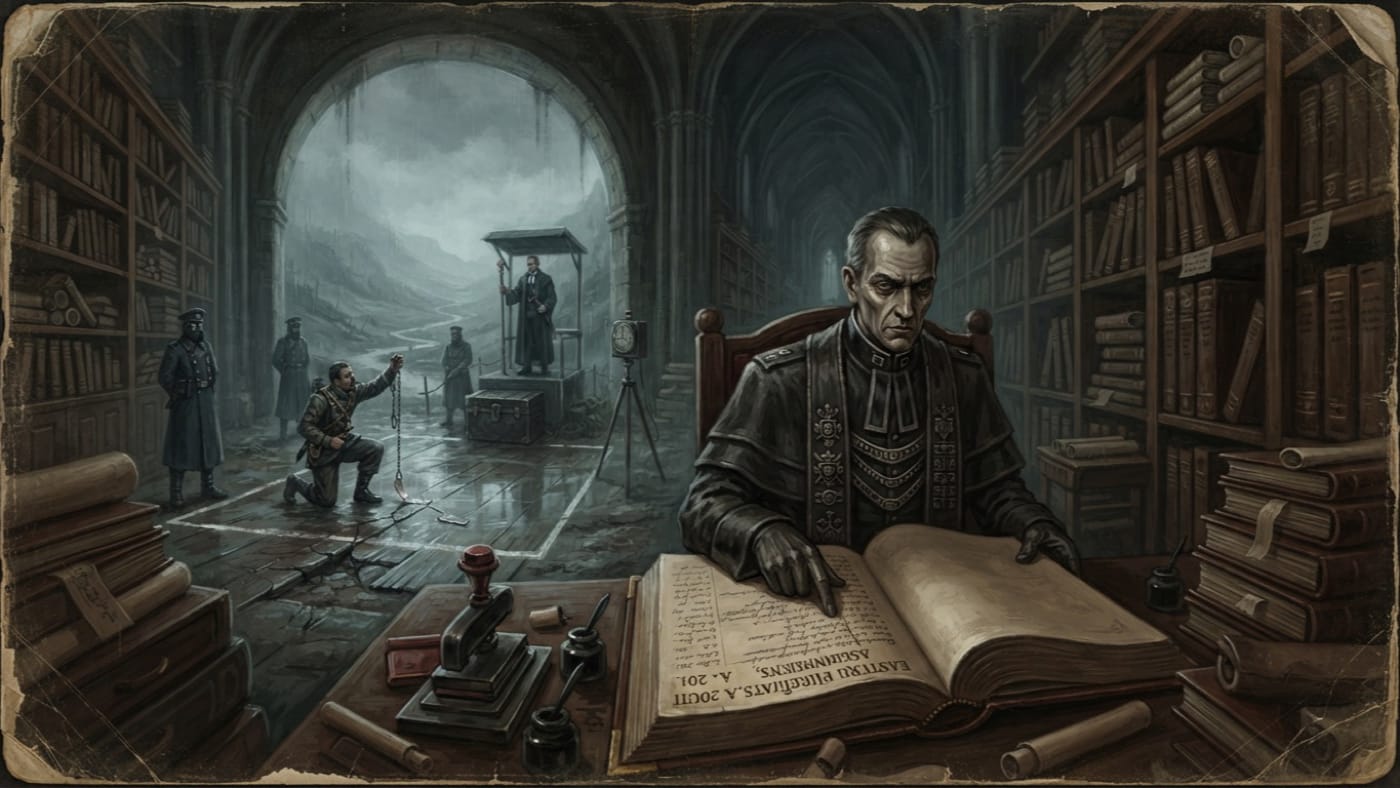
#On the Assignment of Circuits
The Synod Legal Prelate assigns circuits. That sentence looks harmless, and most of what follows is commentary on why it is not.
A circuit is a road with a court on it. To assign one is to decide which districts will see a Judge's seal this season, which bailiffs will sleep beside that seal, which plank roads they will cross to bring it, and which districts will settle their quarrels with knives because no seal is coming. The Roving Judge's Bailiff treats the Judge as master and the Prelate as weather. It is distant and administrative, and it decides where a man happens to be standing when the rain arrives.
The office has no rung on the bailiff's ladder. Court Rope, Docket Runner and Wagon Guard stand at the bottom. The Circuit Bailiff and Trial Marshal hold the middle, with the Bailiff-Captain and Circuit Enforcer above them. The Seal Custodians and Demon-Route Screeners stand off to one side, where specialists are kept. The Legal Prelate stands outside the ladder altogether, in the registry of patrons, which is higher and better heated. The corps names two authorities over its work: the Judge, who directs it, and the Prelate, who sends the Judge somewhere.
The Codex records no founding year for the office, no first holder and no instrument of creation. Offices of this kind are seldom founded. They build up like wax on the underside of a seal press until some clerk thinks to give the residue a title.
#On the Court Sent Down the Road
What the Prelate assigns is heavy. A roving court carries a Judge, a seal chest, a docket, a writ satchel, chalk for the perimeter, iron for the accused, rifles with stamped stocks and a hymn-chime on a chain. Since the Road Riots of A.S. 140, it has carried men trained to fire. Since the Hymn-Length Reforms and Judicial Circular 4.12 of A.S. 141, it has carried a clock in the shape of a creed-hymn, divided into opening, testimony, rebuttal and ruling. Each chime closes a window. When the last one sounds, consequence has been pronounced, and the bailiffs carry it out with cuffs, receipts and wagons.
The Prelate performs none of this. The Judge presides. The bailiffs chalk the line, hold the witnesses, ring the marks, guard the chest and do whatever the ruling requires. The Prelate's work is finished before the wagon leaves: this circuit, these districts, this road. After that the office knows the circuit as a column in a register, and a column does not ride in a wagon.
The consequences ride instead. A circuit drawn through bandit country produces dead bailiffs. A circuit drawn through districts in arrears produces seizures, auctions and riots of exceptional sincerity. A circuit drawn too thin gives the corps the oldest joy in administration: three districts and one seal. Bailiffs say they owe their patrons for their postings. They say it the way a debtor reads a balance.
The patronage does not stop at the road. Citation Advocates list a Synod Legal Prelate among the senior patrons who can advance an advocate's career, alongside the High Registrar and the Judge's Patron. One office stands behind the men who argue the docket as well as the men who chain the accused to it. Nobody in the Synod objects to this. It is called coherence.
#On the Chime That Rang Before Permission
The Demon-Route Years, A.S. 160 to 175, tested the Prelate's register against the roads it described. The eastern circuits between the bastions began to produce crowds that vanished at ten paces, witnesses who arrived twice, market squares that no village claimed, and hymn-chimes that rang before any hand touched the striker.
The last of these was a legal question before it was a horror. The hymn-length court depends on the chime meaning exactly what the Circular says it means. If the second mark sounded before the court opened, had testimony begun? If the fourth mark sounded before accusation, had consequence been pronounced? The Bureau of Bells could study metal fatigue, counterfeit strikers and sympathetic vibration for as long as it liked. Somebody still had to rule on the law.
The Legal Prelate's first answer was no.
The road replied by leaving three sealed dockets on a table at dawn. Their ruling impressions were still cooling and the seal mark was accurate. The Judge's seal was locked in its chest the whole time.
By A.S. 168 the office had put its position in writing. That year a Legal Prelate's note described Demon-Route screening as "temporary field caution pending restoration of ordinary circuit conditions." By then the Screeners already walked the chalk before Prime with consecrated bell-metal slivers on their chime chains. If a sliver cracked, the court did not open.
#On Temporary Caution
Read in the room where it was written, the phrase is reasonable. It assumes that ordinary circuit conditions exist. It assumes they are waiting somewhere to be restored, like a seal sent away for re-cutting.
In A.S. 172 a circuit court was ordered to sit on a raised plank road east of the pass at Bastion-Shipka to hear charges against six marsh-haulers. The Syrionic fog lay close enough that the chime was wrapped between sessions. The Screener's sliver hummed at the north stake, went quiet at the witness pen, hummed behind the Judge's platform and cracked on the route by which the accused had been brought in. He cancelled the court. The Judge and the seal left by the second road. The six accused stayed chained to the plank rail. A purification detail was requested from the Bureau of Rites and never arrived. In A.S. 173 a recovery patrol found six chain lengths fused into the rail, no bodies, and one witness slate wiped clean except for HEARING CONTINUES.
The Codex places no Legal Prelate on that road and charges the office with no share of the missing detail. It notes only that the circuit existed, and that circuits are what the office assigns.
Assignment record, Shipka eastern circuit, A.S. 172: ███████████████. Assigning desk: ███████. Status: not requested by any review.
The Bureau declared the Demon-Route Years contained in A.S. 175, and the screening continued afterwards. The procedure now runs through offices that do not answer to the Prelate. The Bureau of Records keeps each cancellation as a docket wound. Purity reads each wound for contagion. Bells listens to the chimes and calls it research. The Bureau of War asks only that roads go on being roads. Rites sends its details, eventually.
The core of it is narrow and absolute. If the sliver cracks, the court is void. A Judge who tries to force a cracked court open takes on personal seal liability, a phrase that has cooled more judicial courage than artillery ever did. The Codex has found no instrument that lets a Legal Prelate set this rule aside. Readers who know of one are asked to keep it to themselves.
The A.S. 168 note of a Legal Prelate described Demon-Route screening as "temporary field caution pending restoration of ordinary circuit conditions."
Corrected by the false courts, the duplicate witnesses, the Shipka recovery and every decade since. The caution has now lasted into A.S. 201. Ordinary circuit conditions have not reported for restoration.
#On Present Allocations
As of A.S. 201, every major eastern circuit keeps at least one trained Screener. Every minor circuit says it would keep one if staffing allocations followed danger rather than population, revenue, or the cousinhood of Legal Prelates.
The Codex records that last phrase as a district grievance, which is what it is. No register names a cousin. The districts manage without one. A district that sees a Screener ride past toward a larger town learns all the genealogy it needs.
Official language follows the office. The Legal Prelate calls the Demon-Route protocols safeguards, and the Bureau of Doctrine calls the Screener a procedural safeguard. Bailiffs call the whole arrangement the Crack-Watch. Judges call it delay until a sliver saves them, and confidential afterwards. Accused men chained to rails in the rain call it nothing anyone has written down.
The assignments go out each season, as they always have. The Prelate has never had to stand in the chalk to send someone there.