
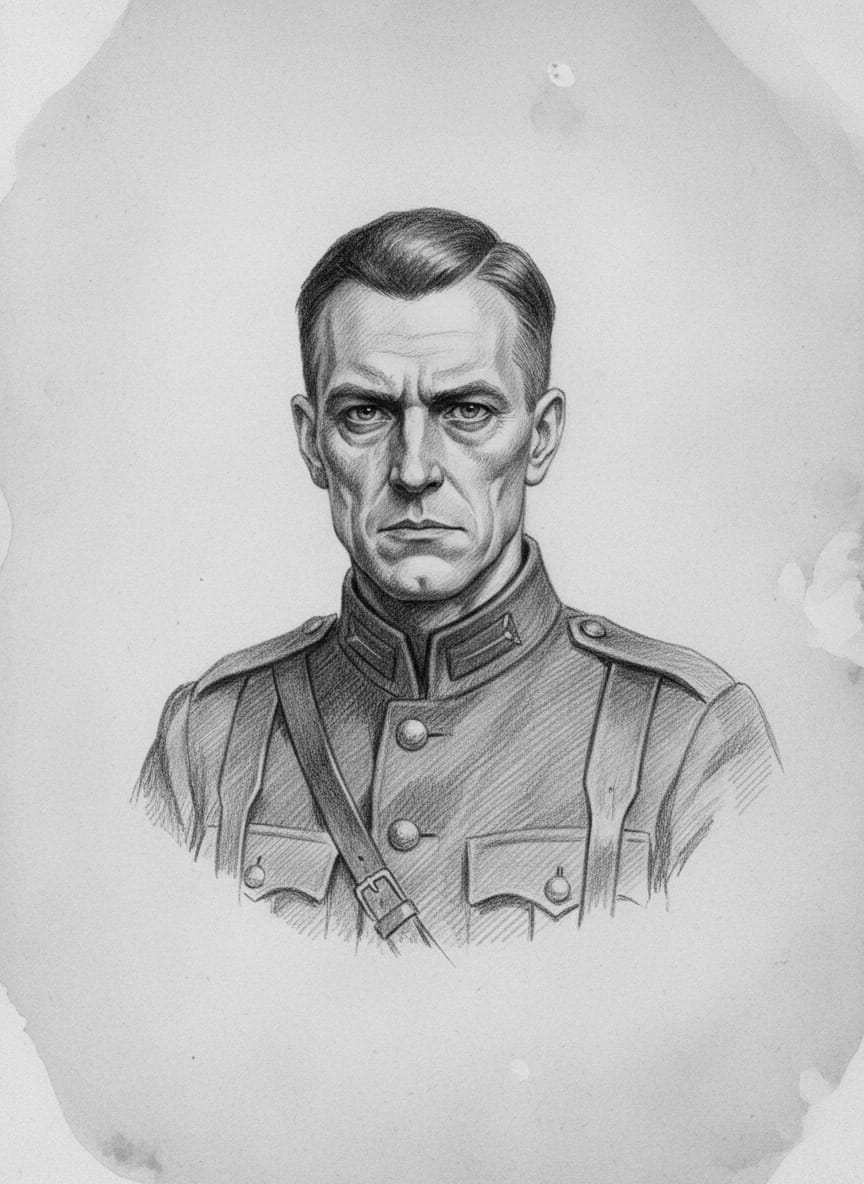
#On His Unfortunate Accuracy
Lieutenant Voss enters the Ledger by reporting a stomach-ache.
This is an undignified portal into history, but the Ledger has never promised dignity. It promises sequence, seal, correction, and the occasional mercy of legible ink. In A.S. 120, Voss commanded a twelve-man patrol out of the eastern garrison of Bastion-Constantinople, operating along the western approaches of what would later be classed under Famine Pit notation. His task was ordinary: inspect a mass-burial site, confirm boundary markers, return before Vespers with boots, men, and report intact.
He returned with all three. The Bureau took fourteen years to understand the report.
Voss’s patrol approached a burial site south-east of Pécs, then recorded simultaneous gastric distress at approximately three hundred yards. At two hundred yards, cramping. At one hundred, vomiting. At fifty, incapacitation. Voss himself described the sensation as “a fist inside my stomach, squeezing, and then opening, and then squeezing again, and the fist was not mine.” It is a good sentence. Too good for a field lieutenant. The Bureau of War (Unregistered) distrusted it at once.
#On the Patrol Report
The report’s original placement in the eastern garrison’s miscellaneous correspondence file tells the reader everything necessary about institutional self-defence. Miscellaneous is where facts go when they have arrived without sponsors. Voss wrote with military plainness: distance, symptom, ration issue, withdrawal time, personnel condition, weather. He appended a sketch-map with the burial mound, trellis remains, and the approximate line at which men began clutching their bellies.
The sketch-map survives. The men do not, in any sense the Bureau finds convenient.
Early internal summaries described Voss’s report as “medically inconclusive.”
Corrected. The report was medically unprocessed. Inconclusive suggests an examined matter. No examination occurred until A.S. 134, when Medicine’s statisticians found the file and experienced, according to their own minutes, “administrative discomfort.”
Voss ordered withdrawal before collapse reached the point of no command. This has been criticised by later auditors as premature retreat. Later auditors are a priestly species of coward, bred in rooms with chairs. Had Voss advanced twenty more yards, he would have provided clearer data and fewer living witnesses. The Bureau loves clearer data. The families prefer witnesses.
#On Fourteen Years of Silence
From A.S. 120 to A.S. 134, Voss’s report sat beneath ration complaints, mule-transfer disputes, one denunciation of a chaplain for improper fish blessing, and a weather log written by an artillery corporal with ambitions above his station. During those years, other men cramped, vomited, weakened, and died near old burial grounds. Their deaths were classified separately: food poisoning, morale collapse, demonic nervous influence, heat weakness, poor discipline, divine correction.
The dead are patient with clerks. They can afford to be.
The Bureau of Medicine rediscovered Voss while investigating “unexplained gastric failures” along the Blightmarsh perimeter. The cluster corresponded to known mass burials. The mass burials corresponded to old retreat roads. The old retreat roads corresponded to hunger. Voss had written the first clean line in a diagram no one wished to see.
Excerpt, Medicine Appendix, A.S. 134: “Lieutenant Voss’s men reported dreams in which the burial site counted them. Private ███████ consumed his ration card on the return march. Corporal ███████ attempted to feed his own shadow. Voss ordered both restrained, then apologised to both by name.”
Medicine confirmed Residual Consumptive Emanation, Category Three. Doctor Trenn later refined the phrase “pseudo-starvation cascade,” defending the pseudo as cause, never effect. Voss’s report became precedent. Precedent is what the Bureau calls a man after it has finished ignoring him.
#On His Irregular Career
The Bureau of War describes Voss’s subsequent career as irregular. This is one of the Bureau’s tenderer insults. An irregular career may contain insubordination, genius, bad luck, survival beyond one’s assigned narrative, or a superior officer’s irritation sharpened into administrative form. Voss’s file suggests all five.
After A.S. 120, he requested no eastern reconnaissance command for eleven months. Request denied. He objected to patrol routes passing within unmeasured burial fields. Objection noted. He ordered double rations issued to a patrol under his temporary command after one scout reported bread-smell in open air. Reprimand entered. He attached copies of his original Pit report to three separate route-planning memoranda. Two attachments were removed before filing. The third reached a captain who wrote in the margin: “Voss again.”
No portrait is attached to the surviving file. The Bureau of Records lists him as thirty-one at the time of the patrol, born somewhere in the southern corridor, commissioned under emergency frontier authority, literate, numerate, “temperamentally unsuitable for reassurance.” That last phrase should be carved above the entrance to every academy. Reassurance has killed more soldiers than despair. Despair at least encourages a man to check the ground.
#On the Man the File Would Not Keep
After the Bureau of Medicine confirmed the phenomenon in A.S. 134, Voss’s earlier report became useful. Usefulness did not make him safe. The Bureau dislikes owing a debt to an officer it has reprimanded. It prefers to launder the debt through procedure until gratitude emerges without a creditor.
Voss was summoned twice for testimony. The first testimony was entered as supporting evidence. The second was sealed after he objected to the controlled exposure methodology at Pit Seven. We know this because the seal slip survives in a docket of cross-references, and because the clerk who stamped it made the blessed error of writing the subject line too clearly: “Voss objection — prisoners — distance trial.” The Bureau of Doctrine later ruled the objection non-germane. Germane, in Bureau dialect, means convenient to the verdict.
A devotional pamphlet printed in A.S. 148 identifies Lieutenant Voss as “the discoverer of the Famine Pits” and praises his “obedient participation in subsequent investigations.”
Withdrawn. Voss discovered nothing that the dead were not already declaring. He reported. He objected. Obedience, if present, was intermittent and poorly documented.
His file thins after A.S. 137. Thin files are never empty; they are merely wearing gloves. One note places him at a rear hospital in Bratislava, recovering from “dietary aversion.” One places him in a disciplinary convoy bound for the southern theatre. One, copied badly and then struck through, places him as an adviser to Hunger Warden training before the Hunger Wardens had an authorised name. All three may be true. Bureau chronology is a drawer full of knives.
#On His Proper Use
Lieutenant Voss is not a saint. The Bureau has canonised worse material, certainly, but no petition has crossed my desk and I shall burn the first one that does. He is more useful as a warning. A saint becomes plaster. A warning remains sharp.
His use is this: the first report is often ugly, local, beneath style, beneath theory, beneath the notice of men who prefer their horrors named in Latin before they will agree to fear them. The patrolman says his stomach hurts. The lieutenant measures the distance. The clerk shelves the paper. Fourteen years later, the Bureau discovers doctrine in the miscellaneous file.