
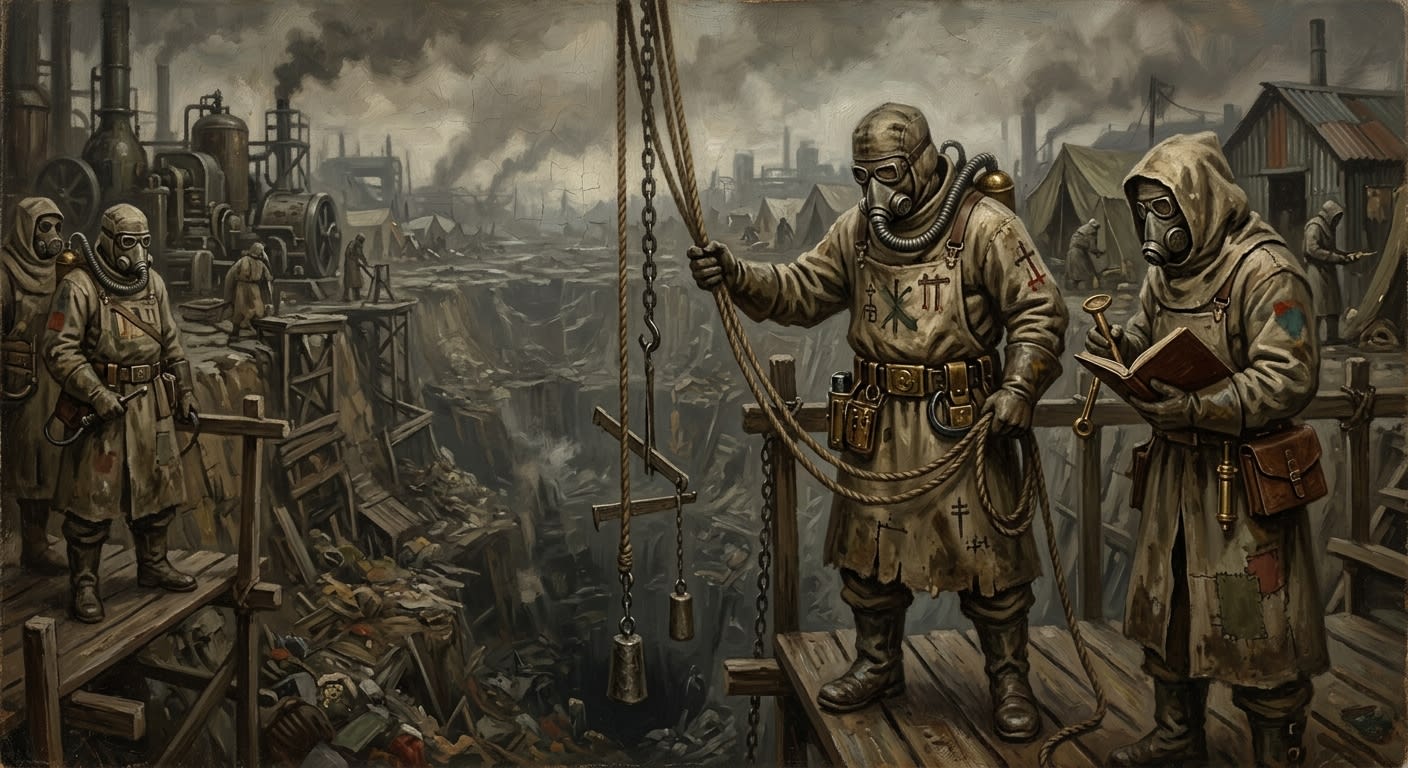
#On the Office Nobody Wanted Named
The Hunger Wardens are the Synod’s authorised proximity workers at Famine Pit sites: canvas-suited, rope-tethered, brass-instrumented fools of great utility and poor prospects. The Bureau of War calls them auxiliary hazard personnel. The Bureau of Medicine calls them field observers. The men at Bastion-Constantinople call them Grave-Tasters, a rude accuracy no formal memorandum could survive.
They exist because the Pits must be measured and ordinary soldiers now refuse to stand where the dead can make their stomachs remember starvation. They exist because maps require numbers, exclusion zones require stakes, and the Bureau cannot bear a horror that lacks a perimeter.
The Wardens were not constituted by noble charter. They grew out of necessity, which is the Theocracy’s most honest legislator. After Lieutenant Voss filed his A.S. 120 patrol report and the Bureau of Medicine confirmed Residual Consumptive Emanation in A.S. 134, somebody had to approach the burial sites with measuring chain and notebook. Priests volunteered until the first priest came back biting his own sleeve. Soldiers volunteered until commanders noticed the word volunteer had become a synonym for condemned. Medicine requested trained personnel. War requested expendable personnel. Doctrine requested better phrasing.
The Hunger Wardens were born between those requests.
#On Their Equipment
A Hunger Warden’s canvas suit is a fraud in the useful sense. It does not stop hunger. It does not prevent emanation. It does not keep the dead from reaching through the body’s own appetite and pulling. What it does is slow mud, insects, ash-dust, sweat panic, and the common soldier’s belief that nothing stands between his skin and the grave. A soldier with a suit will walk five yards farther than a soldier without one. Five yards is data. The Bureau is fond of data.
The rope is less fraudulent. It is fastened under the arms, crossed at the chest, passed through a brass ring at the rear of the harness, and held by two pull-men beyond the marked line. If the Warden collapses, the pull-men retrieve him. If the Warden resists retrieval, the pull-men retrieve him harder. If the Warden begins crawling toward the Pit on hands and knees while requesting bread in a voice not his own, the pull-men do not discuss theology. They pull.
The instruments are brass because iron misreads, wood warps, glass sweats black, and silver produces devotional excitement among chaplains who should know better. Each kit contains a chain, a depth-hook, three appetite dials of Bureau of Medicine pattern, a symptom slate, waxed pencils, sealed ration pellets, and a bell-token to mark time in ninety-minute increments. No Warden enters a perimeter without two witnesses counting breaths aloud.
Earlier training sheets described the canvas suit as “protective.”
Corrected. The suit is isolating, identifying, and recoverable. It is protective only in the sense that a coffin protects its contents from rain.
#On the Work
The work is simple when written down. Approach. Measure. Record. Withdraw. Wash. Eat under observation. Sleep under observation. Report dreams.
The work is not simple in the body.
At eight miles from a confirmed Pit, a Warden begins tasting metal. At four miles, double rations are issued under Standing Order 77-K, and every man pretends he is not counting the bites of the man beside him. At one mile, the appetite dials twitch. At two hundred yards, the Warden’s hands begin making little grasping motions inside the gloves. At fifty yards, no man is permitted to work alone, speak without witness, or remove his mouth cloth. The data from closer ranges is sparse. Sparse is the Bureau’s gracious word for paid in meat.
Field Recovery Note, Pit Three, A.S. 193: “Warden ███████ reached stake-line 49 and reported hearing a woman ask whether the children had eaten. Pull order given. Subject resisted. Subject stated, ‘I have their bowls.’ No bowls recovered. Canvas suit contained mud, ration crumbs, and seven human milk teeth.”
The Wardens mark boundary stakes, replace warning tablets, test instrument drift, and retrieve abandoned equipment when the Bureau judges the equipment worth more than the risk. They also perform the worst labour the Synod assigns without calling it spiritual: they witness the dead’s hunger at distances close enough to make denial indecent.
#On Discipline and Appetite
Hunger Wardens are watched like relic thieves. Before duty, they are weighed, fed, questioned, blessed, and searched for private food. After duty, they are weighed again, fed again, questioned again, blessed with less confidence, and confined until the supervising physician signs the appetite sheet. A man who refuses food is quarantined. A man who requests more food is quarantined. A man who eats calmly is watched with particular suspicion, since calm is often a later symptom wearing a clean collar.
The rule is ugly and sound: every appetite after Pit exposure is evidence.
The Bureau of Mercy objected to the post-duty search of prayer books, calling it an infringement upon devotional privacy. Medicine replied that previous Wardens had hidden ration fragments between psalm pages. War replied that devotional privacy was admirable outside a four-mile exclusion perimeter. Doctrine replied with a committee. The searches continued.
#On Their Recruitment
The first Wardens were drawn from punishment companies, failed scouts, dismissed surveyors, and the thin category of men who will volunteer for anything that sounds specialised. Later intake came from engineers with steady hands, medics with poor advancement prospects, and soldiers removed from ordinary patrol duty after showing too little fear. Too much fear breaks a man early. Too little fear gets him killed later. The Bureau prefers the middle fear: obedient, literate, respirating.
Training includes knot work, instrument maintenance, symptom vocabulary, controlled fasting, emergency extraction, and the memorisation of Doctor Trenn’s distance tables. Recruits are taught to distrust generosity from the ground. They are taught that the smell of bread is an alarm. They are taught never to answer a voice that knows their mother’s name. This last rule produces laughter in the classroom. It does not produce laughter after the first perimeter walk.
Recruitment records once classified Hunger Warden duty as “non-combat auxiliary service.”
Amended. The current classification reads “hostile exposure service, non-engagement.” The distinction matters to pensions, widows, and cowards with pens. It does not matter to the Pits.
#On Casualties
The Wardens die badly and file well. That is the Bureau’s favourite combination.
Some die at the rope. Some die later, in quarantine, after their bodies begin spending themselves faster than food can answer. Some survive and become permanently unsuitable for dining halls, feast days, children’s choirs, bakeries, harvest processions, or any sermon that employs hunger as metaphor. The Bureau of Medicine classifies long-term cases as Residual Appetitive Injury. The barracks call it Pit-mouth.
No one knows whether the Wardens are contaminated by the dead or educated by them. The distinction matters to Doctrine. It matters less to the man who wakes each night with his jaw aching from a dream in which he chewed gravel and thanked the Creator for it.