
#On the Dead Who Did Not Finish Dying
"The Bureau of Rites performed rites over the nearest. The Bureau of Records documented the rest. Neither Bureau has volunteered to return." — Standing notation, Bureau of War Eastern Command, filed A.S. 121
I have written of the Blightmarsh at length and with a reluctance the Bureau mistook for thoroughness. I have written of Kargath and his territories and his armies and his appetites. But the Famine Pits are something else — something prior, something that belongs to us as much as to the enemy, because the dead in those trenches are ours. They were Synod subjects, or the precursors of Synod subjects, or simply human beings who died on roads leading westward with their hands clutching children who had stopped crying. The Pits are not Kargath's invention. They are his inheritance, and ours, and the distinction between those two claims is the kind of theological problem the Bureau of Doctrine prefers to file rather than resolve.
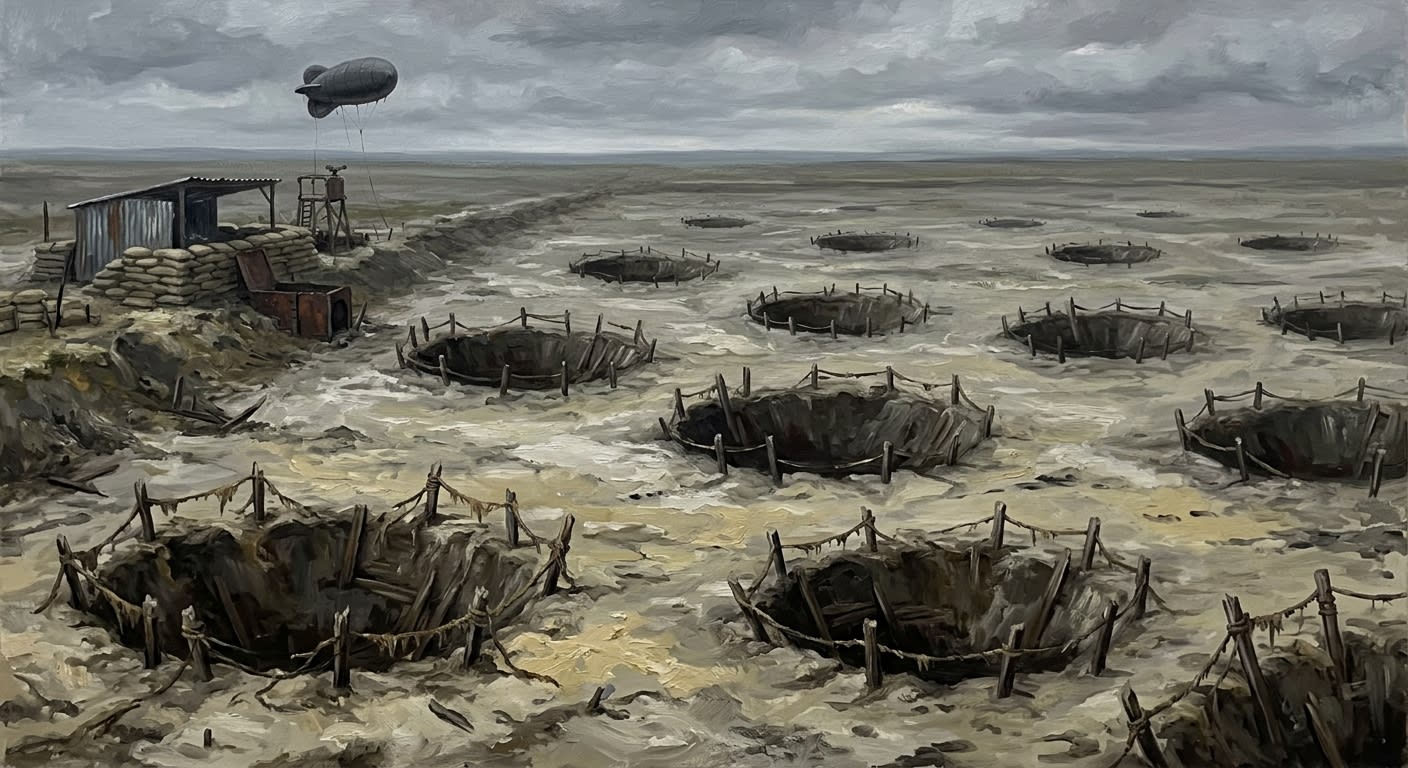
Fourteen confirmed. The Bureau of War suspects twenty or more, given that the Blightmarsh's expansion has swallowed territory where mass burials are documented in the records of three separate predecessor administrations, none of which survived long enough to maintain consistent filing practices. Fourteen confirmed, each one a wound in the earth that has refused to scar over, each one radiating a hunger that does not belong to any living thing and that the Bureau of Records has classified, with the particular precision of men who do not wish to be blamed for imprecision, as "Residual Consumptive Emanation, Category Three, Theological Origin Probable."
#On the Burials
The Great Retreat stripped the eastern provinces of everything the Rationalist wars had left them, which was already less than the Bureau's post-war assessments claimed. The armies ate what the refugees carried. The refugees carried what Kargath's advance had left, which was nothing, because Kargath does not leave. He consumes. The fields that had fed Pannonia for centuries were grey mud by A.S. 50, and the roads that crossed those fields were rivers of the starving and the already dead, and the chaplains who walked among them administered last rites with the speed of auctioneers because there were always more dying than absolving, always more bodies than graves, always more hunger than any prayer could answer.
They buried them where they could. Shell-craters from the Rationalist artillery served as ready-made pits — already dug, already deep, already consecrated by the violence of the Age of Reason in a manner that the Bureau of Rites would later classify as "inadvertent sanctification, status: ambiguous." Trenches left by retreating armies. The cellars of abandoned farms, where the dead were stacked like cordwood and the doors pulled shut by hands too weak to nail them. River-cuttings. Quarry-floors. Roadside ditches widened with entrenching tools by soldiers who had not eaten in four days and who dug with the mechanical efficiency of men performing a task they expected to require for themselves within the week.
The rites were abbreviated. The Bureau of Records — which did not yet formally exist, though Archon Veyrault's clerks were already keeping lists in the margins of requisition forms — documented what it could: names, when names were known; numbers, when numbers could be estimated; locations, when the location would hold still long enough to be charted. Many of the dead had no names left. Starvation strips identity as efficiently as it strips flesh. The chaplains recorded "souls, unknown, commended" and moved on, and the clerks recorded "bodies, enumerated, disposed" and moved on, and the earth received what was given and did not move on. The earth held. The earth kept.
#On the Phenomenon
What the Bureau understands now — and has understood since A.S. 120, when a patrol from Bastion-Constantinople's eastern garrison reported the effect and was, predictably, disbelieved — is that the hunger of those dead did not expire with them.
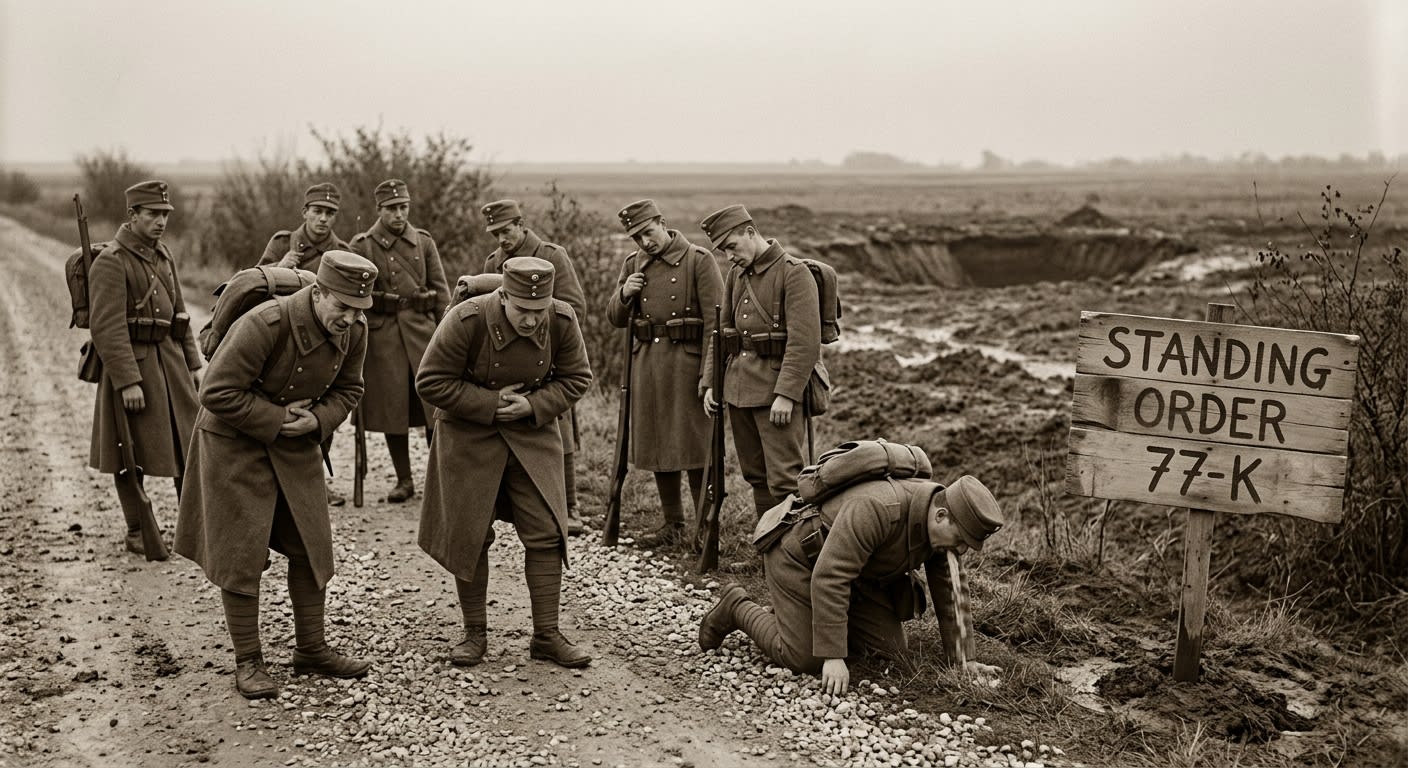
The patrol, commanded by a Lieutenant Voss whose subsequent career the Bureau of War has described as "irregular," reported the following: at a distance of approximately three hundred yards from a known mass burial site south-east of the former town of Pécs, every member of the twelve-man patrol experienced simultaneous gastric distress. At two hundred yards, the distress became cramping. At one hundred yards, one soldier vomited the contents of a full mess-tin consumed less than an hour prior. At fifty yards, three soldiers were incapacitated. Lieutenant Voss, who had eaten the same rations as his men, reported a sensation he described in his deposition as "a fist inside my stomach, squeezing, and then opening, and then squeezing again, and the fist was not mine."
The patrol withdrew. Lieutenant Voss filed his report. The report was stamped RECEIVED and shelved in the eastern garrison's miscellaneous correspondence file, where it remained for fourteen years until the Bureau of Medicine, investigating a separate cluster of "unexplained gastric failures" among troops stationed along the Blightmarsh's western perimeter, discovered that the cluster corresponded, with a precision the Bureau's statisticians called "uncomfortable," to the locations of mass burial sites recorded in Archon Veyrault's marginal notations.
The Bureau of Medicine confirmed the Famine Pit phenomenon in A.S. 134. The confirmation was the kind of document Bureaus produce when they wish to be credited for a discovery and absolved of responsibility for its implications: meticulous in its measurements, evasive in its conclusions, and accompanied by a jurisdictional transfer request that was denied before the ink dried.
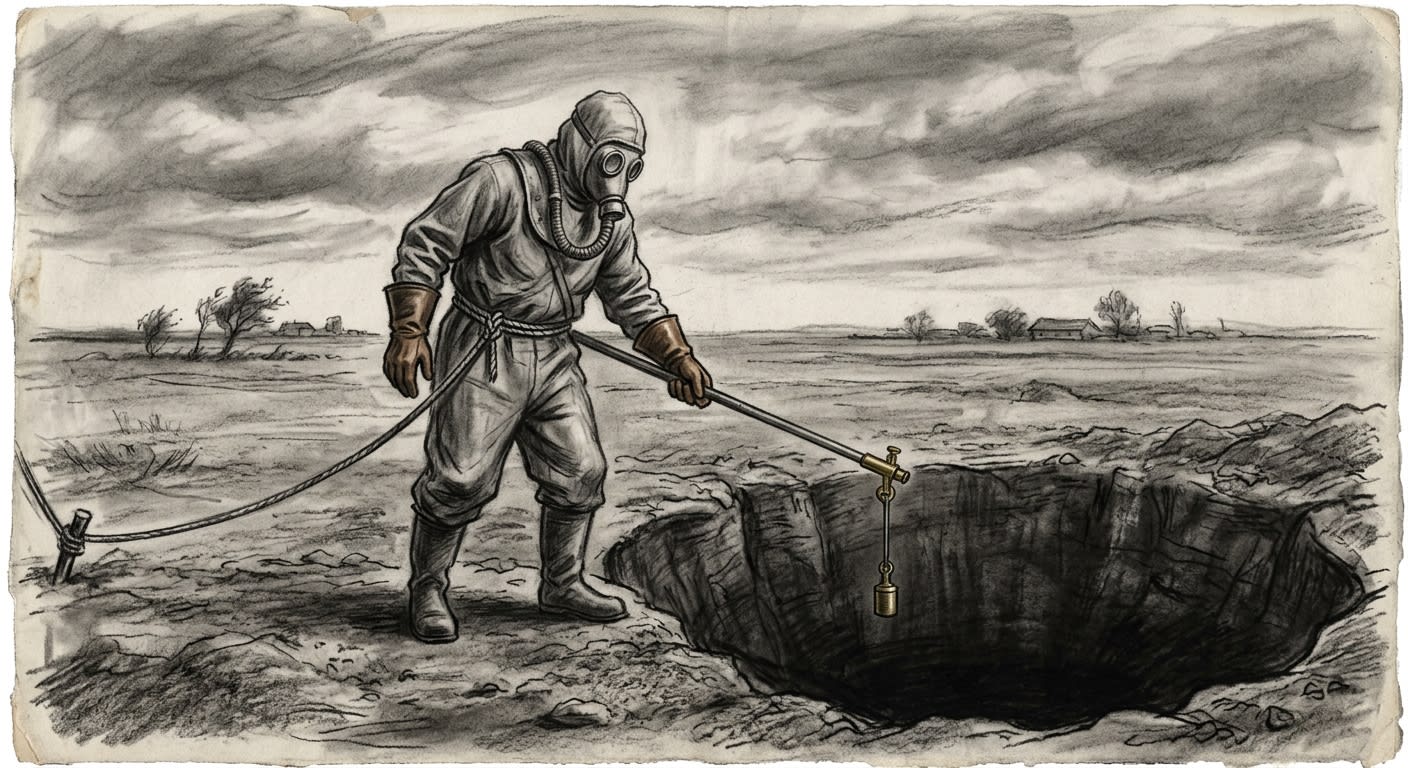
What the measurements established — across seven confirmed Pit sites, using instruments the Bureau of Alchemical Standards had designed for detecting relic emanations and which registered, in the Pits' vicinity, readings the instruments' designers insisted were "impossible and therefore incorrect" — was a radiating field of consumptive force. The field diminished with distance but did not cease. At one mile, sensitive instruments detected anomalous readings. At half a mile, a trained observer could identify the sensation: a tightening in the abdomen, a hollow urgency, the body's conviction that it had not eaten despite evidence to the contrary. At two hundred yards, the sensation became debilitating. At one hundred yards, the body began to respond as though genuinely starving — metabolic acceleration, tissue catabolism, the systematic consumption of the body's own reserves at a rate inconsistent with any known medical process.
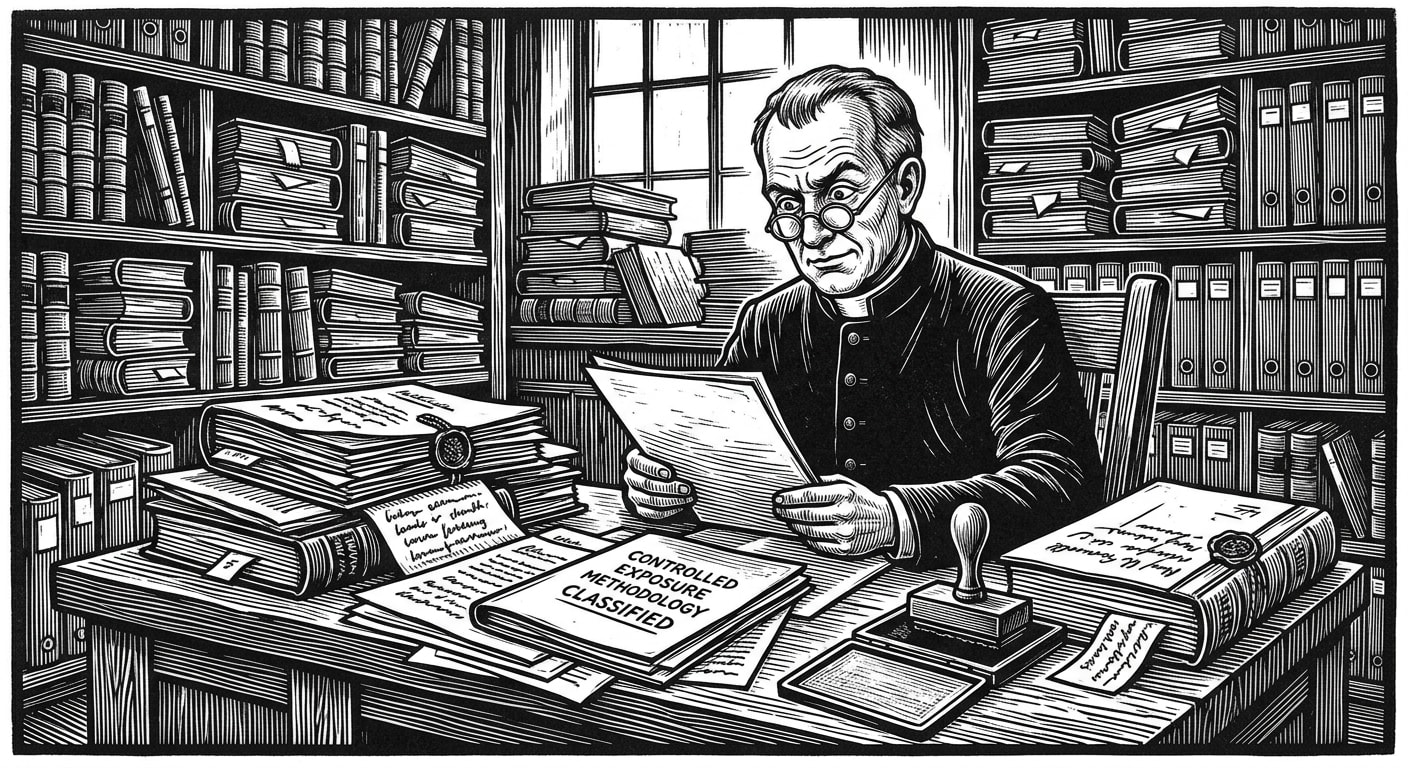
At fifty yards, the field intensified past what the Bureau could study without casualties. The data from closer than fifty yards comes from a controlled exposure conducted at Pit Seven — the burial site south of Mohács, where an estimated four thousand refugees from the fall of Debrecen were interred in A.S. 48 — using subjects whose identities the Bureau of Doctrine has classified and whose participation the Bureau of Doctrine has described, in a phrase I find instructive, as "involuntary but theologically defensible."
The controlled exposure established the following. At thirty yards, the human body enters full metabolic crisis within forty minutes. Muscle tissue begins to break down. Fat reserves are consumed at a rate equivalent to three days' starvation per hour of exposure. Subjects report a hunger beyond anything the medical literature documents — a hunger that does not respond to food, that intensifies with feeding, that becomes the single defining characteristic of the subject's consciousness until nothing remains but the appetite and the body's failing attempt to satisfy it.
At ten yards — and the report notes that data from this range is based on "two subjects, both restrained" — the body consumes itself. Dermis thins. Fingers shrivel to the bone in hours. Teeth loosen. Hair falls. The subjects were recovered at the six-hour mark. One survived the extraction. Her testimony, which is Seal Amber in its entirety, contains a single phrase the Bureau has permitted to circulate among garrison commanders: "I could feel their mouths."
[EXPUNGED — Bureau of Doctrine Order 88-V, A.S. 135. See: Sealed Protocol, Pit Seven Controlled Exposure. Note: the second subject's remains were interred at the Pit's perimeter by order of the Bureau of Medicine. The Bureau of Rites was not consulted. The Bureau of Rites has filed a protest that has been under review for sixty-six years.]
#On the Fourteen
Fourteen Pits confirmed. Each one catalogued in the Bureau of War's Eastern Command files with the clinical indifference of documents that have been read by too many clerks and understood by too few. I list them here because they are places where the Synod's dead lie, because the dead in them are not resting, and because a Codex that omits the names of its own graves is a Codex that has forgotten what it is burying.
Pit One — South-east of Pécs, in the former vineyard country. Approximately nine hundred bodies, interred A.S. 47. The first to be identified as anomalous. Lieutenant Voss's patrol site. The vineyard trellises are still visible above the grey mud, blackened wood frames standing in rows like the ribs of something long since butchered.
Pit Three — Near Szekszárd, on the Danube's eastern bank. The Veyrault notation site. Eleven hundred bodies. The Bureau of Records maintains a commemorative register for this pit, updated annually by a clerk who has never visited and who, I am told, considers the assignment a punishment posting. He is correct.
Pit Seven — South of Mohács. Four thousand refugees from Debrecen. The controlled exposure site. The Bureau of War has declared a two-mile exclusion zone around this pit since A.S. 135, which is the widest exclusion zone of any confirmed site and which the Bureau attributes to "elevated readings" and which the garrison attributes to the fact that Pit Seven is where the Bureau conducted its experiment and no one wishes to go near a place where the Bureau conducted an experiment.
Pit Eleven — The so-called Children's Pit, near Kalocsa, where a refugee column of predominantly women and children was overtaken by the Blightmarsh's advance in A.S. 52 and buried by a detachment of soldiers who, according to the burial officer's log, "completed the task in silence and declined to eat for two days afterward." The Bureau of Rites has maintained a vigil at this site — rotated quarterly, each vigil-team consisting of three chaplains and an armed escort — since A.S. 140. The vigil's purpose is classified. The vigil-teams return from their rotations thinner than they departed and disinclined to discuss the experience. One chaplain, upon his return in A.S. 198, submitted a single-page report to the Bureau of Doctrine consisting of the sentence "They are still crying" repeated forty-three times.
Pit Fourteen — Confirmed A.S. 197, the most recently identified site, located in territory the Blightmarsh consumed between A.S. 190 and A.S. 195. Pit Fourteen is different from the others. The dead in Pit Fourteen are not Sundering-era refugees. The bodies — identified through fragments recovered by a patrol that lost two members during extraction — are soldiers. Synod soldiers. Their identification tags date them to A.S. 134, the year of the Bureau of Medicine's confirmation, and they belong to a company listed in the Bureau of War's files as "detached for eastern survey duties, returned to garrison A.S. 135, full strength." Full strength. The company that returned to garrison was full strength. The company buried in Pit Fourteen is also full strength.
The Bureau of War has not commented on this discrepancy. I have brought it to the attention of three separate officials. Two directed me to file a formal inquiry. The third asked me to close the door and then told me, in a voice I will describe as measured, that the company sent east in A.S. 134 had been sent to conduct the Bureau of Medicine's controlled exposure, that the company that returned was not the company that left, and that the matter was closed. I asked what "not the company that left" meant. He asked me to leave.
Previous Codex entries referenced thirteen Famine Pits within the Blightmarsh's confirmed boundaries.
The count has been revised to fourteen following the A.S. 197 survey. The Warden notes that the fourteenth Pit raises questions the Bureau has declined to answer and which the Codex is not, at present, authorised to pose. The Warden further notes that he is posing them anyway, in the margins, where the Bureau's censors have historically been too lazy to look.
#On the Countermeasures
There are none.
I write this with the bluntness the Bureau of Doctrine will censure and which the soldiers at the observation posts deserve. The Bureau of Medicine has no counter-ritual. The Bureau of Rites has no prayer that quiets the dead's hunger. The Bureau of Alchemical Standards has tested fourteen compounds, nine relic preparations, and one experimental tincture derived from — I am told — the rendered fat of a Maw-Born specimen captured at the Sagittal Line in A.S. 178, and none of them produced any measurable reduction in the emanation field. The dead are hungry. The dead will remain hungry. The Synod's theological apparatus, which can consecrate a bell-cannon at three hundred yards and exorcise a Velkara infiltrator by the application of the proper litany, cannot persuade the starving dead to stop starving.
What the Bureau of War offers instead is distance and discipline. Standing Order 77-K, Bastion-Constantinople Eastern Command, mandates a four-mile exclusion perimeter around all confirmed Pit sites. Patrols operating within eight miles of a confirmed Pit must carry supplementary rations — double the standard issue — and must rotate on ninety-minute cycles. No patrol may approach within one mile of a Pit without written authorisation from the garrison commander, and no patrol has received such authorisation since A.S. 190, because the garrison commanders have learned what the Bureau of Doctrine has not: that faith is insufficient armour against hunger, and that the dead do not distinguish between the faithful and the heretical when they reach.
#On the Theology
The Bureau of Doctrine classifies the Famine Pits as "Residual Sin-Manifestation, Passive, Origin: Sundering-Era, Agent: Kargath (Gluttony)." The classification is tidy. The classification permits the Pits to be filed alongside seven hundred other Sundering-era anomalies in the Bureau's master ledger, each one stamped and cross-referenced and shelved in the certainty that a classification is a form of containment.
I am not convinced.
The hunger in the Pits is not Kargath's hunger. This is the detail the Bureau has not reconciled. Kargath's forces — the Maw-Born, the Hollow-Walkers, the Blightbearers — radiate a consumptive field that the Bureau's instruments can identify and, in limited circumstances, counter. The Pits' field is different. Its spectral signature, per the Bureau of Alchemical Standards' A.S. 190 report, does not match Kargath's emanation profile. It does not match any known demonic profile. It matches, according to a footnote the Bureau wished to suppress and which I am reproducing here because footnotes are where truth hides in this Synod, "the relic signature of human grief, amplified by a factor the instruments cannot quantify because the instruments were not designed to measure sorrow."
Human grief. The dead in those Pits are not Kargath's servants. They are his victims, and ours, and the hunger they radiate is not the hunger of Gluttony but the hunger of human beings who died wanting and whose want was so vast, so terminal, so complete that it burned through death and lodged in the earth like an ember in a foundation beam — invisible, persistent, and slowly consuming the structure that was built over it.
The Bureau of Doctrine does not wish to hear this. The Bureau of Doctrine classifies all anomalies east of the Sagittal Line as demonic in origin because the alternative — that some of the horrors on the far side of the Line are simply what happens when enough people die badly enough — is theologically inconvenient. Demonic horrors can be fought with faith. Human horrors require something else, something the Bureau has not catalogued and cannot stamp and would prefer not to name.
I have submitted this interpretation to the Bureau of Doctrine on two occasions. On the first occasion, my submission was returned with a note reading "Theologically irregular." On the second occasion, my submission was not returned. Nor was it acknowledged. Nor has it appeared in any subsequent filing.
I take this as confirmation.
It is not sufficient. The dead are hungry, and the Codex cannot feed them, and I have written what I know, which is less than what I have seen, which is less than what the Pits contain.
Hieromnemon Valerius Drax Warden of the Sacred Ledger In absentia cibi, fames manet.