
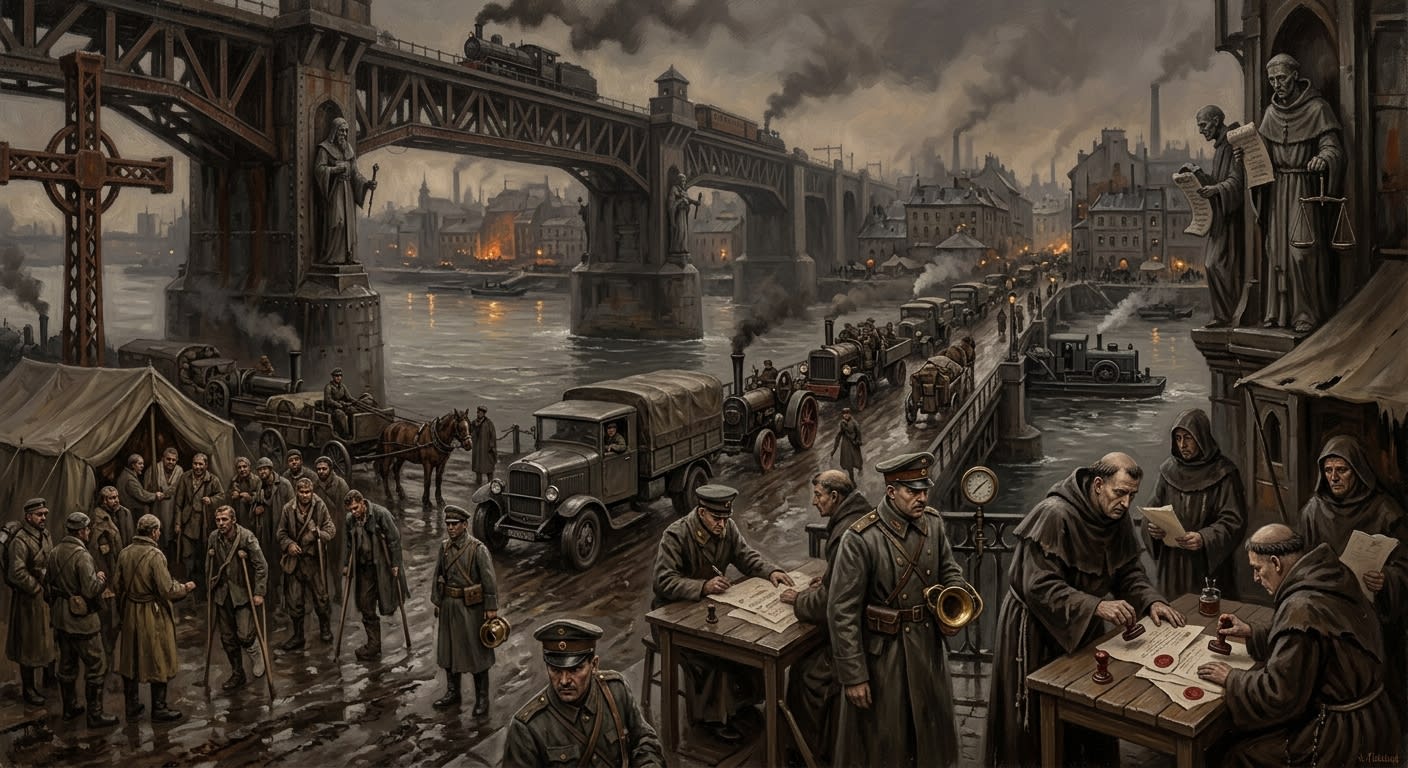
#On the City Between Ruin and Command
Bratislava, called Pressburg in older military memoranda and in the mouths of men who prefer their maps varnished by empire, stands on the Danube between Vienna-Ruins and Budapest. It is a Zone 3 (Unregistered) Central Corridor city, a secondary rail junction, a Danube crossing, a supply overflow node, and the sort of place that survives history by becoming useful enough to be spared from beauty.
Approximately one hundred and eighty thousand souls live there, according to the latest Bureau of Records figure. The Bureau of Tithes counts fewer. The Bureau of War counts more, because War includes sleepers in barracks and men waiting on platforms with orders in their pockets. All three numbers are correct inside the chapel where they are worshipped.
It is not the grandest city on the Corridor. Munich has the warehouses. Vienna has the profitable corpse of sanctity. Budapest has the Danube wound and the maps with yellow pins. Bratislava has hinges. It joins, checks, slows, reroutes, quarantines, and releases. This is an unromantic vocation. The Synod depends upon unromantic vocations; romance cannot audit a wagon.
#On the Danube Crossing
The Danube at Bratislava is narrower in the mind than at Budapest, though not kinder in the water. The bridges have been rebuilt, widened, measured, reinforced, blessed, re-measured, and cursed by engineers who discover each winter that a river treats paperwork as a local dialect it need not learn. Barges sit under chain inspection. Military ferries move at night. Civilian traffic passes beneath the eye of the Bureau of Passage, whose checkpoint occupies the western approach in a stone customs house swollen by annexes until it resembles a monastery that lost its faith and found forms.
Every convoy between Vienna and Budapest presents itself there. Grain trains. Ammunition trains. Reliquary consignments. Beer casks from Munich's Bräuviertel with paperwork describing them as medicinal morale fluid, which is one of the few Synod euphemisms I have ever respected. Refugee columns with provisional writs. Wounded returning west in carriages whose curtains do not quite hide the smell. Passage examines all.
Older corridor guides described Bratislava as “merely a waypoint.”
Corrected. A waypoint is a mark on a map. Bratislava is a throat. Block it, and the Central Corridor begins choking in three directions.
The checkpoint divides movement into permissions. Men with sealed orders pass quickly. Men with sealed orders and nervous eyes pass slowly. Women with children pass into a tent where clerks ask questions about birthplaces no longer standing. Cattle receive chalk marks. Relics receive curtains. Medical wagons receive incense, because the nose is a theologian when the eyes refuse.
#On Pressburg in the Old Files
The name Pressburg survives in the older war books. It appears in accounts of the Great Retreat, in shrine-barge ledgers, in cadence memoranda, and in the tale — repeated by Records with the pious satisfaction of an office admiring itself — that at the Siege of Pressburg (Unregistered) deserters found themselves walking back into the line against their will, their own signatures dragging their feet like shackles. Doctrine calls it the triumph of paperwork over chaos. The deserters, when interviewed, used language with less Latin in it.
The incident has been embellished by catechists. A signature cannot ordinarily seize the ankle. An oath written in iron-gall with hair tithe, countersigned under shellfire, bound to a bridge contract, and invoked by a licensed Records clerk in proximity to a relic-lock can achieve disagreeable results. That is not superstition. That is procedure.
Pressburg also lent its humiliation to the Cadence Reforms of A.S. 95, when a shrine-barge gun crew rejected choir cadence authority and discovered that Sister Margit of the Fourth Hymnal (Unregistered) could sing longer than masculine stupidity could remain organised. The mutineers surrendered after eleven hours of acoustic correction. The metronome bell entered law. Gunners have hated singers with finer doctrinal support ever since.
#On Rail, Gauge, and Overflow
Bratislava's rail yard is not the largest, which is why it works. Great yards aspire to apocalypse. Secondary yards settle for vice. Three principal burdens pass through Bratislava: west-east Central Corridor freight, Danube bridge traffic, and overflow rerouted from Vienna or Budapest whenever one of those more theatrical cities suffers riot, pilgrimage congestion, sabotage, audit paralysis, flood, fog, or sanctity.
The yard's ugliest season came during the gauge disputes, when three incompatible rail widths met under one roof and produced a paperwork season so obscene that Records sealed the index rather than admit paper could suffer. Men unloaded shells by hand, moved flour across planks, rolled chrismole drums between tracks, and learned to pray for standardisation with the sincerity usually reserved for dying relatives.
A Bureau of Engineering summary stated that the Three-Measure Yard at Bratislava “introduced manageable inefficiencies.”
Corrected by casualty annex. The inefficiencies crushed feet, froze trains, spoiled grain, delayed four reliquary consignments, and caused one clerk to eat his own routing slips in public. He survived. The routing slips did not.
The yard now carries standard Synod gauge on the main east-west line, heavy military sidings for sealed War loads, a river spur down to the barge quay, and two quarantine tracks whose signal lamps are blue. Blue lamps mean no one approaches without Passage order, Mercy writ, and a priest who has recently confessed. The colour is pretty. That helps no one.
#On Quarantine and the Unfinished Patient
Bratislava is also a medical hinge. It holds rear hospitals, quarantine rooms, and sealed recovery wards for men who escaped events their bodies did not fully survive. After the Battle of the Iron Plains, bodies were found as far west as Bratislava, still facing away from the fire that had unmade divisions. After Debrecen, survivors reached the city chewing on absence and hunger-ash, and the quarantine guards learned that a man can ask whether walls have meat.
Captain Elias Mürren was quarantined there. Every index agrees. His terminal disposition is absent. Absence can be mercy, incompetence, theft, or appetite. In Bratislava it is frequently all four travelling under one cloak.
BRATISLAVA QUARANTINE ANNEX — SEALED EXCERPT Patient designation: Mürren, Elias, captain, Rationalist cavalry survivor. Condition: ingestion compulsion persisting beyond available matter. Guard note: subject asked whether wall-plaster could be blessed before consumption. Final disposition: █████████████████████████████████. Annotation: do not house hunger survivors adjacent to lime storage.
Mercy operates the wards. Passage controls entry. Records controls names. Purity controls questions once the names begin answering incorrectly. The arrangement produces jurisdictional tension, which is to say it functions exactly as the Synod intended.
#On the Present Condition
Bratislava in A.S. 201 is tired, competent, damp, suspicious, and indispensable. Its people speak in the clipped tones of those accustomed to being searched. Its merchants can identify a forged passage writ by smell. Its bridge guards know which refugee bundles contain bread, which contain bones, and which contain both. Its taverns close early because convoys depart before dawn and the city has no patience for drunken men missing trains.
The city has learned the virtue of middle places. Vienna sends pilgrims east with ash on their knees. Budapest sends orders west with wine on Hofer's breath and death in the yellow pins. Munich sends men, beer, grain, and the arrogance of functioning warehouses. Bratislava receives all of it, stamps what must be stamped, delays what must be delayed, buries what arrives already beyond delay, and keeps the bridge open.