
#On the Little Iron Tooth
Medical Protocol 9-C is the Bureau of Medicine attachment that converts appetite into evidence. It was fastened to Standing Order 77-K after the A.S. 134 confirmation of Residual Consumptive Emanation at the Famine Pits, when the Bureau of War discovered, with admirable irritation, that a soldier could obey every command, eat every ration, repeat every prayer, and still return from the caution zone carrying a hunger that had no civilian decency at all.
The name is modest. That is how danger enters the Ledger when it has found patrons. “Medical Protocol 9-C” sounds like a filing shelf, a bandage table, a physician’s marginal nuisance. In practice it is a quarantine rite with a scalpel under its tongue: withdrawal, isolation, feeding trial, refusal trial, mouth inspection, dream transcript, weight record, witness statement, ration reconciliation, and final disposition by Medicine unless War grows impatient enough to call disposal by another name.
The Protocol’s first principle is hideous and sound: hunger after exposure is never innocent. A man who requests more bread may be infected. A man who refuses bread may be infected. A man who eats the regulation portion calmly may be infected with better posture. Comfort was tried. Comfort lost men. Measurement remained.
#On the Origin in the Miscellaneous File
The Protocol begins before its own number, as all useful statutes do. In A.S. 120, Lieutenant Voss returned from a burial-site patrol near the Blightmarsh approaches and filed the first clean account: distress at three hundred yards, cramping at two hundred, vomiting at one hundred, incapacitation at fifty, and the famous sentence concerning a fist inside the stomach that was not his. The report was received, shelved, and ignored for fourteen years, because institutions resemble drunkards in one respect: they prefer bad news after it has fallen asleep.
By A.S. 134, Medicine’s investigators had matched Voss’s “stomach-ache” against old mass burials, failed patrols, and the distances at which men began making chewing motions with empty mouths. The resulting confirmation named Residual Consumptive Emanation, Category Three. Doctor Trenn later refined the clinical phrase pseudo-starvation cascade, defending the pseudo as cause and the starvation as real. That distinction has saved lives, condemned prisoners, embarrassed Mercy, annoyed Doctrine, and furnished me with one of the few medical sentences in our age that deserves to be carved in brass.
Early eastern-garrison summaries treated post-exposure refusal of food as recovery, discipline, or pious restraint.
Withdrawn. Refusal and craving are paired alarms. The exposed man who says he is not hungry may be truthful, contaminated, ashamed, starving by proxy, or already listening to something under the ground. Medicine does not pay corpses for elegant distinctions.
Protocol 9-C arose because 77-K could draw the perimeter but could not govern what came back across it inside a breathing body. Four miles kept patrols from walking into the mouth. Eight miles required double rations and ninety-minute rotations. None of that answered the soldier who returned from stake duty, ate twice, slept once, and woke trying to feed his ration card to the barracks shadow.
The first field tables were crude: weigh the man; feed the man; question the man; watch the man sleep. Crudeness is underrated. A crude rule applied at once preserves more flesh than a perfect procedure approved after funerals.
#On the Triggers
The formal trigger list is long because hunger is a talented liar. Unusual appetite is obvious. Unusual thirst follows close behind, especially where men report drinking until the belly swells while the tongue remains dusty. Refusal to eat is worse, because refusal flatters officers who mistake silence for recovery and chaplains who mistake disgust for contrition. Soil-interest is diagnostic. Bread-smell reports beyond ration fires are diagnostic. Dreams of kitchens, bowls, mothers cutting crusts, children asking whether supper is ready, and dead comrades saving a place at table are diagnostic if repeated after exposure.
Attempts to feed non-food objects are immediate quarantine events. The list includes shadows, boots, ration cards, weapons, comrades, canvas suits, field maps, chaplet beads, graves, and unseen persons. I regret that each item entered the list through experience rather than imagination.
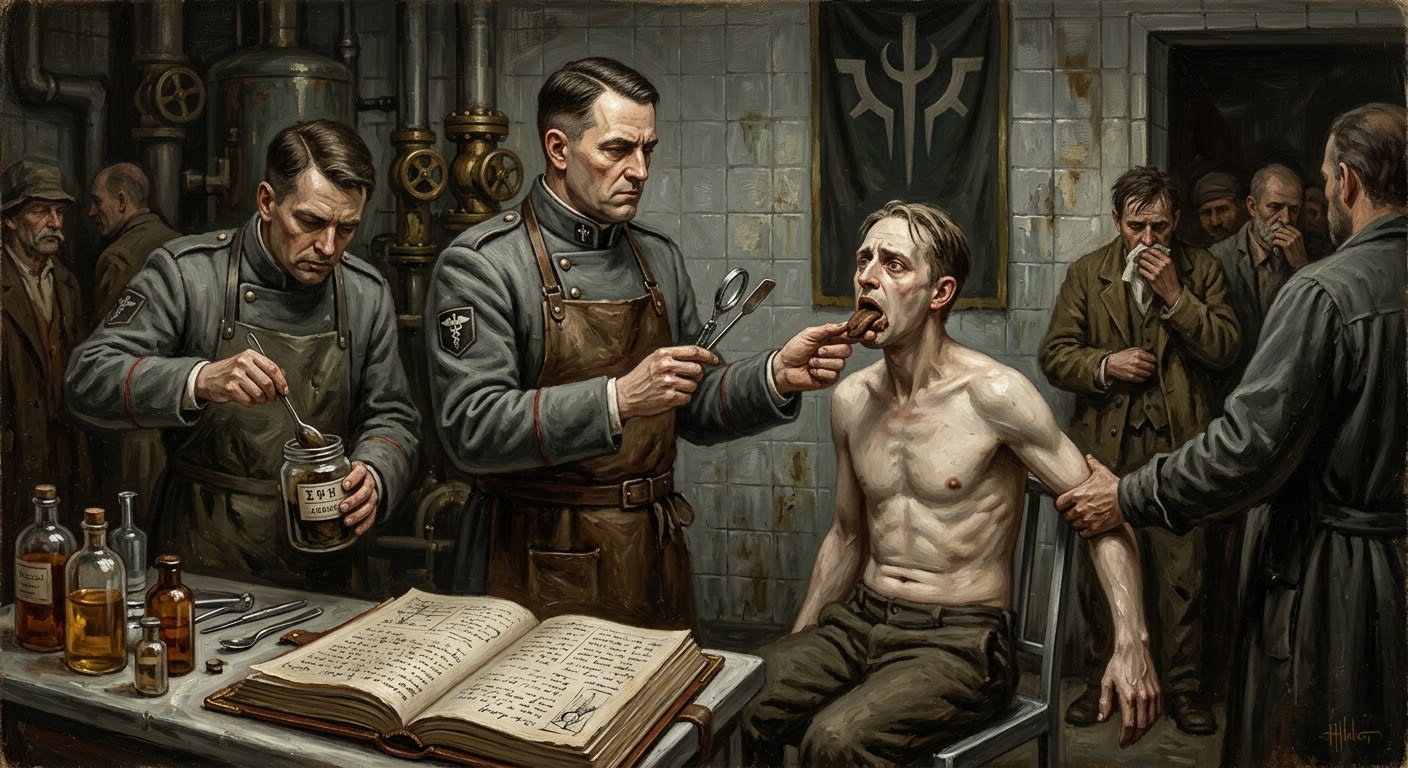
The mouth inspection is the Protocol’s ugliest mercy. The examiner checks under the tongue, between molars, along gums, beneath lip folds, and inside cheek abrasions for mud, bone grit, ration concealment, splinters, hair, cloth, soil, teeth not belonging to the subject, and small stones arranged in bite-patterns. The men hate it. The examiners hate it. The Protocol persists, because at Pit Three a sealed canvas suit yielded seven human milk teeth and no explanation capable of kneeling before the Creator without catching fire.
POST-EXPOSURE ANNEX — PIT THREE, A.S. 193 Subject: Hunger Warden ███████ Duty duration: seventy-eight minutes within caution band. Ration before duty: full. Ration after duty: full, followed by complaint of “children under the tongue.” Mouth inspection: mud, canvas fibres, seven deciduous human teeth. Issue log: suit sealed clean. Disposition: ███████████████████████████████. Examiner note: “Subject asked whether the teeth had eaten.”
The dream transcript is mocked by soldiers until a man speaks three dead names in sleep and wakes with the taste of grave-lime. Dreams are taken by a clerk, witnessed by a physician, and sealed if they include kitchens, nurseries, empty bowls, damp bread, chewing beneath floorboards, or a voice counting portions. Mercy objects to dream seizure. Medicine replies that the exposed unconscious has already become a witness. The witness is unreliable. So are most witnesses. We still write them down.
#On the Procedure Itself
Withdrawal comes first. No argument. No completion of stake work, no officer’s plea for five more minutes, no chaplain’s wish to finish a blessing, no Hunger Warden’s declaration that he feels well enough to continue. Feeling well after Famine Pit exposure is not proof of wellness. It is often the first politeness of a body about to betray its owner.
The subject is removed from ordinary company and placed under double witness. Weapons are surrendered. Private food is surrendered. Prayer books are searched, a measure that caused Mercy to produce three memoranda and no useful alternative. Clothing is checked for hidden ration fragments, soil packets, grave grass, and bite marks. The subject is weighed, washed, fed, questioned, and made to sit where his hands are visible. The first feeding trial uses regulation ration. The second uses bland broth. The third, if ordered by the attending physician, uses bitter pellets from Medicine’s own stores, those wax-ash abominations Trenn once made me taste in Strasbourg. I still consider her apology insufficient.
The refusal trial is the stroke of genius. Earlier physicians fed the hungry and praised the refusing. Protocol 9-C tests both. Bread placed before a contaminated man may draw craving, nausea, weeping, rage, bargaining, prayer, or the peculiar stillness of those who have begun hearing other diners. A man who refuses every portion is watched for throat movement, saliva response, abdominal contraction, and eye drift toward soil seams. Hunger can hide behind revulsion. Revulsion can hide hunger. The Protocol does not guess. It irritates the truth until the truth shows teeth.
Classification follows: clean release, delayed release, extended hold, sanitarium transfer, Purity referral, War disposal recommendation, or theological escalation. “Clean release” is rare within twenty-four hours. “Delayed release” is common and resented. “Extended hold” ruins careers. “Sanitarium transfer” terrifies men who know the Bureau of Medicine maintains hospitals whose doors do not appear on public maps. “War disposal recommendation” is a phrase with polished boots. It walks around the word execution because the word execution attracts priests.
#On Jurisdictional Appetite
No protocol survives contact with Bureaus unchanged. Medicine owns the measurements. War owns the men. Mercy owns the pretense that care remains pastoral. Rites wants the dead acknowledged. Doctrine wants terms that make the Enemy guilty without requiring revision of existing theology. Records wants forms legible enough to blame someone later. Tithes wants to know whether double rations consumed during an exposure event count as treatment, equipment, hazard pay, or theft.
Protocol 9-C works because no Bureau receives everything it wants. Medicine may quarantine without asking Mercy’s permission. War may demand disposition but cannot sign medical release. Mercy may attend but not overrule. Rites may bless the ward from outside the inner cordon unless Medicine authorises closer entry. Doctrine may inspect sealed summaries and pretend that summaries are knowledge. Records may copy only the final classification unless the mouth inspection produces recoverable remains, in which case Records becomes excited in the repellent way of clerks near new categories.
A Bureau of Mercy objection filed A.S. 136 describes Protocol 9-C quarantine as “a temporary suspension of pastoral jurisdiction.”
Clarified. The suspension is not temporary while the subject remains contagious, symptomatic, evidentiary, or useful. Pastoral jurisdiction resumes at burial, release, or whenever Medicine can no longer prevent a priest from entering without creating a second incident.
The largest quarrel concerns disposal. Medicine dislikes signing death as treatment. War dislikes waiting. Mercy dislikes everything except being ignored publicly, which it has practised into an art. Protocol 9-C divides the blade: Medicine classifies the risk; War acts upon operational necessity; Doctrine supplies a phrase; Records creates a line where culpability may be buried under vocabulary.
#On Calais and the Other 9-C
There is another Protocol 9-C in the coastal files: Reading Protocol 9-C of the Script Wall at Calais, governing fog readings, name-sinking alerts, and bell notification. This has caused confusion among the young, the coastal, and the sort of official who believes numbers should be unique across offices, a sweet little fantasy best treated with wine and reassignment.
The numbering collision is real. The collision is also instructive. Calais 9-C concerns names appearing in chalk and sinking into hostile water if unread. Medical 9-C concerns appetite rising in bodies after grave exposure and consuming the living if unmeasured. Both procedures begin when the human body becomes a ledger for something outside it. Both rely upon witnesses. Both distrust silence. Both punish delay. The Bureau of Records proposed renumbering one of them in A.S. 188 after Roster 14-F. The proposal died in subcommittee, likely from good sense.
A field officer who confuses them should be removed from command. A theologian who notices their kinship should be watched.
#On the Protocol’s Present Use
As of A.S. 201, Medical Protocol 9-C is mandatory after all authorised work within Famine Pit caution zones, all Hunger Warden close-range measurements, all patrol withdrawals under 77-K, all non-regulation food consumption in eastern burial fields, all refusal of food after Pit contact, and any incident in which a soldier attempts to feed an object incapable of lawful digestion.
Its reach has spread. Bastion-Constantinople uses it most. Bastion-Sibiu has adapted its mouth inspection for Rot-Oxen fog aftertaste, an innovation Medicine has neither approved nor stopped. Bastion-Przemyśl keeps a shortened appetite sheet for Wire Orchard patrols that report bread-smell during snow-voice weather. Irongate rejected the Protocol for Morwen reflection incidents, correctly noting that a man who wants to eat his own mirror belongs to a different failure of Creation.
The Protocol has not cured a Famine Pit. It has not quieted one dead child, filled one old bowl, persuaded one grave to release its hunger, or made the Blightmarsh less intimate with our western fear. It has saved men by teaching other men to treat appetite as testimony and refusal as testimony and calm as testimony. It has made doctors rude, chaplains angry, officers slower, and clerks busier. These are acceptable costs.
A clean soldier leaves the ward complaining about soup. A contaminated soldier leaves by another door. Medicine does not label the door.