
#On the Town That Fed the First Lie
Pécs was once a hill-town of vineyards, bishop-stone, warm cellars, Roman bones, and that fat provincial contentment by which men persuade themselves that the frontier is a rumour told by poorer districts. It sat in the old Pannonian basin with its back to the Mecsek hills (Unregistered) and its face toward fields that had been obedient longer than most dynasties. Grapes ripened on the slopes. Wheat moved through the markets. Cellars held wine in the dark with the patience of buried saints. The town knew hunger as weather, tax, bad harvest, soldiers, and winter. It did not yet know hunger as jurisdiction.
After the Sundering, Pécs became one of those names the Bureau handles with gloves: the town is not great, for greatness is usually a matter of architecture and a sufficiently ruthless guidebook, yet three separate hungers wrote themselves into its approaches. The Great Retreat buried its dead south-east of the town. Lieutenant Voss measured the first clean Famine Pit exposure there in A.S. 120. The first confirmed Abundance community near its ruins was found in A.S. 147, full of bread and empty of flesh.
The Bureau of Cartography marks Pécs as ruined, exposed, used, and not to be approached without Eastern Command authorisation. The Bureau of Doctrine marks it as instructive. The dead, having been consulted by no Bureau, continue their own offices beneath the trellis-mud.
#On the Vineyard Country Before the Pit
Before the fields learned to lie, the vineyard country south-east of Pécs possessed the ordinary virtues of a food district: dirt, labour, quarrels, tithe evasion, parish vanity, and harvest songs obscene enough to make Orison and Song discover sudden deafness. The hills supplied wine. The plains supplied grain. The roads supplied gossip and tax men. Every cellar had a saint in one niche and contraband in another, which is to say the town practiced balanced devotion.
The old episcopal houses were neither unusually holy nor unusually corrupt. That is praise, in a province. Pécs sent wine west, seed south, mules east, and sons wherever the latest uniform demanded sons. Its clergy kept registers in a hand the Bureau later judged irritatingly legible. Its merchants altered weights with such local delicacy that punishment would have been aesthetically cruel. Its peasants cursed drought, hail, requisition officers, and bishops in an order that varied by season.
Then the eastern reports thinned during the Eastern Silence of A.S. 38. Pannonia's barns contradicted their ledgers. Letters arrived without destinations. Flour greyed in bags. Cattle swelled and died with feed still in the trough. Pécs did what prosperous towns do at the beginning of catastrophe: it treated each warning as a solvable inconvenience.
By A.S. 45, Kargath had taught the basin that plenty can rot from within. The flight westward began in earnest. Roads filled with soldiers, refugees, clerks, priests, carts, children, livestock, and men carrying keys to houses already swallowed by a horizon they refused to name. Pécs received them, bled them, fed what it could, and failed. Failure in those years was not a moral state. It was arithmetic.
#On the Road-Cellars and Famine Pit One
The first wound that made Pécs more than a ruined town was not in the town itself but beyond it, where retreat columns used vineyard cellars, shell-cuts, and roadside hollows as mass graves. The dead were stacked with a haste that shames no one living who has seen what a retreat does to hands. Rites shortened. Names collapsed into counts. Counts collapsed into gestures. Men dug until they could not stand and then lay down close enough to simplify the next labour.
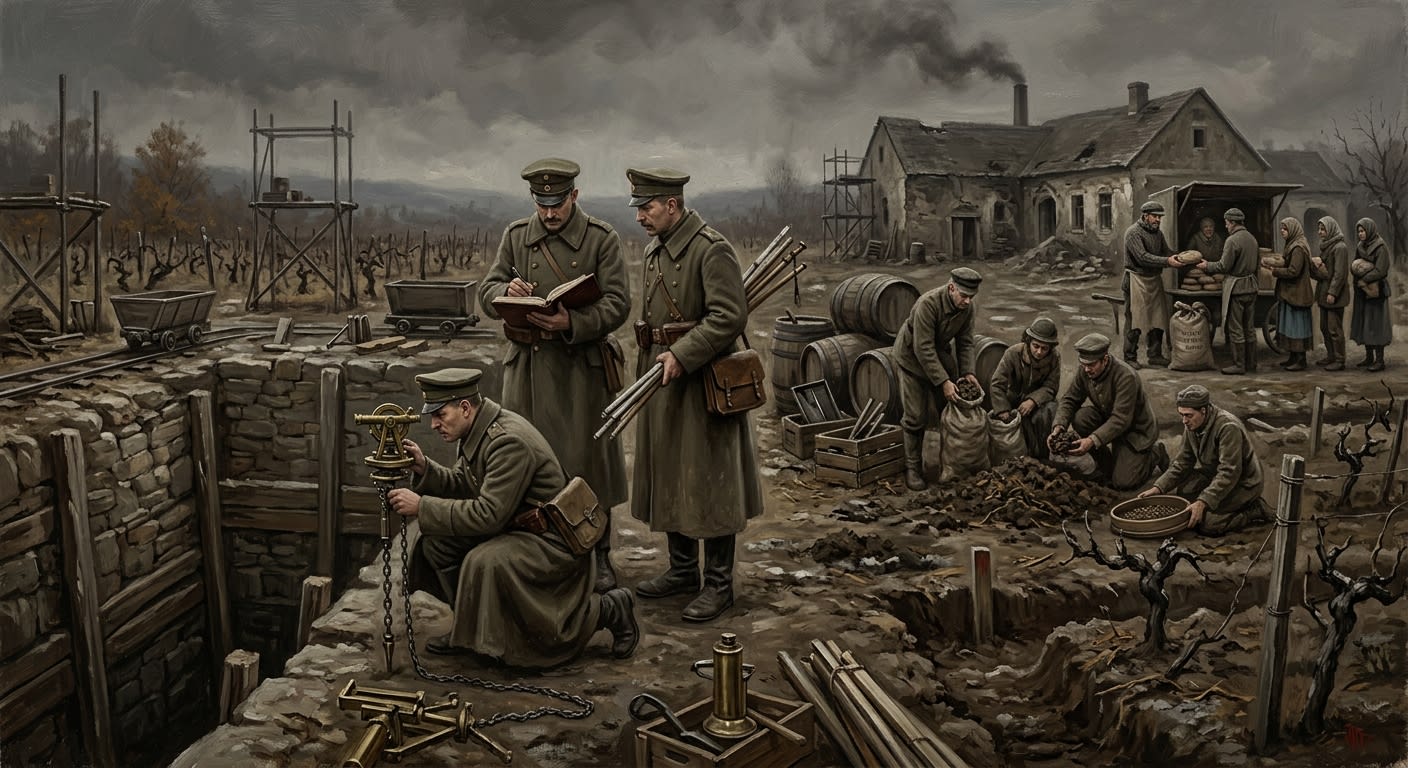
Famine Pit One lies south-east of Pécs in former vineyard country. The Bureau of War gives the burial as approximately nine hundred bodies, interred in A.S. 47. The trellises remain above the grey mud: blackened, half-sunk, rowed like ribs. A clerk once described them as “agricultural remnants.” I prefer “evidence.” Agriculture does not usually continue pointing at the grave.
An early eastern garrison abstract placed Pit One “near an unnamed Hungarian farmstead.”
Corrected. The site lies in the Pécs vineyard approaches. The omission of the town name was not prudence. It was cowardice with a map.
For decades the grave was known only as one more retreat burial, one more sour patch of earth among many, one more place where patrol animals refused to graze. Then, in A.S. 120, Lieutenant Voss took twelve men within its field and returned with the first report too clean to dismiss forever. Three hundred yards: simultaneous distress. Two hundred: cramping. One hundred: vomiting. Fifty: incapacitation. Voss named distance because distance was the only mercy available to him.
The report slept for fourteen years in a file. This was not silence. This was institutional digestion. The Bureau of Medicine later found the pattern in gastric failures along the Blightmarsh perimeter and discovered, with all the astonishment of a man finding his own signature on a warrant, that Voss had already drawn the first line of the map.
#On the First Abundance Community
The second wound arrived wearing mercy.
In A.S. 147, a patrol near the ruins of Pécs found a farming settlement of approximately eighty souls dead of starvation amid enough food for three winters. Root-cellars full. Tables set. Ovens holding bread risen and golden. Preserves stacked. Grain dry. Vegetables sound. The bodies were wasted to bone. Their mouths still worked.
Father Anselm Gries recorded that last detail and later hanged himself in the vestry at Bastion-Constantinople. The Bureau of Doctrine classified the moving mouths as post-mortem caloric reflex. Father Gries called them proof that Kargath's hunger outlives the stomach. I record both statements because one is official and the other is true in the way official statements rarely survive being.
The community's final tithe report praised an unexpected recovery in yield. The Assessor annotated the margin with a pious exclamation and requested seed samples. He arrived with the patrol that found the dead. His exclamation remains in the file, a small bright stupidity in brown ink: Providence restores. Providence, in that document, smells of ovens.
EXCERPT — FIELD DIARY OF FATHER ANSELM GRIES, A.S. 147 “The child at the table had bread in both hands and no flesh on either. The mother’s jaw moved when I said the prayer. I thought at first she answered. Then all of them █████████████████████████████████. I cannot write the sound. I can hear it while ink dries.”
The Harvest entered the eastern files as more than rumour. The Abundance Fields gained their first formal acknowledgment. The phrase treacherous abundance began its crawl from field report to festival banner, from garrison order to parish cruelty, until the Triumph of the Gaunt could crown thinness and flog fat with a clean conscience and a municipal drum.
#On Standing Orders and Local Ruin
Pécs's name appears in later orders as a warning pressed flat enough for soldiers to carry. Standing Order 119-F, issued by Bastion-Constantinople Eastern Command in A.S. 163, was born sixteen years after the first Abundance dead near Pécs. Sixteen years is a scandal when counted in corpses and deliberation when counted in minutes. The Order forbids approach, harvest, sampling, smelling after the A.S. 199 revision, sentimental contemplation if my suggested language is ever adopted, and all the little permissions by which hungry men talk themselves into a grave with vegetables in it.
The local geography is now a catechism of refusal. The vineyard approaches are Pit country. The outer fields are Field country. The old road toward Kaposvár is watched for green where green has no licence. Patrols operating in the Pécs district carry dull rations and are instructed to praise their dullness aloud. A grey biscuit may insult the mouth, but it has never asked the soul to sign a receipt.
The ruins of the town proper remain less clearly damned and more dangerous for that courtesy. A cursed place announces terms. A half-cursed place invites debate. Some stone houses still stand. Some cellar mouths remain open. The old market square can be reached in dry weather by scouts willing to walk under rope and bell. Wine vaults have been found sealed and empty, sealed and full, open and singing with flies, or bricked behind walls no surviving plan records. No salvage licence has been granted since A.S. 190.
BUREAU OF WAR — PÉCS DISTRICT FIELD SUMMARY: Pit hazard confirmed, Pit One radius active; Abundance hazard confirmed, first community A.S. 147; salvage suspended except by sealed writ; agricultural recovery prohibited; ration instruction limited to issued food only, no local produce, no cellar stores, no exceptions for apparent wine.
The last clause required emphasis. Soldiers can resist demon fruit with training. Soldiers are less heroic before old wine, especially when the bottle wears a bishop's seal and the patrol has been eating ration paste for three weeks. Three men were quarantined in A.S. 181 after drinking from a Pécs cellar amphora. They did not die. They dreamed of harvest tables for forty nights and refused bread for the rest of their service. The Bureau of Medicine declared the wine inert. The garrison commander ordered the cellar burned anyway. A sound decision, and predictably underreported.
#On Present Condition
As of A.S. 201, Pécs is a ruined marker at the western fringe of Kargath's appetite: too far gone for settlement, too useful for Doctrine to forget, too hungry for War to ignore, too entangled with human burial for Rites to speak plainly. Pécs is no bastion, no city, no battlefield in the grand sense men like because grand battle permits grand sentences. Pécs is a lesson-site, and lesson-sites are usually where someone suffered too specifically for the Bureau to make clean poetry of it.
The maps show boundary rope, pit radius, orchard prohibition, cellar hazard, Abundance watch, and retreat-burial uncertainty. They do not show the moral geography: the road on which refugees traded relic clasps for bread; the vineyard trench where nine hundred dead began wanting through the soil; the settlement table where a child held bread while starving; the vestry hook at Constantinople where Father Gries finished writing the sound of chewing into himself.
Several western school primers refer to Pécs as “the town where Kargath first grew false food.”
Corrected for instructional use. The food was not false. That is the horror. False food would have been kinder, easier to condemn, easier to burn without argument. Pécs teaches that real bread can serve a false appetite.
The proper approach to Pécs is distance, record, and refusal. Distance for the body. Record for the dead. Refusal for the soul when the wind smells of kitchens and the ruined vines seem, for one bright and criminal instant, to have leafed again.
The Synod keeps the name because the name does work. Pécs ties together the Famine Pit and the Abundance Field, Voss's measurement and Gries's despair, the dead who hunger and the living who must not eat. It is a small word for a large appetite. That is often how the Enemy enters the Ledger.