
#On the Purpose of a Day Out
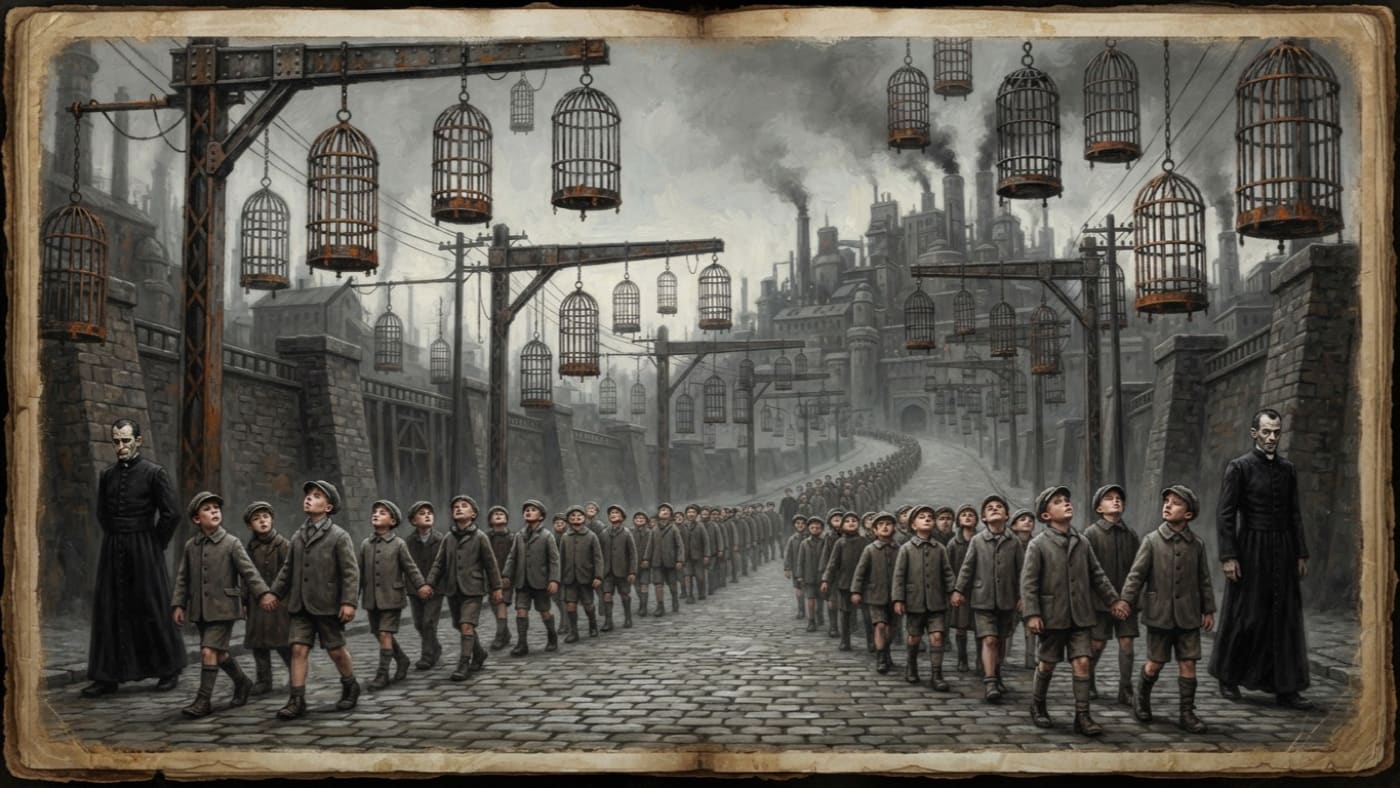
The Little Witness Program is how the Synod takes children off their school benches and marches them past the Iron Choir on the Mainz road, so they learn the catechism a second time, through the ears. The Lore Book calls it a day: the day when a schoolroom is walked to the cages. It names no feast, fixed date or frequency. The Synod has never needed a calendar to frighten a child. It needed a road.
Mainz supplied the road. It is a Zone 2 city on the Rhine, built on bridge tolls, pilgrim traffic and supervised crossings, where everything that passes is counted and most of it is charged. Along one of its roads Severian of Mainz raised the cages after declaring the city a single heretic body. Severian built the instrument. No file I have examined names him as the man who thought of bringing the children. The program has no recorded founder, which suits it. A schoolroom is easier to march when nobody has signed for the idea.
The Mainz registry calls the program a pilot. The A.S. 201 survey of the Choir records that the schoolrooms keep coming. No ratification links the two, and no charter or ceremony of expansion is on file. The pilot simply never ended. Half the Bureaus of the Synod began the same way.
#On the Conduct of the Visit
The children walk in pairs. They are told to look up. Both instructions come from the Choir survey, and between them they hold the whole of the program's genius. Everything else is staffing.
What the children see when they look up: cages hung from iron stanchions along the verge, every joint seamed with rust. Historically those cages held the condemned, cut at the throat so that they sang for as long as they lasted. Most now hang empty, and a child counting cages counts mostly air. The Bureau does not mind. An empty cage instructs by implication, and implication is cheaper to maintain.
A diocesan abstract kept with the Mainz Choir records one local procedure. I reproduce it as the abstract gives it and claim for it no authority beyond Mainz:
The prohibitions repay study. A pity noise is the small sound a seven-year-old makes on seeing a cage, and it is banned because other children catch it. Mimicry is banned because children copy what they hear, and the Bureau does not want that road's music reproduced in nurseries. Orison declines to explain the ban on harmonising in writing. Whoever paired the recitation of Article 19 with the stanchions understood staging: a child who has just recited the duty of denunciation beneath a cage knows exactly whom the cage is for.
None of this goes beyond the ordinary curriculum of the Catechism Schools, which teach discipline as the highest subject and present pain borne for the Creator as proof of belonging. At set intervals the schools also hold Trials of Loyalty, setting a child against a friend or a parent and recording who obeys. Those trials are a separate instrument with separate ledgers. The Mainz road asks for nothing so intimate. The child is asked only to walk, to look and to keep quiet. The examination comes later, at the confessional screen, where Records waits with a watch.
#On the Figure
According to the Bureau of Records, the Little Witness Program has increased confessional punctuality in Mainz by sixty percent.
Admire the figure first. It is round without looking suspicious and large without being absurd, and it measures the one thing a Bureau can actually time: the minute a penitent arrives at the screen. Records did not measure contrition, but lateness, and lateness fell.
What the figure lacks is everything a heretic would need to check it. The file gives no baseline, no count of children and no period of observation. It does not say how Records separated the cages from the season, the sermon, or the many other terrors at work in Mainz. The city has no shortage of instruction. Hildegarde's stamp sits behind glass there, the bridge officers presume guilt by the hour, and the morning cough is still inspected. To credit the full sixty percent to one walk past the Choir is an act of faith, and Records performs it calmly, as an institution that has never had to show its working to anyone it could not reclassify.
I do not dispute the figure. I record it under the name of the Bureau that produced it. Between Bureaus, no courtesy is more dangerous.
#On Mercy's Objection
The Bureau of Mercy protested. The record gives no date for the protest, no names for its authors and no text beyond the exchange that followed. That exchange survives because it is short enough to memorise.
Mercy objected to children being walked to the cages. The Bureau of Purity replied that children die in the trenches every day. The sum was meant to settle the matter: the Line spends children already, so the road may as well frighten them first.
"Let them die literate," said Mercy.
"Let them live obedient," said Purity.
Spare Mercy your sentiment. It is a Synodal institution with its own ledgers and its own compromises, and it never asked that the children be spared the Line. It asked only that they be allowed to read before they were spent. Purity gave the better sermon. It offered the children life and charged them nothing but obedience.
The matter went to the Council of Veils, which ruled for obedience. The record does not say who sat or when. The Council's membership remains as veiled as its name promises, and rulings of this kind are usually published as the High Censor's Advisory. The ruling stood. The schoolrooms kept walking.
#On Attendance and the Bill for It
The program turns up next in a fiscal ledger, which is where every Synodal practice eventually goes to be judged.
In A.S. 199 Purity opened an inquiry into Archbishop Salome Veyrault of the Bureau of Tithes. She answered with Ledger Four, a record of thirty-one years of waived charges for Purity's activities: pyre timber, prisoner transport, interrogation candles, ash certification and "doctrinal spectacle attendance by schoolchildren under the Little Witness Program." None of the waivers had been countersigned by Tithes. Veyrault said they were awaiting gracious reconciliation.
The entry establishes three things: Tithes treats the children's attendance as a chargeable service, it has raised that charge against Purity, and Purity has been treating the service as free. It establishes nothing more. Veyrault did not design the program, run it or send a single child down the Mainz road, so far as any ledger shows. The thirty-one years do not date the program either. Ledger Four totals many categories, and nobody has shown that the schoolroom charges run its full length. Anyone who subtracts thirty-one from 199 and calls the answer a founding year will be corrected, and the correction will be invoiced.
Under the usual logistics of Synodal spectacle, Tithes supplies the audience by fining absence. No document I hold records a fine levied on a schoolchild. The children are delivered by their teachers. Tithes' complaint is that Purity enjoyed a delivered audience and never paid for delivery.
The inquiry closed with Veyrault's practices declared doctrinally sound. She then sent Purity a twelve-thousand-Crown invoice for the administrative cost of complying with it. That invoice belongs to the inquiry. It is neither the price of the schoolroom charges nor a budget for the program, and it must not be quoted as either.
#On the Present Application
As of the A.S. 201 survey, the schoolrooms still walk the Mainz road. Most of the cages are empty. The stanchions are inspected and the rust seams logged. The Bureau of Orison and Song maintains the installation and classifies its hum as "residual liturgical resonance." The punishment itself remains Purity's. On windless days travellers still report the crossbars humming with nobody inside. Engineers blame the bellways. Purity credits the saints. Neither explanation has been certified, and I will not certify one here.
The children count bells. They identify silence, which is harder on that road than it sounds. Then they are walked back to their benches, where the Bureau of Doctrine resumes the lesson by duller means and Records sets its watch against the confessional screen.
An earlier Purity annex lists one witness drawing as removed from storage after the paper was reported to hum. The drawing is not described and its author is not named. I mention it because it is on file, and for no other reason.
Travel permits formerly described the Mainz road cages as "decorative penitential architecture."
Withdrawn. Approved wording: "active acoustic correction installation; distance recommended." Instructional parties are told to look up. The two instructions have not yet been reconciled.