

#On the Red Cord
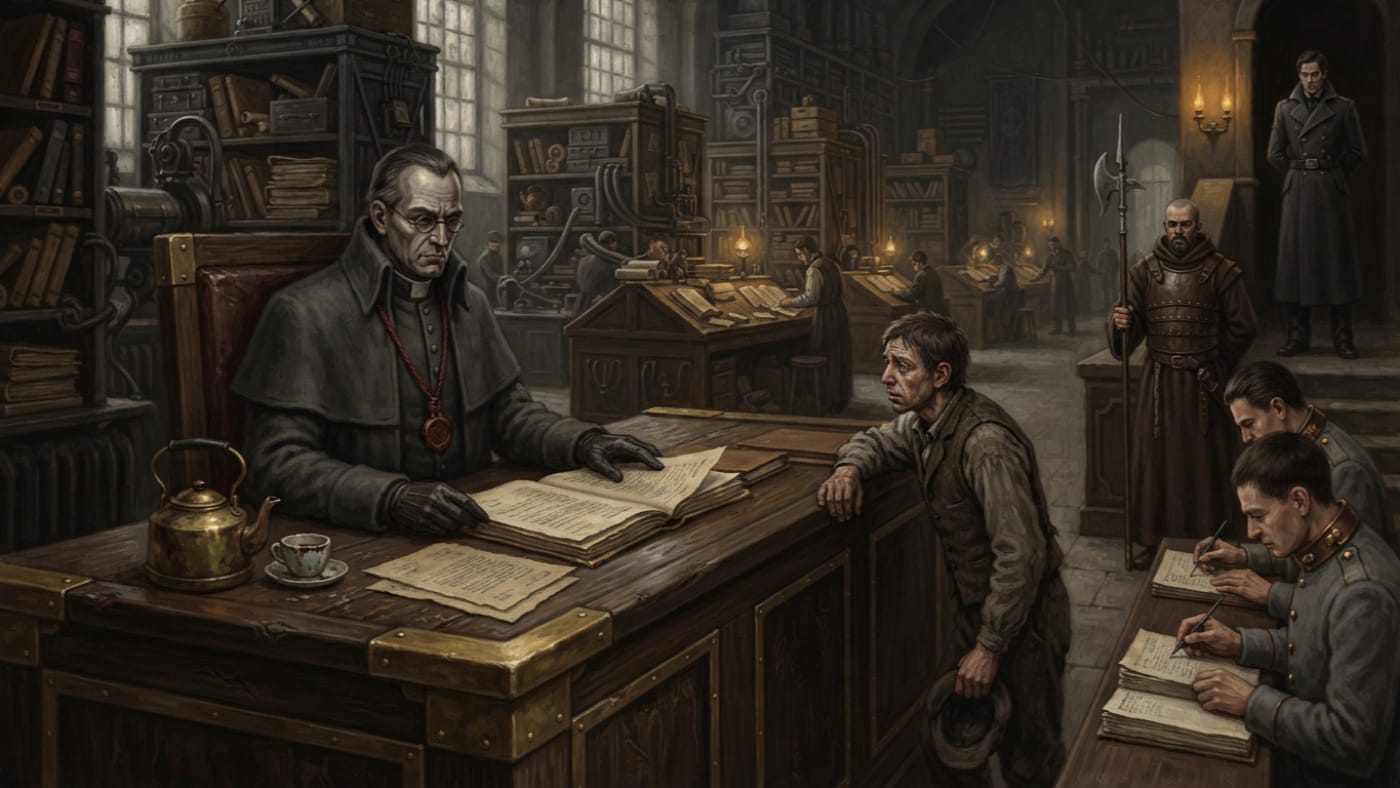
The petitioner arrives holding a certified copy of an intake record. If the petitioner cannot produce one, the Court will supply it, and the petitioner will hold that instead. The paper goes onto a bench of scarred leather beside a cup of tea that went cold before the morning bell. The judge behind the bench wears a red cord. For a moment the judge reads the copy and ignores the face, which is the proper order of things.
That is the occupation in one scene. The Margin Judges sit in the Margin Court, which is both the tribunal and the annex district around it at the Hollow-Script Scriptorium of Nemea, the chalk-ridge archive town in the inland heartlands. They are recognised by the cord. Nemea's own class reckoning puts them below the Abbot-Registrar's circle and above the senior scribes. That ladder belongs to Nemea. I have found no Church-wide rank of margin judge, no college that trains them, no published rite of appointment and no career beyond the bench at Nemea. Readers who like their institutions with staircases should look elsewhere. I will not build one for them out of chalk.
What a judge decides is where a person is written, and in Nemea that is no small question. Ration chits, debts, service terms and the right to answer to one's own name all follow from the record the Bureau of Records recognises. The Court enforces that record, and the Court profits from enforcing it. Nemea's survey says so in a single word, profit, written without embarrassment. I copy it without embarrassment either.
#On the Work of the Bench
Three kinds of matter reach the red cord. Identity claims ask whether a person is who the ledger says. Contract violations ask what is owed. Disputes over position ask where a name stands on the leaf. Position matters because the place of a name decides what it can claim. A name in a heading is a party to the document. A name in the body may be a debtor. A name moved to the footnotes keeps very little.
The documented remedies are fines, redactions and name seizures. A fine is paid in coin, chits or page-debt. A redaction strikes the faulty matter from the corrected copy. A name seizure takes the name itself into the Court's custody. I have found no fourth remedy in any record I would put under seal.
The judges rule on certified copies, because the originals are not theirs to handle. The originals lie in the under-vaults. The vault keys and the Chapterhouse seal belong to Abbot-Registrar Maelen Voss, so a judge who wants to see an original has to ask for it, and may be refused. A red cord gives standing at the bench. It does not open the stair.
The people around the bench hold different posts, and none of them is a judge. Oath-collared clerks stand at the bench. Monastic provosts keep the door and arrest forgers. An inquisitor liaison sits wherever the light is best. Nemea also knows a recurring figure, the Margin Judge's pet clerk, who sells verdict drafts before the trial. The figure is documented as a type, and I name no one who has filled it. A bought draft tells the buyer what the bench intends to rule. It does not promise what the bench will seal. Some hearings are reported to have asked the petitioner for a replacement name, meaning another name for the Court to erase in place of the petitioner's own. That is reported of particular hearings. Nobody has published it as a fee, and I will not.
#On the Precedent They Cite
Ask a Margin Judge why a corrected copy should govern a living person and you will usually hear one name: Solene.
Solene of Lyon was the first Abbot-Registrar of Nemea, appointed under Records writ in the A.S. 96 / 1806 CE founding cycle. She was never a margin judge. No record I hold says she founded the Court, and I will not hand her a bench she never sat on. What she left was a method. The Bureau now calls it original by ratification: one corrected copy, witnessed and sealed, treated from then on as the record that legal consequence follows.
Her early case is the one the bench remembers. A wagon-master named Odran Pell was alive in the tax ledgers, dead in the troop rolls, and guilty of desertion in a tribunal copy written by a clerk who had never met him. Solene called two chaplains, a quartermaster, Pell's sister, and a man missing three fingers who remembered loading Pell onto a fever cart. She declared Pell dead, paid his arrears, voided the desertion and ordered the contrary copies burned. His family got bread. The tribunal lost a culprit.
She worked this way before the A.S. 103 / 1813 CE fire in the west wing. The fire spread the doctrine, because the rebuilt books needed it. It did not start it. Margin Judges cite her today, and so do erasure notaries and archivists with unsteady hands. A cited precedent is a reason given on the record. It confers no power on anyone who quotes it. Each ruling that cites Solene still needs its own witnesses, its own certified copy and the seal Voss keeps.
#On the Road Down the Slope
A page that loses at the bench may be condemned. A condemned page goes to the Redaction Yards, the burn pits and shred mills on Nemea's western slope. The Court is one of three sources for that traffic. The Chapterhouse can supersede a document. A mirror check can catch a page carrying text its certified copy lacks, which brings it under the standing order to burn the second draft. Losing exhibits from identity hearings arrive by the cartload, and some of them come from the Court.
Each office has its own task. The judge condemns. Voss decides which originals exist to be condemned. Shred-yard hands and novices from the Novice Barrens do the lifting. No judge goes down the slope to feed a mill, and no mill hand has ever been charged with an erasure.
In law, the fire finishes the matter. In the air above the pits the result is less tidy. Ash from Nemea's ash-ink sometimes gathers for a breath into readable letters before it breaks apart. Two testers from the Silence Test Collegium are stationed there to write the formations down, and their transcripts are classified. Nothing public establishes that the ash repeats the burned page faithfully, and the ash has no standing at any bench. No judge has reopened a ruling because the soot spelled a surname.
The page's debts outlive the page. Nemea's term for one such survival is Margin Inheritance.
Margin Inheritance is the Court's practice of moving a debt into the footnotes, where it waits for whoever inherits the page.
CORRECTED. That is one application. The sources describe a second one separately: rulings on a name moved from a heading into a footnote. No complete code for either has reached my desk, and I will not write one to fill the gap. V.D.
#On Present Pressure
The Chapterhouse classified the Night-Rewriting Contracts in A.S. 198 / 1908 CE. That is the year of classification. Nobody has established when the rewriting began or why. The attested cases all point the same way. Service terms lengthen and debts grow. A guarantor's name slides from the signature line into the body of the text, and a witness wakes up a debtor. Seals are reported to re-seat themselves, and signatures are reported to appear faintly before they are written.
For a Margin Judge, a contract that changes overnight creates a dispute about copies. The bench may be shown the certified copy, the morning text, or the original that only Voss can reach. A judge has to tell apart three kinds of alteration that can look alike on the page. A sanctioned correction is made by day, under seal, for a fee, and the Court is where it is made. A forgery is made by a human hand, and the provosts arrest that hand. A night revision is made by no hand anyone has yet arrested. The Bureau of Doctrine has offered an interpretation, and I have signed it. That makes it an interpretation with my signature on it. It does not make it a finding.
The bench does not have the last word on any certificate. Silence-Master Rhu Tern's Collegium can fail a document that Voss has certified. The countermeasures are salt-lamp circles, mirror checks, silence tests and the order to burn the second draft. Their exact procedures and their effectiveness remain classified. "Sister" Halvein trades in information drawn from redaction drafts. That often lets her read a correction before the bench seals it. It gives her no office in the Court and no say over its rulings.
Inquisitor-Corrector Sel Durn was dispatched from Strasbourg in A.S. 201. The inquiry remains open. It has named no culprit, and no inspection of the Yards has been filed. The Chapterhouse plans broader correction powers and a wider vault quarantine. The Second-Draft Circle is said to be planning a mirror-release of hidden names. These are plans, and none has happened. I record them as plans and leave the predictions to the tea-leaf readers in Lampglass Row.