

#On the Western Slope
"If it isn't written, it isn't real." Chapterhouse maxim, carved above the Silence Gatehouse
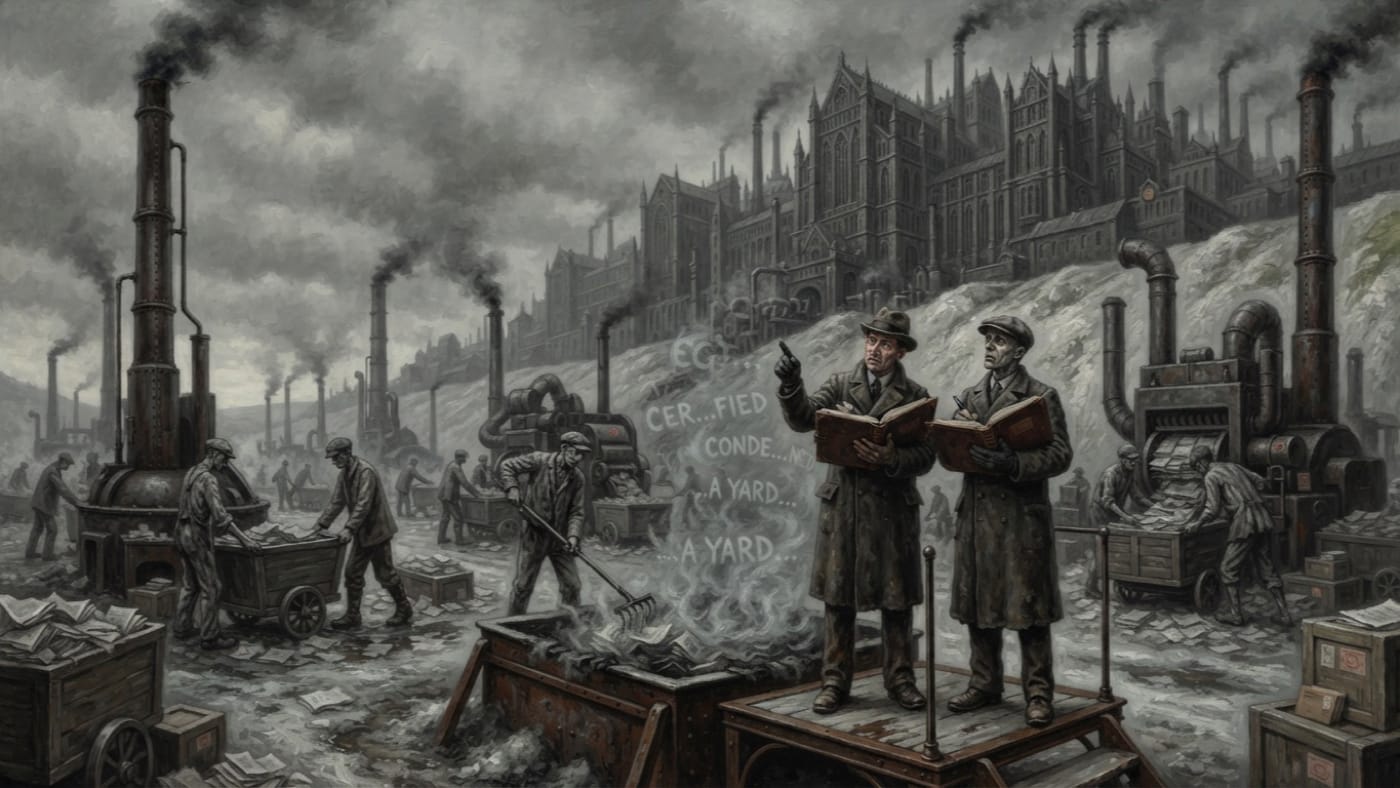
The Hollow-Script Scriptorium of Nemea uses its crown for copying, its belly for ink and its cellars for originals. It uses its western slope for endings. The Bureau of Records already had a long history of offices and reforms when it raised Nemea, and when it centralized its paper on this ridge it needed somewhere to put the fire. That place lies below the copying halls and downwind of nobody important. It is the Redaction Yards: open burn pits and shred mills cut into the chalk, where condemned documents are turned into ash and into strips too narrow to hold a surname.
You smell the Yards before the path turns. Sweet paper smoke is pleasant for about the length of a psalm, and after that it sits in the throat like a lien. Soot falls as grit on hands, collars and bread. Within a pace of every pit the chalk goes grey. During the correction cycles the redaction bells ring, and the locals say they feel them in their teeth. I felt them in a molar I had believed reformed.
The ash rises too. On a windless afternoon it ought to fall back into the pit that made it. It hangs there instead, and every so often it arranges itself into writing.
#On Condemned Pages
Nothing arrives in the Yards by accident. A page is sent down the slope for one of three reasons. The Margin Court has ruled against it, or the Archive Chapterhouse has superseded it, or a mirror-check has caught it carrying text its certified copy lacks, which brings it under the standing order to burn the second draft. Confessions come down. Intake records come down. So do guarantor slips, disputed parentages, superseded debts and the losing exhibits of identity hearings, by the cartload.
I admire the administrative logic as a professional. Once the Yards have taken a confession, that confession was never spoken. Once they have taken the only intake record that set a woman's birth-name beside her archive designation, the Court's copy is the only copy, and it says what the Court wrote. A disputant who turns up later remembering the original is like a man suing on behalf of his own shadow. Margin Inheritance goes ahead. The debts go ahead. The paper is gone, and its consequences are in excellent health.
The work has multiplied since the Night-Rewriting Contracts were classified in A.S. 198. A contract that alters itself overnight has to be answered by a document certifying that no alteration occurred. That document is written in the same ink, so it sometimes alters as well, and the certifications of the certifications come down the slope in the next cycle. The Chapterhouse calls this diligence. The shred-mill hands call it the harvest, and they do not mean it pastorally.
In law, the fire finishes an erasure. In chalk it finishes nothing. The ash still has to come down somewhere.
#On the Hands That Feed the Mills
The Yards are worked by the bottom of Nemea's order. Above the shred-yard hands stand the novices, then the silence testers, the senior scribes, the margin judges and finally the Abbot's circle. Below the hands stand only the "quieted," who have no names left to stand on. Ash-robed novices from the Novice Barrens work the pits beside the mill hands, often on night shifts owed against page debt. A scribe who falls behind quota in the copying halls pays the shortfall in hours, and many of those hours are served here. Vow contracts and quota penance keep the rest from wandering off.
The hazards come with the trade. Ash lung takes the long-serving. When the weather turns, ash storms come up the slope and lift the whole output of the pits into the air at once, and a hand caught in one coughs grey for days. The lime that whitens the ridge does to skin what lime does. I have seen no mortality register for the Yards. I have not asked for one, the Chapterhouse has shown no wish to keep one, and we both respect the economy.
On paper the chain of responsibility is plain. The Margin Court condemns. Abbot-Registrar Maelen Voss, who holds the vaults, the originals and the Chapterhouse seal, decides which originals exist to be condemned. The hands carry out what both have signed. No hand in the Yards has ever been charged with an erasure. Hands do not erase. They lift.
Now and then they also pocket. A scrap that escapes the mill has a price. Somewhere in Nemea a heretic cell called the Second-Draft Circle collects originals and works to undo erasures. Somewhere else a broker known as "Sister" Halvein trades redaction drafts against the people named in them. The hands know both markets exist. Given what the Yards pay, I do not ask which one buys more.
#On Category Two Textual Remnants
The shred-mill hands call it "the Yards talking." Nothing is actually heard. The phrase is theirs, and it describes what happens on a still day when the ash will not settle and instead gathers, for a breath or two, into letters: a clause, part of an oath, sometimes a name. Then the air shifts and the sentence comes apart into soot. In wind the formations run longer, and whole sentences can be read as they cross the slope. None of them lasts. Nothing in the Yards has ever stayed written in the air.
The hands treat it as part of the working day, like the bells and the cough. I once watched an old mill hand duck under a line of drifting script without breaking stride, the way a sexton steps around a grave he dug himself.
The Silence Test Collegium does not duck. It classifies. Under Silence-Master Rhu Tern it has designated the phenomenon a Category Two Textual Remnant and stationed two testers in the Yards full-time to write down what forms. They stand at the pits in every weather with their ledgers open, and they write fast. Their transcripts are classified. I have not read them, and nothing below summarizes them.
What I can say without breaking seal is what the Yards show any visitor. The ash writes, and its letters can be read. That does not make them testimony. A sentence formed over a pit has passed no silence test, carries no seal and has sworn no oath. The Collegium has not said publicly whether any given formation repeats a burned page, contradicts one or matches nothing ever filed, and I will not say it on their behalf. The workers never claim the Yards tell the truth. They say the Yards talk. A fishwife talks.
The theologians are less disciplined. One argument in the Chapterhouse holds that the relic residue in Nemea's ash-ink, residue the Chapterhouse officially denies is there, keeps some of its sanctity, and that the ash is text trying to become true. The Bureau of Doctrine has filed that view where it files all such views, under heresy, and I countersigned the filing. Others in Nemea point out that the Great Deceiver will write in any medium he is given, and soot is cheap. Neither side has produced a witness I would seat. The Creator has not been called to testify and has not volunteered.
#On Controlled Incineration
The Bureau's remedy for writing that will not stay burned is to burn it hotter. The Bureau of Alchemical Standards has filed the experiment.
Ash-ink residue sample NN-7/201 is classified ACTIVE. Its file records an incineration at 900°. The ash from that burning spelled the name of the technician who carried it out. The file then recommends controlled incineration above 900°, specifically 1,100°, and there it stops.
Note where it stops. A recommendation is a sentence about the future. The file records no burning at 1,100° and no ash that lay down quietly afterward. So far the Bureau has certified only its intention to light a hotter fire. The record does not identify the technician whose name went up in soot. On this slope that is either a courtesy or a precedent.
The Yards' other defences belong to the copying halls. Salt-lamp circles and mirror-checks can catch a page that has changed before it reaches the pits. They can do nothing about ash already in the air, and the Collegium has never pretended they could. The only instrument in the Yards aimed at the remnant itself is a tester's ledger, and a ledger corrects nothing. It only keeps.
Earlier Codex material attributed the contract-rewriting phenomenon to "residual schismatic interference" and a contaminated batch from Inkhouse vat number seven.
CORRECTED. The Bureau of Alchemical Standards found that vat number seven produces ink chemically identical to every other Nemea vat. That cleared vat seven and nothing else. Readers who carried the vat-seven explanation down the slope to account for the ash should carry it back up. The Bureau has drawn no connection between sample NN-7/201 and vat seven beyond a shared numeral, and the Codex draws none. Bureau of Doctrine
#On the Present Condition
The pits are lit and the mills are turning. The correction cycles have not slowed, because nothing upstream of them has slowed. Contracts still rewrite themselves in the vaults. Certifications still follow the contracts, and pages still follow the certifications down the western slope. The bells ring often enough that newer novices have stopped reaching for their jaws. The two testers fill ledgers faster than the Chapterhouse can classify them. The Second-Draft Circle goes on hiding what it can. Abbot-Registrar Voss has requisitioned more gloves.
Everything a page ever said to a tribunal, a debtor or a mother is ruled closed at the moment it enters the pit. The ruling is lawful and sealed. It travels by courier to every registry that relies on the Great Ledger. Meanwhile, on a still afternoon above the chalk, the residue of that closed matter sometimes spells part of it again in front of two officials whose job is to write it down and tell nobody.