

#On the Brothline
"If the ladle stops, the knives come out." — Marrow Row proverb
This compilation was made in A.S. 201 and describes Marrow Hall as it stands in that year. The Hall is the principal refectory of the Marrow Kitchens of Saint Ilka and the best-known feeding house on Marrow Row, which runs along the canal spine of the Candle-Sump District above the Ash-Sluice Line. Lower Vire, Zone 1, the River-belt. I give the address in full. Nobody in the queue needs it. The Bureau will.
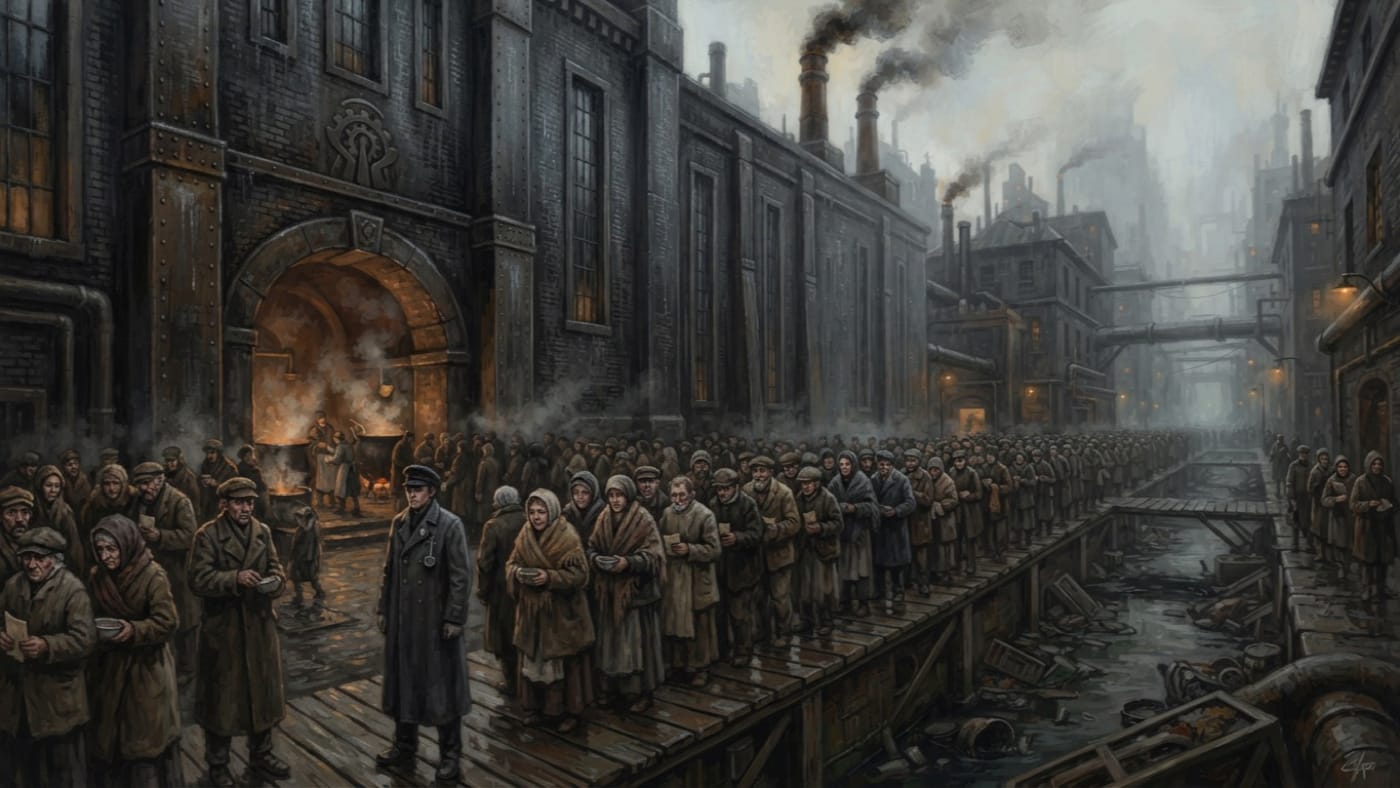
The queue is the way to approach the Hall, because it is how everyone else approaches it. The brothline forms in the dark. It stands on wet planks beside walls of soot brick that nobody living has seen dry. Condensation runs down the face of the Hall and gathers in the mortar, and the mortar keeps it. The district survey gives the place four entries. It feeds thousands. It smells of fat steam and prayer. Its hazard is the riot line. It is reported to keep a secret ledger. My nose confirms the first three. The fourth is dealt with below.
No surveyor has drawn the Hall. None of the files put before me records its rooms, its dimensions, the number of its cauldrons or its hours of service. I have not supplied a floor plan. Clerks who draw buildings they have not measured end their careers in the Bureau's basement, filing the drawings of other clerks.
#On the Fires and the Fare
The broth fires are lit at dawn. The sluice crews change shift at the same hour, and the first quarantine bell sounds over the canal. By then the queue has been standing for some time, and the Row's air already smells of fat steam with garlic-ash behind it.
The work inside is plain and hot. Cooks tend the fires and stir and scour the cauldrons. Runners cross the raised Coughwalk planks carrying messages and pots between the Hall and the Row's other kitchen fires. Kitchen crews wear ladle pins. In Candle-Sump the pin earns more deference than a Registry clerk's ink cuffs, and the clerks have noticed.
The fare is marrow broth, ash-bread and pickled riverweed. Garlic and real salt are luxuries. The garlic in the air belongs to the ward and promises nothing about any particular bowl. As for the marrow, the district's rendering vats are reported to stand near the broth kitchens. Nearness is a measurement. It names no animal. The sources name none either, and I will not fill that gap with whatever the reader was hoping for.
Marrow Hall feeds thousands. The record allows me no closer figure for attendance. Candle-Sump registers forty-two thousand souls, but that number counts the district and says nothing about the Hall's bowls. Some of the district eats at the Hall, some eats at other kitchens and some goes without.
My assessment of Candle-Sump stated that on Marrow Row "the broth kitchens feed the district's forty-two thousand registered souls."
The Marrow Row entry corrected this sentence, and I correct it again here because the error keeps applying for readmission. Forty-two thousand is the district's registered population. It does not count Marrow Hall's diners, the Row's residents or the reach of the Kitchens. The Hall feeds thousands. No daily total exists, and I supply none.
#On the Bowl and Its Paper
Before the ladle goes in, Matron Ilka recites the Broth Benediction over the cauldrons. It is a litany of quotas. I do not have its words, and I will not compose a prayer to be chanted over somebody else's soup. Its form is on file: before the first bowl is filled, the queue hears what has been allotted.
Then the queue speaks. The Kitchens double as confession points, and the district puts the arrangement in three words: speak to eat. The broth lasts minutes. The confession is kept as a tag attachment in the cabinets of the Bone-Tag Registry. Through that Registry it connects to the Bureau of Records, whose work ends in the Great Ledger of Souls. The record does not say what is asked at the ladle or how the attachment is made. The Ledger accepts a damp sin as readily as a dry one. The Registry is less forgiving about the paper.
The Hall pays out in paper. Ration chits and care credits circulate through the district alongside the Registry's stamped paper, bone tokens and a little coin. A household that wishes to keep eating files a broth ration renewal. No rate of exchange has been recorded, and no daily allowance. I would look closely at the motives of anyone who produced either.
Debt gives the soup a jurisdiction. Candle-Sump collects what it is owed through Registry liens and Care ration holds. A debt can be worked off in sanitation labour or body-delivery quotas, or secured with name collateral, meaning a dependent's papers held against the account. The Kitchens take part in this machinery, though they did not build all of it. Not everyone in the brothline owes anything. Those who do stand in the same queue as those who do not, and the queue can count.
The district survey also records that Marrow Hall keeps a secret ledger of names, with the fed set against the unfed. The survey lists it without qualification. I have not inspected it, and no assessment I have read has inspected it either. I enter it as reported.
#On the Ladle and the Gate
Ilka commands the Kitchens, and Marrow Row calls her the Broth-Saint. My district assessment credits her with giving the institution its saintly name, and with a canonisation she administered to herself. No Synodal tribunal has ruled on it, and no miracle is on file. The title holds on the Row anyway. It is backed by the one sanction nobody there will test.
The Row's name for her authority is ladle law: kitchen rules outrank city rules. It is a practice and not a title. No court has issued it, and the Hall at dawn has never needed one.
The ladle rules a pot that other people fill. Prefect Sera Mott of the Sluice Prefecture holds the gates, the flood releases and the Prefecture's calorie allocation to the district. Chief Clerk Dalen Voss holds the Registry seals. Ilka holds distribution. The grain is imported, and so are the clean water and the fuel for the Hall's fires. All of it comes through gates that open on Mott's timings. The Kitchens' recorded crisis trigger is a delayed grain shipment. A matron can quiet a queue. She cannot hurry a skiff.
The three powers renewed their joint-authority compact in A.S. 187 (1897 CE). That is the date of the compact's renewal. It is not the Hall's date, and nothing in it tells me who first lit a fire under these cauldrons, or when. Ownership of the Hall by any Bureau is undetermined. There was one failed, undated attempt to bring the Kitchens under the Bureau of Pilgrimage. It proves that Pilgrimage wanted them and nothing more.
Broth leaves the Row by wagon, guarded by the Care crews. Residents step aside for the wagons. Custom requires this and no statute does, and the custom is better kept than most statutes. The Quarantine Provosts move their cordons through the wards as rot-lung moves. My Marrow Row entry states that the wagons go only where the ribbons allow. My Care crews entry finds no restriction on broth in the record, and no exemption either. I have filed both and resolved neither, and I stand behind each with equal authority. The district also exports broth concentrate. How much of it was boiled in the Hall is not recorded.
#On the Present Allocation
As of this A.S. 201 compilation, the Care crews have threatened to strike if rations are cut again. They have not struck. The earlier cut is undated. The crews have kept count of it, but the record has not dated it. I will not say what an unguarded wagon would do until one exists.
Ilka is pressing for the Kitchens' autonomy from the Prefecture's calorie allocation. The Synod's published plan proposes the opposite: broth centralised under Synodal supervision. Neither has been enacted. No document says whether the Matron and the crews are working to one plan or are simply queueing beside each other.
Around the Hall, the district closes in. Rot-lung advances. The Registry and the Prefecture are disputing who owns the seized clean slips. A transfer order bearing the name of Inquisitor Halvyr is working its way through the approval chain of the Bureau of Purity. Nobody has been transferred and no audit has been held. Each of these matters ends up, sooner or later, in the brothline, where Candle-Sump stands every morning before first light.
The fires were lit at dawn, and the queue had formed before them.