
#On the Quarter and Its Record
The Marrow Quarter lies in the lower wards of Strasbourg, below the Bureau steps and the cathedral bells, where the capital keeps the people its sermons describe as the faithful poor. The files place it there and stop. No survey I am permitted to cite fixes its boundaries, counts its roofs, names its streets or assigns it a governing officer. For one season the capital kept excellent books on the Marrow Quarter. It kept almost none on any other.
That season is the Gray Week Famine, fixed at A.S. 138 for public instruction while Records and the Bureau of Festivals go on disputing what the year should be counted from. Records begins with the first failed grain return. Festivals begins with the decree that made the failure useful. Within that disputed season the quarter entered the archive twice: first as the street where an audit officer was turned into stationery, then as the site of the first miracle attributed to Saint Caldrin the Jubilant Scribe. The Bureaus file whatever happened between those two entries under pacification.
The residents appear in both entries without names. They are entered as households, deficits, rioters, ribbons and a total. I will do what I can with that. It is more than the Bureaus did.
#On Hunger and Inspection
Whatever grain the capital held had passed through convoys, granaries, garrison requisitions and parish ledgers before any of it reached the lower wards, and each handling cost the bottom of the city something. By the time the audit came, the published account says the households of the quarter had lived on bone-broth for eleven days. Mothers boiled it thin enough to shame rainwater. Children learned the difference between a pot that had seen a bone that morning and a pot that remembered one from last week.
The Bureau of Tithes called the shortfall local misreporting. Records suspected concealment. The Synod chose to test both suspicions on the hungry, and the open grain audit came down into the lower wards under escort, as it came that week into Marseille, Munich and a fourth city the Bureaus still cannot agree to name.
The audit's forms required household tallies, ration slips, cellar inventories and declarations of any grain held back. A clerk at a folding table was expected to ask a woman with a dry pot how much she was hiding. He asked it with ink still wet on his warrant and a pair of escorts behind his chair, and he wrote her answer down whether she gave one or not.
I have read those forms. They are well designed. Every column anticipates a lie, and no column provides for a household with nothing left to lie about. A family that answered "nothing" was entered under suspected concealment, because the form had no other place to put them.
#On the Prefect's Passage
The officer charged with the quarter's returns held the rank of Ledger Prefect. Every account I have been allowed to read leaves out his name, and this one leaves it out too. The Bureau has taken enough from him.
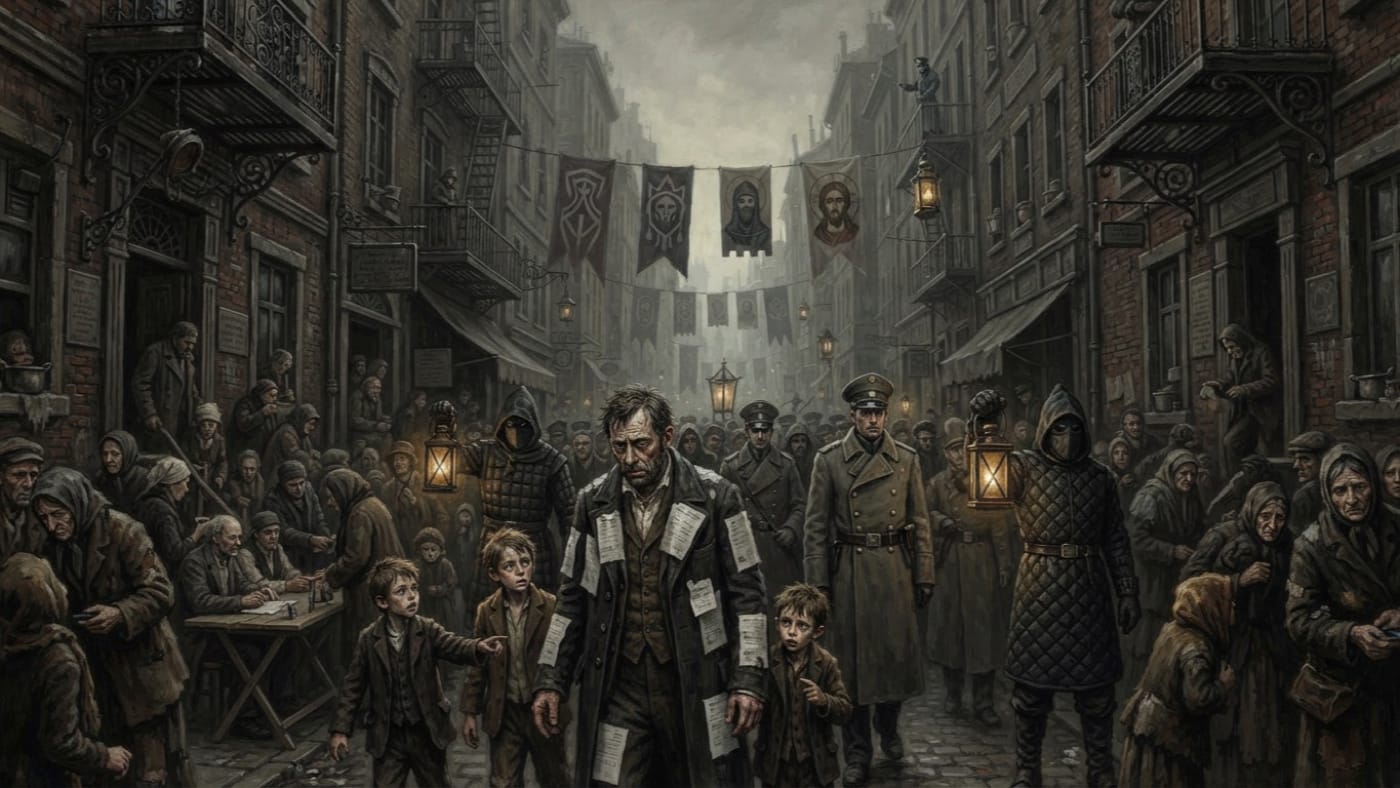
The crowd took the rest. They stripped him of sash, collar, buttons and the doctrine that went with them. They took his own audit forms, still blank in the columns he had come to fill, and pasted them to his skin with fish glue, which the lower wards could apparently still find when they could no longer find flour. Then they walked him through the streets he had come to inventory, and the children of the quarter went ahead of him reciting the column headings: household, grain, deficit, suspected concealment, correction due.
He survived. Gray Week's dead belong to other streets and other tables, and nothing in the record turns this procession into an execution. The glue was meant to humiliate him, and it did. His career did not survive. I have seen a copy of his reassignment order to the Paper Mines of Ulm, and I report it as I found it: brief, cold and a long way from crowds.
The scene deserves a professional reading. In a single afternoon the residents of the Marrow Quarter performed the Prefect's audit more completely than he could have. They counted him and itemised him, and they published the result on his own body to every window on the route. They also taught the headings to children who could not read them, which no Records apprentice school has managed in a decade of trying.
#On the Claimed Calming
Caldrin of Essen, then a junior clerk of Festivals, read the riot returns at a desk well above the lower wards. His conclusion was that the quarter had refused the clerk rather than the count. His first memorandum proposed three instruments. The Ribbon Runner worked the edge of the crowd with a punch-tool and a smile. The receipt-scroll carried names to be reconciled against the parish roll. The gratitude pause halted the procession under banners, saints and free cider long enough to count wrists. For confetti he used shredded audit paper, which may have included some of the stock the Marrow Quarter had already used for glue.
The hagiography calls what followed the Calming of the Marrow Quarter, the first of Caldrin's three attributed miracles. According to the tradition, a procession entered streets still sour with riot and came out with no deaths, four thousand wrist-ribbons and a complete household correction ledger.
Each figure answers a narrower question than the pious copies put to it. "No deaths" refers to that procession on that route. It does not cover Gray Week, the lower wards or the Prefect's afternoon. Four thousand ribbons is a count of ribbons. The tradition does not say how many residents, households or loaves stood behind them, and the Bureau that counts everything has never felt any need to say. The correction ledger was complete by the standard of the office that wanted it. The surviving account gives no date for the Calming and does not settle whether it came before or after Directive 88-F. I will not move a miracle's date to suit a feast calendar.
The Bureau of Festivals' earliest vita, on which the Calming tradition rests, states that Caldrin "heard the people's distress and answered with joy."
Corrected: Caldrin read the riot returns from the lower wards, marked the failure of the open audit and noted the census gap in the Marrow Quarter's households. He proposed an instrument for bringing those households into the street under banners. The quarter's distress came to him as paperwork. The joy was supplied by the Bureau.
A competing account exists, and Festivals has tried to suppress it. A witness note filed after Gray Week puts Clerk Caldrin behind a cider table at the third pause of a Marrow Quarter procession. A woman asked him whether the ribbon meant bread. He laughed and told her, "It means you have been remembered." She struck him. A Lantern escort stepped in, the drums were played louder, and the line moved on. The note does not identify which procession it describes, and I will not make it the Calming. It is enough that the Calming's quarter left a record in which someone asked for bread.
The quarter seems to have left a second record of its own. Approved images of Caldrin show a receipt-scroll reading "Joy Leaves a Trace." A few suppressed Marrow Quarter prints change the scroll to We Know You Were There. Nobody has traced a press, a guild or a movement behind them. The rewording needed only one engraver who had stood in the line.
#On the Quarter in Festival Memory
The Receipt Reform of A.S. 138 turned the lesson into law. Synod Directive 88-F abolished paper receipts at Bureau-sanctioned processions, made wrist-ribbon stamps compulsory and constituted the Receipt-Procession Pageant Captain as a licensed profession. The Council of Prefects recorded no dissent. The Marrow Quarter had no seat on the Council, though its streets had supplied most of the evidence.
The Lantern Accord followed in A.S. 139 and made the Lantern Brotherhood official crowd escorts for the parade structure. The lantern-bearer at the cider table in the witness note belonged to an older arrangement, a tolerated watch whose authority lasted as long as the Bureaus found it useful. The Accord gave that arrangement a collar. Later devotional broadsides credit Caldrin with founding the Accord itself, but his own dossier disputes this, and no copy of it carries his hand. The quarter's experience made the escort look necessary. It did not hold the pen.
In the schoolrooms and chapels of the Bureaus, the Marrow Quarter became an exemplum. Festivals teaches it as the street where gratitude replaced the cobblestone. Records teaches it as the place where the census gap closed. Pageant Captains learn the version their trade uses: an open audit in a hungry ward produces a papered Prefect, and a slowed route with music produces a balanced ledger. The quarter is the only party with nothing on file. Its households were corrected, ribboned and entered, and as of A.S. 201 none of the instruments that counted them has asked whether the broth got any thicker.