
#On the Origin of the Profession
“The grave is a permit.” — Inscription above the Intake Bay, Tariff-Chapel of Saint Morin (Unregistered), Marrowgate, carved in bone-lime mortar, date disputed
The Dead-Goods Tariffer exists because the dead, in the Age of Heresy, have refused to remain a simple category. A corpse in the Rationalist era was a biological fact — weighed, measured, disposed of with the brusque efficiency of men who believed matter was all there was and all there would ever be. The Sundering corrected this assumption with a thoroughness the Bureau has spent a hundred and fifty-six years attempting to administer.
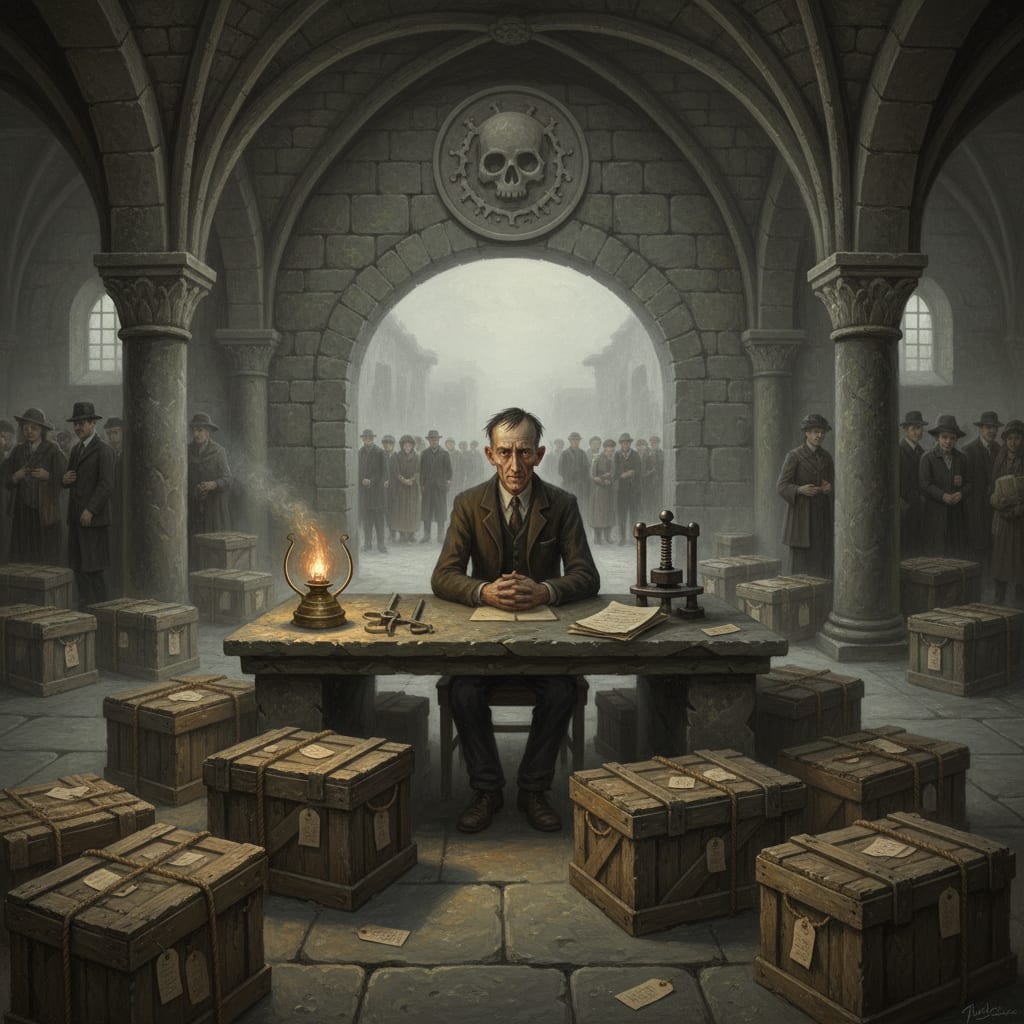
Bone is mortar. Bone is currency. Bone is relic, ornament, structural beam, ash-credit, evidence, and, on three confirmed occasions at Constantinople, ammunition. The dead are not disposed of in the Synod's territories; they are classified, and classification requires a clerk, and a clerk requires a desk, and a desk requires jurisdiction, and jurisdiction requires a tariff schedule, and a tariff schedule requires enforcement, and enforcement requires a man with a seal press, bone calipers, a purity lamp (Unregistered), and the trained inability to hear sobbing as anything other than queue noise.
That man is the Dead-Goods Tariffer.
The profession crystallised in the decades following the Great Retreat, when the Synod's nascent bureaucracy confronted a logistical reality the Rationalists had never imagined: mass casualties on a scale that turned burial from a civic duty into a supply-chain crisis. Bodies stacked faster than graves could be dug. Bones accumulated faster than ossuaries could absorb them. And the bones were useful — for mortar, for reliquary fragments, for the walls of the very bastions that would house the living. Someone had to decide which bones went where. Someone had to stamp the paperwork. Someone had to stand between grief and commerce and pretend the two were separate categories.
The First Ossuary Panic — undated in the Bureau of Records, which is itself a datum — provided the immediate catalyst. Unsealed burial pits along the Rhine corridor began producing sounds at night. The Bureau classifies these sounds as “post-interment atmospheric settling.” The soldiers who dug the pits called them screaming. Mandatory burial clearance followed within the season: no remains to be interred, transported, processed, or displayed without a stamped clearance certificate issued by a licensed Tariff-Chapel clerk. The Dead-Goods Tariffer was born in the space between a scream and a stamp.
#On the Substance of the Work
The Tariffer's desk sits in the tariff-chapel — a stone-floored weigh hall that smells of lime bite and stale incense, where the competition between rot and sanctification plays out daily in the nostrils of the staff. The workspace is cold by design. Warmth accelerates decomposition, and decomposition complicates classification, and complicated classification generates appeals, and appeals generate paper, and paper is the one resource the Synod can never quite produce fast enough to match the volume of the dead.
The classification system is brutally direct. A set of remains entering a tariff-chapel is assigned one of five designations:
Burial — interment in consecrated ground, requiring kin verification, confession receipt from the deceased's last attending priest, and a purity-lamp check confirming the absence of spiritual contamination. Standard procedure. Standard tariff. Standard grief.
Transport — transit to a specified destination: a family ossuary, a distant parish, a reliquary vault. Requires sealed tags, convoy manifest entry, and a Bureau of Tithes transit levy calculated by weight and distance. A femur travelling from Marrowgate to Strasbourg costs more than a living pilgrim walking the same road, because the femur requires refrigerated sealing, an escort writ, and a notarised chain-of-custody document that the Bureau of Records will lose and the Bureau of Rites will dispute.
Salvage — remains designated for material reuse. Bone-lime for mortar. Calcium powder for road surface. Ash for credit tallies. The Saint-Bone Melting Acts govern the rendering of relic fragments into structural lime, but salvage-grade remains — the common dead, the unattested, the unclaimed — fall under the Tariffer's sole authority. He decides what becomes a wall and what becomes a road. He does this before lunch.
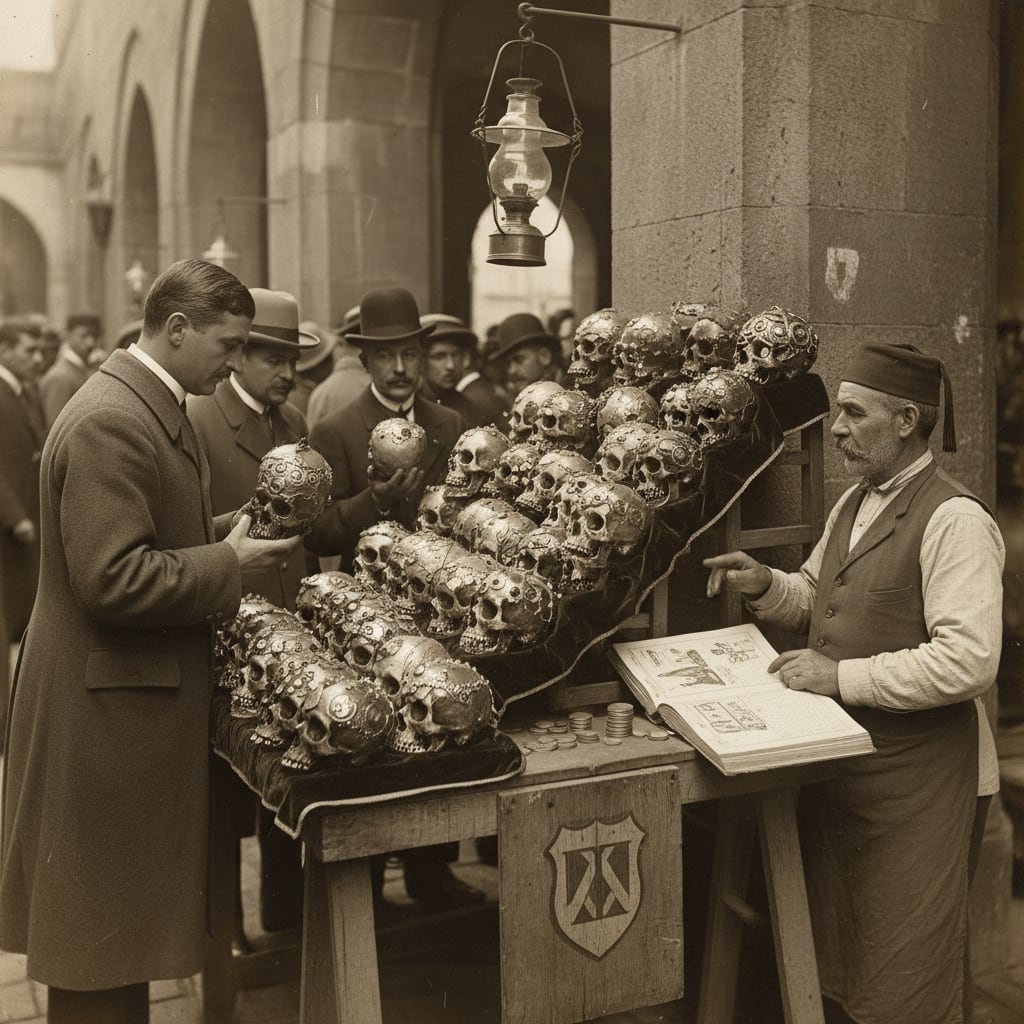
Ornamental — the category that generates the most paperwork, the most bribes, and the most riots. Bastion elites wear bone. Skull-lanterns illuminate ossuaries. Carved femurs serve as processional staffs. Tooth-strings hang from chapel rafters as devotional ornaments. The tariff on ornamental remains is the highest in the schedule because the Bureau has discovered that vanity is the only grief tax that the wealthy will pay without complaint. A skull classified as “ornamental, Category Two, decorative domestic” costs its purchaser three times what a standard burial costs its mourners. The economics are impeccable. The ethics are filed under a classification that does not require the Bureau to examine them.
Contaminated — remains that fail the purity-lamp check. The lamp flickers. The chapel freezes. The Tariffer seals the intake bay and sends for a Bureau of Purity officer, who arrives with an unhurried stride that has been calibrated to communicate both competence and menace. Contaminated remains are quarantined, examined, and — in nine cases out of ten — incinerated without further classification. The tenth case generates a file that the Bureau of Doctrine marks “Pending” and the Bureau of Medicine marks “Urgent” and the Bureau of Rites marks “Outside Jurisdiction” and the Tariffer marks “Above my seal grade, may the Creator preserve the next shift.”
#On the Ornament Boom and the Skull Markets
The profession's moral crisis arrived approximately A.S. 120, when bastion elites discovered that bone — polished, carved, set in brass or mounted on velvet — possessed a beauty that no quarried stone could match. The demand was instantaneous. The supply was, by the mathematics of war, inexhaustible. And between demand and supply stood the Dead-Goods Tariffer, holding a seal press and a classification codex that suddenly determined whether a dead soldier's skull adorned a general's mantelpiece or fed the lime kilns.
Skull tariffs were introduced by the Bureau of Tithes in A.S. 124 with the stated purpose of “deterring vanity and preserving the sanctity of the departed.” The actual purpose was revenue. A skull stamped “ornamental” generated four times the tariff of a skull stamped “salvage.” The distinction between the two categories was, in practice, whatever the Tariffer decided it was, and what the Tariffer decided was influenced by a constellation of pressures that included chapel faction loyalty, syndicate threats, patron relationships, and the simple human calculus of a man offered three months' wages to reclassify a crate.
The Relic Counterfeit Scandals (Unregistered) of A.S. 140–155 compounded the crisis. Forged saint-fragments flooded the markets — pig-bone passed off as martyrs' knuckles, river-horse teeth sold as molars of the blessed. The Bureau of Relics discovered that its seventeen-femur problem had metastasised into an economy where every bone was potentially sacred, potentially decorative, potentially structural, and potentially counterfeit, often simultaneously. The Tariffers were granted relic-authentication protocols: a secondary lamp check, a caliper measurement against the Bureau's standard bone-density tables, and a wax seal certifying provenance. The protocols added forty minutes to each intake. The queues doubled. The bribes tripled.
Prior editions of this entry classified the skull market as “an aberrant economic phenomenon, self-correcting.” The Bureau of Tithes' A.S. 200 revenue audit indicates the skull market constitutes approximately eleven per cent of ornamental tariff income across Zones 2 through 4.
CORRECTED by order of the Bureau of Tithes, A.S. 201. The skull market is “a regulated devotional-materials exchange operating within established tariff parameters.” The eleven per cent figure has been reclassified as “devotional revenue, subcategory aesthetic.” The correction changes nothing except what the Bureau is willing to say aloud.
#On the Plague Winter and the Gray Clearance
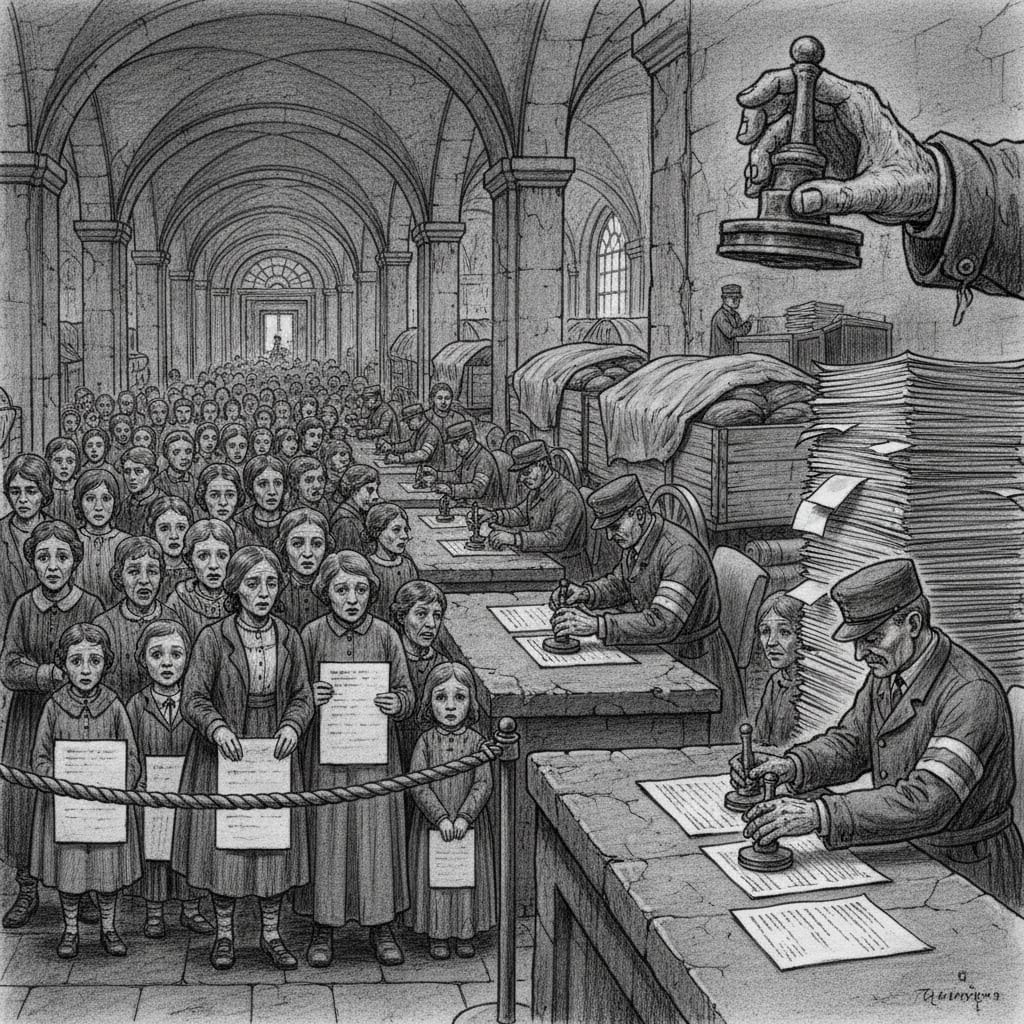
The profession's operational crisis arrived with the Plague Winter (Unregistered) of A.S. 157 — the same famine year that saw the Widow's Pennies revived and the Bureau of Pilgrimage overwhelmed. Corpse backlogs at Marrowgate, Strasbourg, and the Rhine corridor bastions exceeded processing capacity within a fortnight. Bodies stacked in intake bays, in chapel corridors, in the streets outside the tariff-chapels where families queued for clearances that the Tariffers could not issue fast enough to prevent the dead from becoming a public health catastrophe.
The response was the Gray Clearance — an expedited classification protocol that reduced the five-category system to two: “cleared” and “held.” A Gray Clearance stamp moved remains directly to the Lime Yards without purity-lamp check, without caliper measurement, without kin verification. Speed replaced diligence. Throughput replaced sanctity. And into this gap rushed the bribe economy that the profession has never subsequently expelled, because once a family learns that a stamp can be purchased — that grief has a market rate, that a father's burial can be accelerated from three weeks to three hours for the price of a wax stick and a whispered arrangement — the knowledge does not evaporate when the plague recedes.
The Gray Clearance was revoked in A.S. 158. Its ghost persists in every tariff-chapel in Europe. The “mercy stamp” — the unofficial, off-ledger expedited clearance available to those who know the price and the protocol — is the Gray Clearance's direct descendant, stripped of its pandemic justification and operating on pure patronage. Every Tariffer knows the mercy stamp exists. Every Tariffer denies it. The denial itself has become a form of professional courtesy, a shared fiction that permits the system to function while preserving the appearance of integrity that the Bureau requires and the dead, presumably, do not.
#On the Present Condition
The Dead-Goods Tariffer in A.S. 201 occupies a position of considerable power and negligible dignity. He controls burial clearance, transport routing, material salvage allocation, and ornamental classification for every set of remains that passes through his chapel's intake bay. He is bribed daily. He is threatened weekly. He is audited quarterly by inspectors from the Bureau of Records whose attention to wax chemistry and tag-fibre consistency has improved markedly since A.S. 194 and whose attention to the systemic conditions that produce the fraud they are detecting has not improved at all.
The hierarchy runs from Tag Runner — a child, usually, lime-dusted and coughing, who matches intake tags to convoy manifests — through Intake Clerk, Purity Lamp Technician, and Classification Scribe, up to the Dead-Goods Tariffer proper, and thence to the Quarantine Master and the Tariff-Chapel Prelate who sits above the entire apparatus with the serene authority of a man whose hands have never touched a purity lamp and whose lungs have never tasted lime.
The factions are predictable. The “Pure Chain” clerks insist on full protocol — every lamp check, every caliper reading, every kin verification — and damn the queue. The “Mercy Stamp” clerks insist on throughput, on clearing the backlog before the bodies generate the kind of disease that turns a tariff-chapel into a plague ward. The two factions despise each other with a professional intensity that would be admirable if it were not so obviously a displacement of the moral distress that both camps share and neither will name.
Between them, the ossuary syndicates and bone-factor cartels exert a pressure that the Bureau acknowledges in classified assessments and ignores in public policy. A Tariffer who refuses a syndicate's reclassification request may find his chapel's lime supply delayed, his tag stock “misrouted,” his junior clerks suddenly reassigned by a Bureau of Settlement order that no one in the Bureau of Settlement remembers issuing. A Tariffer who cooperates finds his ledger haunted: literally, in the specific sense that names he delayed show up in dreams, and the dreams have the texture of depositions, and the depositions are accurate.
The Tariffer's private truth, the one he carries home in his lime-stained cuffs and his chemical-burned wrists and his chronic cough that the Bureau of Medicine classifies as “occupational atmospheric exposure, non-urgent”: he has stopped seeing faces. He sees tags, weights, clearance states, tariff codes, chapel seal impressions, purity-lamp readings. He sees the classification before he sees the dead. This is necessary. This is the only way the work gets done. This is what the Bureau means when it says the system functions.
The system functions. The queues move. The dead are classified. The bones build the walls. The walls house the living. The living die and return to the intake bay, where a Tag Runner matches them to a manifest and a Tariffer reaches for his seal press and the lamp burns its sanctified tallow and the lime dust settles on everything, on the ledgers and the scales and the calipers and the hands of the man who stamps the clearance, and the stamp reads CLEARED, and the dead go where the stamp says they go, and the Tariffer does not look up, because looking up is how you start hearing the sobbing as sobbing instead of queue noise, and once you hear it as sobbing the seal press gets heavier and the lamp burns dimmer and the lime tastes like what it is, which is powdered people, which is the foundation of everything the Synod has built since the day the ground opened and the dead stopped being simple.
Requiescat in archivo.