
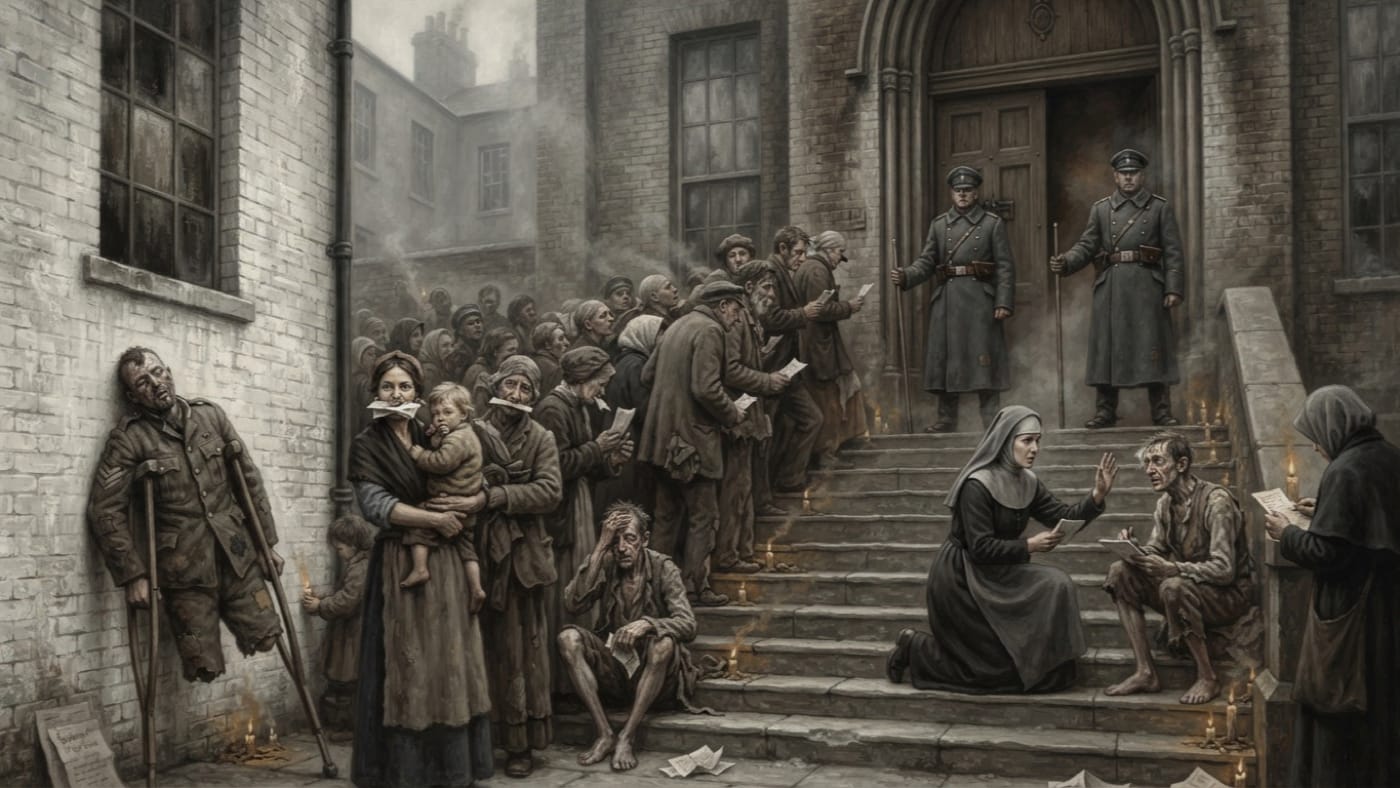
#On the Chapel Steps
"Kneel for the draught, stand for the receipt." — said on the steps of Mercy Chapel; not an approved formula
The queue forms before the dawn intake bells. It never really ends. People leave it and others take their places. By the time the Lime Yards have breathed their first chalk across Marrowgate, the steps of the Mercy Chapel of the Unburdened are already full. A sapper with one leg leans against the whitewashed brick. A mother holds a folded paper in her teeth because both her hands are holding the child. A debt labourer up from the Suture Slums has fever sweat drying under his collar. Behind them stretches a long grey line of everyone else. Tallow candles stand in the cracks of the bone-lime mortar, giving off brown smoke and the smell of mutton fat. Somebody whispers a prayer every few minutes, and somebody else tells them to save it for the door.
The city calls it Mercy Chapel because nobody in pain wants to say the full name. There is only one Mercy Chapel. Mercy Market spreads out below the steps, selling ration exchange, pain draughts, black tea and sour bread. The chapel counts the market as part of its territory, and the market counts the chapel among its customers. Rusted iron gutters drip onto the lowest step. The upper steps stay dry. Where you stand on the steps tells you a good deal about how close you are to relief.
The steps have one recognised hazard. When word goes down the line that the stores are running low, the line stops being a line. Chapel guards hold the door. The crowd presses toward it. People are crushed on the steps of a house of pain relief, and the chapel records this, in its fashion, as demand.
#On the Rationed Draught
At Marrowgate, pain relief is a sacrament, and sacraments are rationed. Morphic draught ingredients come into the city among its imports, alongside lamp oil, surgical steel and supplies for the rites. The finished draughts sit in the chapel's stores. The chapel decides who gets one.
Critics of Mercy would prefer otherwise, so I will say it plainly: the draught works. A soldier whose amputation has been notarized, but not yet accepted by his nerves, swallows it and sleeps. A child stops screaming. The family that watched will be grateful for the rest of their lives, and that gratitude is the chapel's real store. It keeps longer than anything in a vial.
The chapel publishes no tariff. I have looked for one. There is no posted price, schedule or rule, only a door, a sister behind it and a decision. Relatives bring what they can: linen, coin, and a word about a neighbour. Marrowgate's gate inspectors list a "donation" to Mercy Chapel among the bribes that reliably work in the city. Nobody at the chapel has told me what such a donation buys, and nobody has denied it to me either.
The alternatives are not kind. The Stitchmarket sells stolen anaesthetic in the Suture Slums and beneath the Prosthetics Arcade. A cellar clinic will promise anything, measure nothing and charge for both. Unlicensed anaesthetic prayers are forbidden, which suggests that someone, somewhere, has found them effective. Living next to all this does not make the chapel a partner in it. It only means that the chapel and the black market draw on the same scarcity and serve the same desperate people.
Two things put the chapel under strain: a shortage of draughts, and a panic about heresy. Either one is enough to exhaust the patience of the steps.
#On Confession and Sanctuary
Across Marrowgate, confession is a toll. Every arrival makes an intake confession at the gates, healthy or not. You need a confession receipt to enter a ward. Confessions are attached to medical ledgers and cited in tribunal judgments. The Bureau of Mercy has long collected the words of the dying for the Bureau of Records. Its deathbed confession harvesters belong to that wider apparatus, and I do not claim any of them for this chapel.
What the chapel does have is its own confession archive and the patience to use it. Its methods are listed in the city's own description of it: rationing the sacrament, quiet blackmail, and sanctuary as a bargaining position. Its purpose is listed beside them: to collect confessions and to decide who receives the morphic draughts. Put the two lists together and you have the whole machine.
On the steps, confessions change hands like scrip. People trade in who heard what, who will say what at the door, and whose secret might buy a place nearer the candles. A sin of your own buys you a hearing. A sin of your neighbour's buys more.
Sanctuary at Mercy Chapel means a door with a guard behind it and an archive behind the guard. It holds against a provost for exactly as long as the chapel prefers the person inside to the provost outside. No saint guarantees it. Nothing in the stone prevents arrest. A person given sanctuary here owes the chapel, and the chapel never forgets a debt.
#On Those Who Keep the Chapel
Sister-Matron Ilka is kind. Witnesses agree on this, and so do I, and it explains why the chapel works. She will kneel on the wet step to look a fevered boy in the eye. She will hold a widow's hand while the widow is being refused. She will not change the terms of the refusal. Kindness and immovability live together in her without any visible quarrel. The patient on the step gets every comfort except the one decision that matters.
Brother Dane knows everyone's secrets. He has not published a single one. In Marrowgate, that restraint is power.
Chapel guards keep the door and the stores. The chapel wards depend on the counted care that the Mercy ward-sisters and ward-brothers practise across the Synod: broth measured with marked ladles, mercies logged, confessions sent on. I have no staff roll for the chapel, and I will not invent one.
The chapel's authority overlaps with others and stops short of them. The Sanitation Chapter holds the cordons and decides on quarantine. The Civic Triage Tribunal decides who is salvageable and who gets a bed. The Sealhands decide who may lawfully cut. The Prosthetics Guild decides who may walk again and on what terms. The chapel decides who will hurt less, who may pray, who may hide, and who said what. That is a smaller jurisdiction than the others hold. It is also the one every patient eventually needs.
#On the Wind at the Threshold
By A.S. 201, the Marrowwind incidents are increasing, and the chalk wind has reached the chapel steps. I have no date for the first time it arrived there, and I will not make one up.
Here is what has been observed. A dry gust comes up from the Lime Yards. The vinegar smoke thins. Chalk dust settles where it has no business being, under bandages, between the pages of closed ledgers, in the grooves of stamps. Patients report hearing their birth names spoken aloud. Ledgers correct themselves overnight. Sutures attached to false notes give way. A queue of people holding folded papers and tallow candles is about as exposed as a crowd can be to something like that.
Explanations are another matter. The Sanitation Chapter blames residual vocal particulate. The Bureau of Doctrine has considered three theological readings and sealed the one it finds most plausible. None of them has been certified, and this article certifies nothing about how the wind works.
Since A.S. 198, true-name slips have been contraband in chapel precincts, along with the wards, quays, slums and yards. This is a prohibition issued by the Sanitation Chapter. The chapel did not decree it. It is enforced by confiscation and by inspecting mouths, which at the threshold of a house of prayer is a sight to see. People in the queue still carry the slips, folded small and written in a family hand.
This survey's draft stated that true-name slips are destroyed in chapel precincts as "superstitious impediments to correct patient classification."
Corrected. After the White Ward Three incident of A.S. 200, Doctrine's general guidance changed the stated reason to "excessive efficacy outside licensed sacramental channels." The prohibition in chapel precincts has not changed. Only the reason has improved.
The chapel has not said whether the wind has reached its confession archives. That question worries it more than any other. Whatever corrections the dead might make, the Bureau of Doctrine's standing position applies here as everywhere else: a Marrowwind correction cannot be accepted as testimony without living corroboration. The chapel gets no exemption. Brother Dane may be glad of that.
#On the Present Allotment
The queue is there tomorrow. The candles burn down to the stone and are replaced. The stores fill and empty with the convoys. The archive grows by one folded confession at a time. Sister-Matron Ilka kneels. The guards hold the door. Mercy Market sells sour bread to the people waiting. The steps keep the order in which pain was admitted, and the chapel keeps the record.