
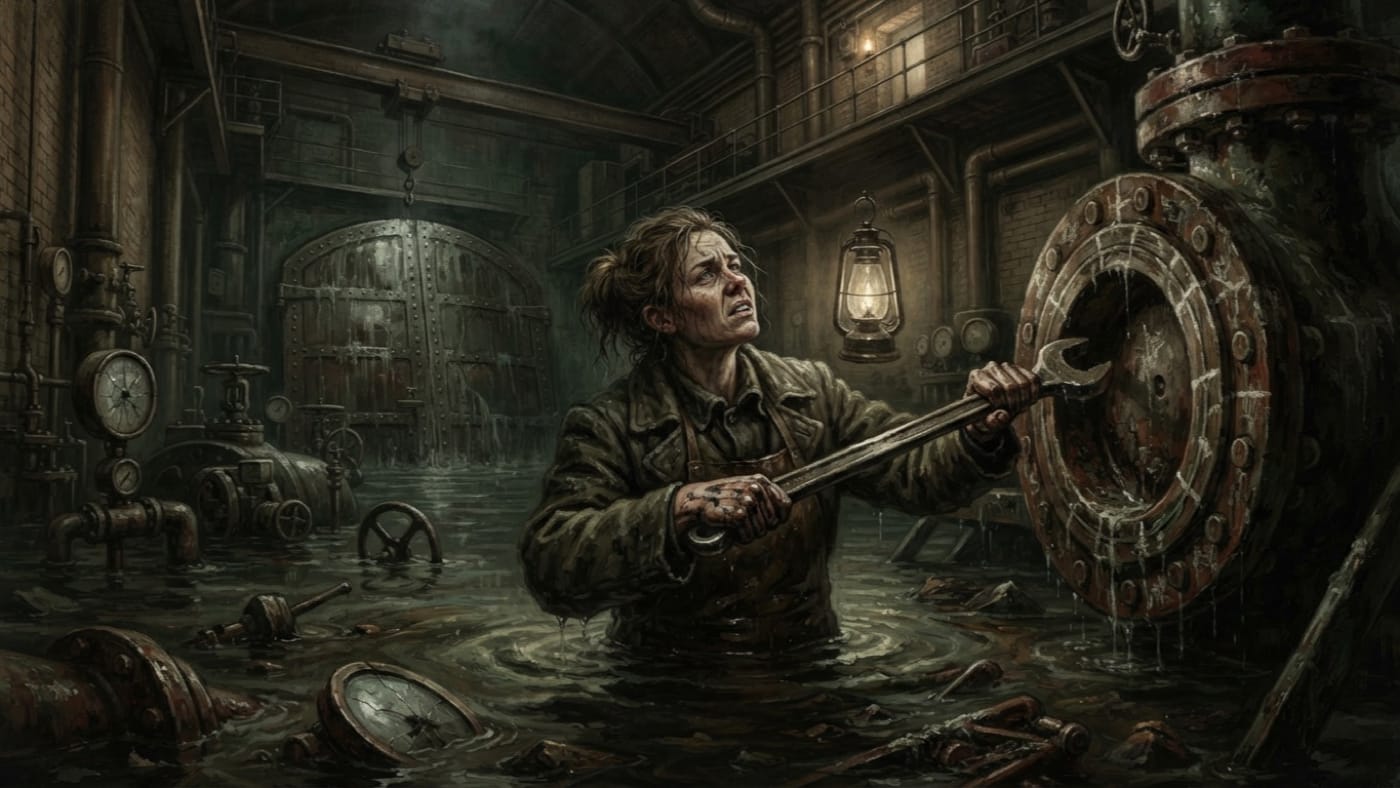
#On the Rear Fortress
Old Bastion-Metz was never one of the seven primary bastions of the Sagittal Line, and its garrison took offence whenever anyone said so. It was a rear fortress, a supply-bastion that stood behind the depots of Metz. Like every useful place it had grown past its own walls: refugee wards built against the curtain, boiler sheds in the ditches, rail locks, ash vaults, and underneath all of it a wet underworks that fed pressure to the gate machinery. The formal Synod had been governing for forty-two years by then. Its Bureaus had already learned to count. They had not learned to drain.
I date the flood to A.S. 132, which is 1842 in the reckoning of the Common Era. The official Life of Saint Orla of the Seventh Line has a year on it so spoiled by water and clerical reluctance that it can't serve as a certificate of anything. The assignment is mine. The water belonged to the river. No day, month or season survives in a form I would sign, and I have signed worse.
The western pressure door guarded a low ward. Families slept behind it, and so did condemned labourers, and so did children whose parents had bought them dry bunks with three months of ration debt. At Metz you paid for dryness. Remember that fact, because the Records clerks will be along to collect it.
#On the Rising
The rain began at Matins. The Life gives no measurement and I won't invent one. The liturgical hours are the only clock that came through the deluge intact, and they make a poor instrument for hydrology. By Vespers the rain had become a matter for Engineering. The river is not named in the Life, and I won't guess its name in a document that Records may one day quote against me. It came into the works by every route the fortress had dug for its own convenience: the culverts, the sump doors, the coal drains, the confession runnels that carried penitential wash-water out of the lower chapels, and finally the southern service stair.
The dependency can be stated in four lines, and every one of them was under water. The lower engine chapel held the conduit of Seal Seven. Seal Seven fed the western pressure door. Pressure held that door shut while the engine works flooded around it. If the seal failed, the door would lose its pressure and the low ward would take the river at bunk height.
A pressure door is a dull instrument. Its holy work is to be pushed shut harder than the world pushes it open, and for that it needs a pipe that does not leak. It protects a ward. It is not a dam, and nobody of sense ever claimed it saved the city.
The Life describes the conduit at Seal Seven as old work rebuilt over pre-Synodal stone, patched through three wars and blessed under four rites that disagreed with one another. I give that as the Life's account. No surveyor has since put a rule against it for my benefit.
Three mechanics fled when the first gauge cracked. Two died trying to lift the crate of spare rings. The Life reports these as incidents and I report them the same way: five men accounted for, in a flood whose full death toll no ledger I have seen will admit to having counted.
#On Seal Seven
The seal had slipped. The old gasket had swollen and no longer sat true. A replacement ring would seat only through the full discipline of the Gasket-Hymn Mechanic. The flange had to be cleansed of old wax and grit, and the ring aligned on the pins and seated without a twist. Then came eight bolts, tightened in the star pattern, each turn timed to its line of the Boundary Litany and each bolt marked in chalk so a later inspector could see whether it had moved. The trade calls these witness marks. They are the only witnesses in the profession that cannot be bribed, which is why the Bureau keeps such close watch on chalk.
The hymn was not ornament laid over the labour. It was the timing. The verse kept the hand from rushing and the line kept the count when the gauges could no longer be read. A mechanic who skips a phrase skips a quarter-turn, and the water notices the omission before the auditor does.
Orla stayed at Seal Seven.
Our earliest witness is Wax-Hand Jerun Pell, who was twelve years old at the time. He later became a licensed Torque Technician, and later still he was immured for unregistered sequence alteration. I hold no reliable date for either change of fortune and won't decorate them with one. Pell says she stood thigh-deep with the torque key raised, her mouth bleeding from the cold, and refused to skip the cleansing phrase. When the water reached her waist she had finished the third movement. At her ribs she seated the ring. At her chest she began the torque.
WAX-HAND PELL TESTIMONY — EXCERPT AS PRESERVED She said the Sixth and the pipe knocked once. She said the Seventh and the water stopped climbing for █████ heartbeats. Her hand was still on Bolt Eight. The witness chalk line crossed her thumb and the flange in one unbroken stroke.
The pause in the rising water is Pell's. So is the key fused to her palm, which he reports elsewhere in his statement. I enter both in the Ledger as testimony, the drawer where the Bureau files everything it can afford neither to believe nor to deny.
The chapbook printers need telling again. The Seventh Line is the closing phrase of the sequence. It does not mean the repair has seven steps. The profession's own manuals list nine, ending in documentation, as every trade does that has been audited for long enough.
Popular devotional chapbooks state that Orla of the Seventh Line held back the Metz flood by prayer alone.
Corrected. Orla seated a replacement ring and tightened eight bolts in sequence while the water rose. The prayer was the cadence of the torque. If any further agency was at work, Doctrine may claim it in writing and Engineering may enter its objection beneath.
#On the Counted Living
The repair held. The western pressure door stayed closed. The low ward came through. Orla did not, and her body was recovered after Prime. The Life and Pell's testimony give her final position differently, and I won't stage a corpse for the forensic satisfaction of readers who were not there.
Seven hundred and twelve names were entered in the rescue ledger. Records later recognised six hundred and eighty-nine, after it found that some of those rescued held no proper bunk permits.
That leaves twenty-three. They were alive. The same seal had saved them from the same water, and they had woken in the same dry ward as their neighbours, cold and in debt. All they lacked was paper. A bunk permit certifies that the Synod knew where you slept. A person the Synod did not know about could not, in strict accounting, have been saved from anything, and so the twenty-three were removed from the total of the rescued while remaining materially among the living.
Neither figure gives the population of the fortress, the number of people the flood touched, or the number it killed. The first counts the people Mercy found breathing behind one door. The second counts the people Records allowed to have been there.
#On Recognition and Later Use
The Bureau of Doctrine canonised Orla in A.S. 162, thirty years after the flood. Thirty years is about how long sanctity takes to dry. The Bureau of Engineering attached her name to a torque specification, which the published Life describes as three light passes, a listening pause, two opposing seats and a final quarter-turn on the closing syllable. Nobody in the chapel that night called anything Orla-Seven. The name arrived with the incense.
Metz supplied the example. Law came later, and from elsewhere. In A.S. 164, two years after the canonisation, the Split-Ring Disaster at Bastion-Przemyśl killed forty-three men across seventeen engine pits over nine hours. The Synodal timeline records the formal licensing of the profession and Operational Classification 7-G as following from it. I repeat the timeline's attribution as it stands. I have not had the legislation read to me.
In retrospect both factions of the trade claim her. The Line-Purists point to a woman who skipped nothing and died correct. The Field Pragmatists point to a woman who understood which lines seated the ring and was left alone to say them. Orla belonged to neither party in A.S. 132. The parties did not yet exist in the form that now fights over her, and she was busy.
The torque key said to be hers rests in the Metz Ash Vault. The Bureau of Relics has authenticated it, doubted it, and then declined to inspect it again after reports that it moved in its case. I report the dispute and decline to join it.
#On the Surviving Record
No source I would sign certifies the present condition of the lower engine chapel, the conduit of Seal Seven, the western pressure door or the southern service stair. I have not walked them. Neither has anyone whose report has reached my desk. I know of no reconstruction, no abandonment and no anniversary rite, and I won't invent any to make the plate look finished.
What survives is paper: a Life with a drowned year, a boy's testimony with the heartbeats cut out, a technical specification named after a corpse, and two totals of the living that disagree by twenty-three.