
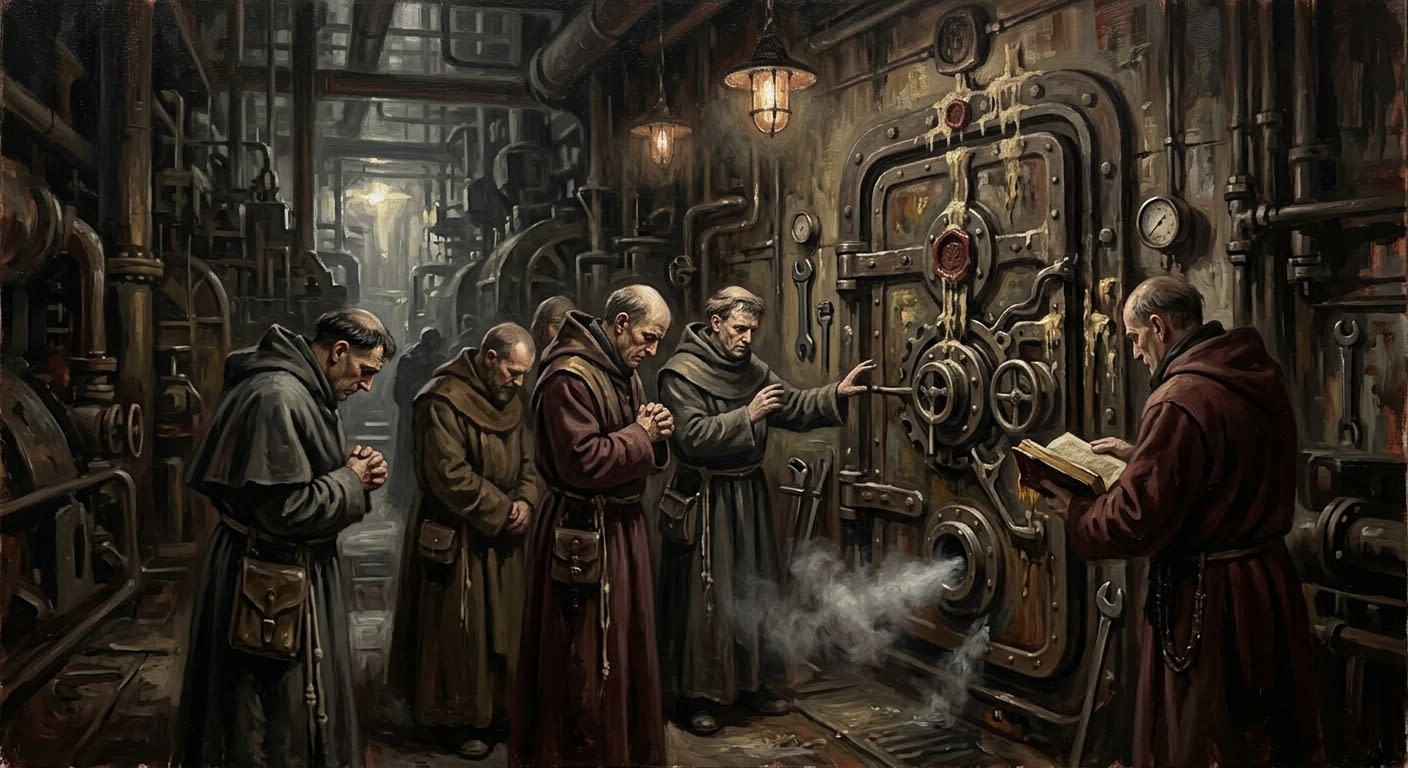
#On the Line That Teaches Matter to Behave
The Boundary Litany is the hymn by which the Synod persuades a seal to remember its office. It is spoken over gasket, wax, flange, drum-mouth, chapel sled, pressure door, ward plate, and every other little frontier where heat, sound, fuel, steam, demon-seep, and administrative panic attempt to become one another. A border drawn on a map requires the Bureau of Cartography. A border drawn in metal requires a mechanic with burned hands and a memorized terror.
The common citizen imagines a boundary as a line. This is childish and useful only in schoolrooms, prisons, and sermons for tax compliance. A true boundary is an agreement under strain. The gasket agrees to keep pressure where pressure has been assigned. The wax agrees to hold the proof. The bolt agrees to carry its portion of the force. The worker agrees not to die before signing the rite sheet. The Litany enters that agreement as witness, metronome, threat, and bribe.
It belongs most famously to the Gasket-Hymn Mechanics, who time star-pattern torque to its Third Line and sing its opening phrase into molten purity wax after the Counterfeit Wax Plague. It also appears in wound-site extraction after the A.S. 152 Gasket Hymn Reform, in Irongate resonance maintenance, Shipka thumper rooms, Brast furnace corridors, and the unofficial shed copies carried by men whose licences have expired but whose usefulness has not.
#On Its Origin in Panic
The first Boundary forms were not hymns. They were field habits.
After the Sundering, during the drag-west terror of the Great Retreat, engines failed in ways that insulted metallurgy. Seals split after passing inspection. Flanges warped without heat. Pipes blew at the hour a convoy began moving, never while an officer with authority to delay was present. Veteran sappers noticed that repairs made to cadence held longer than repairs made in silence. They sang at first because rhythm keeps a frightened hand from murdering a bolt.
The oldest sapper verse was obscene. This is denied by every approved manual and remembered by every old mechanic with a throat left to mutter. Its meter survives under the current First Line, scrubbed of profanity, varnished with doctrine, and made fit for clerks. The Bureau did what it always does with useful vulgarity: it baptized the function and buried the mouth that invented it.
Manual copies before A.S. 164 describe the Boundary Litany as “received intact from early Line chaplaincy usage.”
Corrected under Engineering appendix after the Split-Ring investigation recovered three pre-standard rite cards bearing identical torque marks and entirely unapproved language. The cadence is old. The sanctity arrived later with better handwriting.
A.S. 152 gave the Litany its first hard law. The Furrow of Pest rupture killed thirty-seven extraction workers and sent wrong flame through the southern supply corridor for three weeks. The joint commission of the Bureau of Bells and Bureau of Engines & Furnaces found no single cause; it found a sequence of causes, which is more convenient for governance because sequence can be commanded. Survey, stake, chapel placement, tap, pressure pitch, draw, seal, closing verse, transport. The early Boundary material entered that Reform as a sealing cadence for wound-site drums.
The Litany became unavoidable after A.S. 164, when the Split-Ring Disaster at Bastion-Przemyśl killed forty-three men and proved that a shortened cleansing verse could leave old wax in a groove, seat a gasket falsely, and make obedience look complete until pressure filed its objection. From that winter onward, a repair without full sequence documentation was sabotage. The word was excessive, which is why it worked.
#On the Seven Lines and the Nine Movements
Popular broadsheets speak of seven lines. Training manuals speak of nine movements. This irritates novices and nourishes examiners.
The nine movements are the work: diagnose, cleanse, align, seat, recite, torque, seal, verify, document. The seven lines are the breath placed across that work. The first steadies the hand. The second clears old claim from the surface. The third governs the star-pattern torque. The fourth binds wax to witness. The fifth tests whether the sealed thing answers wrong. The sixth carries the industry canticle residue required for purity stock. The seventh closes, or fails to close, the boundary.
The Third Line has generated more memoranda than some wars. Its syllables fall against the torque key in a pattern matching the opposing bolt sequence across a flange face: one, five, three, seven, two, six, four, eight, then the listening pause. Whether the words were arranged to fit the bolts or the bolts were arranged to flatter the words has produced four memoranda, two errata, and one engine-chapel fistfight, already classified as doctrinal vigour. I admire the classification. It turns a broken nose into a footnote.
The Seventh Line is Orla's line. Saint Orla completed it at old Bastion-Metz in A.S. 132 while floodwater climbed past the ribs, chest, and throat. The seal held. Her hand fused to the torque key. The Bureau canonised her thirty years later, once delay had matured into reverence and reverence could be made inexpensive.
No full public copy of the Litany is printed. Parish devotional versions omit pressure instructions, clamp intervals, and the closing cadence used near wound-site drums. School copies replace the old tool names with moral nouns. Licensed shed copies carry the proper words in ink that resists oil, steam, blood, and most ordinary shame. Unlicensed copies circulate in boot linings, tobacco tins, prayer books, and on the inside of forearms where inspectors are too genteel to look unless they are already losing.
#On Wax, Forks, and the Plague That Worked
The A.S. 178 Counterfeit Wax Plague altered the Litany's public office. Before the Plague, the Litany timed work. After the Plague, it authenticated matter.
False purity wax had entered Bastion-Shipka and Bastion-Irongate under respectable sleeves. It matched resin, chalk, sheen, grip, and stamp tolerance. Its sin was liturgical provenance. It had not cooled while hearing the Sixth Canticle of Industry. This would have been a satisfying scandal if the wax had failed. The wax held.
A working counterfeit is a theological ambush. Purity wanted corruption; Engineering found compliance; mechanics found shortage; quartermasters found a supplier; Doctrine found the need to speak more loudly. The official remedy was the living hymn verification method: sing the opening phrase of the Boundary Litany into molten wax, let it harden, strike it with a licensed tuning fork, and listen for obedience.
The Bureau of Bells insists true wax answers. False wax rings flat, sulks, or refuses devotional posture. The wording is absurd and operationally durable, a combination the Synod mistakes for wisdom whenever the casualty figures improve. Bell-Accountants became necessary overnight. Tuning forks became contraband currency. Counterfeiters began teaching wax to answer within six weeks, proving that criminals are often the quickest theologians in any district.
Post-Plague notices state that living hymn verification ended counterfeit wax circulation.
Clarified by Irongate seizure ledgers and Shipka tavern evidence. Verification ended the previous market. It created a better one, with higher prices, trained singers, stolen forks, and wax that knew enough doctrine to lie in tune.
#On Purists, Pragmatists, and the Sin of Knowing Why
The Boundary Litany is an instrument of unity in the same sense that a knife is an instrument of surgery. It joins by cutting.
The Line-Purists hold that every line must pass through the mouth entire, under all conditions, because the boundary is already broken when obedience is shortened. Their rite sheets are clean. Their tribunals are survivable. Their dead are numerous in ways that polish into martyrdom.
The Field Pragmatists know which words seat the ring and which words seat the paperwork. They do not defend careless abbreviation. They despise it, because careless abbreviation killed forty-three men at Przemyśl and gave Purity a cudgel with scripture carved into the handle. Their heresy is subtler: they believe the Litany has parts, and that some parts perform work while others console the archive.
Bastion-Irongate, Gallery Twelve, pressure-door incident A.S. 196: Pragmatist crew omitted the duplicate witness response, inverted the Third Line to compensate for reversed bolt access, and struck the flange twice during the listening pause. Door held. Choir resonance stabilized. Rite sheet filed as full compliance. Later acoustic review detected a missing syllable preserved in the wax as a hollow. Three auditors assigned to the review requested reassignment to exterior artillery.
Doctrine calls this contamination. Engineering calls it unavailable for comment. Records calls it a filing irregularity unless the seal fails, at which point Records discovers moral courage with indecent speed.
Standing Order 14-Q, revised A.S. 199, requires prior written authorisation for sequence modifications. The order is magnificent. It belongs in a museum of impossible obedience beside ration fairness, honest tollhouses, and cheerful conscripts. Rupture does not request leave. Steam does not await counterseal. A demon-seep drum does not remain stable because a district Hymn-Gasket Master has taken lunch.
#On Teaching the Litany
Children of the trade learn the Litany as pain learns skin: by repetition, correction, and a little fear applied at the proper interval. A Gasket Runner begins with breath counts. A Wax Hand learns to hold the First Line while carrying molten seal wax without splashing his own shoes, a failure that produces screams, scars, and no sympathy from anyone senior enough to possess both eyebrows.
Formal schools divide instruction into throat, hand, and witness. Throat trains cadence, pitch, and the refusal to ornament. Hand trains torque, seating, chalk line, scrape, and the mercy of clean grooves. Witness trains documentation: who saw, who signed, who owned the stock, who touched the wax, who was missing, who is now conveniently dead. The craft calls witness work dull. The craft is wrong. Dullness is where the Bureau hides its teeth.
At Irongate, candidates recite while the floor vibrates under Choir load. At Shipka, they recite under sleep-bell interruption, because Syrion's fog has taught every profession there that drowsiness is an enemy uniform. At Brast, furnace corridors heat the tongue until consonants turn thick. At Przemyśl, instructors stop the candidate midway and mutter that the western pylons are freezing. The candidate must not rush. Rushing is panic wearing boots.
The private tests are harsher. A master knocks over the lamp. A second worker cries false pressure. A third names a dead apprentice. Someone asks, softly, whether the cleansing verse can be skipped. The room waits. The correct answer is not always no. That is why the test cannot be printed.
#On the Present Use
As of A.S. 201, the Boundary Litany is licensed, restricted, plagiarised, forged, sung badly, sung beautifully, and sung through blood. It lives in the official manuals of Gasket-Hymn Mechanics, the post-Reform wound-site instructions of extraction crews, the wax verification protocols of Bell-Accountants, and the illegal shed cards of every worker who has learned that a clean rite sheet does not keep steam out of the lungs.
The Bureaus disagree over what it is. Bells calls it acoustic authentication. Engineering calls it cadence discipline. Doctrine calls it obedience given voice. Records calls it required language for Form 7-G attachments. Mechanics call it the thing you say when the pressure climbs and the bolt still has one turn left.
All are correct enough to be dangerous.
The Litany has enemies. Counterfeiters teach wax to hum. Purists turn it into scaffold rope. Pragmatists cut it and pray the cut bleeds less than delay. Demons answer at the edge of some lines, or so the old mechanics say, and old mechanics possess the special authority of people who have buried younger men.
At the last turn, when the groove is clean or pretending cleanliness, when the gasket sits or flatters the eye, when the wax smokes, when the witness chalk waits across bolt and plate, the mechanic speaks the line. The seal may hold. The seal may fail. The Litany does not promise mercy. It promises that the failure will have been witnessed, timed, named, and made available for prosecution.