
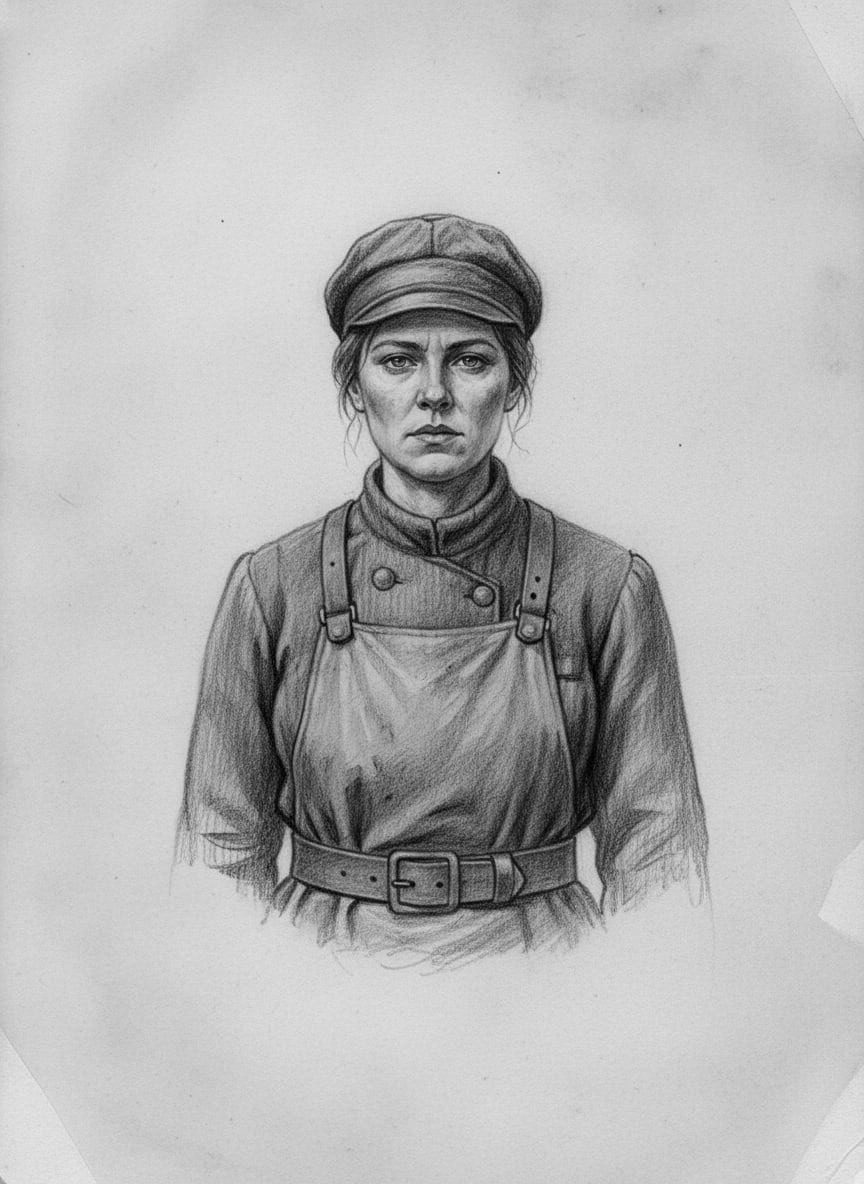
#On the Patron Who Kept the Seal
Saint Orla of the Seventh Line belongs to the Gasket-Hymn Mechanics, those blessed, blistered, indispensable tradespeople who place their fingers where pressure wishes to become murder and then recite the Boundary Litany as if Heaven itself were a flange with poor tolerances. Every dangerous profession receives a patron once the casualty ledger grows embarrassing. The living ask for better tools. The Bureau gives them a saint.
Orla's approved motto is painted above engine-chapel doors from Bastion-Przemyśl to Bastion-Irongate:
Seat the ring. Speak the line.
The sentence has saved men, killed men, and given auditors a convenient stick with which to beat the survivors. Such is the usual efficiency of sacred language.
The Seventh Line is the last phrase of the full repair sequence (Unregistered), spoken only after diagnosis, cleansing, alignment, seating, recitation, torque, seal, verification, and documentation have bound the repair to the Ledger. In training sheds it is taught as closure. In forward engine pits it is taught as breath control. In the private prayers of mechanics who have watched a gasket bubble under their palms, it is taught as a bargain: hold, and I will finish the words.
#On the Flood at Old Bastion-Metz
The official Life places Orla's death at the engine works of old Bastion-Metz, during a flood whose precise year has been scrubbed by damp, embarrassment, and Records clerks who dislike numbers that accuse infrastructure. I date the incident to A.S. 132, before the profession received formal licensing, after the Line's machinery had already acquired the habit of punishing improvisation. The Bureau may correct me when it finds the courage to read its drowned files.
Metz was then a rear fortress and supply-bastion, swollen beyond its walls by refugee wards, boiler sheds, rail locks, ash vaults, and the wet underworks that fed pressure to its gate machinery. The lower engine chapel contained six seal-lines. The sixth was modern. The seventh was old: a pressure conduit rebuilt over pre-Synodal stone, patched through three wars, blessed by four incompatible rites, and maintained by mechanics who knew it the way a jailer knows a prisoner with family money.
Rain began at Matins and became a verdict by Vespers. The river rose through culverts, sump doors, coal drains, confession runnels, and finally the southern service stair. Three mechanics fled when the first gauge cracked. Two died trying to lift the spare ring crate. Orla stayed at Seal Seven (Unregistered), because the conduit fed the western pressure door and the western pressure door held back a low ward full of sleeping families, condemned labourers, and children whose parents had paid for dry bunks with three months of ration debt.
The seal had slipped. The old gasket had swollen. The replacement ring would seat only if the full sequence was completed, because the star torque pattern required timed tightening across eight bolts while the cleansing verse kept the hand from rushing and the final line fixed the witness mark. That is the Engineering explanation. Doctrine adds that Heaven listens to obedience. The workers say the pipe was angry and Orla spoke to it properly.
All three explanations fit. I despise abundance in explanation; it encourages committees.
#On the Death by Sequence
The earliest testimony comes from Wax-Hand Jerun Pell (Unregistered), then aged twelve, later a licensed Torque Technician, later immured for unregistered sequence alteration during the Seal Standardisation quarrels, which proves the Bureau can venerate a man's memory and bury his body in the same administrative breath. Pell's statement says Orla stood thigh-deep in water with the torque key raised, mouth bleeding from cold, and refused to skip the cleansing phrase.
At waist height she had finished the third movement. At the ribs she had seated the ring. At the chest she began the torque. Each bolt turned on its appointed syllable. The water carried coal grit, splinters, lamp oil, and the floating face of a dead apprentice whom Pell declined to name because naming the dead in active machinery invites jurisdictional disputes with the Bureau of Rites.
WAX-HAND PELL TESTIMONY — METZ ENGINE CHAPEL / EXCERPT She said the Sixth and the pipe knocked once. She said the Seventh and the water stopped climbing for █████ heartbeats. When we pulled the door after, her hand was still on Bolt Eight. The key had fused to her palm. The witness chalk line crossed her thumb and the flange in one unbroken stroke.
The seal held. Orla did not.
Her body was recovered after Prime, pinned between the pressure rail and the drowned stair, face turned toward the gauge board. The western pressure door remained closed. The low ward survived. Seven hundred and twelve names appear in the rescue ledger, though Records later amended the number to six hundred and eighty-nine after discovering that some of the rescued lacked proper bunk permits. Mercy counted the bodies breathing. Records counted the bodies entitled to have breathed. Naturally, Records won the archive.
Popular chapbooks claim Orla held the flood back by prayer alone.
Corrected by Engineering addendum and three surviving tool marks. Orla held the flood back by completing a repair under conditions that would have justified flight, profanity, and several forms of authorized despair. The prayer was in the sequence. The sequence was in the hand.
#On Canonisation and Torque
The Bureau of Doctrine canonised Orla thirty years later, in A.S. 162, after three petitions from mechanics' guild chapels, two refusals from Rites, one pressure-door failure in a training shed that killed six candidates, and a memorandum from Engineering written in language so stiff with reluctance that it squeaked. The memorandum recommended “limited vocational recognition of the Metz subject as a discipline-preserving exemplar.” Doctrine translated this into sanctity. Translation is the Bureau's cleanest crime.
The Bureau of Engineering named a torque specification after her before the incense settled. Orla-Seven torque is the final tightening pattern for critical hymn-gaskets under wet, cold, or vibration-compromised conditions: three light passes, one listening pause, two opposing seats, final quarter-turn on the closing syllable. Mechanics trust the specification more than the hagiography. This does not trouble the saint. Saints who work for tradesmen learn to accept practical devotion.
Her cult spread fastest after the Split-Ring Disaster of A.S. 164 (Unregistered), when Bastion-Przemyśl's seventeen engine pits failed over nine hours and forty-three men died because a cleansing verse had been abbreviated. Suddenly Orla's refusal to skip a line became law with a halo. The Line-Purists took her as their iron proof. The Field Pragmatists took her as a woman who understood which lines mattered because she completed the one that held. Both factions quote her. Neither has permission.
#On Relics, Imitations, and Wet Icons
The primary relic is said to be Orla's torque key, preserved in the Metz Ash Vault under a glass bell and a custody schedule that has been violated by every Bureau assigned to enforce it. The key bears eight etched numbers and a blackened patch where palm flesh fused to the handle. Relics has authenticated it twice, questioned it once, and declined a fourth inspection after the key turned one-eighth of an inch inside its case during a hymn-gasket novice examination.
Secondary relics multiply, as relics do when the faithful possess grief, knives, and commercial instinct. Pressure chalk supposedly taken from Seal Seven circulates in Przemyśl engine chapels. Wax slips bearing her thumb-line appear in Irongate, Shipka, and three taverns in Metz whose proprietors are either frauds or theologians of unusual entrepreneurial brilliance. A small brass icon shows Orla chin-deep in water with a wrench raised like a martyr's palm. This is inaccurate. It sells well. Accuracy has never outbid desperation.
A Metz devotional printer described Orla as “the smiling bride of the obedient seal.”
Withdrawn after formal complaint by the Mechanics' Widows' Cooperative, which noted that Orla was recorded neither as a bride nor as smiling, and had died in water cold enough to blacken the lips. The replacement phrase, “witness of the final turn,” is poorer poetry and better doctrine.
The approved iconography is severe: wet hair bound under a mechanic's cap, torque key in the right hand, left palm marked with a chalk line, water at the throat, gaze fixed on the gauge. Some workshops add a child behind the pressure door. Some remove the child to avoid sentiment. Some Line-Purist chapels paint the sequence text around her like a chain. Field Pragmatist sheds paint only the last line and keep a real wrench beneath the frame.
#On Her Use to the Living
Mechanics invoke Orla before wet repairs, double shifts, disputed abbreviations, and inspections by men whose hands are clean. Apprentices touch the torque key to the ribs and whisper her motto before the first live seal. Hymn-Gasket Masters assign candidates to hold the Seventh Line while a superior shakes the bench, shouts false pressure readings, knocks over a lamp, or recites family names from the casualty ledger. A candidate who stops speaking fails. A candidate who finishes too fast fails. A candidate who looks at the gauge, slows the final turn, and keeps the line steady may be trusted with work that kills the impatient.
Her cult has a private cruelty. Mechanics pray to her when deciding whether to obey the manual or save the crew. The Line-Purist says Orla finished every word and died clean. The Pragmatist says Orla understood the seal, chose the words that seated it, and died because no one relieved her. Doctrine prefers the first lesson. Engineering privately prints the second in training marginalia, then denies the ink.
As of A.S. 201, her name appears in every licensed gasket shed, on every Orla-Seven training plate, and in the quietest curses of mechanics sent into chambers where pressure sings like a saint with broken teeth. The seal holds, or it does not. The line is spoken, or the dead file their complaint in steam.