
#On the Night the Ring Split
The Split-Ring Disaster of A.S. 164 began with an economy of ninety seconds.
This is the whole of administrative tragedy: a man is given a process too long for the danger before him, a quota too sacred to amend, a machine too hot to wait, and an auditor who will arrive after the funeral with gloves clean enough to indict the dead. At Bastion-Przemyśl, in the lower furnace district feeding the Wire Orchard's western pylons, a senior mechanic shortened the cleansing verse on four consecutive gasket repairs. He did not omit the entire rite. He trimmed it. He saved breath, time, and the patience of supervisors whose watches had begun to look more important than the gauges.
Forty-three men died.
The name came later. Men in the first hours called it the Lower Works Blast, the Western Pylon Failure, the Night of Steam, the Cold Nine Hours, and one phrase too honest to survive Records review. Split-Ring was chosen because it made the matter sound material. A ring split. A component failed. A circle broke under pressure. Splendid nouns, all of them docile. None pointed at the supervisor who authorised double shifts, the procurement office that delayed replacement stock, or the doctrine clerk who had insisted the cleansing verse remain unabridged after being warned that it added ninety seconds to emergency work.
#On the Lower Works
Przemyśl's lower works are not under the fortress so much as inside its appetite. The Sagittal Line at the Carpathian arc consumes heat, pressure, fuel, prayer, wire, paper, chalk, rubber, wax, and boys with steady hands. The western pylons fed on seventeen engine pits arranged in a rough crescent beneath the Wire Orchard's outer service galleries, each pit coupled to its neighbours through manifold doors, purge lines, and emergency heating veins installed in three generations by men who hated one another's measurements.
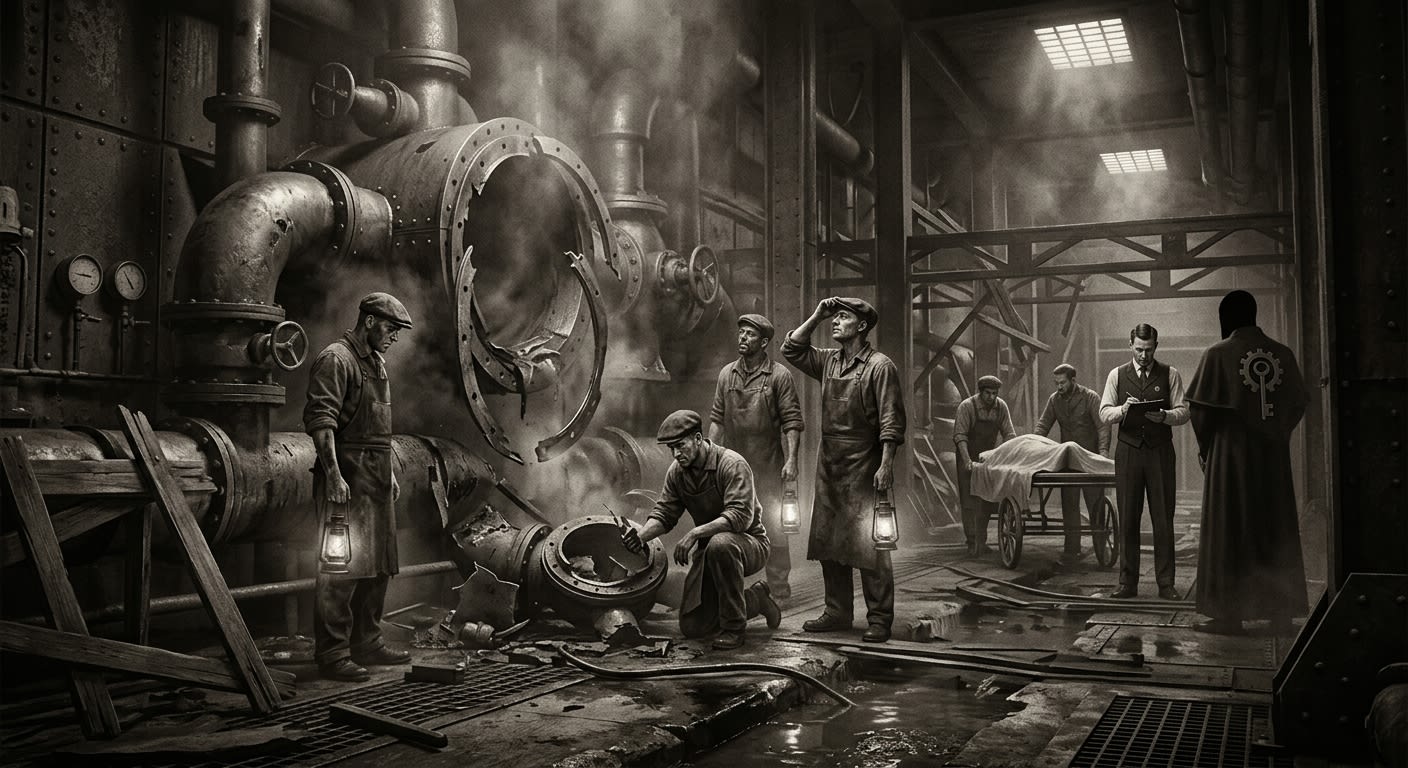
The air there carried coal dust, hot oil, old wax, and the faint sour reek of pressure chalk baked too many times against metal. Every flange had a history. Every gasket wore somebody's confidence. Every witness mark testified, in pale streaks across bolt-heads, that the seal had once been true according to the moment's official definition of truth.
The senior mechanic on duty had worked double shifts for three weeks. His name appears in three ledgers and no sermon. Engineering lists him as Master Seal Mechanic Corven Aul. Doctrine's disciplinary annex calls him “the Aul mechanic.” Purity's later assessment records him as “doctrinally adequate,” which is the kindest insult a dead tradesman can receive from a Bureau whose mercy wears tongs.
Aul faced four overdue repairs in sequence: Pit Three purge manifold, Pit Five heating return, Pit Five secondary door, Pit Six transfer flange. Each required the standard nine movements of the Gasket-Hymn Mechanic craft: diagnose, cleanse, align, seat, recite, torque, seal, verify, document. Each was hot. Each was late. Each had an overseer near enough to smell his fear and far enough to survive the first blast.
The cleansing verse removed old wax as much as it pleased the Creator. Its salt-chalk step scoured the groove where the previous seal had left residue. Aul shortened it. Residual wax remained. The new gasket seated almost flush. Almost is the little chapel where catastrophe lights candles.
#On Propagation
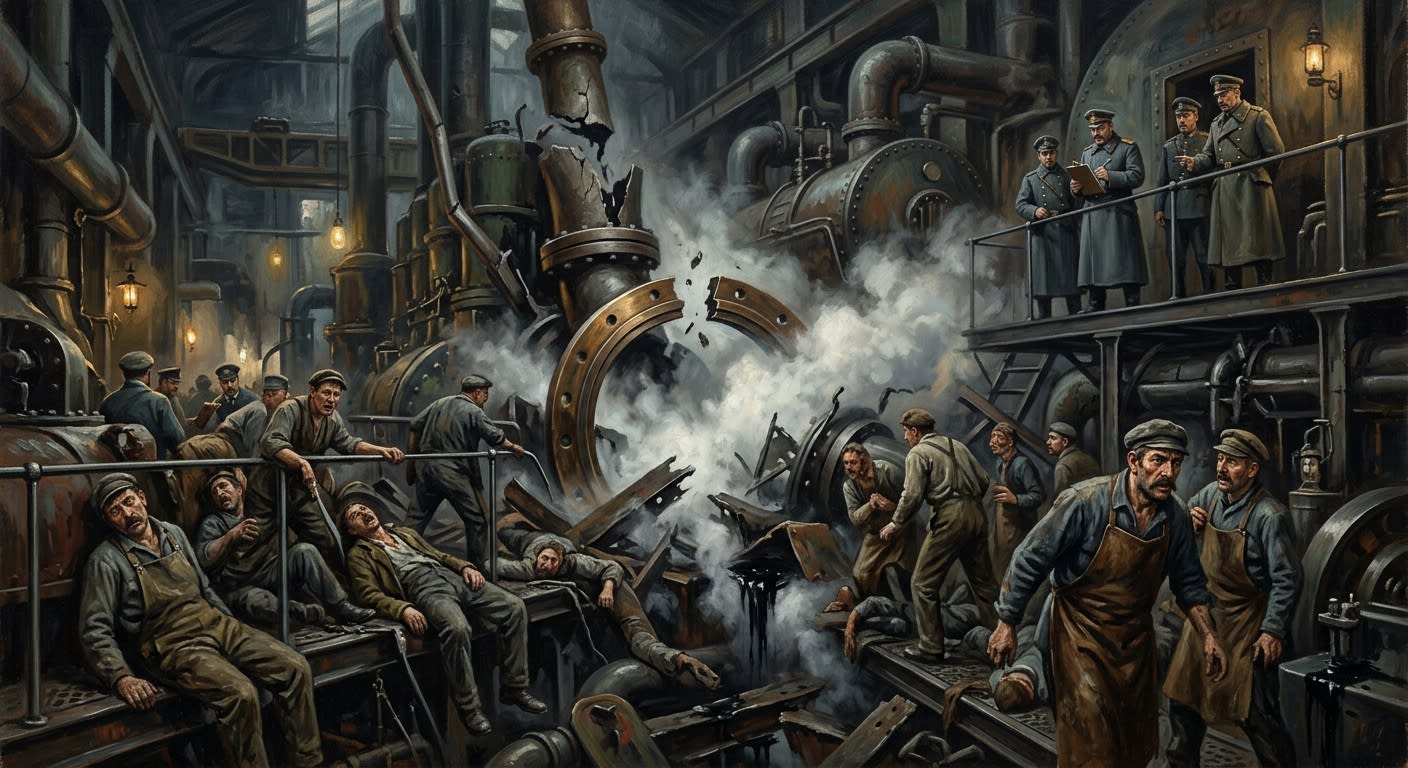
The first seal failed at the third hour after midnight. Pit Three's purge manifold ruptured with a report recorded by the night clerk as “single hammerstroke, oversized.” The blast cut the adjacent line, scalded fourteen men where they stood, and threw pressure into Pit Five through a door whose gasket had been seated by the same hand, on the same shift, under the same abbreviation.
Pit Five held for eight minutes. This interval later acquired theological attention because eight is the number of witness movements in the old Boundary gloss, excluding documentation. The Bureau of Doctrine is capable of finding symbolism in a ration biscuit if the biscuit has killed enough people.
Early devotional broadsheets claimed the second seal held for seven minutes, one for each virtue, before surrendering under martyr-pressure.
Corrected. The seal held for eight minutes by the surviving clock-face in Pump Gallery C. The virtues are not invited to correct the clock.
The second failure struck the pressure door between Pit Five and Pit Six. That door had been sealed by a different mechanic who had followed the full sequence. The shock load exceeded a design meant for steady pressure rather than a neighbour's death arriving through the wall. Pit Six's transfer flange lifted. Pit Seven's heating vein took the force through a cross-coupling never drawn on the current plans. Pit Eight's vent stuck shut. Pit Nine opened where it should have closed. In nine hours, seventeen engine pits failed in a chain the Engineering commission named sympathetic propagation and the survivors named the thing coming.
Lights died in three galleries. The western pylons lost power for eleven hours. Heat vanished where heat had been assumed into the moral order of the fortress. Men escaped the steam only to freeze against ladders, rails, grates, and hatch rims. Fourteen died in the initial blast. Twenty-nine died afterward in cold so intimate that skin remained on metal as a signature.
Recovery Appendix 164-WP/7 records three bodies found fused at the hand to pressure-door rungs, two men inside a closed tool locker whose interior frost pattern spelled ███████████████, and one Wax Hand alive beneath a grate for forty-six minutes, repeating the shortened verse and stopping at the same missing phrase each time. The appendix was removed from apprentice training copies after two candidates refused pit assignment.
#On the Investigation That Found the Useful Cause
The joint commission arrived with admirable speed, once the danger had passed and the dead had cooled into evidentiary convenience. Engineering brought gauges, diagrams, metallurgical knives, and the expression of men preparing to blame matter for obeying pressure. Doctrine brought rite cards, witness clerks, an auxiliary cantor, and the expression of men preparing to blame a syllable for behaving like law. Purity brought silence. Records brought boxes.
The gasket stock was standard-issue, purity-certified, and structurally adequate. This finding ruined the first theory. The manifold iron was fatigued but within tolerance. This ruined the second. Sabotage traces were absent, despite three inspectors' visible yearning. This ruined the most comfortable theory of all, because sabotage has the decency to own a culprit.
The cause settled on procedure. Aul had abbreviated the cleansing verse. The omitted salt-chalk step allowed residual wax to remain in four grooves. The residual wax prevented flush seating. Pressure found the gap. Pressure is an honest auditor. It never accepts rhetoric.
The commission's first report attempted the old evasion: material fatigue, substandard gasket provenance, supply irregularity under investigation. Then the surviving rite sheets were compared against witness testimony. A Wax Hand had marked the missing line in his own margin because he expected to be blamed for it. That boy, unnamed in public, saved the truth for exactly long enough that the Bureau could punish a dead man with precision.
The initial Bureau of Engineering report attributed the disaster to “material fatigue in substandard gasket stock, provenance under investigation.”
Withdrawn. The gasket stock was adequate. The failure was procedural, supervisory, doctrinal, logistical, and political. The final public sentence retained only “procedural,” because a single corpse is easier to discipline than five offices.
#On the Sabotage Reforms
Operational Classification 7-G was issued before the ash had left the lower works. The Bureau of Engineering and Bureau of Doctrine licensed the Gasket-Hymn Mechanic as a formal profession, fixed the nine movements into mandatory sequence, and classified undocumented repair on critical seals as sabotage. A repair without verse, witness, torque record, wax stamp, and rite sheet became legally indistinguishable from enemy action.
This was called clarity. It was also a net.
The Sabotage Reforms produced three immediate miracles. First, they created a trade. Before A.S. 164, gasket singers had been tolerated mechanics, useful eccentrics, dirty-handed men and women whose humming made boilers less murderous. After A.S. 164, they became licensed personnel with hierarchy, collars, audit exposure, and a patron saint sharpened into doctrine. Saint Orla of the Seventh Line spread through engine chapels like fire through rag, her refusal to skip the final phrase turned into proof by Line-Purists and counter-proof by Field Pragmatists.
Second, the Reforms made paperwork part of the seal. Purity wax, rite sheets, Bell verification, witness signatures, torque diagrams, and Records filings became boundary material. A gasket held matter inside a pipe. Documentation held blame inside the mechanic.
Third, the Reforms manufactured crime. Once every undocumented repair became sabotage, every shortage became a temptation and every emergency became a tribunal in advance. The Counterfeit Wax Plague of A.S. 178 was born in this cradle: false wax, true seals, fourteen suppliers immured, counterfeit stock returned within six months like any sensible doctrine that has found a market.
#On the Dead and Their Uses
Forty-three names were entered in the lower works casualty ledger. Public plaques list forty-two. The missing name belongs to a runner whose employment status was pending at the time of death. Records declined to engrave him until payroll confirmed he had existed for wage purposes. Payroll confirmed the matter in A.S. 166. The plaque had already been blessed. Chisels were unavailable, grief had moved on, and the runner remained in the annex where inconvenient boys acquire archival dust.
The families received heat chits, funeral wax, and three lines of authorised explanation. Aul's family received notice that his pension was under review. The review remained open until the office responsible for it was reorganised, at which point the file was transferred to “legacy obligations, unresolved.” His widow took laundry from engine crews for twelve years. Mechanics left chalk at her door. This was illegal support. It was also better theology than the Bureau's.
The lower works changed in small visible ways. Cleansing verses were painted on iron plates large enough to read through steam. Rite cards were issued in wax sleeves. Witness lines became mandatory after every repair. Supervisors were ordered to remain within “accountable distance,” a phrase meaning close enough to sign and far enough to deny panic. Apprentices were taught the Disaster as a moral tale. Veterans taught it as arithmetic.
#On the Present Memory
As of A.S. 201, the Split-Ring Disaster remains the hinge on which the entire gasket craft turns. Every licensed mechanic knows Aul's abbreviation. Every Hymn-Gasket Master knows the nine-hour cascade. Every auditor knows the pleasure of asking whether the cleansing verse was spoken in full. At Bastion-Irongate, where the Gasket Choir sustains the mountain's borrowed lungs, the Disaster is recited before first live-seal certification. At Brast, beneath the Chrismole Crown, Ward-Seal Artificers use it as a warning and then do unapproved things anyway, because wisdom is knowing which rule was written by a corpse and which was written by a clerk.
The Wire Orchard's western pylons still run. Their current seals bear three stamps and a fourth mark no office admits authorising. The lower works are warmer now. This is recorded as improvement. Men still touch metal before trusting it. This is recorded nowhere.