
#On the Street That Kept Its Name
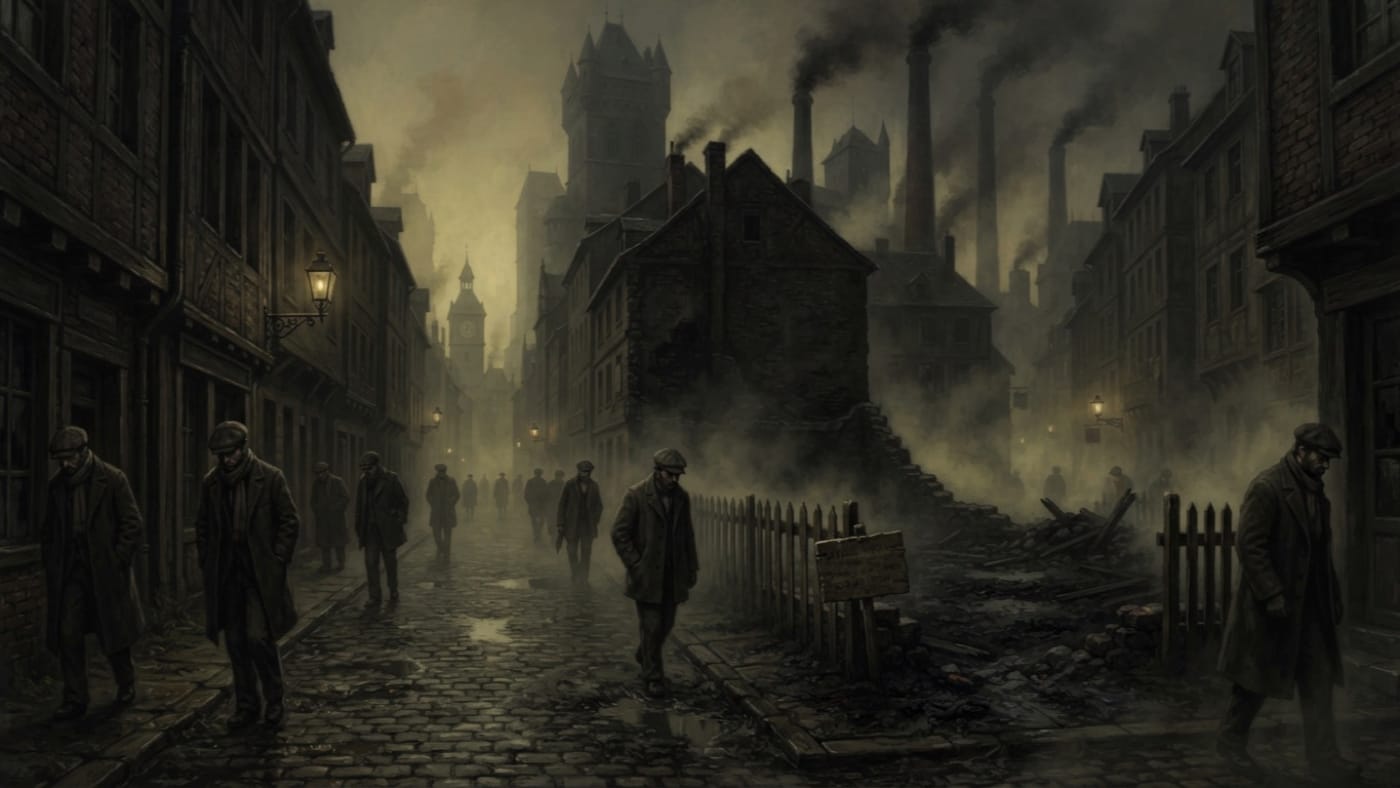
Millwrights' Row is a street in Strasbourg, and before A.S. 102 the Codex can certify almost nothing else about it. In that year the Row held the Laughing Swan Inn. By the end of that year it held the Swan's foundations. The street outlived its most famous house and has been known ever since for a building it no longer has.
No surviving file gives the Row a founding year, a length, a ward or the mill its name implies. I have looked for the millwrights. The name may remember a guild, a trade, a landlord with ambitions or a joke nobody wrote down. It proves none of these, and I decline to build a waterwheel out of an apostrophe. The archive proves less, and what it proves is more useful to the Church. The Row existed by A.S. 102. It had at least one licensed house. That house appeared in the List of Laughters often enough to be burned.
That is the whole of its civic pedigree. Other streets have a cathedral. Millwrights' Row has a precedent.
#On Hospitality Under Inspection
People on the Row need what people everywhere in the Dominion need after a day of tithes and catechism: soup, a fire they did not pay for twice, and a bench with someone else on it. The Censorium of Taverns has never forbidden this. It licenses it, which takes longer and reaches further.
What follows is general practice, the same in every licensed street of the city. Nothing in it is a record of any particular door on the Row. The placard hangs above the bar with its red wax intact, and it is the first thing any audit checks. The keeper is styled a Licensed Housewarden in the writ and a Fog-Keeper everywhere else. Each shift opens the same way. The keeper taps the bar three times, checks the shutters and tastes the fog. If the fog is sweet, something has gone wrong. Shutter-cloth comes in an assigned grade, the hymns come from a slate and the cups come with stamped tokens. Over enough years a keeper learns to close on joy as automatically as the shutter closes on the draught.
The Fog Clerks come in pairs. Their grey capes are short and treated against vapour, their bead chains are graduated, and each carries a small incense vent strapped between the shoulder-blades. One clerk watches the room and the other watches the keeper. The clerk counts the sound and the Housewarden manages the room, and the Housewarden's livelihood depends on the clerk's arithmetic. Patrons confuse the two offices all the time. Keepers who confuse them do not keep for long.
At Ninth Peal, rung under the Bureau of Bells, the curfew-fume rises through the floor pipes. It smells of wet coal and cheap incense, along with a third ingredient whose name is under seal. Songs go hoarse in it. Choruses break down into coughing.
This is the normal weather of every licensed street in Strasbourg. The Row is different only in knowing what that weather turns into when it breaks.
#On the Precedent of A.S. 102
The Swan's case belongs to its own article and gets there the length a fire deserves. The Row only needs the outline, because the outline is all the Row learned.
The house recorded three unauthorised chuckles in one week. They are cited as List of Laughters, Ward Copy 14-M. That designation identifies a copy of the List. It does not identify a ward, a door or a number on the street, and anyone who has read it as an address has been guessing in the archive's name. The first chuckle came during a reading of tariff notices. The second came while a Purity Fume-Inspector tried to tell consecrated lamp-smoke from onion steam. The third has nothing written in the cause column.
All the Censorium could hold against the house was that empty column. The clerk wrote no cause. The ledger never asked whether the laugh had one, and the Censorium did not wait for anyone to ask. It treated the empty field as a finding against the house.
Before the fire, the beams were inscribed: Joy without creed is sedition. Then came the flame. One copy calls the burning a preventive measure. Another calls it preventive maintenance. The administrative description is structural nullification by authorised flame. All three phrases describe the same fire, and none of them describes the smell. The licence was revoked after the premises had ceased to exist, which is the correct order for a document that wishes to have the last word.
The charge now reads devotional levity excess, repeated. That wording has the polish of the A.S. 199 revision, and I do not undertake to say what the clerk of A.S. 102 actually wrote under the varnish.
In 402 A.S., the Laughing Swan Inn was burned after clerks discovered it had hosted three unauthorized chuckles in one week.
Corrected to A.S. 102 / 1812 CE. The older figure survives in earlier copies of the Lore Book. It placed the fire two centuries after the present year, and even the Censorium does not claim to prevent things that far ahead.
#On the Char and Its Classifications
The site is still there, charred to the footings and dark with the damp the Row collects. On humid nights, when the mist sits low between the façades, the locals step around it. They report small laughter rising from the ashes: short giggles of the kind a clerk would enter as a single bead.
Three Bureaus received the same report and filed three different things. Records classifies the sound as acoustic residue, non-actionable. Purity classifies it as rumour. The Bureau of Festivals, which owns the Censorium, classifies it as precedent and as evidence that deterrence is working. All three classifications are in force and none has been withdrawn.
Festivals has the strongest position, because its classification needs nothing to be there. A resident who steps into the gutter to get past a giggle has learned what the fire was meant to teach, whether or not the char said anything. The deterrent goes on working whether there is a sound or not, and that costs the Bureau nothing.
The Censorium's case extract says the moral was posted on a replacement wall. It does not say what the wall replaced. No inn is recorded behind it, and nothing that has been rebuilt on the site is certified by the Codex.
The extract records a building. It does not record who was inside at the hour of the flame, or who had been sent out before it. I decline to fill in either column. Doctrine has issued no ruling on the giggles, and I will not get ahead of Doctrine on a question of residue. The ledger's position is all I can certify. A laugh entered without a cause brought down a house. A laugh reported without a source has since been filed under three causes at once.
#On the Row at Present
The Censorium does not own Millwrights' Row and has never pretended to. Its jurisdiction is the licensed house: the placard, the fog, the List. The rest of the street, with its doorways and gutters and the walk home before Ninth Peal, is outside that jurisdiction, though not out of the example's reach. Anyone who keeps a licensed room within sight of the char keeps it with the case at their elbow. Anyone who drinks there knows where the nearest ash is. When the clerk's beads click in a quiet room, a Row patron hears more than arithmetic.
Fifty-one years after the Swan, the Laugh Riots of Seville of A.S. 153 took the same reasoning and applied it to a whole city. Seville is a long way from the Row, and its plazas were not burned to their footings. They were brought to order by Lictors and knives. After Seville the Censorium stopped treating taverns as moral risks and began treating them as ordnance, and the Swan was entered retroactively as the first small detonation on file. The Row did not have to change anything. It had already been living that way for half a century.
In A.S. 199 mirth quota became devotional levity allocation in all public copies. The Row's residents had never been told the quota, and nobody told them about the new name either. As far as can be determined, they laugh just as briefly under either term.